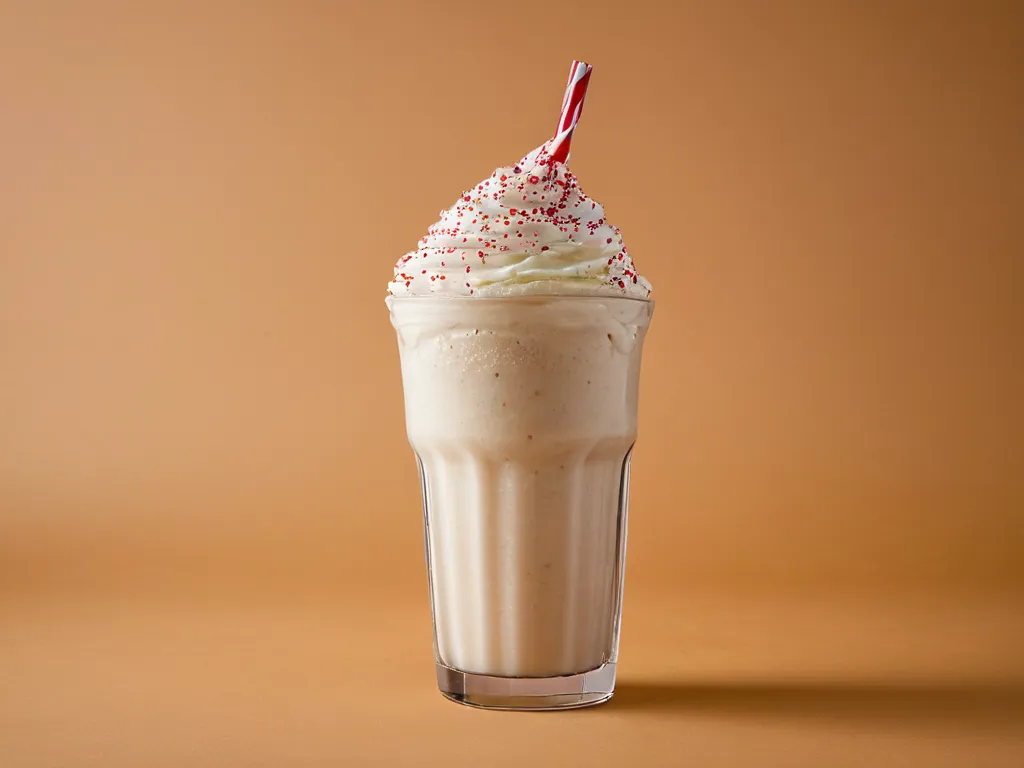
Copycat Culver’s Concrete Mixer
Prep time: 10 min Cook time: 0 min Servings: 4
Culver’s Concrete Mixer is the Midwest’s answer to the Dairy Queen Blizzard, and many people in Wisconsin would argue it’s the better version. It starts with Culver’s signature frozen custard — denser, richer, and more egg-forward than standard soft serve — then gets loaded with candy, cookies, fruit, or sauce of your choosing. The whole thing gets blended right in front of you, and if it’s made correctly, the cup can be turned upside down without anything falling out. That’s the concrete test.
This recipe replicates the experience using a combination of Reese’s Peanut Butter Cups, Oreos, hot fudge, and caramel — one of the most popular mix-in combinations at Culver’s. The key is using frozen custard rather than regular ice cream. Frozen custard has a higher egg yolk and butterfat content, which gives it that dense, creamy, almost chewy texture that makes a Concrete Mixer feel like eating a frozen candy bar.
No blender needed. You fold everything together by hand, which actually gives you a better result at home — visible chunks of candy, swirls of sauce, and pockets of pure custard in every bite.
Why Make It at Home?
A regular Concrete Mixer at Culver’s costs between $5 and $7 depending on the size and number of mix-ins. A quart of premium frozen custard from the grocery store runs about $6, and the mix-ins add another $4 to $5 total. That gives you four generous servings for roughly $11, or about $2.75 each — a savings of about 50%.
Making it at home also means unlimited mix-ins. At the restaurant, each additional topping costs $0.50 to $0.75 extra. At home, you can throw in as many toppings as the custard can structurally support.
What Makes Culver’s Concrete Mixer So Good
Frozen custard is fundamentally different from ice cream. By regulation, frozen custard must contain at least 1.4% egg yolk solids and 10% butterfat. In practice, most quality frozen custards exceed those minimums. The egg yolks create an emulsion that produces a smoother, denser product with less air whipped in. Where ice cream can have up to 50% overrun (air pumped in during churning), frozen custard typically has 15 to 20%. Less air means more flavor per spoonful and a heavier, more satisfying texture.
The Concrete Mixer process itself matters. Culver’s uses a machine that folds the mix-ins into the custard rather than blending them at high speed. This preserves the texture of the candy and cookies so you get actual chunks in every bite rather than a homogenous slurry. The folding also creates those swirls of sauce throughout the custard instead of mixing them into a uniform color. You see the caramel ribbons. You hit a pocket of fudge. The experience changes with each spoonful.
Temperature also plays a role. The custard is served at a slightly warmer temperature than hard ice cream, which means the flavors are more pronounced and the texture is more yielding. It’s firm enough to hold its shape but soft enough that your spoon glides through without effort.
Tips & Variations
-
Seek out real frozen custard. Brands like Culver’s retail pints (available in some Midwest grocery stores), Andy’s, or Shake Shack frozen custard give you the closest base. If you can’t find frozen custard, use the highest-fat vanilla ice cream available — look for at least 14% butterfat on the label.
-
Chop mix-ins before you start. Have everything cut and ready to go before you pull the custard from the freezer. Working quickly is important because frozen custard softens faster than ice cream, and once it melts past a certain point, you can’t refreeze it without losing the texture.
-
Warm the fudge sauce. Cold fudge sauce seizes into hard chunks when it hits frozen custard. Warming it to a pourable consistency lets it ribbon through the custard in smooth swirls.
-
Try other classic combos. Cookie dough and hot fudge. Salted caramel and pecans. Strawberries and chocolate chips. Andes mints and Oreos. The Concrete Mixer is a template, not a fixed recipe.
-
Don’t over-fold. Five to eight folds is plenty. You want a marbled effect with distinct sections of custard, mix-ins, and sauce. Stirring until everything is uniform defeats the purpose.
Storage & Reheating
Concrete Mixers are best eaten immediately. The mix-ins start to soften and the sauces blend into the custard as it sits, losing the contrast that makes the dessert work. If you have leftover custard base without mix-ins, return it to the freezer in an airtight container. It will be harder than its original texture but still usable — let it sit on the counter for 10 minutes before scooping.
If you’ve already mixed everything together and can’t finish it, transfer to a freezer-safe container and freeze. It will be significantly harder and icier when you eat it later, but 10 minutes at room temperature will soften it enough to enjoy. The cookies and candy will lose their crunch after freezing, so for the best experience, mix only what you plan to eat in one sitting and keep the remaining custard and toppings stored separately.