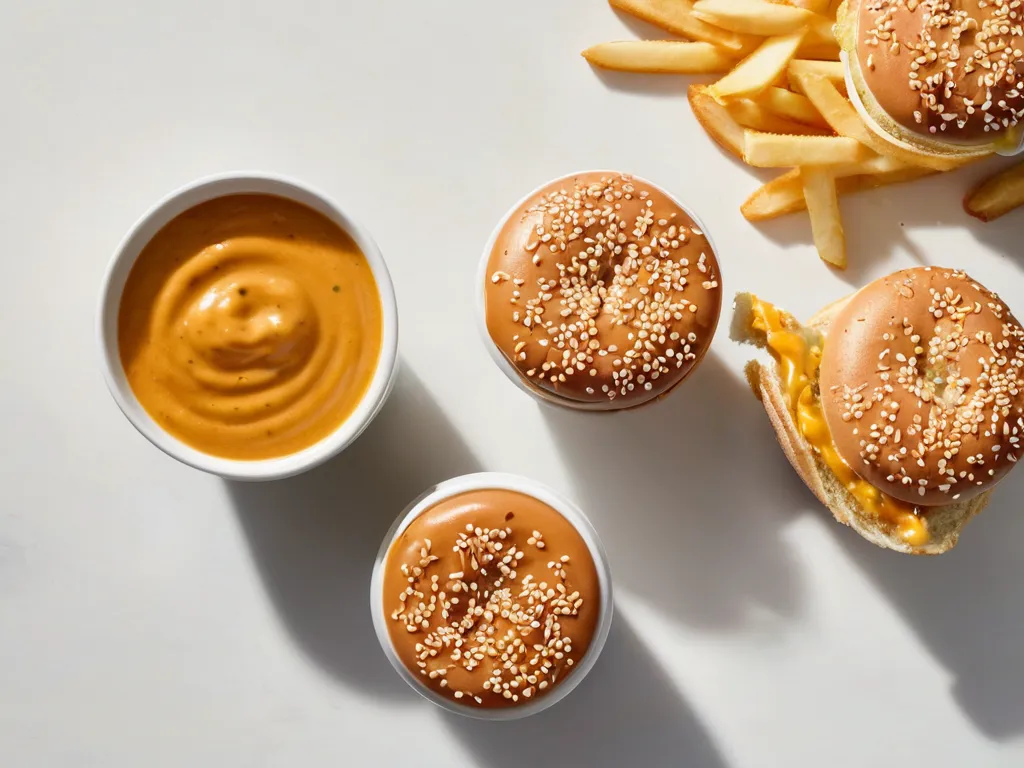
Copycat McDonald’s Big Mac Sauce (The Real Recipe)
Prep time: 5 min | Refrigeration rest: 1–12 hours | Makes: About 3/4 cup (enough for 10 burgers)
Most copycat Big Mac sauce recipes get the main ingredients wrong. They include ketchup because Big Mac sauce looks orange and Thousand Island dressing is orange. They use yellow mustard because yellow mustard is what’s in the burger aisle. The result tastes vaguely similar but noticeably off — sweeter and more tomatoey than the real thing.
In 2012, McDonald’s Executive Chef Dan Coudreaut made a YouTube video demonstrating a Big Mac sauce recipe for the first time publicly. His version explicitly contained no ketchup — which debunked the Thousand Island myth — and used six pantry ingredients. Later, former McDonald’s corporate R&D chef Mike Haracz published what he describes as “as close as you can get to the real thing,” specifying Dusseldorf mustard where Coudreaut’s home demo had used yellow mustard. The commercial ingredient list confirms no tomato products of any kind, and mustard seed and mustard bran (not yellow mustard) among the spice components. The recipe below uses the Haracz formula: no ketchup, Dusseldorf mustard, white wine vinegar, and a pinch of white pepper that most copycat recipes omit entirely.
Why So Many Copycat Recipes Get It Wrong
The visual confusion between Big Mac sauce and Thousand Island dressing is the root of the problem. Both are creamy, orange-ish, and mayo-based. Thousand Island was invented in the early 1900s and traditionally contains ketchup, hard-boiled eggs, sweet relish, and sometimes hot sauce. It became the standard reference for any orange special sauce — which led generations of home cooks to assume Big Mac sauce was just a simplified Thousand Island.
It is not. The similarity in color comes from the paprika in Big Mac sauce, not from tomato. The similarity in texture comes from the mayonnaise base both share. But the flavor differs clearly once you taste them side by side: Thousand Island leans sweet and tomatoey; Big Mac sauce is sharper, more savory, and built around a mustard backbone that Thousand Island does not have.
The Two Official Sources
Dan Coudreaut’s 2012 video (McDonald’s Canada) was the first public reveal from inside McDonald’s. Coudreaut — then the company’s Executive Chef — made a Big Mac at home on camera and listed the sauce ingredients: mayonnaise, sweet relish, yellow mustard, white wine vinegar, paprika, garlic powder, onion powder. He explicitly framed it as an at-home approximation using what was in his kitchen, not the exact commercial formula.
Mike Haracz (former McDonald’s corporate R&D) came after. Haracz worked in McDonald’s internal research and development — the team that actually develops and standardizes the commercial recipes. His published formula specifies Dusseldorf mustard where Coudreaut used yellow mustard, and adds a pinch of white pepper that no other copycat source includes. Haracz calls his version “as close as you can get to the real thing” — and given his access to the actual recipe through his role in R&D, his version is the more authoritative source for the commercial sauce.
The commercial McDonald’s ingredient list confirms both sources are in the right direction: no ketchup, no tomato, no eggs, no French dressing. The actual sauce uses mustard seed and mustard bran as raw ingredients, which most closely resemble a spiced brown mustard in profile.
Dusseldorf mustard is a German-style spiced brown mustard, sharper and more complex than American yellow mustard. It is sold in US grocery stores under brands like Inglehoffer (brown bottle, often near the gourmet mustards section) or labeled as “German brown mustard.” Dijon is an acceptable substitute that works better than yellow mustard. If you cannot find either, a 50/50 blend of Dijon and yellow mustard is the third-best option — but if you have used yellow mustard alone in past attempts and been disappointed, the mustard swap is likely why.
What Each Ingredient Does
Mayonnaise — the emulsified base that gives the sauce its creamy body and off-white color. Full-fat mayo is essential; light mayo thins the sauce and alters the mouthfeel. Hellmann’s or Best Foods are the standard; Duke’s works as well.
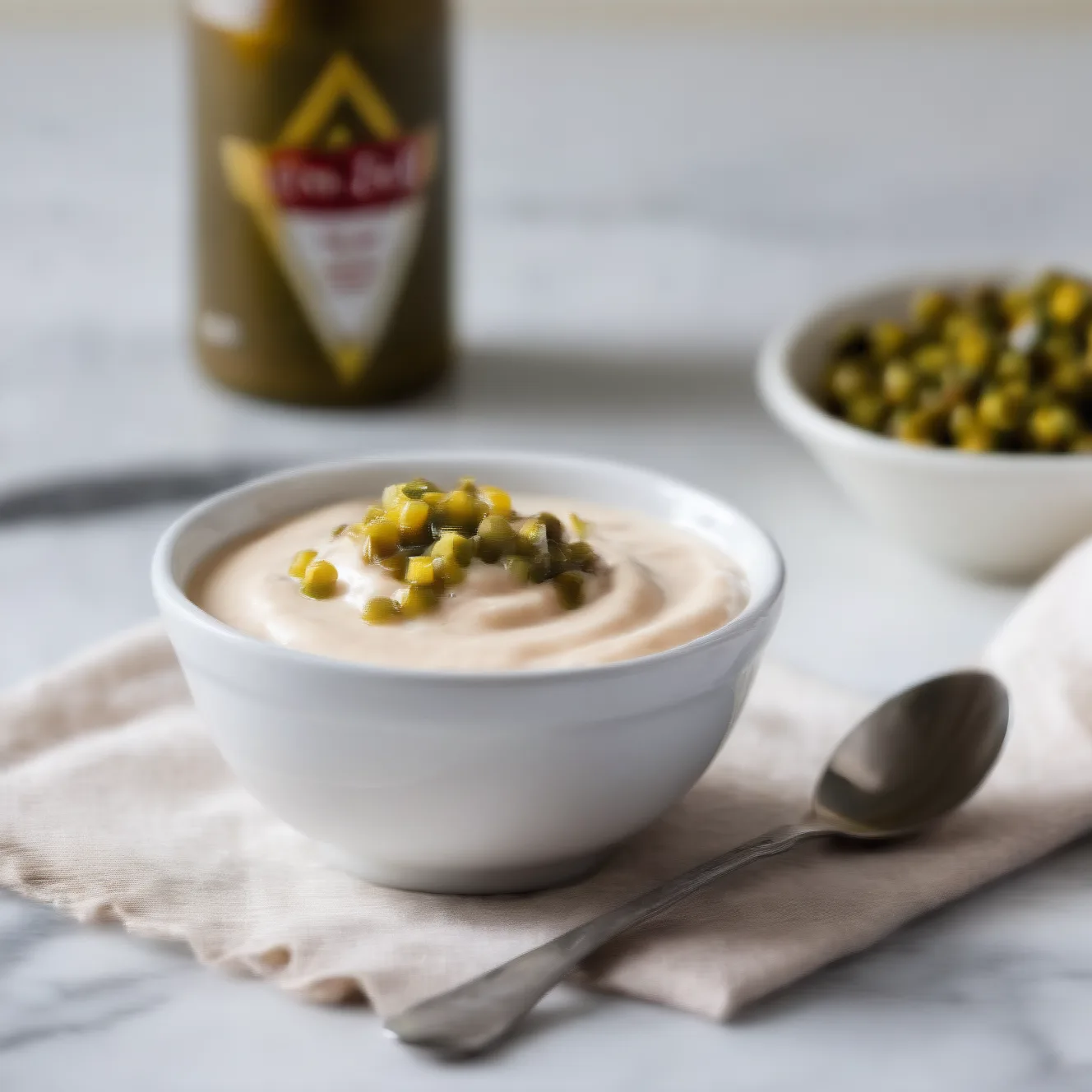
Sweet pickle relish — provides the characteristic sweet-briny note and tiny textural bits. The relish must be minced finer than it comes from the jar; the chunks in most commercial relish are too large and create an uneven texture. After mincing, drain briefly to prevent the sauce from becoming watery.
Dusseldorf mustard — the ingredient most copycat recipes substitute incorrectly. Yellow mustard adds color but not complexity. Dusseldorf mustard adds genuine spice and depth that binds the other flavors together. Without it, the sauce tastes flat regardless of how well you calibrate the other ingredients.
White wine vinegar — provides acidity without the sharp edge of white distilled vinegar or the sweetness of apple cider vinegar. The vinegar is what makes the sauce pop on a heavily built burger; without enough acid, the mayo-rich sauce tastes muted under the beef, cheese, and pickles.
Paprika — contributes the orange color and a very mild earthiness. Use sweet paprika, not smoked (smoked paprika would be detectable in a sauce this simple and is not in the original). The paprika’s main job here is color, not flavor.
Garlic powder and onion powder — add savory depth without detectable garlic or onion pieces. These are background ingredients; their job is to make the other flavors rounder, not to be identifiable in the finished sauce.
White pepper — the ingredient almost no copycat recipe includes, and the one that gives the Haracz version a subtle back-of-the-palate warmth that black pepper cannot replicate without being visible as flecks. White pepper is milder and more floral than black; at 1/8 teaspoon it is completely undetectable as pepper but rounds the sauce’s finish in a way that is noticeable when absent.
The Relish Prep Step Most Recipes Skip
Standard jarred sweet pickle relish has two problems: the pickle pieces are larger than McDonald’s uses, and the brine makes the sauce watery if added without draining.
Fix both with two extra minutes: drain the relish in a fine-mesh strainer for 30 seconds, then chop it with a knife until the pieces are very small — about 2mm across, barely visible in the finished sauce. This creates the smooth-with-subtle-bits texture McDonald’s achieves in theirs. If you skip this step and use relish straight from the jar, the sauce will have visible green pickle chunks and will thin slightly as the brine bleeds out during refrigeration.
Resting Time Is Not Optional
The flavor transformation between freshly made sauce and rested sauce is dramatic enough to matter.
Fresh out of the bowl: you can distinguish the mustard, the relish, and the vinegar individually. The sauce tastes like its components.
After 4 hours: the powders have fully hydrated into the mayo, the vinegar has mellowed, and the mustard has distributed evenly. The sauce reads as a single cohesive flavor instead of a mixture.
After overnight: the sauce reaches something very close to what McDonald’s applies. The flavors have rounded; the sharpness has settled. This is the version worth using.
If you need the sauce in under an hour, make it and use it — it will be serviceable. But if you are making it specifically to taste like the original, plan ahead.
Beyond the Big Mac
Big Mac sauce is not just for burgers. Its combination of creamy body, sharp mustard tang, and sweet relish note works well on a surprising range of things:
As a fry dip — better than ketchup or plain mayo, especially for thick-cut fries. The mustard cuts through potato starch in a way that plain mayo does not.
On a fish sandwich — spread on both bun halves as a richer alternative to tartar sauce. The relish in Big Mac sauce performs the same function as relish in tartar; the mustard makes it more interesting.
On a grilled chicken sandwich — replaces mayo for something with more personality. Works especially well with a spicy grilled chicken.
As a salad dressing — thin with 1 tablespoon of water or white wine vinegar and toss with shredded iceberg lettuce, white onion, and shredded cheddar for a retro chopped salad. The sauce at full concentration is too thick for salad; cut 50/50 with a neutral vinaigrette.
On a BLT — spread on both sides of toasted white bread. The tang cuts through the bacon fat; the mustard undertone works the same way Dijon does on a classic club sandwich.
Variations
Spicy version — add 1 teaspoon sriracha and a pinch of cayenne. The heat builds underneath the familiar Big Mac flavor without changing the character of the sauce.
Smokier version — replace the sweet paprika with half sweet and half smoked paprika. Use sparingly; a full teaspoon of smoked paprika overwhelms everything else.
Herb version — stir in 1 teaspoon of finely chopped fresh dill after the rest period (not before — dried-out dill that has steeped overnight loses its brightness). Works well as a fish sandwich spread.
Extra-tangy — increase the white wine vinegar to 2 teaspoons and add 1 teaspoon of lemon juice. This version is better as a dipping sauce than as a burger spread.
Cost Comparison
A Big Mac at McDonald’s runs about $6.49 in most US markets in 2026, with the sauce included but not available separately. A full cup of homemade Big Mac sauce — enough for 10 burgers — costs about $1.50 in ingredients total, which is roughly $0.15 per burger serving. If you make the full McDonald’s Big Mac at home with smash patties and a club bun, the total burger costs about $2.50 to $3.00 in ingredients versus $6.49 at the restaurant — a savings of roughly $3.50 per burger, or $14 for a family of four.
The sauce keeps for 10 to 14 days in the refrigerator. Make a batch on Sunday and you have a week of improved burgers, sandwiches, and dipping sauces.
Storage
Keep in a sealed jar or airtight container in the refrigerator. Shelf life is 10 to 14 days — the limiting factor is the mayonnaise base. Label the jar with the date.
Do not freeze. The emulsion in mayonnaise breaks below freezing temperatures, and the sauce becomes grainy and oily when thawed. It does not recover with stirring.
Do not leave at room temperature for more than 2 hours (standard food safety guidelines for mayo-based preparations).
The sauce thickens slightly over the first few days as the powders continue to absorb into the mayo. If it becomes too thick to spread easily after several days in the fridge, thin it with a few drops of white wine vinegar.
Use It On These McDonald’s Copycats
- McDonald’s Big Mac — the full two-patty smash-burger build this sauce was designed for, with the triple-bun assembly and all the right toppings
- McDonald’s Quarter Pounder — a single larger patty where Big Mac sauce works as well as it does on the Big Mac
- McDonald’s McChicken — swap the standard mayo for Big Mac sauce on this for a significantly richer sandwich
- McDonald’s Fries — the most underrated use of this sauce; it outperforms ketchup as a fry dip
See all McDonald’s copycat recipes →