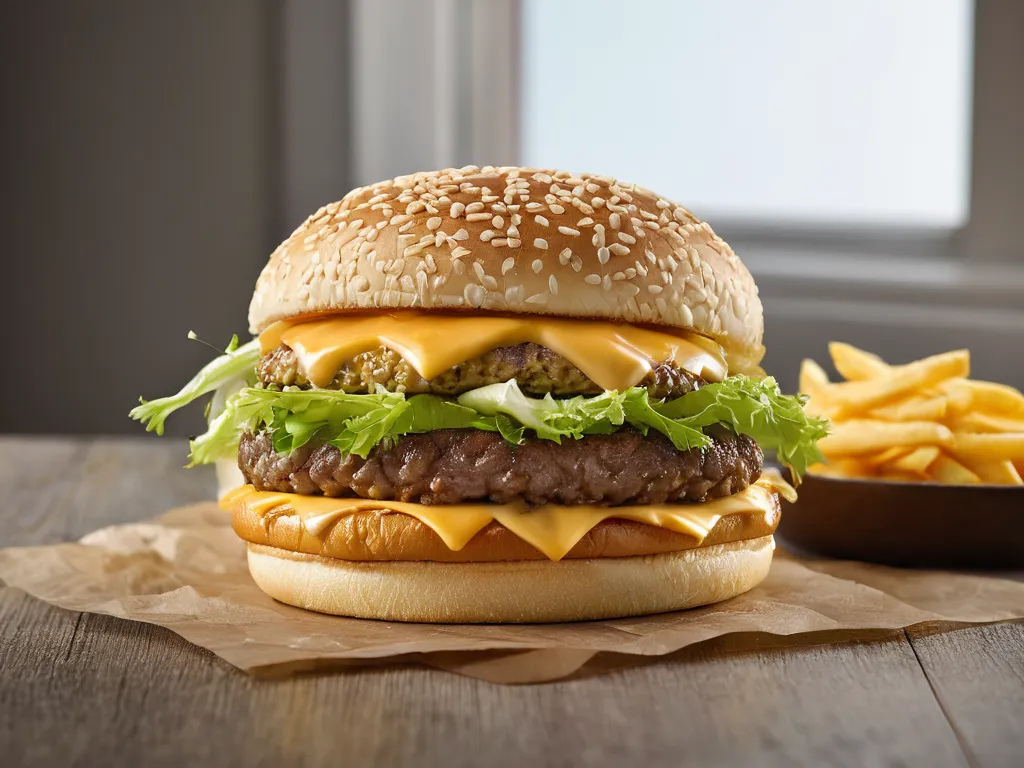
McDonald’s Big Mac
Prep time: 20 minutes | Cook time: 10 minutes | Serves: 2
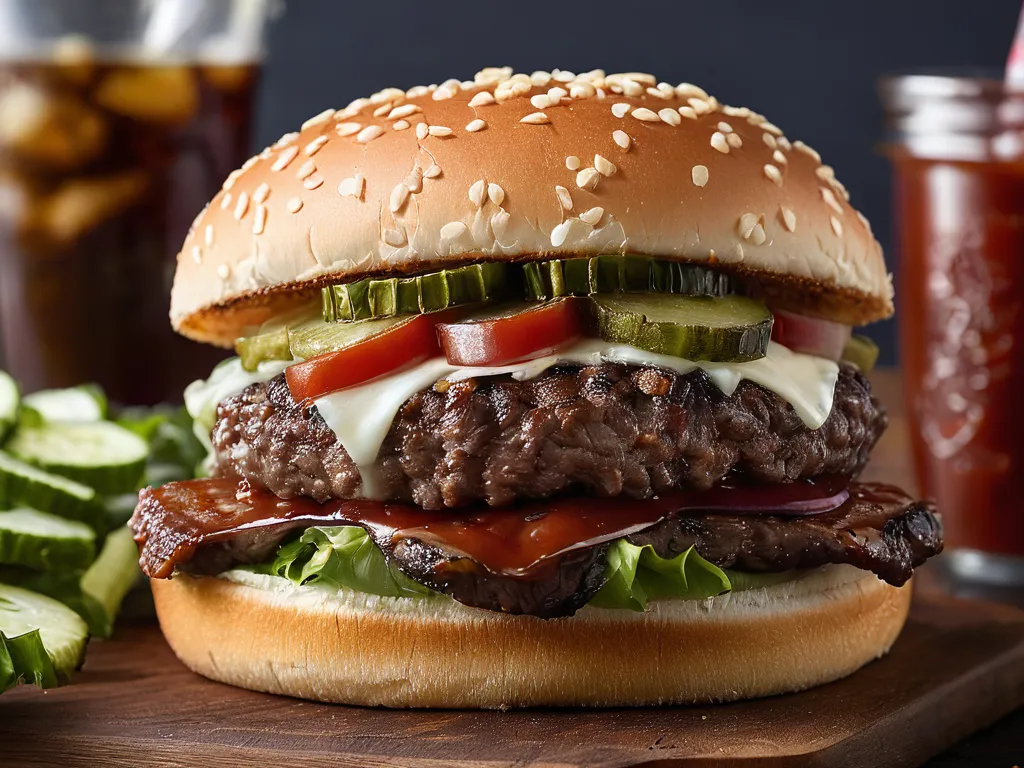
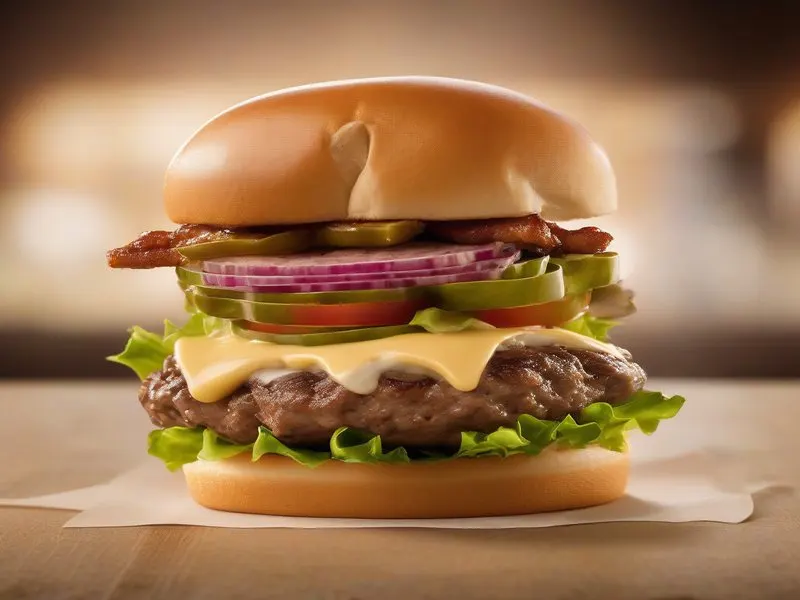
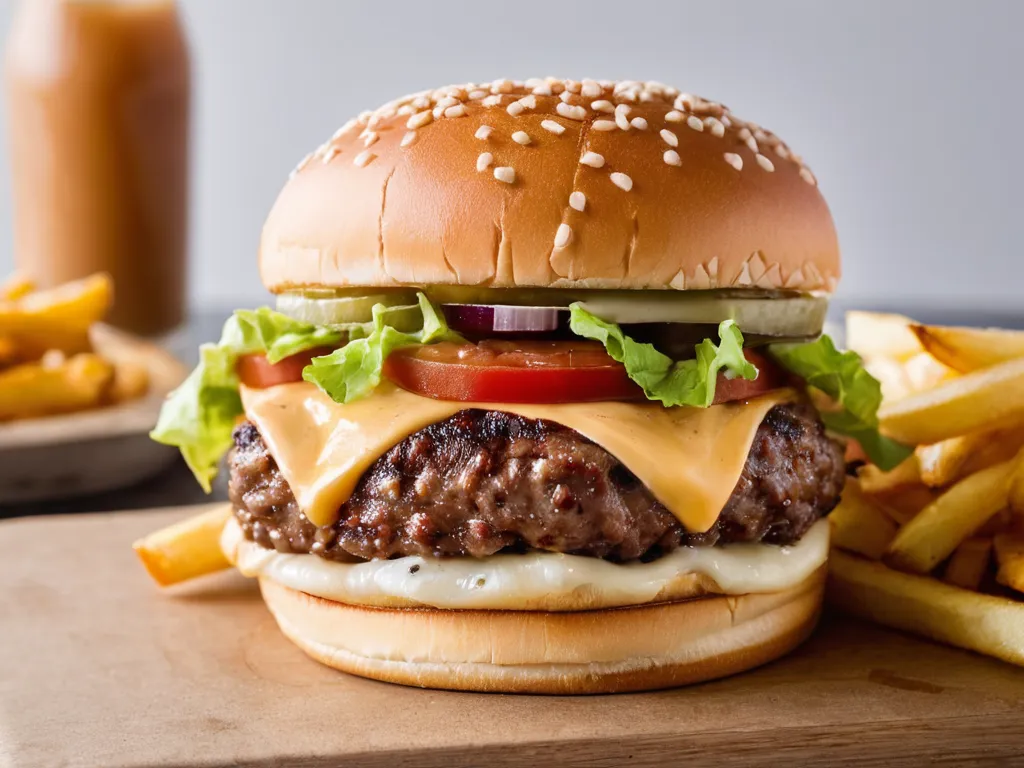
The Big Mac is America’s most recognized burger. Two thin beef patties, that specific tangy-sweet special sauce, shredded lettuce, American cheese, pickles, diced white onion, sesame seed bun — plus the mysterious middle layer that divides the two halves. It has been on McDonald’s menu since 1968, and the ratio of sauce to meat to crunch to soft bun has changed remarkably little in nearly 60 years.
TL;DR
- Thin patties are everything — 1/8 inch, pressed flat, cooked at high heat without moving
- Big Mac sauce: mayo + sweet pickle relish + yellow mustard + white wine vinegar + garlic powder + onion powder + paprika — no ketchup
- Build in two distinct layers with the middle bun as the divider
- Wrap in parchment for 2 minutes after assembly — the steam-rest is what makes it taste right
The Origin Story
Jim Delligatti was a McDonald’s franchisee in western Pennsylvania who didn’t wait for permission. In 1967, he developed a larger, more substantial sandwich for the franchises he operated, working from the basic elements on McDonald’s menu — beef, bun, American cheese, special condiments — but assembled in a structure nobody had tried at McDonald’s.
The corporate office wasn’t enthusiastic. Ray Kroc, McDonald’s founder, had built the chain on operational simplicity — a short, standardized menu that any location could execute at high volume. Adding a complex three-bun sandwich with a bespoke sauce went against the system. But Delligatti believed there was demand for a more satisfying main course, tested it at select stores, and eventually persuaded McDonald’s to run broader trials.
It went national in 1968. By the early 1970s it was McDonald’s flagship product and remains so today.
The name itself came from a 21-year-old secretary at McDonald’s corporate headquarters named Esther Glickstein Rose, who won an internal naming contest in 1967. Delligatti had been calling it the “Aristocrat.” McDonald’s had briefly tried “Blue Ribbon Burger.” Esther’s suggestion, “Big Mac,” was two words that fit on a menu board, were easy to say, and sounded like exactly what the sandwich was.
Jim Delligatti died in November 2016 at age 98. His obituaries credited him with one of the most successful product ideas in fast food history.
The Big Mac Index
Since 1986, The Economist magazine has published the Big Mac Index — an informal but useful measure of purchasing power parity between countries. The concept is simple: because a Big Mac requires similar inputs (beef, bread, labor, real estate) everywhere it’s made, its price in local currency — when converted to US dollars — reveals whether a currency is over- or undervalued relative to the dollar.
If a Big Mac costs $5.00 in the United States and the equivalent of $8.50 in Switzerland, the Swiss franc is approximately 70% overvalued relative to the dollar. If a Big Mac costs $2.20 in Russia, the ruble is 56% undervalued.
Economists don’t use the Big Mac Index as a serious monetary tool — it ignores non-tradable inputs like local rent and wages. But it’s a legitimate starting point for currency discussions and has been cited in academic papers, central bank analyses, and policy debates for four decades.
The index is updated twice a year and published at economist.com/big-mac-index.
The Sauce — Dan Coudreaut’s 2012 Reveal
For decades, Big Mac sauce was a trade secret. Food writers speculated. Copycat recipes guessed at Thousand Island dressing (close but not right — Thousand Island contains ketchup; Big Mac sauce doesn’t).
In 2012, McDonald’s executive chef Dan Coudreaut answered the question directly in a YouTube video titled “McDonald’s Recipe — Big Mac Sauce.” The ingredients, which Coudreaut measured on camera:
- Mayonnaise
- Sweet pickle relish (the defining ingredient)
- Yellow mustard
- White wine vinegar
- Garlic powder
- Onion powder
- Sweet paprika
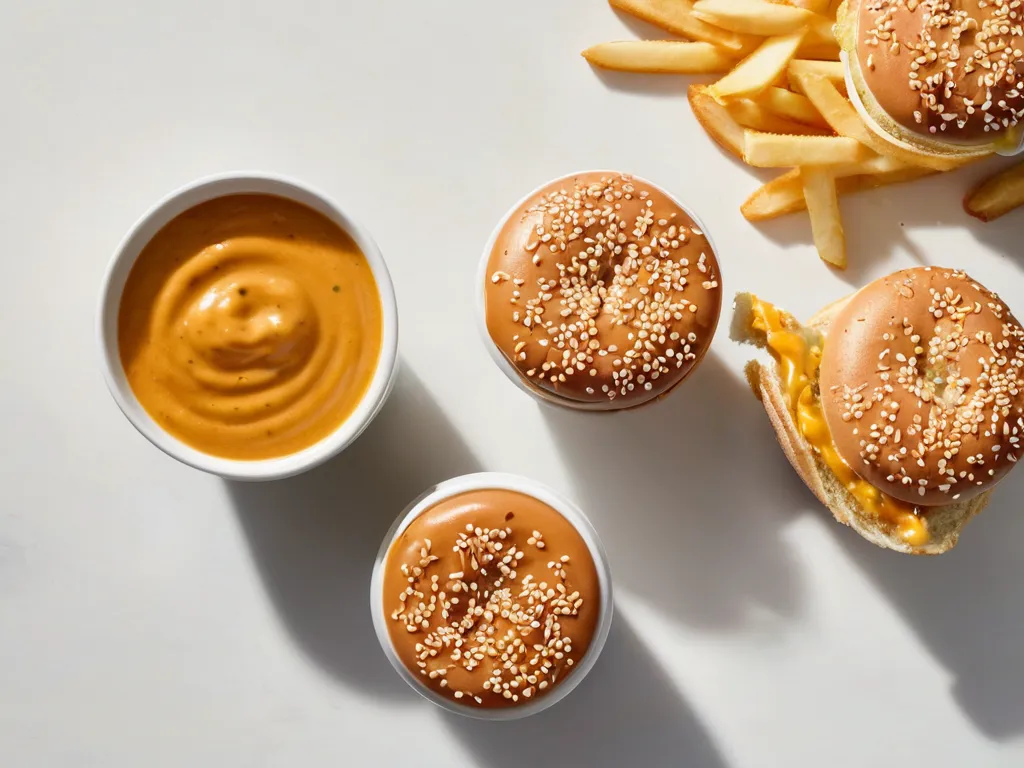
No ketchup. The tangy-sweet profile that most people associate with Thousand Island comes from the relish-mustard-vinegar combination without ketchup. White wine vinegar (not plain white vinegar) gives the sauce a specific brightness; plain white vinegar works as a substitute but tastes slightly harsher.
The right ratio: the relish should be detectable but not dominant — you want each element in balance, not pickle-forward. If your sauce tastes too sweet, add another quarter-teaspoon of vinegar. If it’s too sharp, add another half-teaspoon of mayonnaise.
Make it ahead. Big Mac sauce improves significantly with 30+ minutes of refrigeration. The vinegar slightly pickles the onion powder, the paprika blooms into the mayo fat, and the relish integrates. Make it a day ahead and keep in a jar — it holds for two weeks and works well on any burger or sandwich.
The Three-Bun Architecture
The middle bun is not a novelty. It solves a specific structural problem.
When you stack two patties with their toppings in a single layer, the combined weight of lettuce, onion, pickles, and sauce from both patties compresses into an unstable, leaky mass. Things slide. The bun gets soaked from both sides. The meat-to-topping ratio per bite is inconsistent.
The middle bun creates two separate hamburger zones, each with its own sauce, lettuce, onion, pickle, and cheese patty. The bottom zone (bottom bun → toppings → patty) is structurally independent from the top zone (middle bun → toppings → patty → crown). Every bite crosses both zones and hits a consistent ratio.
The middle bun is also what makes the Big Mac tall. That height is deliberate — it’s what makes the sandwich feel like a substantial meal rather than a fast snack.
One trick for home cooks: The middle “bun” is just the bottom half of an extra bun. You use the flat (cut) side facing up on top of the first patty, then sauce on the flat top, then the second patty layer above that. You discard the rounded crown from that extra bun — you only need the flat piece. Buy three buns if you’re making four Big Macs.
Patty Technique
McDonald’s uses a formed patty, not a smash burger. The patty is 1.6 ounces before cooking — about the weight of a half-dollar. At that size, it’s thin enough to cook through completely on both sides in under 3 minutes on a flat-top griddle at 350–375°F.
At home, the cast iron skillet is the best approximation of a commercial flat-top: it holds heat when cold patties hit it, distributes heat evenly across the surface, and creates the crust that the thin patties need to hold together when assembled.
The most important step: Do not move the patties once they hit the pan. The crust forms through sustained contact. Every time you press, slide, or peek by lifting, you break the contact and delay browning. Set a 2-minute timer and walk away.
On smash burgers: Smash technique produces a crispier, more irregular patty with more browned surface area — excellent for a different style of burger but not a Big Mac replica. McDonald’s doesn’t smash; the real Big Mac has a soft, flat patty with browned edges and a cooked-through center, not a lacey, thin smash patty. For this recipe, press the patty flat before it hits the pan (not in the pan with force), and let the crust develop without additional pressing.
Assembly Order
The order of the toppings is not arbitrary — it’s designed so every ingredient is distributed across both layers:
Bottom layer: bottom bun → sauce → shredded lettuce → diced onion → 2 pickle slices → cheese patty
Middle layer: middle bun (toasted side down, flat side up) → sauce → shredded lettuce → diced onion → 2 pickle slices → cheese patty → crown
Sauce goes on both the bottom bun and the middle bun. Lettuce, onion, and pickle appear in both layers. Each patty has its own cheese slice.
Shredded vs. leaf lettuce: McDonald’s uses finely shredded iceberg, not leaf lettuce. The reason is distribution — fine shreds spread evenly across the sauce layer without clumping into a single mass that slides out on the first bite. If you use leaf lettuce, it folds and layers unevenly, and large pieces pull out when you bite in.
The Wrap-and-Rest
Wrap the finished Big Mac in parchment paper or foil for 1–2 minutes before eating. This is what most homemade Big Mac recipes skip, and it’s why they feel different from the restaurant version.
During the rest:
- The steam from the hot patties softens the bun slightly and binds the layers together
- The sauce warms and distributes more evenly between the bun and the toppings
- The cheese finishes melting from residual heat
- The overall texture becomes cohesive rather than assembled
Don’t rest longer than 2 minutes or the bun goes too soft. The window is narrow but the result is correct.
Variations
Double Big Mac: Four patties instead of two — McDonald’s sells this permanently in most markets. Same sauce, same structure, same bun. Four patties in two layers of two. Roughly 720–750 calories in the restaurant version.
Big Mac Bacon: Add two strips of crispy bacon to each layer — McDonald’s tested this as a permanent item. Fry the bacon separately, pat dry, break into halves, and add one half per layer on top of the patty.
Grand Mac: A standard two-patty Big Mac but with patties roughly twice the size (about 3.2 oz each). Better for those who want more meat relative to bun. Assembly is identical to a standard Big Mac.
Chicken Big Mac: Replace the beef patties with thin crispy chicken breast or chicken tenders. McDonald’s launched this in several markets in 2024. The sauce works equally well on chicken; the architecture stays the same.
Cost vs. the Restaurant
A McDonald’s Big Mac averages $5.50–$7.00 depending on location. This recipe makes two Big Macs for approximately $7–9 in ingredients — similar total price for double the quantity. The homemade version also lets you control patty thickness, sauce ratio, and topping quantity, which most people find superior to the standard restaurant portion.
More McDonald’s Copycat Recipes
- Big Mac Sauce — the secret sauce standalone. Make a double batch to use as a dipping sauce, burger spread, or salad dressing all week.
- McDonald’s French Fries — the essential side: the double-fry technique, why they switched from beef tallow in 1990, and the blanching step that creates the signature crunch.
- McDonald’s Hash Brown — the flat, crispy breakfast side made from shredded potato.
- McDonald’s Chicken Nuggets — the tempura-batter technique that creates the specific light, airy crust.
- McDonald’s Apple Pie — the original fried version, not the baked one.
See all McDonald’s copycat recipes →