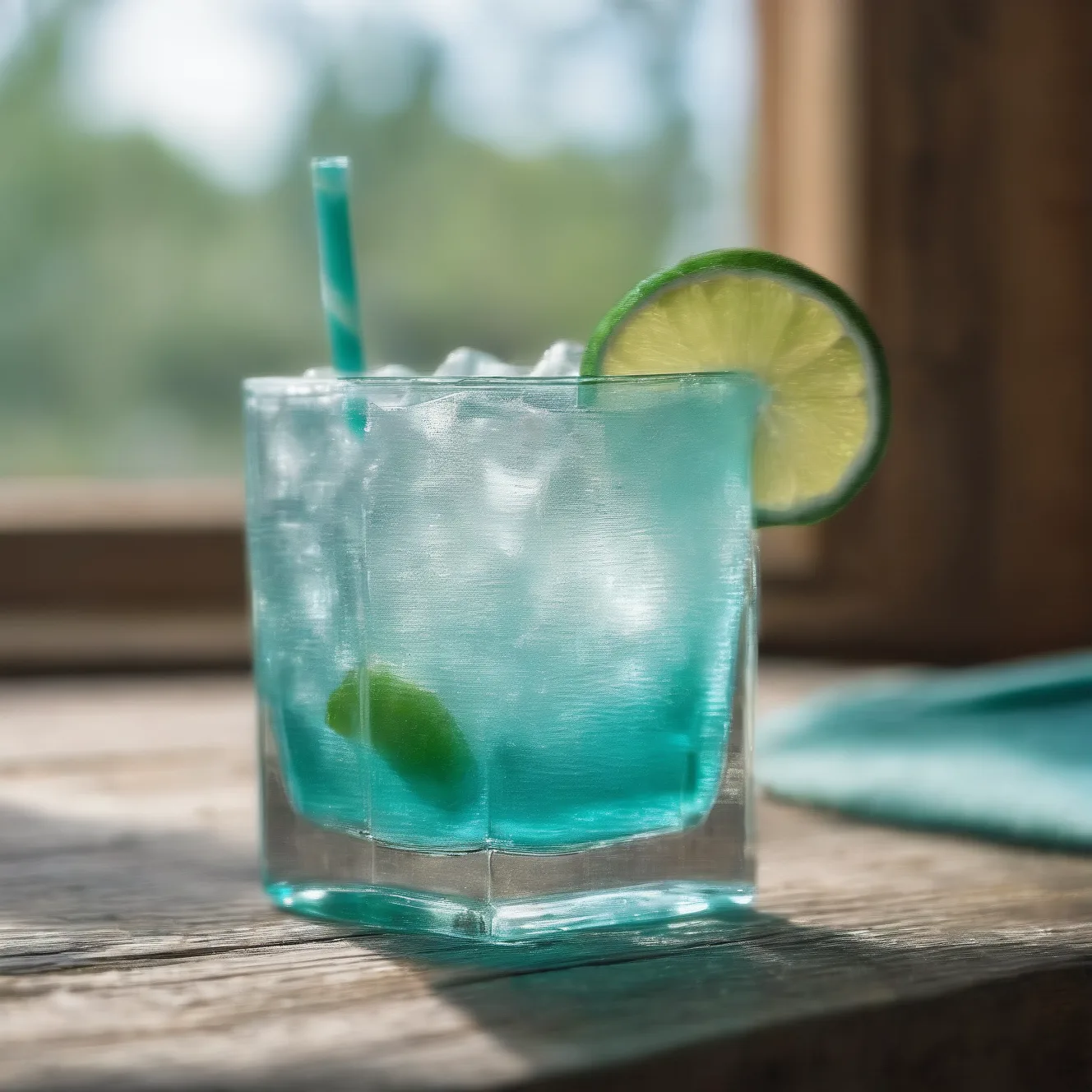
Copycat Taco Bell Baja Blast
Prep time: 5 minutes Servings: 2 (about 12 oz each, plus ice) Cost at home: under $0.40 per serving
Baja Blast is one of the most imitated fast food drinks because it is one of the most unusual: a custom Mountain Dew flavor that Taco Bell has been serving exclusively since 2004, in a color so specific and recognizable that it has become a cultural marker. The teal is what people are chasing when they make it at home.
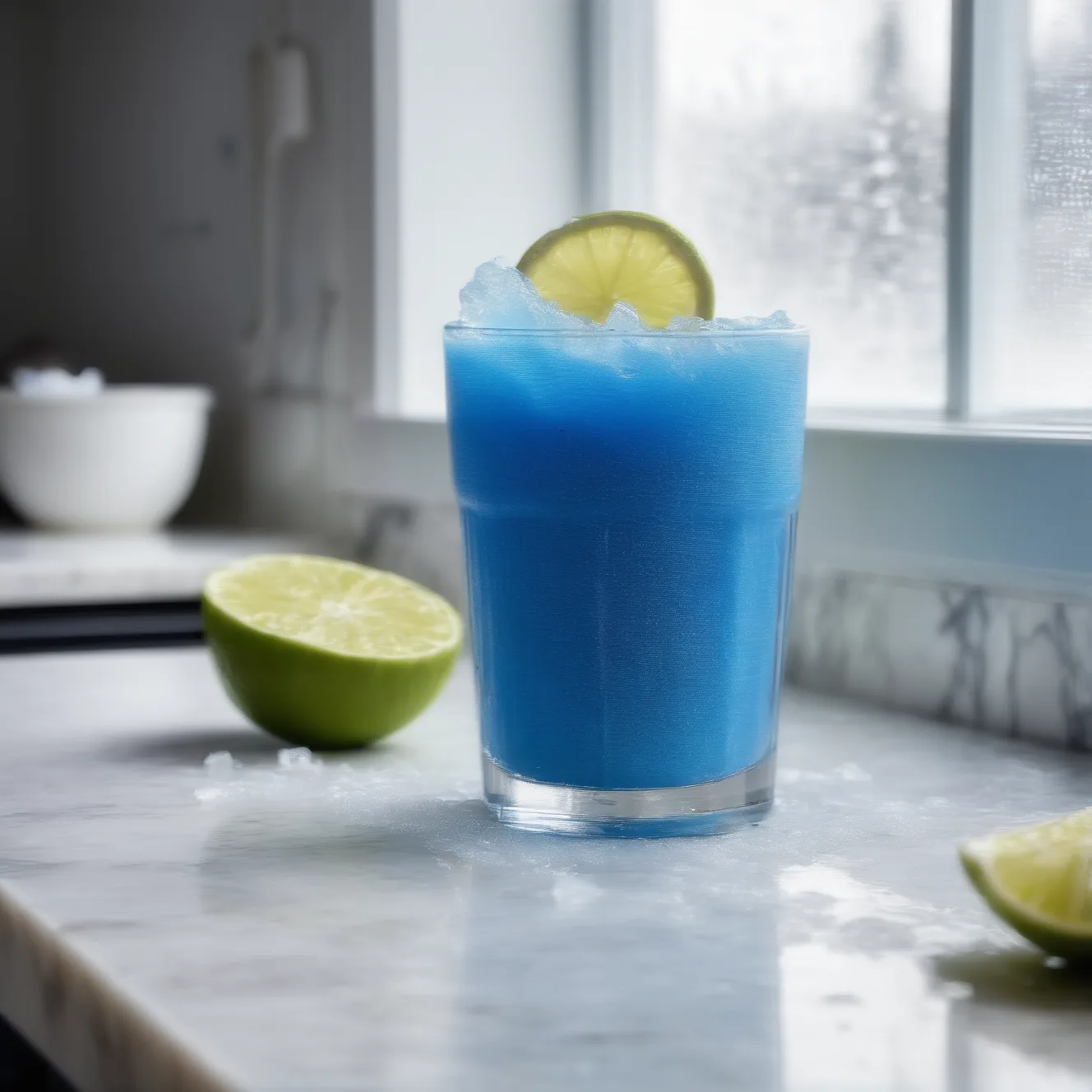
The good news is that the teal does not require food coloring. It occurs naturally when you combine Mountain Dew’s yellow-green with any blue sports drink — the pigments mix the same way paint does: blue plus yellow-green equals teal. The ratio determines the exact shade. Two parts Dew to one part blue sports drink hits the target. That is the entire formula.
What Baja Blast Actually Tastes Like
The flavor of Baja Blast is described everywhere as “tropical lime,” and that description is accurate in a specific way: it is lime-forward but not sour. Regular Mountain Dew has an aggressive citric sharpness — a lot of acid that you feel at the back of the throat. Baja Blast is softer and sweeter, closer to lime candy than lime juice. The Mountain Dew DNA is there — the sweetness, the slight carbonation cut, the faint citrus base — but the tropical lime formula dials back the tartness and pushes the sweetness forward.
This is why most copycat recipes that add a lot of lime juice or limeade taste slightly off: they’re making the drink more sour than the original, which tilts it toward limeade rather than Baja Blast. If you want authenticity, use limeade concentrate (sweeter than lime juice, with a syrupy lime flavor) in a small amount — or skip additional lime entirely and let the ratio do the work.
The Color Science
Mountain Dew’s standard formulation uses Yellow 5 (tartrazine) as its primary food dye, which gives the soda its yellow-green color. Baja Blast adds Blue 1 (brilliant blue) to that base, and the two pigments combine to produce the teal.
When you make the copycat at home, the Blue 1 comes from the sports drink:
- Gatorade Cool Blue (labeled “Cool Blue” or “Blue Raspberry Lemonade”) contains Blue 1 — the dye that produces its blue color
- Powerade Mountain Berry Blast similarly uses Blue 1 for its deep blue
Pour either into Mountain Dew and the blue pigment mixes with the Dew’s yellow-green to produce teal — no additional food coloring required. The shade varies slightly depending on the sports drink’s dye concentration, but both land solidly in the Baja Blast color range.
Ratio and color: At 2:1 Dew to blue sports drink, you get the target teal. At 3:1, you get a slightly greener teal (closer to Dew’s base color). At 1:1, the drink goes too blue and starts to taste more like the sports drink than Dew. Stick with 2:1 for color and flavor accuracy.
Choosing the Right Blue Sports Drink
Not all blue sports drinks produce the right result. The color has to come from a blue dye at sufficient concentration, and the flavor has to be neutral enough that it doesn’t overwhelm the Dew.
Gatorade Cool Blue — the standard recommendation. The flavor is blue raspberry lemonade, which at a 1:3 dilution with Mountain Dew becomes subtle enough to blend in. The resulting color is a bright teal with a slight green cast, close to the fountain Baja Blast.
Powerade Mountain Berry Blast — slightly more concentrated dye, producing a deeper, more vivid teal with a slight blue bias. Some fans prefer this because the color feels more accurate to what comes out of Taco Bell’s fountain machine. The flavor is similar: a mixed berry that disappears into the Dew ratio.
Avoid: Gatorade Berry (purple), any blue-purple sports drinks (these contain Red 40 in addition to Blue 1, which shifts the color toward violet), and blue sports drinks with strong fruit flavors that overwhelm the Mountain Dew base.
Food coloring as a fallback: If you want more precision, add 2 drops of blue gel food coloring directly to the Dew before adding the sports drink. This lets you use any sports drink (including clear ones) and adjust the teal shade exactly. But for most purposes, the Gatorade or Powerade route is simpler and tastes better.
The Limeade Concentrate Question
The current recipe includes an optional 2 tablespoons of limeade concentrate per serving. Here is when to use it and when to skip it:
Skip it if you want the most authentic taste close to the Taco Bell fountain drink. The fountain version does not have added lime beyond what is in the Mountain Dew formulation itself.
Add it if you are serving this as a standalone drink (not alongside food) and want a slightly more complex tropical flavor. Limeade concentrate adds sweetness and a mellow lime character without sharpening the drink. Half a tablespoon per 16 oz is sufficient — too much reads as limeade rather than Baja Blast.
Do not substitute lime juice. Fresh lime juice is much more acidic and will make the drink taste sour in a way that does not match the original. If you want citrus brightness, limeade concentrate is the right vehicle, not lime juice.
The Baja Blast Freeze
The Freeze is Taco Bell’s slushie version — a machine-churned frozen drink that is slightly sweeter and denser than the fountain Baja Blast, because frozen drinks need more sugar to taste balanced at lower temperatures (cold suppresses sweetness perception).
At home, a blender replicates the texture well. The critical points:
Ice ratio: 1:1 premixed Baja Blast to ice by volume. More ice makes it too watery; less ice makes it slushy but not frozen enough and it melts immediately.
Blend timing: Pulse first to break up the ice, then blend on high for 15–20 seconds. Stop before the mixture becomes a smooth liquid — you want slushy texture with small ice crystals, not a smoothie.
Better texture via ice cube trays: The most common problem with blending fresh Baja Blast with regular ice is that the ice is dense and the result comes out grainy or too watery. The fix: pour premixed Baja Blast into an ice cube tray and freeze overnight. Blend the Baja Blast cubes (no added water or ice) until slushy. This produces a much smoother, more uniform texture and doesn’t dilute the flavor — the same reason slushie machines work better than blenders for this application.
Temperature: Pre-chill your serving glass in the freezer for 5 minutes before pouring. The frozen Freeze melts faster than a slushie machine’s output because home blenders warm the drink slightly during blending. A cold glass gains 5–8 minutes of slushie life.
Sweetness adjustment: The frozen version needs slightly more sweetness than the fountain version because cold suppresses sweetness perception. Add 1 tablespoon of simple syrup per serving if the blended result tastes flat. This is not needed if you freeze the Baja Blast cubes ahead of time, because the freeze-concentration process slightly amplifies existing flavors.
Zero Sugar Baja Blast
MTN DEW Zero Sugar is available in stores and at some Taco Bell locations. For the homemade zero-sugar version:
- Replace regular Mountain Dew with MTN DEW Zero Sugar or Diet Mountain Dew
- Replace the sports drink with Gatorade Zero Cool Blue (sugar-free, same color as regular Cool Blue)
The color is identical — food dyes are unaffected by whether the drink is sweetened with sugar or artificial sweeteners. The flavor is thinner and has the characteristic aftertaste of aspartame, but the Baja Blast character comes through. At 2:1 ratio, the result is a credible zero-calorie copycat with roughly 10 calories per serving (from trace carbs in the dye/flavoring).
For the Freeze version using zero-sugar ingredients, blend with the same 1:1 ratio of liquid to ice. The result is slushier than the sugar version because sugar contributes viscosity — the zero-sugar Freeze will melt faster and feel slightly thinner.
Baja Blast Variants at Taco Bell
PepsiCo has used the Baja name for a series of Mountain Dew extensions, nearly all of them Taco Bell exclusives:
Baja Gold (2022, limited) — pineapple-citrus flavor, bright yellow-orange color. No lime; completely different flavor family from the original.
Baja Flash — coconut-pineapple, white/opalescent color. More dessert-like; the coconut note is a distinguishing feature absent from original Baja Blast.
Baja Mango Gem (2022, limited) — orange-tropical mango flavor.
Baja Laguna Lemonade / Baja Point Break Punch (March 2024, LTO) — mango lemonade and tropical punch variants released to mark the 20th anniversary.
Baja Cabo Citrus (Spring 2025, 8-week LTO) — tropical punch with natural colorings.
Baja Midnight (Summer 2025, Taco Bell exclusive) — passionfruit flavor, dark purple color.
None of the variants have matched original Baja Blast’s cultural staying power or fountain availability, and none have established widely-replicated home copycat formulas. The original remains the one worth replicating at home.
Cost Comparison
| Taco Bell | Homemade | |
|---|---|---|
| Baja Blast medium (20 oz) | ~$2.79–$3.49 | ~$0.35 |
| Baja Blast Freeze (medium) | ~$3.29–$3.99 | ~$0.40 |
| Baja Blast Zero (medium) | ~$2.79–$3.49 | ~$0.25 |
The cost advantage is modest compared to coffee drinks, because fountain soda is already cheap at Taco Bell. The real reasons to make it at home: you can batch a pitcher, you can adjust the ratio to your color and sweetness preference, and you do not have to drive to Taco Bell.
The 2004 Origin and Retail History
Baja Blast launched July 29, 2004 as the first dedicated fast-food/soda partnership between a chain and a beverage company. The name came from Baja California — reportedly the drink was brainstormed by PepsiCo and Taco Bell executives during a golf trip to a Baja resort. The design intent was a fountain drink that would pair specifically with Taco Bell food: light, sweet, and tropical enough to complement spicy and salty Mexican-American flavors without adding the sharp citric edge of regular Mountain Dew.
For the first 16 years, Baja Blast was a Taco Bell fountain exclusive. PepsiCo ran limited summer retail releases in subsequent years, but the drink was not a permanent store product until January 2024 — the 20th anniversary, which PepsiCo marketed as the “Bajaversary.” Since then, 20-oz bottles, 16-oz cans, and 2-liters have been a year-round grocery store staple. Fans still consistently report the fountain version tastes different — more carbonated, slightly less sweet — which is consistent with the difference between fountain syrup dilution and a sealed can.
More Taco Bell Drinks and Sides to Make at Home
- Copycat Taco Bell Nacho Cheese Sauce — the smooth, mild processed-style queso that Taco Bell uses for Nacho Fries and Nachos BellGrande; 10 minutes on the stove.
- Taco Bell Nacho Fries — double-fried seasoned fries with the specific paprika-cumin-cayenne spice blend that Taco Bell uses, plus the cheese dipping sauce.
- Copycat Taco Bell Crunchwrap Supreme — layered tortilla, seasoned beef, nacho cheese, lettuce, tomato, and sour cream, folded into a hexagonal pocket and grilled flat.
For more fast-food drinks to make at home, the Copycat Chick-fil-A Lemonade explains why Chick-fil-A’s lemonade tastes different from every other fast-food version (fresh-squeezed, 100 lemons per gallon), and the Copycat Starbucks Pink Drink shows how to replicate the acai-berry-coconut-milk formula for about $1.50 per grande.
See all Taco Bell copycat recipes →