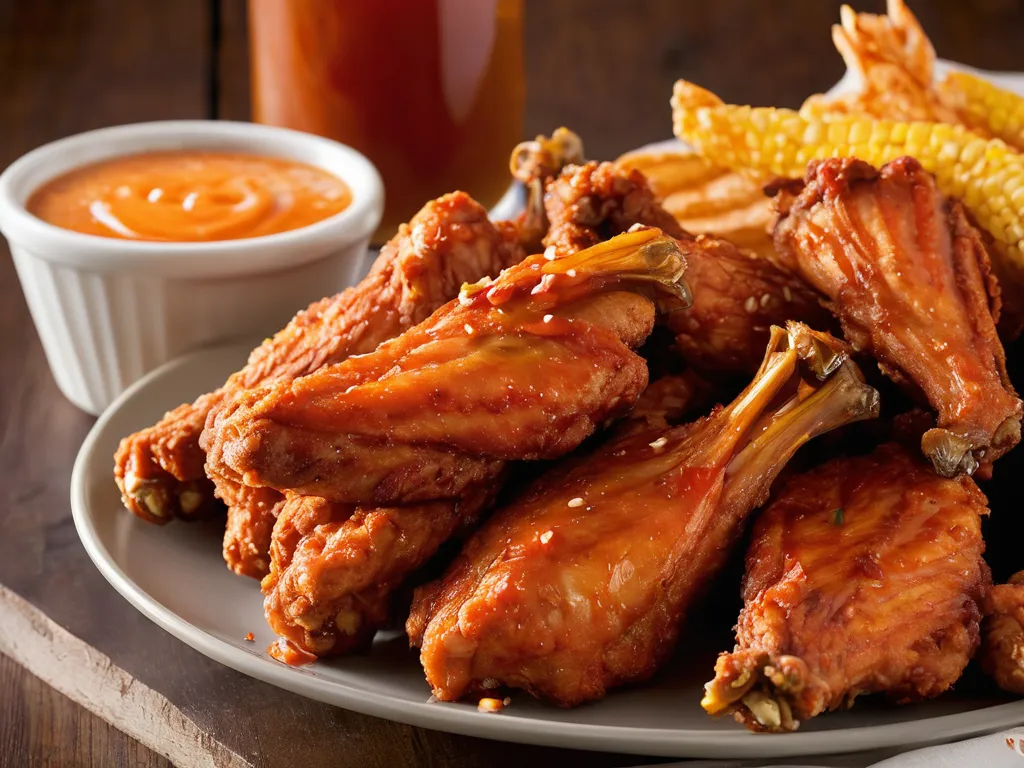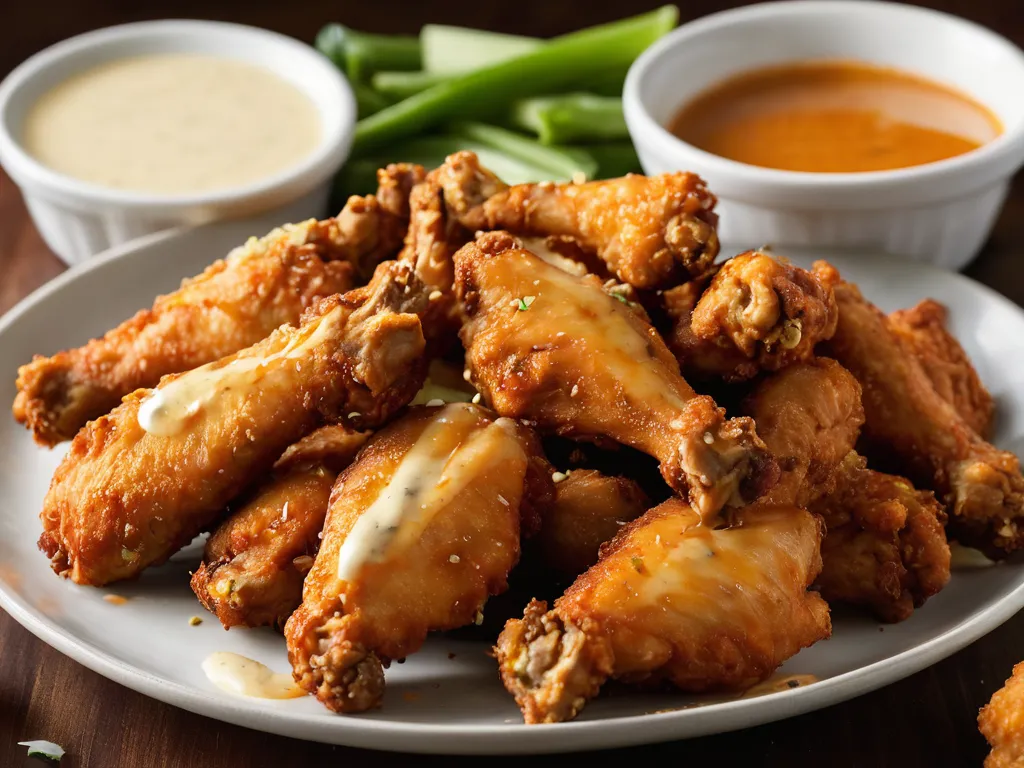
Copycat Buffalo Wild Wings Garlic Parmesan Wings
Prep: 10 min | Cook: 40–45 min | Serves: 4 | Difficulty: Medium
Buffalo Wild Wings’ Garlic Parmesan is the chain’s most popular non-buffalo flavor, and it looks simple: crispy wings, a creamy sauce, garlic, Parmesan. But most copycat recipes miss the target in a specific way — they use a butter-based garlic Parmesan sauce that tastes good in its own right but does not taste like what BWW serves. The reason: BWW’s actual Garlic Parmesan sauce, including the bottled version sold in grocery stores, is a mayo-based emulsion with shallots and lemon juice, not a cooked butter sauce. Butter adds sweetness and dairy richness in a different direction than the sharp, clinging, garlicky creaminess the restaurant version has.
The recipe below corrects that — and pairs the accurate sauce with the baking powder technique that makes oven-baked wings genuinely crispy rather than pale and soft.
Why Most Copycat Garlic Parm Sauces Taste Off
The confusion comes from how the dish is conceptually framed. “Garlic Parmesan” reads as an Italian-American flavor combination, and the natural instinct is to start with butter — browned garlic butter plus Parmesan is a classic pasta sauce move. For breadsticks, for pasta, for garlic bread, that combination is perfect.
For a wing dipping and tossing sauce it produces the wrong texture. Butter-based sauces thin out as they cool, pool at the bottom of the bowl, and lose their cling after 5 minutes. The original BWW sauce — commercially formulated — uses an oil-and-egg-yolk emulsion as its base, which is structurally identical to mayonnaise: stable, clinging, does not separate or pool, and doesn’t thin as it cools. The commercial ingredient list confirms it: soybean oil, egg yolk, distilled vinegar, Parmesan, garlic, shallots, lemon juice concentrate — no butter, no cream.
At home, substituting Hellmann’s (or Best Foods) for the commercial emulsion gets you very close. The resulting sauce clings to the hot wing skin, doesn’t pool on the platter, and holds its texture from first wing to last.
How BWW Actually Cooks Their Wings
Buffalo Wild Wings deep-fries their wings in beef tallow — rendered beef fat — at 325–350°F. Beef tallow has a high smoke point and a distinctive, intensely savory flavor that vegetable oil does not replicate. It is a significant part of why BWW wings taste slightly different from any oven-baked version: the tallow contributes flavor that technique alone cannot replace.
At home, the baking powder method is the closest achievable approximation without deep-frying. It won’t taste identical to the restaurant — nothing will, short of a home deep-fryer loaded with beef tallow — but it produces genuinely crispy skin rather than the soft, steamed texture that oven-baked wings usually have, and it requires no hot oil to manage.
If you want to go the whole way and deep-fry: use beef tallow (rendered beef fat, sold at specialty grocers and online — not to be confused with lard, which is pork), heat to 350°F in a Dutch oven, fry the wings (without baking powder coating) in batches for 10–12 minutes until deeply golden, and drain on a rack before tossing with the sauce. The result is significantly closer to the restaurant.
One caveat on the tallow claim: it applies to standard Buffalo Wild Wings dine-in locations, per the chain’s allergen and preparation guide. The smaller takeout-focused “Buffalo Wild Wings GO” locations may fry in soybean oil instead, so the flavor there is closer to a standard vegetable-oil fry.
The Baking Powder Trick: Why It Actually Works
The mechanism is chemistry, not magic. Baking powder is alkaline. Coating raw wings in it raises the pH of the skin immediately, which does two things:
First, the higher pH breaks down the peptide bonds in the skin’s protein structure, loosening it so the fat underneath can render out during baking. Normally, wing skin has a tight protein matrix that holds moisture in and prevents the deep-fry-like crispiness you want.
Second, the alkaline environment accelerates the Maillard reaction — the reaction between proteins and sugars that creates brown color and roasted flavor. Wings coated in baking powder develop deep golden blistering that looks and tastes like deep-fried skin rather than the pale, leathery result you get from plain oil.
Two requirements: use aluminum-free baking powder (the aluminum-containing kind creates a faint metallic aftertaste on the wings), and do not substitute baking soda (pure alkaline with no acid buffer — too aggressive, same metallic problem).
Sauce Ingredient Breakdown
Mayonnaise — the emulsified base that creates cling and body. Full-fat is required; light or reduced-fat mayo has more water and thins the sauce. Hellmann’s, Best Foods, and Duke’s all work.
Freshly grated Parmesan — the second most important ingredient after the mayo base. Pre-grated Parmesan from a green canister is coated in cellulose anti-caking agents that prevent it from blending smoothly — the sauce will be gritty, not creamy. Grate directly from a wedge of aged Parmesan. Parmigiano-Reggiano is worth buying here; its more complex, crystalline flavor carries into the sauce in a way that domestic Parmesan doesn’t quite match.
Fresh garlic, very finely minced — not garlic powder, not garlic paste from a tube. Fresh garlic provides sharpness and raw garlic bite that the sauce needs to cut through the richness of the mayo and Parmesan. Mince it as finely as possible — large garlic pieces in a cold sauce will be harshly pungent where they concentrate. If the texture bothers you, mash the minced garlic into a paste with the flat side of your knife and a pinch of salt before adding it.
Shallot — one ingredient missing from most copycat recipes but present in BWW’s actual commercial sauce. Shallots bring a mild, sweet onion note that’s more delicate than yellow onion and less sharp than red onion. Very finely mince the shallot so it distributes evenly into the sauce rather than creating textural chunks. Like the garlic, it mellows significantly after resting in the mayo base overnight.
Lemon juice — provides the citric acidity that makes the sauce pop. Without acid, a mayo-and-Parmesan sauce tastes flat and overly rich. Use fresh lemon juice rather than bottled; the fresh version has volatile aromatics that bottled lemon juice loses in processing.
White wine vinegar — adds acidity alongside the lemon in the same way the commercial sauce uses distilled vinegar and lemon juice concentrate in combination. The double-acid approach gives the sauce more dimensionality than a single acidic element would.
Italian herbs and red pepper flakes — parsley and oregano in small amounts give the sauce its Italian-American character. The red pepper flakes add a background heat that you notice in the finish rather than upfront — the BWW sauce has a mild kick, not a buffalo-level heat.
The Refrigerator Rest
The sauce can — and should — be made ahead. Fresh out of the bowl, the minced raw garlic and shallot are sharp and individually detectable. After 2 hours in the refrigerator, they mellow into the mayo base and the sauce reads as a single cohesive flavor. After overnight, the result is noticeably better and closer to the restaurant’s more rounded, mellow garlic character.
If you are making the sauce the same day as serving, try to give it at least 30–60 minutes of rest time. If you are making it for a party, make it the night before.
Air Fryer Method
The air fryer outperforms the oven for this recipe and cuts the cook time by about a third.
Use the same baking powder coating. Load the air fryer basket without crowding — one layer, wings not touching, with at least a quarter inch between them. Cook at 380°F for 20 minutes, flip, then increase to 400°F for 8–10 minutes until the skin is deeply golden and cracks when you press it. The circulating hot air in the air fryer is perfectly suited to the baking powder technique — the result is closer to deep-fried than what the oven achieves.
If your basket is small, work in two batches. First-batch wings will cool slightly while the second batch cooks; toss all the wings together with the sauce at the end — the sauce warms slightly on contact with the second-batch wings and everything comes out hot enough.
Beyond Wings: Other Uses for Garlic Parmesan Sauce
The sauce from this recipe is versatile. Make a double batch and use the extra on:
Pasta — thin with 2–3 tablespoons of hot pasta water and toss with penne for an instant garlic Parmesan pasta. The sauce thins and smooths into a coating consistency that works surprisingly well.
Pizza dip or spread — serve as a dipping sauce alongside pizza (especially white pizza) as an alternative to marinara. The garlic-Parmesan combination is well-suited to bread and pizza crust.
Garlic bread — spread on sliced Italian bread, top with extra grated Parmesan, and broil for 3–4 minutes. Better than standard garlic butter because of the shallot and lemon balance.
Roasted vegetables — toss cauliflower florets or broccoli in the sauce before roasting at 425°F. The mayo base helps the sauce cling and creates a caramelized exterior on the vegetables.
Chicken sandwich spread — use in place of mayonnaise on a grilled chicken sandwich. The garlic and Parmesan make an otherwise simple sandwich considerably more interesting.
Cost Comparison
A 10-piece Parmesan Garlic wing order at Buffalo Wild Wings runs approximately $16–19 depending on location in 2026. Making 3 lbs at home (roughly 28–32 wings) costs approximately $12–15 in ingredients — chicken at about $6–8, Parmesan wedge at $4–5, and the remaining sauce ingredients at $2–3 combined. Per wing, the restaurant runs about $1.60–1.90 per wing; the home version is about $0.40–0.55 per wing. A family of four saves $25–30 per session.
Storage
Wings: Wings are best eaten immediately after tossing, while the baking powder crust is at peak crispiness. If you have leftovers, store them in an airtight container in the refrigerator for up to 3 days. Reheat on a wire rack in a 400°F oven for 8–10 minutes — microwaving makes them soggy.
Sauce: The garlic Parmesan sauce keeps in a sealed jar in the refrigerator for up to 5 days. Because it is mayo-based, keep it refrigerated and discard if it has been at room temperature for more than 2 hours. The sauce thickens slightly as it chills; it returns to its original consistency after 5 minutes at room temperature.
Other Wing Recipes and Related Dishes
- Copycat Buffalo Wild Wings Blazin’ Sauce — the hottest sauce on the BWW menu, for when garlic parm is too mild
- Copycat Buffalo Wild Wings Mango Habanero Wings — sweet heat, the most popular flavor tier between mild and blazin
- Wingstop Lemon Pepper Wings — if you like the citrus note in this sauce, Wingstop’s lemon pepper takes it in a completely different direction
- Copycat Chick-fil-A Chicken Biscuit — for when you want fast-food chicken done at home in a completely different direction