Waffle House Hash Browns: Complete Ordering Guide and Copycat Recipe
Prep time: 5 minutes Cook time: 15 minutes Servings: 2
Waffle House hash browns have their own language. Order them and you’re expected to know the code: scattered, smothered, covered, chunked, diced, peppered, topped, capped, country. Knowing what each word means — and what combination to order — is the mark of a Waffle House regular.
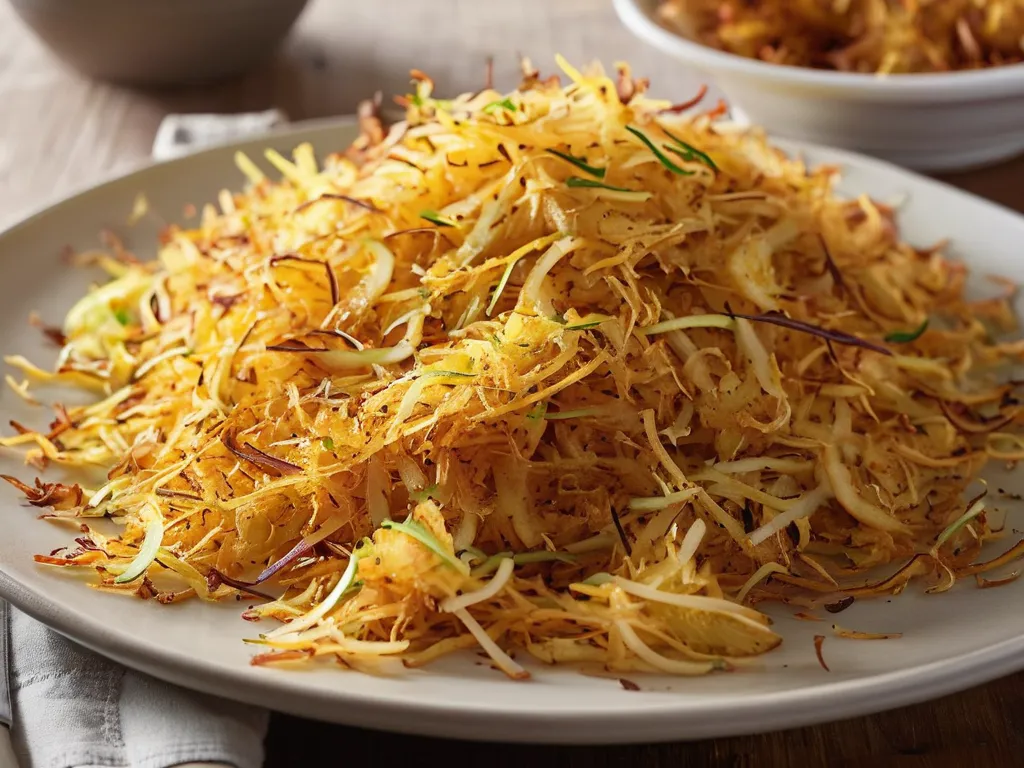
The hash browns themselves are deceptively simple: frozen shredded potatoes, scattered thin on a blazing-hot flat-top griddle, pressed flat, and left alone until they’re deeply golden on both sides. The technique is the entire recipe. Get that right and the toppings take care of themselves.
This guide covers the full ordering language, the science behind why these specific potatoes work, the FEMA Waffle House Index (a real government disaster-assessment tool), and the complete technique for making every variation at home.
TL;DR
- Base recipe: frozen dehydrated shredded hash browns, scattered thin, pressed flat, undisturbed on a very hot surface for 5 minutes per side
- “Scattered” is the preparation method (spread thin on flat top vs. ring mold); the 8 toppings are: smothered (onions), covered (cheese), chunked (ham), diced (grilled tomatoes), peppered (jalapeños), topped (Bert’s sausage chili), capped (mushrooms), country (sausage gravy)
- Waffle House uses dehydrated potatoes, not fresh-shredded — dehydration removes moisture so they crisp instead of steam
- FEMA literally uses Waffle House operational status to measure hurricane severity
- The chain opened September 5, 1955, in Avondale Estates, Georgia; now has more than 2,000 locations
The Full Waffle House Ordering Language
The Waffle House hash brown system has one preparation method and eight toppings. Regulars rattle them off in sequence, and the cooks translate them onto the grill without writing anything down.
Scattered — This is the preparation method, not a topping. Hash browns scattered means they are spread thin across the flat-top grill rather than cooked in a ring mold. All Waffle House hash brown orders are scattered by default — the word signals to the cook to use the open flat-top. This thin spreading is what creates the crispy texture: maximum surface contact with the hot griddle.
Smothered — Grilled onions, cooked until softened and slightly caramelized, then folded into the hash browns. This is the most popular add-on and the combination most people picture when they think of Waffle House. The onions pick up some of the potato starch and butter during cooking, which integrates them rather than just sitting on top.
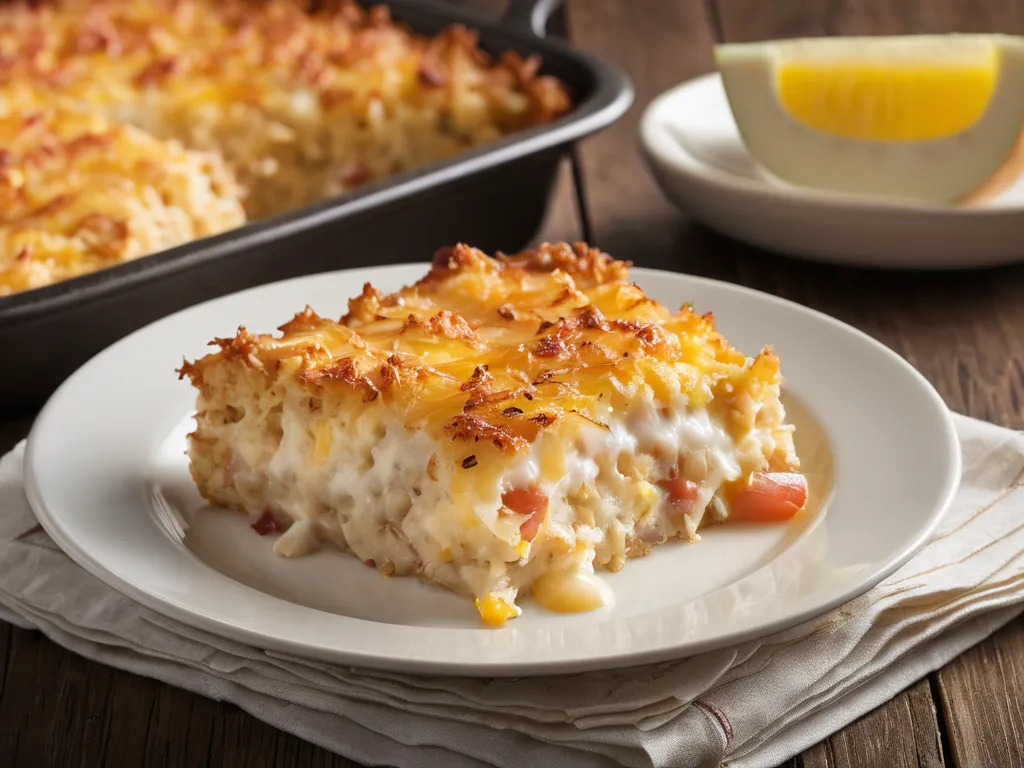
Covered — Melted American cheese. A lid goes over the hash browns for 60 to 90 seconds until the cheese fully melts into the potatoes. American cheese is the correct choice here — it melts cleanly and evenly in a way that sharper cheeses don’t.
Chunked — Diced grilled ham, tossed onto the hash browns and cooked into them during the last minute of griddle time. The ham chars slightly on the flat-top, which adds flavor beyond what plain ham brings.
Diced — Diced tomatoes, grilled directly on the flat-top alongside the hash browns until they soften and caramelize at the edges. Unlike many home versions that add raw tomatoes after plating, Waffle House cooks the tomatoes on the grill, which reduces their moisture and concentrates their flavor.
Peppered — Sliced jalapeño peppers, grilled on the flat-top alongside the hash browns. Unlike fresh jalapeños, grilled jalapeños lose some of their raw heat and take on a slightly sweet, smoky edge.
Topped — Bert’s chili ladled over the hash browns after plating. Waffle House’s proprietary chili is sausage-based with beans — not a Texas-style beef-only chili, but a milder, wetter sausage-and-bean version. This is the heaviest modifier — a Waffle House “All the Way” (all eight toppings applied) includes chili over everything.
Capped — Sauteed mushrooms, cooked on the grill until golden and folded in. Less common than smothered or covered, but adds a savory, earthy layer that works especially well with ham (chunked and capped together).
Country — Sausage gravy, ladled over the finished hash browns. A thick white gravy made with sausage drippings and milk. This is a Southern-style breakfast combination that turns hash browns into a full plate.
The “All the Way” Order
If you want all eight toppings, you order them “All the Way” — every topping applied simultaneously. The result is a plate of hash browns buried under onions, cheese, ham, grilled tomatoes, jalapeños, Bert’s chili, mushrooms, and sausage gravy. It’s extreme, but it’s real, and Waffle House cooks handle it without writing a single thing down.
The Most Popular Combinations
- Scattered, Smothered, Covered — the classic
- Scattered, Smothered, Covered, Chunked — adds ham
- Scattered, Smothered, Covered, Diced — adds tomatoes
- Scattered, Peppered — the simple heat option
- Scattered, Covered, Country — cheese and sausage gravy
The FEMA Waffle House Index
This is not a joke: the Federal Emergency Management Agency uses Waffle House operational status as a real disaster severity metric.
The system works on three levels:
Green — Waffle House is fully open with a full menu. Power is on, supply chains are intact, and the surrounding area is functional. Damage is manageable.
Yellow — Waffle House is open but serving a limited menu. This usually means they’re running on generator power or dealing with supply disruptions. Real damage has occurred, but the area is still partially functional.
Red — Waffle House is closed. When a Waffle House shuts down, the surrounding situation is serious. FEMA uses a Red status as an indicator that the area will need significant outside resources and recovery time.
Craig Fugate, who was leading the Florida Division of Emergency Management during the 2004 hurricane season, coined the Waffle House Index after Hurricane Charley that year. He later brought the concept to the federal level when he became FEMA administrator from 2009 to 2017, citing it in congressional testimony and interviews as a genuine first-response tool. His reasoning: Waffle House is more reliable than many official data sources in the immediate aftermath of a disaster because the chain has invested heavily in its ability to keep running — backup generators, relationships with multiple suppliers, and employees (Waffle House calls them “associates”) who are trained to operate under difficult conditions.
The Waffle House corporate office dispatches a “jump team” before major storms: a group of corporate staff who move into the projected path of the storm ahead of time with extra supplies, equipment, and the authority to make fast operational decisions. The goal is to be operational within hours of a storm passing.
Why Waffle House Stays Open
Several factors make Waffle House unusually disaster-resistant:
- The menu is simple enough to execute on generator power alone. Most items require only the flat-top griddle and basic refrigeration.
- Waffle House operates 24/7/365 by default, so the operational infrastructure for extended hours is already in place.
- The company maintains its own supply chain relationships that let them source locally when normal delivery routes are disrupted.
- After Hurricane Katrina in 2005, Waffle House locations in affected areas were among the first food-service operations to reopen. The chain’s post-Katrina response helped establish the pattern that FEMA now formally tracks.
The History: Joe Rogers and Tom Forkner, 1955
Waffle House opened on September 5, 1955, in Avondale Estates, Georgia, a small suburb east of Atlanta. The founders were Joe Rogers Sr. and Tom Forkner.
Rogers had worked for the Toddle House restaurant chain and later moved to Atlanta, where he met Forkner. The two combined $4,000 in savings: Forkner proposed the name, Rogers proposed the 24-hour hours. They settled on “Waffle House” because waffles were the most profitable item on their 16-item menu. First-year revenue was $50,000. The name went in lights on the roof — those yellow-on-black letters have been the chain’s visual identity ever since. Both founders died in 2017, less than two months apart: Joe Rogers Sr. in March and Tom Forkner in April.
The concept worked. By the 1960s, Waffle House was expanding through Georgia. By the 1970s, it had pushed into neighboring Southern states. The chain never meaningfully expanded to the Northeast, West Coast, or Midwest — it remained a regional institution, concentrated in the states that Southerners are from and travel through.
Today, Waffle House has more than 2,000 locations across 25 states. Georgia alone has around 445 locations — roughly 22 percent of the entire chain. About 90 percent of all locations are in the South or mid-Atlantic. If you’re from Atlanta, Charlotte, Birmingham, Nashville, or anywhere in between, Waffle House is background noise — a yellow building on the way to the highway, open at 3 a.m. the same as it is at 3 p.m.
The scale is remarkable: Waffle House serves roughly 272 million eggs per year. The chain goes through 341 strips of bacon, 145 waffles, and 127 cups of coffee every minute it’s open, and more than 1,600 tons of grits move through its kitchens annually.
The Science: Why Waffle House Hash Browns Are Different
Dehydrated Potatoes, Not Fresh
Waffle House does not use freshly shredded potatoes or standard fresh-frozen hash browns. They use dehydrated shredded potatoes — a product that has had most of its moisture removed before packaging, and is then reconstituted (rehydrated) before being cooked on the griddle. The potatoes are supplied by Basic American Foods, which dehydrates Idaho-grown potatoes into the shredded product the restaurants rehydrate on site.
The moisture content is everything. Fresh potatoes are roughly 80 percent water. When you put high-moisture potatoes on a hot griddle, the water turns to steam before the surface can brown. You end up with potatoes that steam from the inside and turn soft rather than crisp.
Dehydrated potatoes have most of that water removed. When they’re scattered on the griddle, there’s less steam competing with the browning process. The result is a hash brown that crisps faster, browns more evenly, and holds its texture longer on the plate.
At home, the closest equivalent is boxed dehydrated shredded hash browns (Idahoan makes the most widely available version) or the frozen shredded variety, which has lower moisture content than fresh-grated. If you use fresh potatoes, you must squeeze them very dry — press them in a clean kitchen towel and wring out as much liquid as possible before they hit the pan.
The Flat-Top Advantage
The Waffle House griddle is a large flat-top — a smooth, seasoned cooking surface that covers several square feet at a consistent temperature across its entire area. This does two things a regular skillet can’t match perfectly.
First, the even temperature means every part of the hash brown gets the same heat exposure. In a round skillet, the center is slightly cooler than the edges closest to the burner. On a flat-top, the entire surface is at the same temperature, so the hash browns brown evenly without hot and cool spots.
Second, the flat-top’s large surface area means the cooks can spread the potatoes very thin and leave them undisturbed. Hash browns that are spread thin and left alone for 5 minutes develop a unified crust across their entire bottom surface. Hash browns that are stirred or moved cool down every time they’re touched.
A wide cast iron skillet is the best home approximation. Cast iron holds heat well and distributes it more evenly than stainless or nonstick. A cast iron griddle pan that covers two burners is even better — it gives you the large flat surface that makes thin-scattered hash browns work.
Making Every Waffle House Modifier at Home
Smothered (Onions)
See our dedicated Waffle House smothered hash browns recipe for the full technique, including why you should cook the onions separately on medium heat before adding them to the potatoes, and the correct timing for integrating them without losing the crust.
Covered (Cheese)
Add 2 to 3 slices of American cheese per serving after the final flip. Cover the pan with a lid or a sheet of foil for 60 to 90 seconds until the cheese melts completely into the hash browns. Do not use pre-shredded cheese — the cellulose coating prevents it from melting smoothly. Slice your own from a block, or use deli-sliced American cheese.
Chunked (Ham)
Add 3 to 4 ounces of diced ham (standard deli ham works; thick-cut is better) to the pan about 2 minutes before the hash browns are done. Toss to combine. The ham should pick up some color from the hot surface. For a closer approximation to Waffle House, use a flat griddle and cook the ham directly on it rather than dropping it on top of the potatoes.
Diced (Tomatoes)
Dice 1 Roma or vine tomato and add the pieces to the flat-top or skillet for the last 2 to 3 minutes of hash brown cooking time. Cook them until their edges soften and they pick up a little color. Fold them into the hash browns when you plate. Waffle House grills the tomatoes rather than adding them raw — this concentrates their flavor and removes excess moisture that would make the hash browns soggy.
Peppered (Jalapeños)
Add 6 to 8 thin slices of jalapeño to the pan for the last 3 minutes of cooking time. They should soften and pick up some char from the griddle. For a less spicy version, remove the seeds before slicing. For more heat, use serrano peppers.
Topped (Chili)
Ladle 3 to 4 ounces of sausage-and-bean chili over the plated hash browns. Waffle House uses a proprietary sausage-based chili with beans — milder and wetter than Texas-style beef chili. At home, a canned chili with sausage (such as Hormel’s chili with beans, or any mild sausage-forward variety) approximates the flavor better than beef chili alone. Warm the chili separately before serving.
Capped (Mushrooms)
Saute 4 to 5 mushrooms (button or cremini, sliced thin) in a separate pan with butter over medium-high heat until they’re golden. Season with salt. Add them to the hash browns after plating. Mushrooms cooked at too low a temperature steam instead of brown — use high heat and give them space in the pan.
Country (Sausage Gravy)
Make a simple white gravy: cook 4 ounces of ground breakfast sausage in a skillet until browned, then whisk in 2 tablespoons of flour and cook for 1 minute. Add 1 cup of whole milk, bring to a simmer, and stir until thickened, about 3 to 4 minutes. Season aggressively with black pepper and salt. Pour over the finished hash browns. Our Denny’s country fried steak recipe uses essentially the same gravy if you want a reference.
Home Cost vs. Waffle House
A plain scattered hash brown plate at Waffle House runs about $3.75 before tax. Each modifier adds approximately $0.75 to $1.25 to the order — a smothered, covered, chunked order can reach $6 or more at current prices.
At home, a 30-ounce bag of frozen dehydrated hash browns costs about $3.50 and makes 4 to 5 servings. The butter, oil, and seasoning add roughly $0.20 per serving. Plain scattered hash browns at home cost under $1.00 per plate.
The modifiers add minimal cost: a partial onion ($0.25), two slices of American cheese ($0.30), a handful of jalapeños ($0.15). A full smothered, covered, peppered plate at home runs about $1.50 versus $5.50 or more at the restaurant.
The trade-off is convenience. Waffle House is open at 3 a.m. in locations across 25 states. Your kitchen is only open when you’re awake and willing to cook.
More Waffle House Copycat Recipes
- Waffle House Waffles — the thin, crisp-edged Southern-style waffle made in the chain’s distinctive round iron
- Waffle House Pecan Waffle — chopped pecans folded into the batter and pressed into the waffle iron
- Waffle House Smothered Hash Browns — dedicated full recipe for the onion-topped version with the complete caramelization technique
- Cracker Barrel Hash Brown Casserole — the rival Southern chain’s cheesy baked version, a completely different preparation
See all Waffle House copycat recipes →