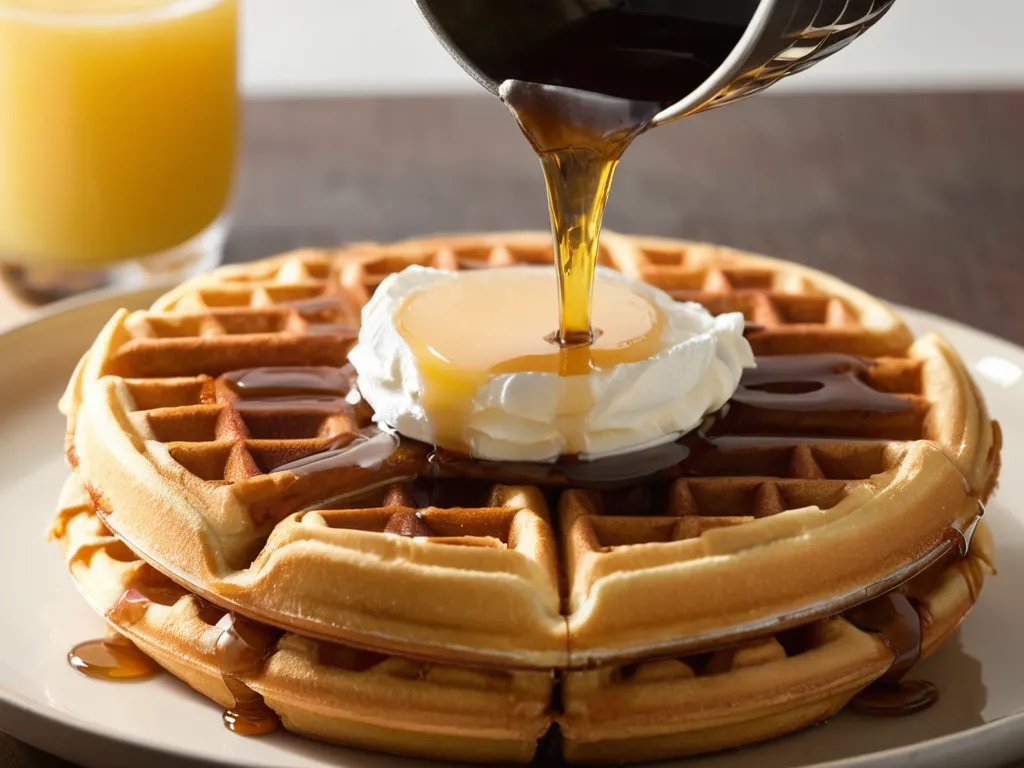
Copycat Waffle House Waffles
Prep time: 15 min (plus 5 min iron preheat) Cook time: 20 min (4–5 min per waffle) Servings: 4 waffles Cost at home: about $1.40 per waffle vs. roughly $4–5 at Waffle House
Waffle House has been making the same waffle since Labor Day weekend 1955, when Joe Rogers Sr. and Tom Forkner opened the first location in Avondale Estates, Georgia. The restaurant turned 70 in 2025. Today there are about 2,000 Waffle House locations across 25 states, and they collectively serve roughly 145 waffles per minute. The waffle has not changed.
The Waffle House waffle is not a Belgian waffle. It is a Southern-style diner waffle: thinner, with a crispy golden edge and a tender (not doughy) interior, and it holds up under a full pour of maple syrup without collapsing. It is a simpler, more workmanlike waffle than the towering Belgian grid — and for that reason, it is arguably more satisfying.
This recipe gets you there with a cornstarch batter and a key technique detail that most copycat recipes miss: beating the egg whites separately.
What Makes Waffle House Waffles Different
Waffle House does not make their waffle batter from scratch in-house. They use “Original Sweet Cream Waffle Mix” from C.H. Guenther & Son, a San Antonio-based milling company founded in 1851. At the restaurant, that dry mix is combined with eggs and half-and-half — not milk. The half-and-half matters: its higher fat content gives the waffle a richer melt-in-your-mouth quality compared to a standard milk-based batter. Waffle House even sells the dry mix directly at shop.wafflehouse.com for home cooks who want the exact product. What is observable is that the result is thin, crispy-edged, and golden throughout — the flavor is subtly sweet, lightly rich, and exactly what you expect a diner waffle to taste like.
Two things drive the result more than any particular batter ingredient:
The iron temperature. Waffle House uses commercial irons that run hotter and hold heat more evenly than home irons. When batter hits a very hot surface, the exterior sears and crisps immediately. When batter hits a less-than-hot surface, it steams first and crisps later — or not at all. This is why preheating your home iron for a full 5 minutes (not 1–2) makes a significant difference.
The butter on the plates. Waffle House uses a small pat of butter on the iron for each waffle — not cooking spray. Butter does two things: it prevents sticking, and it promotes even browning through the fat’s contact with the metal surface. Cooking spray gives you a non-stick surface but a less golden, less flavorful crust.
Why Cornstarch Is the Key Ingredient
Cornstarch works differently than flour in waffle batter. Where flour builds gluten (which creates chewiness and structure), cornstarch is almost pure starch — it absorbs moisture from the batter and swells under heat through a process called starch gelatinization, forming a thin, rigid crust on the exterior of the waffle. It also dilutes the gluten-forming proteins in the flour, producing a more delicate, crumble-at-the-edge texture rather than a leathery or bready one.
The ratio in this recipe — 1/2 cup cornstarch to 1 1/2 cups flour — is a 25% cornstarch substitution. Less cornstarch produces a standard waffle; more starts to taste powdery and faintly chalky. At 25%, you get the crisp exterior without any off-flavor.
This technique applies to any waffle recipe. If you have a waffle recipe you already like, replacing 1/4 of the flour with cornstarch will noticeably improve the crispiness.
The Egg White Technique
Beating the whites separately and folding them in at the end is the difference between a waffle with a light, open crumb and one with a dense, bread-like interior.
Stiff-peaked egg whites are a foam — millions of tiny air bubbles surrounded by protein strands. When you fold that foam into the batter and pour it onto a hot iron, the air bubbles expand rapidly in the heat, creating steam pockets that lift the interior of the waffle. The outside crisps from the iron; the inside stays open and almost soufflé-like.
A few rules for this to work:
- The bowl must be completely clean and dry. Fat (including trace egg yolk) collapses the foam before it forms.
- Fold gently — 10 to 12 passes with a spatula. Aggressive stirring deflates the whites and defeats the purpose.
- Cook immediately after folding. The foam starts to settle within minutes; if you let the batter sit for 15 minutes, the whites will partially deflate and you will lose the effect.
Waffle House Style vs. Belgian Style
Waffle House waffles are made in a standard, shallow-plate waffle iron. Belgian waffle irons have deep pockets and a different batter (often yeasted) that produces a thicker, chewier, softer result. The two are genuinely different products.
If the only waffle iron you own is a Belgian one, this recipe still works — you will just get a thicker waffle. The cornstarch crispiness will be present, and the flavor will be identical. But for a true Waffle House clone, a standard iron is the right tool.
For deep-pocket Belgian waffle variations, there are better recipes optimized for that style. This recipe is specifically tuned for the thin, Southern-style result.
Variations: The Waffle House Menu at Home
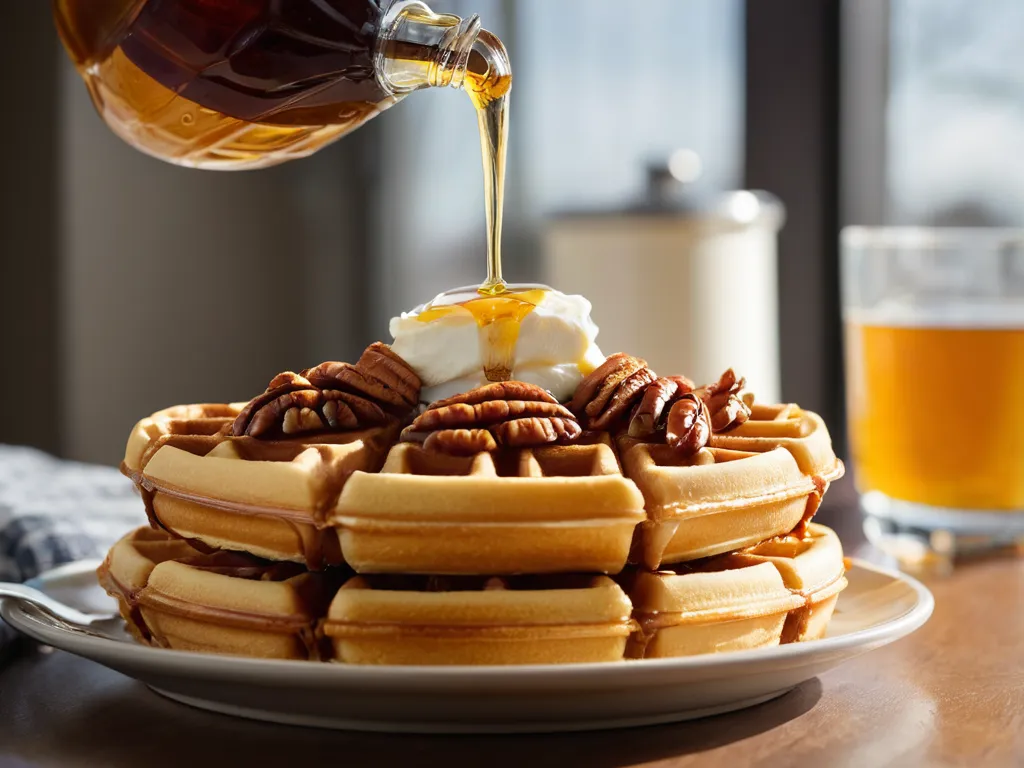
Pecan Waffle: Before closing the iron, sprinkle 2 tablespoons of finely chopped pecans onto the batter after pouring. The pecans press into the waffle and toast against the iron — producing a crunch and a nutty flavor that is the most popular Waffle House waffle variation. See the full Copycat Waffle House Pecan Waffle recipe for the exact technique and pecan-to-batter ratio.
Chocolate Chip Waffle: Fold 3 tablespoons of mini chocolate chips into the batter after adding the egg whites. Mini chips distribute better than regular-sized ones and melt more evenly across the waffle surface.
Blueberry Waffle: Scatter 1/4 cup of fresh or frozen blueberries onto the batter after pouring into the iron. Frozen blueberries work well and release juice into the waffle during cooking — press the lid down gently to avoid overflow.
Plain Waffle (Butter Only): Waffle House serves their plain waffle with a pat of real butter melted into the grid squares. Before adding syrup, add a full tablespoon of butter to the hot waffle and let it melt into the pockets. This is the most traditional way to eat a Waffle House waffle.
The Waffle House Hash Brown Connection
Waffle House is equally famous for its hash browns, ordered in a lingo that has become an institution: scattered (spread thin on the grill), smothered (with sautéed onions), covered (with melted cheese), chunked (with diced ham). The same diner technique that makes the waffles good — high heat, butter, thin spread — applies to the hash browns.
If you are making a full Waffle House diner breakfast at home, the waffles and hash browns complement each other well:
- Copycat Waffle House Hash Browns — the classic thin, crispy griddle-pressed potato
- Copycat Waffle House Smothered Hash Browns — with caramelized onions and melted American cheese
- Copycat Waffle House Pecan Waffle — the sweet, nutty variation of this recipe
Serving and Storage
Serve immediately whenever possible. Waffles lose their crispiness within about 10 minutes of coming off the iron as the interior steam migrates outward and softens the crust. This is unavoidable at home.
Holding a batch: If you are making multiple waffles, place them in a single layer on a wire rack in a 200°F oven. They will stay warm and remain mostly crispy for up to 20 minutes. Do not stack them — stacked waffles steam each other and go soft from the bottom up.
Storing leftovers: Cool waffles completely on a wire rack, then refrigerate in a single layer (or stacked with parchment paper between them) for up to 3 days, or freeze for up to 2 months. A zip-lock bag works for the freezer; press out as much air as possible.
Reheating: A toaster or 375°F toaster oven for 4–5 minutes is the best method. The direct dry heat re-crisps the exterior almost to fresh waffle quality. A microwave heats waffles quickly but makes them soft and slightly gummy — acceptable in a pinch, not ideal.
Cost Comparison
A single original Waffle House waffle runs approximately $5.20 depending on location (prices vary by market). The pecan waffle is about $5.45. Prices have risen in recent years, and in higher-cost markets the original waffle may run closer to $6.
At home, this recipe makes four waffles for roughly the cost of the ingredients:
- All-purpose flour: ~$0.15
- Cornstarch: ~$0.10
- 2 eggs: ~$0.40
- Milk and oil: ~$0.20
- Butter for the iron: ~$0.15
- Vanilla, sugar, leavening: ~$0.10
Total: about $1.10 for four waffles — roughly $0.28 each, or $1.10–1.40 per serving counting syrup and butter. That is savings of about $4 per waffle compared to dining in, or roughly $16 saved on a four-waffle order.
For IHOP-style thick stuffed waffles on the other end of the spectrum, the IHOP Stuffed French Toast uses a similar waffle iron but a completely different (cream-cheese-filled) approach. For a full breakfast centerpiece, the Copycat Denny’s Grand Slam Breakfast covers the complete diner-breakfast lineup — eggs, bacon, pancakes, and hash browns — as a single at-home build.