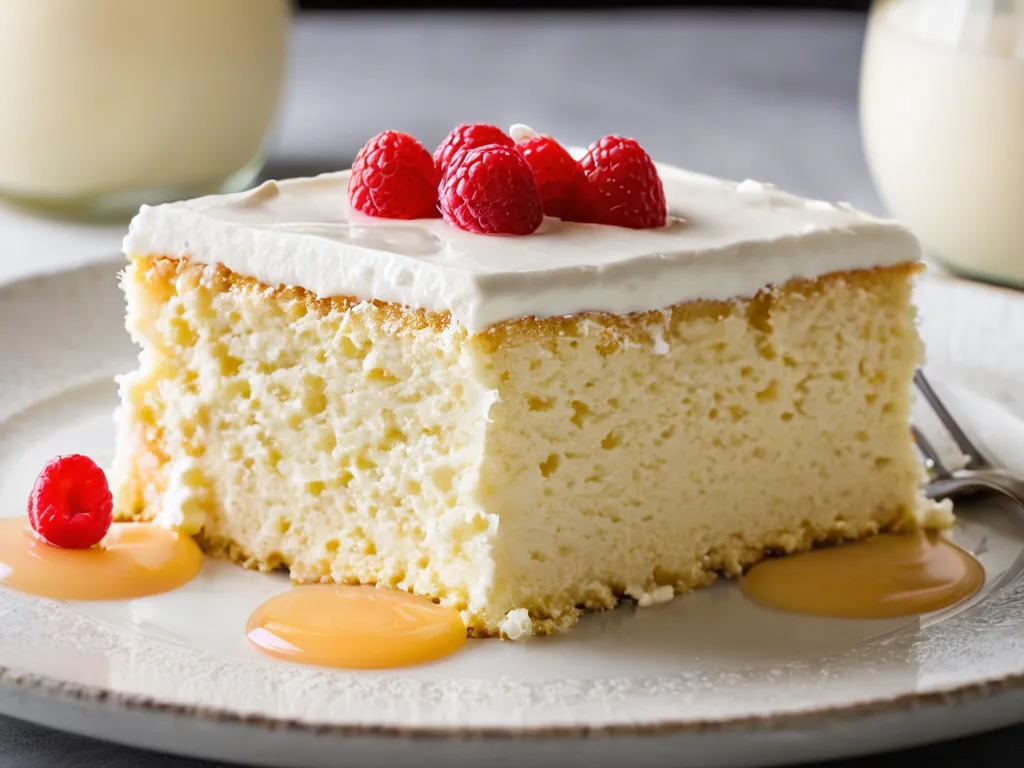
Tres Leches Cake
Prep: 30 min | Bake: 25 min | Soak: 4 hrs minimum (overnight preferred) | Serves: 12 | Cost: ~$12 for the whole pan
Like the viral TikTok churro mug cake, tres leches earned its TikTok fame for one specific moment: the pour. Watching three different milks disappear into a pierced sponge cake — the liquid drawn in as if the cake is drinking — is the kind of content that people watch on repeat. But what the videos don’t always show is the technique underneath: without an airy sponge built on beaten egg whites, the cake doesn’t absorb properly. You get soggy where it should be custardy, dense where it should be light.
Done right, tres leches is one of the most forgiving party desserts there is. It’s made entirely in advance, serves a crowd from one dish, and gets better the longer it sits. The actual work is about 30 minutes. The rest is waiting.
Where Tres Leches Comes From
The origin of tres leches is genuinely disputed — Mexico and Nicaragua have the strongest documented claims, with Cuba and several other countries also in the running. Mexico points to soaked cake recipes in Oaxaca and other regions going back to the 19th century. Nicaragua argues for a more modern version: the 1936 U.S.–Nicaragua trade agreement reduced tariffs on American dairy products, which made condensed and evaporated milk widely available there. By the mid-20th century, Nestlé and other dairy companies printed the recipe on the backs of condensed milk cans to promote the product throughout Latin America. The combination of three shelf-stable milks made it practical in regions where fresh dairy was scarce or refrigeration unreliable.
No single origin is confirmed by primary sources. What food historians agree on is that the recipe as we know it — sponge cake, three-milk soak, whipped cream topping — was industrialized and spread through the region largely because canned dairy companies had every incentive to put a recipe on the label. From there it spread to Mexican-American communities in the United States, where it became a bakery staple by the 1980s.
Why the Sponge Cake Is Non-Negotiable
The single most important decision in tres leches is the cake. Not the milk mixture — the cake.
Most cakes use fat (butter, oil) as their primary tenderizing agent. Fat coats the flour proteins and prevents them from developing too much gluten, which makes the crumb tight and closed. That closed crumb resists liquid. Pour three milks over a box-mix butter cake and the liquid pools on top, makes the surface a soggy mess, and never reaches the center.
A tres leches sponge uses beaten egg whites instead. The process works like this: egg yolks are beaten with most of the sugar until pale and thick, the flour is folded in, and then separately beaten egg whites are folded into the batter. Those beaten whites contain thousands of tiny air bubbles — each one a small pocket in the cake structure. When the cake bakes, those air cells set into an open, porous crumb that acts like a sponge. When you pour the three-milk mixture over, it fills those cells evenly throughout the entire cake, from top to bottom.
The difference between a well-made tres leches and a disappointing one is almost always the egg whites. Beat them to stiff peaks — not soft peaks, not foamy, but fully stiff and glossy. And fold them gently; three or four streaks of white in the batter are fine. Overmixing knocks out the air structure you just built.
The Three Milks, Explained
The standard soak uses:
- Sweetened condensed milk (1 can, 14 oz): concentrated, very sweet, extremely thick. This provides the richness and most of the sweetness. Without it, the soak tastes thin.
- Evaporated milk (1 can, 12 oz): milk with 60% of its water removed, slightly caramelized during processing. It adds a faint cooked-dairy depth and thins the condensed milk enough to pour evenly.
- Heavy cream (1 cup): pure fat richness. This is what makes the soak feel smooth and luxurious rather than just sweet and milky.
Combined, you get about 3.5 cups of soak for a 9x13 inch cake — substantially more liquid than feels right when you pour it. That’s correct. The cake absorbs most of it; the remainder pools in the dish and keeps the bottom moist.
Some recipes add rum (2 tablespoons is typical) or vanilla to the soak. The rum is a Nicaraguan influence and optional; the vanilla is standard and worth including.
The Pierce and Pour Technique
Two variables determine whether the soak absorbs evenly:
Temperature of the cake when you pour. Warm cake (10–15 minutes out of the oven) absorbs the soak better than cold cake. The crumb structure is still slightly relaxed, and the residual heat creates a mild convection that draws liquid inward. Refrigerated cake is more contracted and absorbs more slowly and unevenly. Pierce while warm, pour while warm.
Number and depth of holes. Use a skewer, fork, or chopstick. Poke deep — all the way to the bottom — and make 30 to 40 holes spaced roughly an inch apart across the entire surface. Fewer holes mean the soak channels toward the openings and leaves dry patches between them. More holes mean more even distribution. You can’t over-pierce a tres leches cake.
Pour the milk mixture in a slow, steady stream across the entire surface so it distributes evenly before soaking in. Don’t dump it all in one spot. Let the cake sit at room temperature for 20 minutes — you’ll see the surface visibly absorb the liquid — then refrigerate.
The Whipped Cream Topping
Plain lightly sweetened whipped cream is the traditional Mexican topping. It’s correct: any richer topping (frosting, cream cheese, ganache) overpowers the delicate milk-soaked cake underneath.
The one modification worth making is stabilization. Standard whipped cream begins to weep and separate within 2–3 hours, especially when sitting on top of a very wet cake. Adding ¼ cup of powdered sugar (instead of granulated) gives the cream a slight stabilizing boost from the cornstarch already in powdered sugar. If you need the topped cake to hold for more than 4 hours, add ½ teaspoon cream of tartar or 1 tablespoon instant vanilla pudding powder while whipping.
Beat cold cream in a cold bowl to medium-stiff peaks — the cream should hold its shape when you lift the beater but not be grainy. Overwhipped cream has a chunky, slightly greasy texture that spreads unevenly.
Dust generously with ground cinnamon — the same warm-spice finish that defines a lot of classic Mexican cooking. A drizzle of cajeta (Mexican goat’s milk caramel) or dulce de leche across the top adds visual contrast and works with the flavor without overwhelming it.
Regional Variations
Nicaraguan version: Instead of whipped cream, Nicaraguan tres leches is traditionally topped with toasted meringue — beaten egg whites with sugar, similar to a marshmallow frosting. The lighter, airier topping contrasts with the heavy soak below in a different way than whipped cream does.
Cuban version: Also commonly uses meringue (Italian meringue — hot sugar syrup streamed into whipping whites — or Swiss meringue). Cuban versions sometimes call this technique a “suspiro” finish. Some Cuban recipes add rum to the milk soak as well.
Puerto Rican version: Rum in the milk mixture is a Puerto Rican signature — typically 2–3 tablespoons of light rum added to the soak. Some versions also use coquito flavors (coconut, cinnamon, vanilla) or substitute Media Crema (a shelf-stable cream product widely available in Latin grocery stores) for the heavy cream.
Oaxacan version: A few Oaxacan bakers substitute mezcal-infused cream for one of the three milks, giving the soak a subtle smoky complexity that works surprisingly well against the sweetness.
Restaurant versions: High-end Mexican restaurants often add a touch of cajeta (Mexican goat’s milk caramel) to the soak itself — not just as a garnish — which adds a faint bitter-caramel undertone. A few pastry chefs use crème fraîche in place of heavy cream for more tang.
Common Mistakes
Dense, unabsorbent cake. Egg whites not beaten to stiff peaks, or the whites were overmixed after folding. Both deflate the air structure the sponge depends on. You’re looking for stiff, glossy peaks that hold shape when you lift the beater — not floppy soft peaks.
Soggy bottom, dry top. The soak was poured over cold cake, or not enough holes were made. Pierce deeply and generously, pour while warm, and give it at least 4 hours.
Watery pools at the bottom of the dish. Usually means the cake was too dense and couldn’t absorb the full soak volume, so the excess liquid sits in the dish. Serve these pieces from the bottom with a slotted spatula; they’re still edible, just wetter.
Weeping whipped cream. Unstabilized whipped cream on a wet surface separates within a couple of hours. Add ¼ cup powdered sugar (not granulated) while whipping, or stabilize with cream of tartar. Add the cream topping no more than 4 hours before serving.
Cake tastes flat. The milk mixture is sweet but not complex on its own. Don’t skip the vanilla in both the cake batter and the soak — it’s the flavor bridge that makes everything cohesive.
Storage
Refrigerate the soaked cake (without whipped cream) for up to 3 days, loosely covered. With whipped cream, serve within 2 days. Do not freeze — the high liquid content forms ice crystals that tear the crumb structure, and the soak separates and pools when thawed rather than staying absorbed.
This is an ideal make-ahead party dessert: soak it the night before, add whipped cream the morning of the event, serve cold.
Cost vs. Bakery
A slice of tres leches at a Mexican bakery or restaurant runs $5–8. A full 9x13 cake at home — serving 12 — costs about $12 in ingredients (eggs, flour, two cans of dairy, heavy cream). That’s about $1 per serving versus $5–8. For a party, the economics are hard to argue with.
Related Recipes
- Viral TikTok Churro Mug Cake — another cinnamon-forward dessert that went viral, ready in minutes when you don’t have hours to soak a cake.
- 5 Essential Spices for Mexican Cuisine — the cinnamon, vanilla, and warm-spice backbone behind tres leches and most of the desserts above.
- Copycat Taco Bell Mexican Pizza — round out a Mexican-themed spread with a savory crowd-pleaser to serve before the cake.