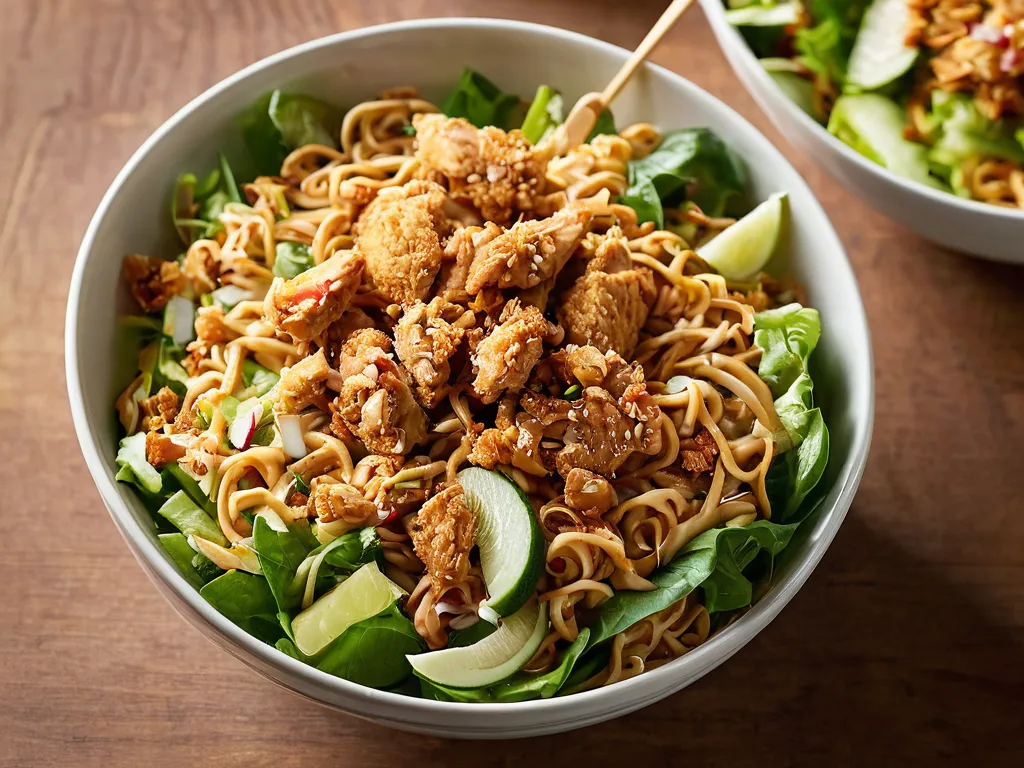
Most copycat recipes for Applebee’s Oriental Chicken Salad make the same mistake: they assume the dressing is a sesame-ginger vinaigrette. It isn’t.
The actual Applebee’s “Oriental Vinaigrette” is a sweet, mayo-based dressing — closer to a honey-mustard sauce than a sesame vinaigrette — with just a small amount of sesame oil used as an accent, not the base. That misunderstanding explains why so many copycat versions taste close but not quite right. This guide gets it right.
TL;DR
Make the dressing: 1/4 cup mayo + 3 tablespoons honey + 1.5 tablespoons rice wine vinegar + 1 teaspoon Dijon mustard + 1/8 teaspoon toasted sesame oil. It’s a creamy, sweet dressing — not a sharp vinaigrette. Bread chicken strips in seasoned flour, egg, and crushed cornflakes. Fry at 350°F until golden. Toss romaine, napa cabbage, red cabbage, and carrots with dressing. Top with chicken, toasted almonds, and crispy chow mein noodles right before serving.
The Dressing: Why Every Other Recipe Gets It Wrong
Search for “Applebee’s oriental chicken salad copycat” and you’ll find dozens of recipes listing the same dressing: rice vinegar + soy sauce + toasted sesame oil + honey + ginger. It’s a reasonable guess — those ingredients read as “Asian-inspired.” But that’s not what Applebee’s actually serves.
The restaurant’s dressing is called “Oriental Vinaigrette” on the menu, and it is mayo-based. The Todd Wilbur clone (from Top Secret Restaurant Recipes 3, his most thorough entry on this dish) nails the profile: mayonnaise is the base, honey is the dominant sweetener, rice wine vinegar provides the tang, Dijon mustard adds structure and a hint of sharpness, and sesame oil appears in a tiny amount — just enough to register as a background note.
The key proportions:
- 1/4 cup mayonnaise — the creamy base
- 3 tablespoons honey — the dominant flavor; this is a sweet dressing
- 1 1/2 tablespoons rice wine vinegar — the tang that prevents it from being cloying
- 1 teaspoon Dijon mustard — structure and a slight sharpness
- 1/8 teaspoon toasted sesame oil — accent only; any more overwhelms
This makes a completely different dressing than the oil-forward versions online. The result is sweet and creamy with a mild tang — less about Asian umami flavors and more about a honey-mustard-style sweetness that happened to include sesame as a quiet note.
Scale this up for a batch (4x, makes about 2 cups): 1 cup mayo, 3/4 cup honey, 6 tablespoons rice wine vinegar, 4 teaspoons Dijon, 1/2 teaspoon sesame oil.
A Note on the Name
As of 2026, Applebee’s still calls this the “Oriental Chicken Salad” on their official menu, with “Oriental Vinaigrette” as the dressing name. A 2021 petition requesting a rename to “Asian Chicken Salad” got very limited traction. Many recipe blogs voluntarily retitled their copies with “Asian” in the headline — which is why both names appear in search results. The restaurant hasn’t changed the name.
This matters for the recipe: Applebee’s also still calls the dressing “Oriental Vinaigrette,” which is useful for tracking down the right version when researching.
The Crispy Chicken: Cornflakes Are the Difference
Applebee’s crispy chicken uses a coating that’s slightly different from standard fried chicken: crushed cornflakes combined with flour. Todd Wilbur’s research on the recipe confirmed cornflakes rather than breadcrumbs or panko. The cornflake crust is what gives the chicken strips their specific shattering crunch — it’s crispier and slightly rougher in texture than a panko crust, and it holds up slightly better against the dressing.
To do it at home:
- Crush cornflakes in a zip-top bag with a rolling pin until mostly fine with some small pieces remaining — about 1 cup uncrushed flakes crushes to about 3/4 cup coating
- Set up three stations: seasoned flour, beaten egg, crushed cornflakes
- Dredge chicken strips fully through each stage (flour → egg → cornflakes), pressing firmly in the last step so the coating adheres
- Fry at 350°F — this is lower than many fried chicken recipes. The goal is a fully cooked interior before the crust burns; cornflakes brown faster than panko at high heat
Panko is a fine substitute. If you want to skip the cornflakes, standard panko gives an excellent crust — slightly less distinct in texture but still noticeably crunchy against the soft greens.
For grilled chicken: Season with salt, garlic powder, and black pepper. Grill or pan-sear at medium-high for 5 to 6 minutes per side. Pull at 165°F internal. Slice thin against the grain. This is the lighter version — and if you also reduce the dressing, it’s a genuinely reasonable weeknight salad.
The Greens: Romaine + Napa Cabbage, Not Mixed Greens
Applebee’s base is a mix of romaine lettuce and napa cabbage, with shredded red cabbage and shredded carrots for color and crunch. The napa cabbage is mild enough that it adds body without overpowering the sweet dressing the way stronger cabbages (savoy, green cabbage) can.
Many home recipes default to “mixed greens,” which changes the salad’s texture and flavor significantly — baby spinach and arugula have strong flavors that compete with the dressing, and they wilt faster. Stick with romaine and napa cabbage if you want the salad to taste like the restaurant version.
The Chow Mein Noodles
Applebee’s uses crispy chow mein noodles — the shelf-stable, pre-fried kind in the canned goods aisle (La Choy is the most widely available brand). These are not the same as wonton strips. Chow mein noodles are thin, dense, and oily-crunchy with a mild wheat-and-oil flavor. Wonton strips are wider, puffier, and more neutral in flavor.
Either works in this recipe. Chow mein noodles are the more accurate choice. Both need to be added right before serving — they start going soft within a few minutes of hitting the dressed greens.
The Almonds
Toast them. Raw sliced almonds taste grassy and bland against the sweet dressing. A 2 to 3 minute dry-toast in a skillet brings out oils and a roasted character that complements the honey in the dressing.
Don’t walk away while they’re toasting. Sliced almonds have a large surface area and go from perfectly golden to bitter-burnt in under 60 seconds at the wrong moment.
Nutrition: Restaurant vs. Homemade
The restaurant version is calorie-dense — most of it lives in the fried chicken and the generous pour of sweet dressing. Making it at home with a lighter hand on the dressing (and grilled chicken, if you want) cuts the count substantially.
| Version | Calories | Fat | Carbs | Protein |
|---|---|---|---|---|
| Applebee’s crispy + dressing | ~1,440 | 97g | 110g | 36g |
| Applebee’s grilled + dressing | ~1,310 | 84g | 94g | 51g |
| Applebee’s grilled, no dressing | ~589 | — | — | — |
| This recipe (crispy, lighter dressing) | ~720 | 38g | 58g | 36g |
Restaurant figures are per full entrée order; the homemade figure is per serving (recipe makes 4). The single biggest lever at home is the dressing portion — halving it from the restaurant’s pour saves roughly 150 to 200 calories per plate without making the salad taste dry.
Make-Ahead Notes
- Dressing: Keeps refrigerated for up to 5 days. May thicken — let it rest 5 minutes at room temperature and whisk before using.
- Toasted almonds: 3 days ahead in an airtight container.
- Greens and vegetables: Washed, dried, and stored in a salad spinner up to 2 days ahead.
- Fried chicken: Best fresh, but reheats in a 400°F oven for 8 minutes on a rack without losing too much crunch. Not suitable for microwave reheating.
Serving Applebee’s Style
The restaurant serves this with a garlic breadstick on the side — a detail most copycat recipes omit. A quick garlic bread (butter + garlic powder on a hoagie roll, broiled 2 minutes) takes about 3 minutes and makes the plate feel complete.
For more Applebee’s classics, see Applebee’s Chicken Wonton Tacos, Applebee’s Honey Pepper Chicken, and Applebee’s Fiesta Lime Chicken. For the spinach artichoke dip, see Applebee’s Spinach Artichoke Dip.