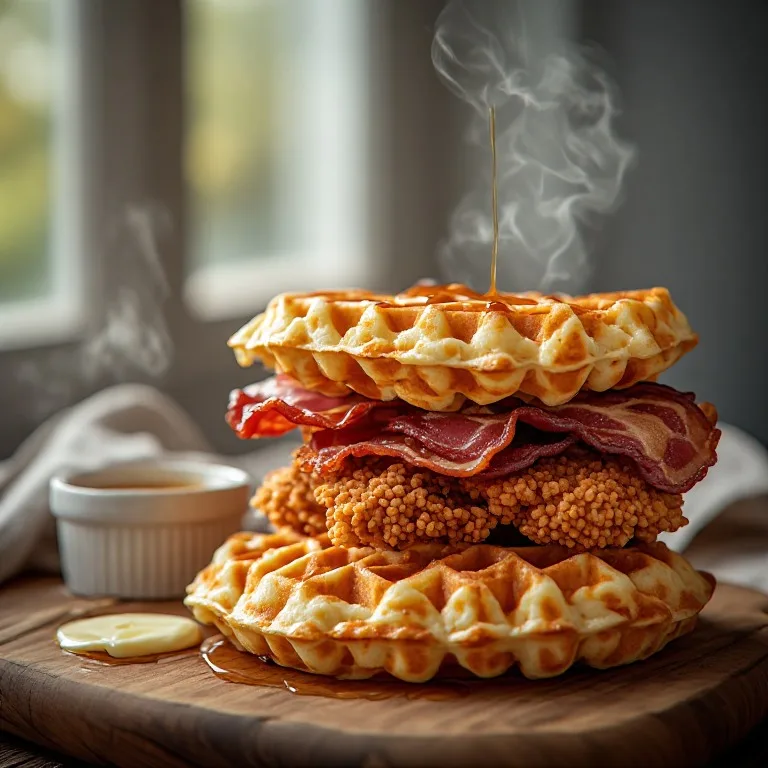


Chick-fil-A launched the Chicken & Waffles Sandwich nationwide on August 24, 2026 as a fall limited-time item (running through November 14, 2026), and it does something most fast-food chicken-and-waffles misses: the waffle is the bread, not a side. There is no plate with a separate waffle. The maple waffle is structural — it holds the chicken, bacon, and honey butter the same way a bun does, and it is engineered to stay that way.
Getting this right at home comes down to two things. The waffle needs to be firm enough not to collapse the moment you pick up the sandwich. The chicken needs to be juicy at the center despite having a crispy crust that can survive 90 seconds of contact with the waffle. Everything else — the honey butter, the applewood bacon, the syrup — is easy.
Why the Waffle Technique Matters
Most waffle recipes optimize for a light, airy interior — great for syrup-soaked breakfast waffles, wrong for a sandwich. A waffle that is soft inside will compress under the weight of a chicken filet, three strips of bacon, and honey butter within 60 seconds, then tear when you bite it.
CFA’s maple waffle is yeast-raised in their production process, which gives it a chewier, more bread-like structure. At home, the closest equivalent is separating the eggs and folding in beaten egg whites — the air incorporated into the whites creates lift without sacrificing structure once the waffle is fully cooked.
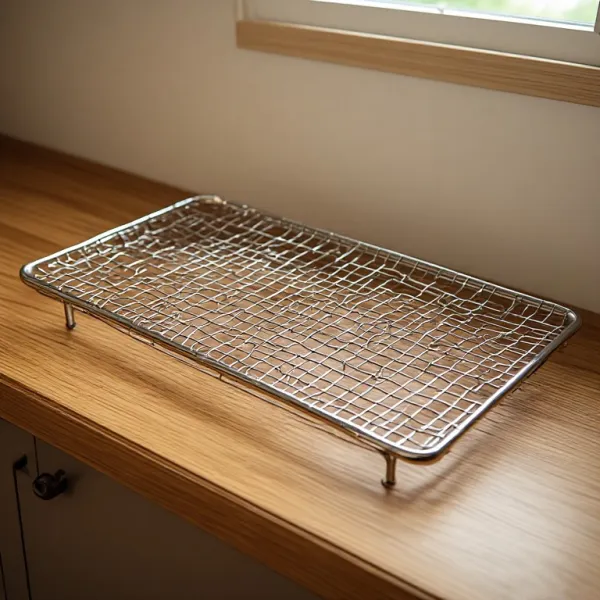
Two other details: cook to deep golden brown (the waffle needs a proper crust, not just a color), and rest on a wire rack for at least 2 minutes after cooking. The steam that escapes during those 2 minutes is what was making the exterior soft. A waffle rested on a rack is noticeably stiffer than one rested on a plate, where trapped steam works against you.
The Pickle Brine Marinade
CFA’s chicken is marinated in pickle juice and milk. This is documented in the company’s marketing and has been independently tested by enough food writers that it is no longer a secret. The pickle juice seasons the meat through osmosis and keeps it moist during frying; the milk proteins begin the denaturing process that helps the flour coating adhere.
Thirty minutes is the minimum. Four hours is better — the seasoning penetrates deeper and the texture is noticeably more even through the cross-section. If you have time, marinate overnight in the refrigerator, then take the chicken out 20 minutes before breading so it fries closer to room temperature (cold chicken drops oil temperature more sharply and extends fry time, often resulting in a pale crust).
Powdered Milk: The Browning Shortcut
The seasoned flour for the crust includes 2 tablespoons of powdered milk. This is not a standard addition in home fried chicken recipes, but it is the most practical way to replicate the consistent golden-brown color CFA achieves through pressure frying. The lactose in powdered milk browns at a lower temperature than starch, giving you deep, even color before the interior overcooks.
You do not need a lot — 2 tablespoons per 1.5 cups of flour is enough to shift the browning behavior meaningfully. Find it in the baking aisle next to evaporated milk and condensed milk. Carnation and Nido are both reliable.
The Three Filet Variations
Original: CFA-style pressure-fried chicken breast. At home, a Dutch oven with 2 inches of peanut oil at 350°F does the same job in 4 to 5 minutes per side. The crust develops the same savory, lightly peppery flavor that makes CFA’s chicken recognizable.
Spicy: Same technique, same crust, but with cayenne and chili powder added to the flour. The heat is in the breading, not in a sauce — which means it distributes evenly across every bite rather than pooling at one spot. The maple syrup served on the side plays directly against the heat in a way that makes the Spicy version arguably the most interesting of the three.
Grilled: The simplest version to make at home. Same pickle brine marinade, but instead of breading and frying, you dry the chicken, brush with oil, and cook on a cast-iron grill pan. The grill marks do the visual and textural work the crust does in the fried versions. It is lighter (540 calories at CFA versus 690 for the Original) and pairs equally well with the maple waffle — the cleanness of the grilled chicken actually lets the waffle and honey butter be more present.
Honey Butter
This is not compound butter with 10 ingredients. Softened butter and honey, beaten together. The ratio is 2 parts butter to 1 part honey by volume. The butter needs to be genuinely softened — not melted, not cold. If it is melted, it will separate from the honey and soak into the waffle rather than sitting on it as a spread. Beat with a fork for 30 seconds; the mixture should look pale and slightly fluffy.
Spread it on the inner face of each waffle, not on the chicken. The honey butter should be the last layer before the waffles close.
Assembly Order and Timing
Build the sandwich immediately before eating. Do not assemble in advance.
From the bottom waffle up: honey butter on the inner face of the bottom waffle, chicken filet, three bacon strips overlapping across the chicken, honey butter on the inner face of the top waffle, top waffle pressed down gently. The honey butter faces inward on both waffles — it acts as a partial moisture barrier and distributes the sweetness across both bites.
Serve with maple syrup in a small cup on the side rather than drizzled over the sandwich, which makes it impossible to eat without both hands and a pile of napkins. The syrup-to-bite ratio is a personal decision best made bite by bite.