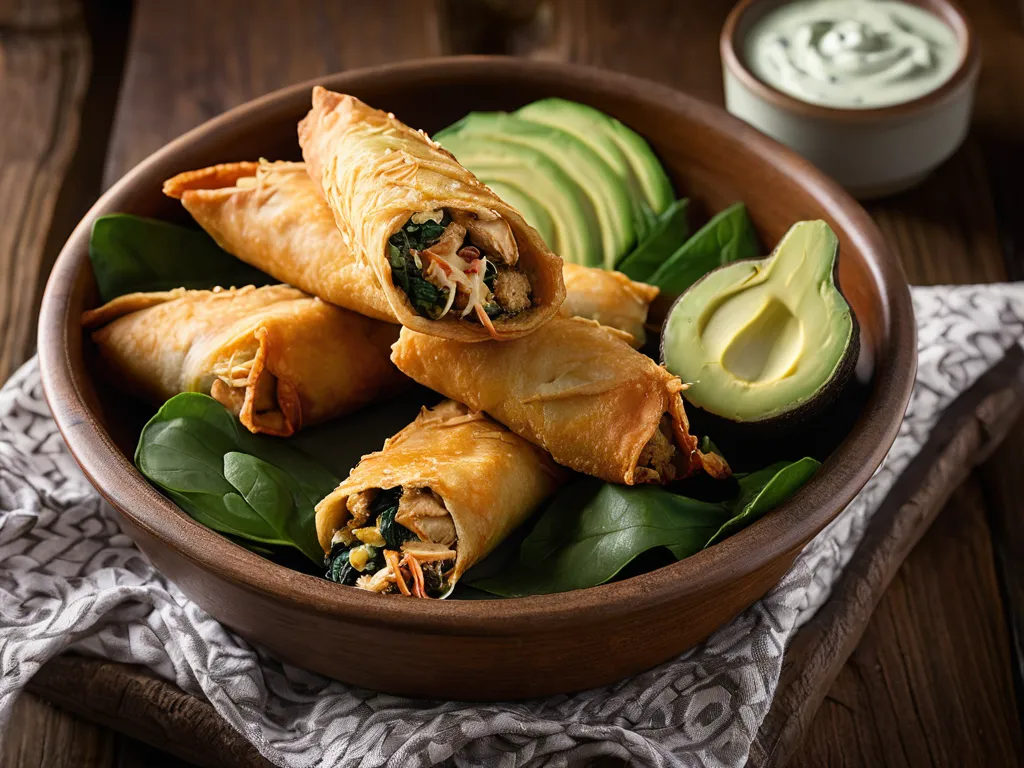
Chili’s Southwestern Eggrolls (Copycat)
Prep time: 25 minutes (plus 20 minutes chilling) Cook time: 20 minutes Servings: 6 eggrolls (12 halves)
Chili’s Southwestern Eggrolls are not eggrolls. They are burrito-shaped fried flour tortillas stuffed with a Tex-Mex chicken filling, and they have been one of the most-ordered appetizers on the Chili’s menu since the 1990s. The naming is pure marketing — the “eggroll” shape (a tight cylinder, fried golden) borrowed the format from Asian cuisine and applied it to Southwestern flavors at a moment when fusion was profitable. The restaurant still serves them today, and they still sell.
There are two things most copycat recipes get wrong: they leave out the spinach (Chili’s uses it; it adds color and mild earthiness), and they make the wrong dipping sauce. The sauce is not Sriracha-ranch or honey-mustard — it’s an avocado-ranch blend, which is creamier, cooler, and genuinely better with the smoky filling than any of the hot-sauce alternatives. Both fixes make the home version noticeably closer to the restaurant.
TL;DR: Chicken, black beans, corn, spinach, and jalapeño Jack rolled tight in flour tortillas. Freeze 20 minutes before frying. Serve with blended avocado-ranch. Total time: about 50 minutes.
Why “Eggrolls” — and Why Flour Tortillas
Chili’s launched Southwestern Eggrolls in the mid-1990s as part of a wave of casual-dining fusion that combined Tex-Mex flavors with the crispy-fried format of Chinese-American egg rolls. At the time, chain restaurants were racing to capture the “adventure” of international food in familiar, dippable packaging.
The actual wrapper is a standard burrito-size flour tortilla, not a traditional eggroll wrapper. Eggroll wrappers — made from wheat flour, water, and egg, rolled extremely thin — fry up to a very different texture: lighter, more crackerlike, with visible blisters. Flour tortillas fry thicker, with a slightly chewy interior layer under the crispy exterior. That textural difference is part of what defines the Chili’s version, and it is why using actual eggroll wrappers (even if you could) would produce a different — and less right — result.
The Filling: What Chili’s Actually Puts Inside
The filling Chili’s uses includes:
- Smoked chicken — seasoned, not plain poached. Rotisserie chicken is the best shortcut; leftover grilled chicken with any char is also excellent. Plain boiled chicken makes the filling taste flat.
- Black beans — rinsed and very well drained. Excess liquid from the can makes the filling wet, which steams the tortilla from inside and causes sogginess.
- Corn — frozen kernels, thawed and patted dry. Canned corn works but is wetter.
- Red bell pepper — diced small (about 1/4 inch). Raw is fine; the frying time and the residual heat from the cooked chicken are enough to soften it.
- Green onions — both the white and green parts. They add freshness and mild onion flavor without the bite of raw yellow onion.
- Spinach — this is the ingredient most copycat recipes skip. Chili’s includes finely chopped spinach in the filling; it wilts into the mixture and adds mild earthiness and green color. Fresh spinach, finely chopped, is best. Frozen spinach works if it is squeezed completely dry — even one tablespoon of excess moisture ruins the filling.
- Jalapeño Jack cheese — this is what Chili’s actually uses, and it matters. Plain Monterey Jack is the most common copycat substitution, but jalapeño Jack adds a mild, background heat that is built into the filling flavor, not an add-on. It melts at the same low temperature as Monterey Jack and won’t compete with the cumin and chili powder — it just makes the filling subtly hotter.
The seasoning: Cumin is the dominant note, followed by chili powder and smoked paprika. Smoked paprika specifically — not regular paprika — gives the filling the subtle smokiness you notice in the restaurant version. The difference between regular and smoked paprika is pronounced enough here to notice.
The Technique: Why Chilling Before Frying Matters
The single most important technique in this recipe is chilling the assembled eggrolls before they hit the oil.
When a warm eggroll goes into hot oil, several things happen at once: the filling creates steam, the tortilla softens briefly before the exterior crust sets, and the seam — which is under tension from the tight roll — tends to open. The result is oil getting inside the filling, the eggroll unfurling, or both.
When a cold eggroll goes into hot oil: the filling is firm, the seam is set, and the exterior starts crisping almost immediately. The tortilla goes from cold to crispy without a long softening phase in between.
20 minutes in the freezer (or 45 minutes in the fridge) is enough. You don’t need to freeze them solid — just cold enough that the filling is firm and the seam has tightened.
Securing the seam with egg wash rather than water also helps. Water creates a weak bond that the oil can break. Beaten egg acts more like glue and holds under the thermal stress of frying.
Oil Temperature: 350°F Is Not Optional
Frying temperature matters as much as rolling technique.
At 325°F, the flour tortilla absorbs oil before the outside crisps — you get greasy, soggy eggrolls. The tortilla needs the initial blast of heat to immediately start forming a crust rather than soaking.
At 375°F and above, the outside of the tortilla burns before the interior heats through, and the cheese won’t have time to melt fully.
350°F is the sweet spot. A candy or fry thermometer is the reliable way to know — oil doesn’t give reliable visual cues until it’s significantly over or under temperature.
Fry in batches of 2–3, no more. Adding too many eggrolls at once drops the oil temperature sharply. Between batches, let the oil come back to 350°F before the next round.
The Avocado-Ranch Dipping Sauce
Chili’s serves their Southwestern Eggrolls with an avocado-ranch dipping sauce, and this sauce is not an afterthought. It is the dish.
The coolness and fat of the avocado against the hot, crispy eggroll is a deliberate textural and temperature contrast. Ranch dressing on its own is fine but one-dimensional. The avocado thickens it, reduces the vinegary sharpness, and adds a richness that cuts the heat of the spiced filling.
To make it:
Blend until smooth:
- 1/2 cup ranch dressing (any brand; Hidden Valley is the most common)
- 1 ripe avocado (must be soft — if the avocado is underripe, the sauce will be chunky and slightly bitter)
- Juice of 1 lime
- 1/4 teaspoon garlic powder
- 2 tablespoons fresh cilantro (optional, but it adds brightness)
- Pinch of salt
The lime juice serves a dual purpose: flavor (acidity balances the fat) and color preservation (it slows the browning reaction in the avocado). Cover the sauce with plastic wrap pressed directly against its surface and refrigerate — the sauce holds well for 4–6 hours before it starts to discolor.
If you want it spicier, add 1 teaspoon of pickled jalapeño brine to the blender. It adds heat and a tangy, vinegary note that works well with the avocado.
Baked and Air Fryer Versions
Both methods produce genuinely good results — not identical to deep-fried, but legitimately crispy.
Air fryer: 400°F for 12–14 minutes, flipping at 7 minutes. Brush all sides with a thin coat of vegetable oil before cooking. The result is a tight, evenly browned crust with a slight crunch that holds for 10–15 minutes after cooking.
Oven: 425°F for 18–20 minutes, flipping once at the 10-minute mark. Line a baking sheet with a wire rack rather than parchment — airflow underneath prevents the bottom from steaming instead of crisping. Brush with oil before cooking.
In both methods, the freezer step is even more important than it is for frying. There is no immediate blast of 350°F oil to set the seam — the heat ramps up more slowly, and a warm, loose eggroll will open in the oven. Freeze for at least 20 minutes.
Freezing and Meal Prep
These are excellent make-ahead appetizers.
Before cooking: Assemble and freeze solid on a parchment-lined sheet (about 2 hours), then transfer to a zip-lock bag. They keep frozen for up to 3 months. Cook from frozen: fry at 350°F for 5–6 minutes (they need a bit more time to heat through), or air-fry at 390°F for 15–16 minutes.
After cooking: Cool completely, then freeze on a sheet before transferring to a bag. Reheat in an air fryer at 375°F for 4–5 minutes. They come back surprisingly close to fresh — the exterior re-crisps and the filling reheats through at the same time.
Do not reheat in the microwave. Microwaving makes the flour tortilla soft and chewy, and there is no way to recover the crunch.
Common Mistakes and How to Avoid Them
Overfilling: More than 1/2 cup of filling per tortilla makes tight rolling impossible. The seam will split. Under-filling is far less of a problem than over-filling.
Wet filling: Moisture is the enemy. Drain the black beans thoroughly. Pat the thawed corn dry. If using frozen spinach, press it in a clean kitchen towel and wring it until no more liquid comes out. One tablespoon of excess liquid inside a flour tortilla becomes steam that makes the tortilla soggy from inside.
Skipping the chill: Warm eggrolls unravel in the oil. This is not a maybe — it happens reliably. The 20-minute freezer step is not optional.
Wrong oil temperature: Use a thermometer. Eye-balling the oil temperature is the most common reason for greasy eggrolls.
Cooling them on a flat plate: Steam from the hot filling collects under the eggroll and softens the bottom. Rest them on a wire rack or paper towels that allow airflow.
Variations
Pepper jack instead of jalapeño Jack — hotter than jalapeño Jack, same easy melt. The visible jalapeño pieces in pepper jack add visual interest; the flavor profile is similar, just more assertive.
Add black olives — some Chili’s locations and earlier menu versions included diced black olives in the filling. They add a mild brininess.
Smoked chicken shortcut — season shredded rotisserie chicken with 1/2 teaspoon liquid smoke, 1 teaspoon cumin, and 1/2 teaspoon smoked paprika and toss to combine. This approximates the flavor of smoked chicken without smoking anything.
Vegetarian version — swap the chicken for 1 cup of frozen edamame (thawed) plus 1/2 cup of finely diced mushrooms sautéed until browned. The mushrooms provide a savory, meaty note and the edamame adds protein.
Cost Comparison
| Chili’s restaurant | Homemade | |
|---|---|---|
| Price | ~$13–14 for 6 eggrolls | ~$9–10 for 12 eggrolls (2 batches) |
| Per piece | ~$2.20 | ~$0.80 |
| Dipping sauce | Avocado-ranch included | Homemade (costs ~$1 in ingredients) |
| Time | 0 | ~50 minutes active + 20 min chill |
| Freezer-ready batch | No | Yes — make double, freeze half |
The cost difference is meaningful if you’re making these for a group. A full restaurant order covers 6 people as an appetizer portion; a double batch at home covers the same table for about the same price as two restaurant orders.
Storage
Leftover cooked eggrolls: Refrigerate in an airtight container for up to 3 days. Re-crisp in an air fryer at 375°F for 3–4 minutes. They will not fully recover their original crunch, but they are still good.
Leftover avocado-ranch: Refrigerate covered (plastic wrap pressed directly on the surface) for up to 24 hours. After that, the avocado begins to discolor and the flavor deteriorates. Make only what you need.
Leftover filling (unrolled): Refrigerate for up to 3 days. It makes excellent burrito filling, quesadilla filling, or a topping for nachos.
If you’re building out the Chili’s menu at home, the Skillet Queso is the other signature appetizer — a creamy béchamel-based cheese dip that pairs well alongside these eggrolls for a full starter spread. The Cajun Chicken Pasta uses a similar Southwestern spice profile (cumin, chili powder, smoked paprika) and is a natural companion if you’re doing a Chili’s-themed dinner. For a different take on the fried appetizer category, the Cheesecake Factory Avocado Egg Rolls use actual eggroll wrappers and a sun-dried tomato dipping sauce — an interesting comparison for how different the two formats fry up.