Pin It

Copycat McDonald's Hotcakes — The Real Recipe (Plus the Syrup Secret)

Copycat McDonald's Hotcakes — The Real Recipe (Plus the Syrup Secret)
Jump to Recipe
Prep 10 min Cook 15 min Serves 4
Quick answer: McDonald's hotcakes use a batter containing enriched flour, corn flour, whey, eggs, soybean oil, and triple leavening agents (baking soda, sodium aluminum phosphate, monocalcium phosphate). The syrup is corn syrup — NOT maple. Three plain hotcakes contain about 340 calories; with McDonald's butter and syrup the full order is about 580 calories. The copycat uses buttermilk (activates baking soda), a 5-minute batter rest, and medium-low heat — the three techniques that produce the same thick, fluffy interior. Do not overmix, do not flip early, do not use high heat.
Copycat McDonald's Hotcakes — The Real Recipe (Plus the Syrup Secret)

Copycat McDonald's Hotcakes — The Real Recipe (Plus the Syrup Secret)

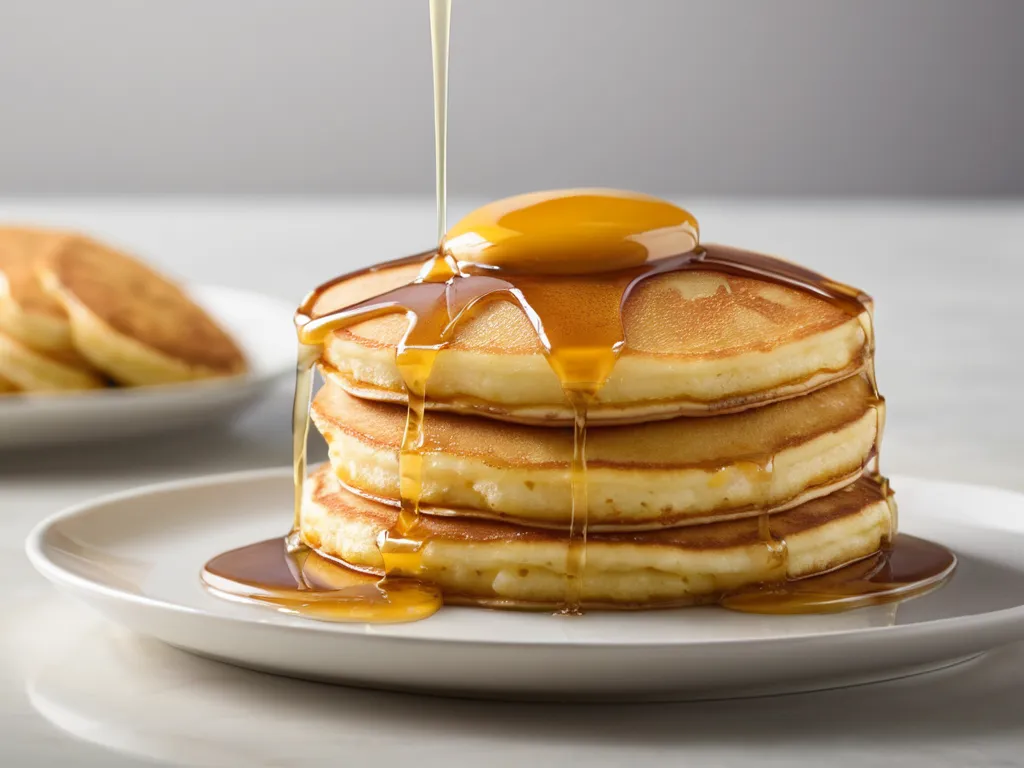
McDonald's hotcakes use corn flour, triple leavening, and a corn-syrup glaze — not maple. This copycat nails the thick, fluffy, slightly sweet texture at home in 25 minutes with one pan.

Easy Prep: 10 min Cook: 15 min Total: 25 min4 servings ~$3.50/serving
Prep10 min
Cook15 min
Total25 min
Servings
4
At home~$3.50/serving
vs
Restaurant~$15.75/serving
You save ~78%

Ingredients

Instructions

💡
Pro tip: This recipe tastes even better the next day. The flavors need time to meld together in the fridge.
❄️
Storage: Keeps in an airtight container in the fridge for up to 2 weeks. Freezer-friendly for up to 3 months.
~350-550 cal/serving · Rich & Indulgent🔥

The Story Behind the Recipe

McDonald’s Hotcakes have anchored the chain’s breakfast menu since the 1970s, when McDonald’s expanded its morning offerings beyond the Egg McMuffin into a full griddle-based lineup. They occupy a specific place in the American pancake landscape: thicker than a diner griddle cake, more uniformly sweet, and served with a syrup that is emphatically not maple. This guide covers what McDonald’s actually uses in their batter, why the commercial version behaves the way it does, and how to replicate that texture reliably on a home stovetop.

TL;DR

Medium-low heat, lumpy batter, 5-minute rest, one flip when bubbles pop across the whole surface — including the center. McDonald’s syrup is corn syrup with caramel color, not maple. Use whichever you prefer at home.

McDonald’s Hotcakes: A Brief History

McDonald’s breakfast as a category started with the Egg McMuffin in 1971 — Herb Peterson’s experiment at a Santa Barbara franchise that eventually persuaded Ray Kroc to add a breakfast menu nationwide. Hotcakes became available in select franchisee locations in the early 1970s and were part of the standardized national breakfast menu that McDonald’s rolled out in 1977, one of the most consequential menu expansions in the chain’s history. They’ve been on the menu continuously ever since, making them one of the longest-running items McDonald’s offers. The Hotcakes and Sausage combo — three hotcakes served alongside a sausage patty — became a standalone menu item as breakfast developed into a significant revenue driver.

The hotcake recipe itself has changed little. McDonald’s uses a pre-mixed batter delivered to locations, not a scratch recipe mixed daily in-store. This consistency is intentional: the commercial batter mix is engineered for uniform results across thousands of locations with workers who are not professional cooks.

What McDonald’s Actually Uses in the Batter

The commercial McDonald’s hotcake batter is more complex than a home recipe:

  • Enriched wheat flour + corn flour — the corn flour component contributes a slightly finer, softer crumb and mild sweetness that all-wheat flour doesn’t produce
  • Whey — dried milk protein that adds richness and aids browning
  • Soybean oil — neutral fat that keeps the batter moist without competing flavor
  • Eggs — structure and richness
  • Triple leavening: baking soda + sodium aluminum phosphate + monocalcium phosphate — see the leavening science section below
  • Dextrose — adds browning via Maillard reaction at lower temperatures
  • Emulsifiers: mono and diglycerides, propylene glycol monoesters, sodium stearoyl lactylate — hold fat and water in suspension for a consistent batter texture
  • Xanthan gum — traps CO2 bubbles in the batter before they can escape, creating the stable, slightly chewy interior
  • Beta carotene — the color; McDonald’s hotcakes have a distinctly golden-yellow hue that comes from beta carotene, not from egg yolk or browning alone

The home copycat doesn’t need the xanthan gum, emulsifiers, or corn flour to produce a good result — but the corn flour note is worth mentioning. You can add 2 tablespoons of fine-ground corn flour (not cornmeal, which is too coarse) to the dry ingredients for a slightly more authentic crumb. The difference is subtle; most people won’t detect it.

The Syrup Is Not Maple

McDonald’s Hotcake Syrup contains: corn syrup, sugar, water, natural flavors, potassium sorbate (preservative), and caramel color. It’s a corn-syrup-based pancake syrup — the same category as Aunt Jemima Original or Mrs. Butterworth’s — darker, sweeter, and more uniform in flavor than real maple syrup.

The syrup packet contains approximately 180 calories and 45g of carbohydrates. It’s high-fructose in composition (corn syrup is primarily glucose-fructose chains) and engineered to pour at room temperature without crystallizing, which is why it behaves differently from maple syrup on the plate.

If you want to match the original as closely as possible, use any standard pancake syrup. If you prefer the real thing, real maple syrup delivers more complexity and is a genuine upgrade — not a compromise. Grade A Dark (formerly Grade B) has the most pronounced maple flavor.

The Leavening Science: Why Triple Leavening Matters

Most home pancake recipes use only baking powder, which is itself double-acting: it releases CO2 once when it contacts liquid and again when heated. McDonald’s commercial batter uses a three-leavener system:

  1. Baking soda reacts immediately with the buttermilk acid (or whey acid in the commercial mix), producing a fast initial lift
  2. Sodium aluminum phosphate (SALP) is a slow-acting leavener that releases gas primarily during baking, sustaining lift through the cook cycle
  3. Monocalcium phosphate is another slow-acting leavener that generates gas when heated, contributing additional rise in the later stages of cooking

Together these produce a more sustained, even rise than a single leavener can achieve. The home recipe approximates this with baking soda + double-acting baking powder — two-leavener system instead of three, but close enough.

The critical variable the commercial system is designed to handle is consistency at scale: a griddle that might be slightly cooler or hotter than ideal, a batter that’s been sitting slightly longer or shorter than optimal. The triple leavening creates a wider window of acceptable results. At home, you can be more precise — which is why the home recipe works.

The Three Techniques That Make or Break Pancakes

1. Don’t Overmix

When you combine flour with liquid, the proteins glutenin and gliadin link into strands of gluten. Some gluten is essential — it gives the pancake enough structure to hold its shape and trap the CO2 bubbles that create rise. But too much gluten, created by aggressive mixing, clamps down on those bubbles and produces a flat, tough result that doesn’t rise properly.

Mix until the flour disappears and the batter is just combined. Lumps are not a problem — they hydrate and disappear during the rest period. Streaks of flour are borderline acceptable. A smooth batter is a red flag.

2. Rest the Batter 5 Minutes

After mixing, set the bowl aside and don’t touch it for 5 minutes. Two things happen:

  • Gluten relaxes. The gluten strands formed during mixing are under tension immediately after stirring. A brief rest lets them relax, producing a more tender final pancake that spreads slightly on the griddle rather than springing back into a thick disk.
  • Leavening pre-starts. The baking powder begins reacting with the buttermilk acid, producing CO2 bubbles in the batter before any heat is applied. These early bubbles create nucleation sites that help the pancake rise more evenly on the griddle. You’ll see the batter look slightly puffier after 5 minutes — that’s the rise building.

3. Medium-Low Heat — Not Medium

This is the second most common mistake, after overmixing. Too much heat browns the exterior before the interior cooks through, producing a pancake with a golden crust but a pale, dense, slightly raw center. McDonald’s commercial griddles run at very consistent temperatures — the home equivalent is medium-low, not medium.

At medium-low, the pancake takes slightly longer to cook, but the heat penetrates evenly to produce the same thick, fully-set interior. Test with water drops: a few drops should skitter and evaporate in 2–3 seconds, not spit violently on contact (too hot) or sit and absorb (too cold).

The Bubble Signal: When to Flip

Do not flip until bubbles form and pop across the full surface of the pancake — including the center. Edge bubbles alone mean the bottom is setting but the batter in the center is still liquid. When the center shows popping bubbles and the edges look dry and matte rather than shiny and wet, the pancake is ready to flip.

Flip once. One flip only. Pressing down with the spatula knocks out the rise. Re-flipping introduces uneven browning and compresses the structure. Flip, let the second side cook 1–2 minutes until golden, and serve.

Consistent Portioning: The McDonald’s Uniformity Secret

McDonald’s hotcakes are famously uniform in size — roughly 4.5 inches in diameter, stacked in groups of three. At home, this requires measuring: exactly 1/3 cup of batter per hotcake. Pour it from a ladle or measuring cup held close to the pan surface (high pours create irregular spreading). Don’t swirl or spread the batter — let it settle into a circle naturally.

On a 12-inch skillet you can cook two hotcakes simultaneously. On a griddle, three at once. Stagger the pours about 30 seconds apart so you’re not flipping them all at exactly the same moment.

Fast Food Pancake Comparison
McDonald’sIHOP (Buttermilk)Denny’s (Original)Cracker Barrel
StyleThick, very uniform, slightly sweetThick, airyMedium thickness, classicDense, home-style
LeaveningTriple-leavened commercial mixDouble-acting baking powderDouble-acting baking powderBaking powder + baking soda
SyrupCorn syrup flavored (packet)Table syrup (corn syrup)Table syrupButter-flavored syrup + real maple option
Price (stack)~$3.49–$4.29~$9.49–$12.49~$8.99–$10.99~$8.99–$10.99
Calories (plain stack)340 (3 hotcakes)~490 (3 pancakes)~480 (3 pancakes)~520 (3 pancakes)

McDonald’s hotcakes are consistently smaller than sit-down chain pancakes (McDonald’s: ~4.5 inches; IHOP/Denny’s: 6–7 inches), which is why the calorie count is lower despite the richer commercial batter.

Hotcakes and Sausage: The Combo

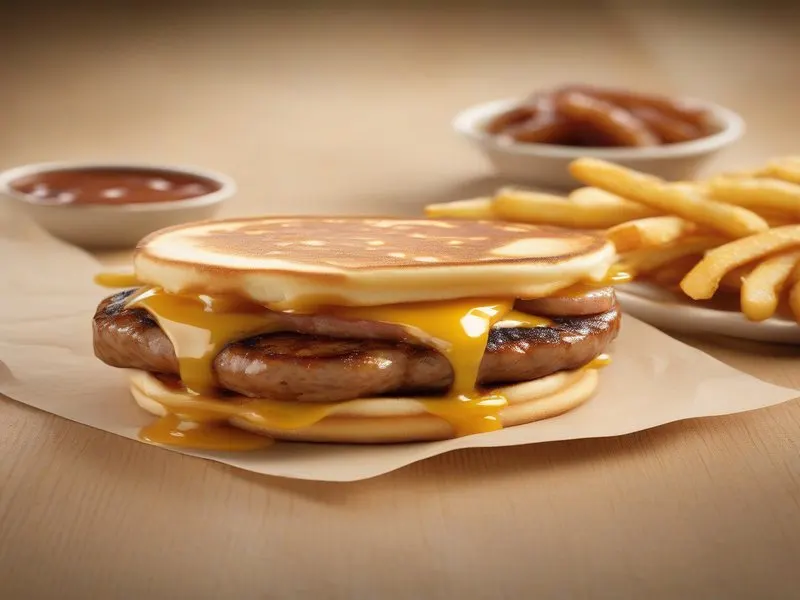
McDonald’s Hotcakes and Sausage is a separate menu item — three hotcakes served alongside a sausage patty. The full combo (hotcakes + sausage, no butter or syrup) is approximately 520–540 calories; with butter and syrup, roughly 770 calories.

To make the sausage patty at home: combine 1 pound ground pork (80/20 fat ratio), 1 teaspoon rubbed sage, 1/2 teaspoon fennel seeds (crushed), 1/2 teaspoon black pepper, 1/4 teaspoon cayenne, 1 teaspoon kosher salt, and 1/2 teaspoon dried thyme. Mix until just combined — don’t overwork. Form into 4 thin patties (~4 inches diameter) and cook in a dry skillet over medium heat, 3–4 minutes per side until cooked through and browned. Sage is the dominant flavor — it’s what distinguishes McDonald’s sausage from generic breakfast sausage.

Troubleshooting
ProblemLikely CauseFix
Flat, dense hotcakesOvermixed batterStir only until flour disappears; lumps are correct
Pale center, brown edgesHeat too highReduce to medium-low; extend cook time to 3 min
Batter too thick, won’t spreadToo little liquidAdd 1–2 tbsp buttermilk; batter should pour slowly but flow
Batter too thin, spreading flatToo much liquidAdd 1 tbsp flour; batter should hold a mound briefly
Hotcakes stickingPan too cool or not greasedLet pan heat fully first; re-grease lightly between batches
Interior gummy/undercookedFlipped too earlyWait for center bubbles to pop — not just edge bubbles
Second batch darker than firstPan temperature risingLower heat slightly for later batches; excess butter burns
Make-Ahead and Batch Cooking

Batter: Can be made the night before and refrigerated. Give it a gentle stir in the morning (it will have settled and thickened slightly — add 1–2 tablespoons buttermilk to loosen if needed). The baking powder will have lost some of its initial reactivity, so the pancakes may be marginally less fluffy, but the difference is minor.

Cooked hotcakes: Stack with parchment paper between layers. Refrigerate up to 3 days or freeze up to 2 months in a zip-lock bag. Reheat in a toaster (best), dry skillet over medium-low, or toaster oven at 325°F for 4–5 minutes. The microwave works in a pinch but steams them soft — 15 seconds at 50% power maximum.

Family batch: For 8 people (24 hotcakes), double the recipe. Cook in batches and hold finished hotcakes in a 200°F oven on a wire rack set over a sheet pan. This keeps them warm and slightly crisp without steaming — superior to covering with a plate, which traps steam and makes them soggy.

Variations

Blueberry hotcakes: Fold 3/4 cup fresh or frozen blueberries into the batter after the rest period (not before — they’ll bleed and turn the batter gray). Add 1 extra tablespoon of sugar to balance the berry tartness. Use the back of the spoon to press a few berries gently into the batter after pouring onto the griddle — they’ll sink otherwise and leave an uneven surface.

Buttermilk dollar pancakes: Use a 2-tablespoon scoop for smaller, thicker dollar pancakes — kid-friendly, faster cooking. Reduce cook time to 90 seconds per side.

Chocolate chip hotcakes: Sprinkle 1 tablespoon of mini chocolate chips onto each hotcake immediately after pouring onto the griddle. Don’t stir into the batter — stirring causes chips to sink and burn on the griddle surface before the batter sets.

McDonald’s vs. Home: Nutrition Side by Side
McDonald’s (3 hotcakes, plain)Home Recipe (3 hotcakes, plain)
Calories340~360
Calories with syrup + butter~580~580
Fat8g13g
Carbs57g52g
Protein9g9g
Sodium~530mg~560mg

The home version carries slightly more fat (butter instead of McDonald’s soybean oil) and comparable sodium. With syrup and butter added, total calories land in the same range. The difference comes down to fat source and exact ratios — not any meaningful nutritional gap.

Related McDonald’s Breakfast Recipes

Nutrition Facts

Per serving (4 servings)
Calories360
Total Fat13g
Total Carbs52g
Dietary Fiber1g
Sugars12g
Protein9g
Sodium560mg

* Estimated values based on standard recipe preparation. Actual values may vary.

🥗

Make It Healthier

Love McDonald's Hotcakes — The Real Recipe (Plus the Syrup Secret) but want a lighter version? Try these simple swaps:

  • Reduce sugar to 1 tablespoon — buttermilk adds natural sweetness and vanilla carries most of the flavor.
  • Swap half the all-purpose flour for white whole-wheat flour: milder than regular whole wheat, adds fiber without noticeably changing texture.
  • Use real maple syrup instead of corn-syrup-based pancake syrup — fewer processed additives, comparable calories, far more complex flavor.
  • Serve with fresh berries instead of a full syrup pour to cut added sugar while keeping the breakfast satisfying.

Equipment You'll Need

Large non-stick skillet or flat griddle

Non-stick or well-seasoned cast iron prevents sticking; a griddle lets you cook two or three at once

1/3 cup measuring cup

Consistent portioning gives you evenly sized hotcakes that cook in the same time — McDonald's uniformity is real

Wide flexible spatula

A thin, wide blade prevents bending and tearing on the flip

Frequently Asked Questions

What's in McDonald's hotcake batter? Is it made from scratch?

McDonald's hotcakes are made from a pre-prepared batter mix, not from scratch at the restaurant. The official ingredient list includes enriched wheat flour, whey, corn flour, soybean oil, sugar, eggs, multiple leavening agents (baking soda, sodium aluminum phosphate, monocalcium phosphate), dextrose, emulsifiers (mono and diglycerides, propylene glycol monoesters, sodium stearoyl lactylate), salt, xanthan gum, natural flavors, beta carotene for color, and soy lecithin. The two most distinctive commercial ingredients are corn flour (which contributes a slightly softer, finer crumb and mild sweetness) and xanthan gum (which traps CO2 bubbles and retains moisture, creating the slightly chewy-tender interior). The home copycat approximates both effects with buttermilk and a gentle mixing technique.

Is McDonald's hotcake syrup real maple syrup?

No. McDonald's Hotcake Syrup is a corn-syrup-based maple-flavored syrup. The ingredient list is: corn syrup, sugar, water, natural flavors, potassium sorbate (preservative), and caramel color. It's the same category as Aunt Jemima Original or Log Cabin — darker, sweeter, and more uniform in flavor than real maple syrup, with none of maple's complexity. McDonald's syrup contains approximately 180 calories and 45g of carbohydrates per serving packet. If you want to match the original as closely as possible, use any standard pancake syrup. Real maple syrup is a genuine upgrade in flavor.

How many calories are in McDonald's hotcakes?

Three McDonald's hotcakes plain — no butter or syrup — contain approximately 340 calories, 57g carbohydrates, 9g protein, and 8g fat. The full as-served order with McDonald's hotcake syrup and butter comes to about 580 calories total — roughly 240 additional calories from the syrup packet (~180) and butter (~70). The home recipe in this article produces about 360 calories for three hotcakes before syrup, which is comparable — the difference is butter vs. soybean oil and exact ratios, not any meaningful nutritional gap.

Why are McDonald's hotcakes thicker and fluffier than regular pancakes?

Three factors. First, triple leavening: baking soda (fast-reacting), sodium aluminum phosphate (slow-reacting), and monocalcium phosphate (also slow-reacting) generate lift throughout the cook cycle rather than all at once. Second, xanthan gum traps CO2 bubbles before they escape, creating a more stable rise. Third, McDonald's commercial griddles cook at precise, consistent temperatures — the home equivalent is medium-low heat, not medium, which is the most common home-cook mistake. The copycat replicates this with buttermilk acid + baking powder/soda and a 5-minute rest to pre-start the reaction.

What's the difference between pancakes and hotcakes?

In terms of recipe, almost nothing — 'hotcakes' is primarily a regional and branding term. McDonald's adopted the name rather than 'pancakes,' and the term has been more common historically in parts of the American South and Midwest. The McDonald's version runs slightly thicker than a diner pancake, with a sweeter batter and more uniform size from their griddle setup. In general usage outside of fast food branding, pancakes and hotcakes are the same thing.

Can I make these without buttermilk?

Yes. Add 1 tablespoon of white vinegar or lemon juice to a measuring cup, then fill to 1 1/4 cups with whole milk. Stir and let sit 5 minutes until it curdles slightly — this is a reliable buttermilk substitute. Plain yogurt thinned with milk to buttermilk consistency also works. Do not substitute with plain milk directly: without the acid, baking soda won't react properly and the pancakes will be flat and taste slightly bitter from unreacted soda.

How do I reheat leftover hotcakes without them getting rubbery?

Toaster method is best: run individual hotcakes through a toaster or toaster oven at medium for 1–2 minutes. The exterior re-crisps without steaming. A dry non-stick skillet over medium-low for 60–90 seconds per side also works well. The microwave is the worst method: 30 seconds turns hotcakes chewy and rubbery. If you use it, 15 seconds at 50% power is the limit — just enough to warm without steaming.

Love this recipe? Share it!

Shop the tools

The right tools make all the difference. We earn a small commission if you buy through these links — at no extra cost to you.

Free PDF: our 12 most-wanted copycat recipes — instant download.

Ratings & Reviews

No ratings yet

Rate this recipe

Click a star to rate

Leave a Review

0/500

CS

Copycat Spices Test Kitchen

Every recipe on Copycat Spices is developed and tested in our home test kitchen. We reverse-engineer beloved restaurant dishes and refine each one until the flavors and the instructions work reliably for home cooks of all skill levels.

Learn more about our mission →