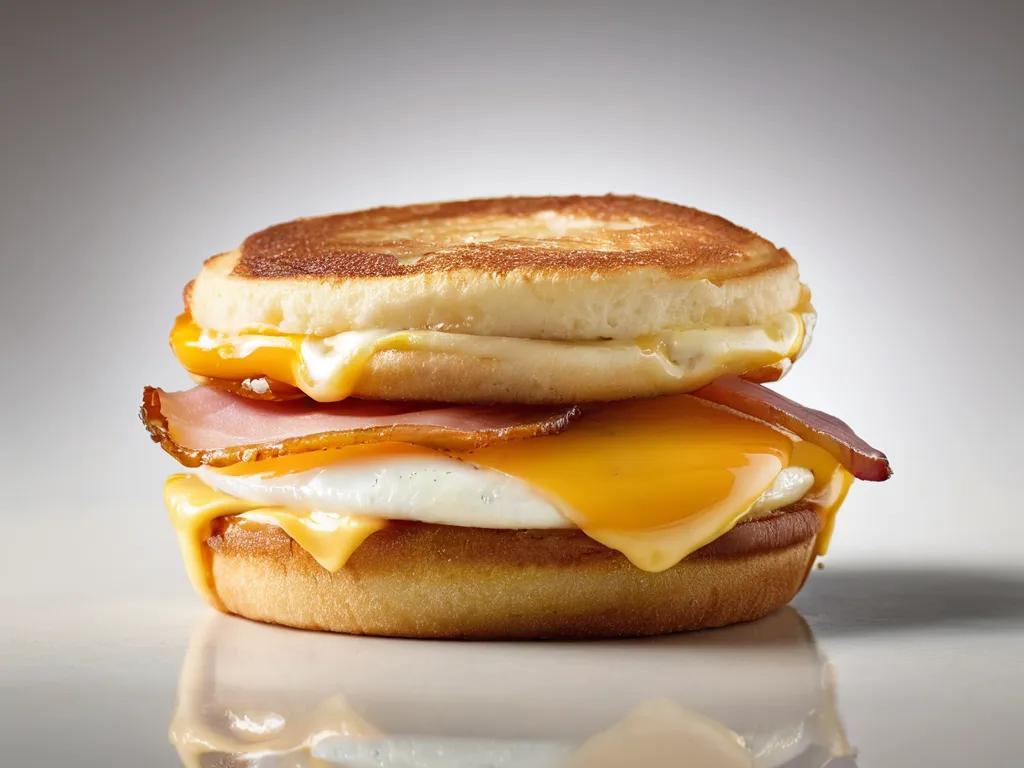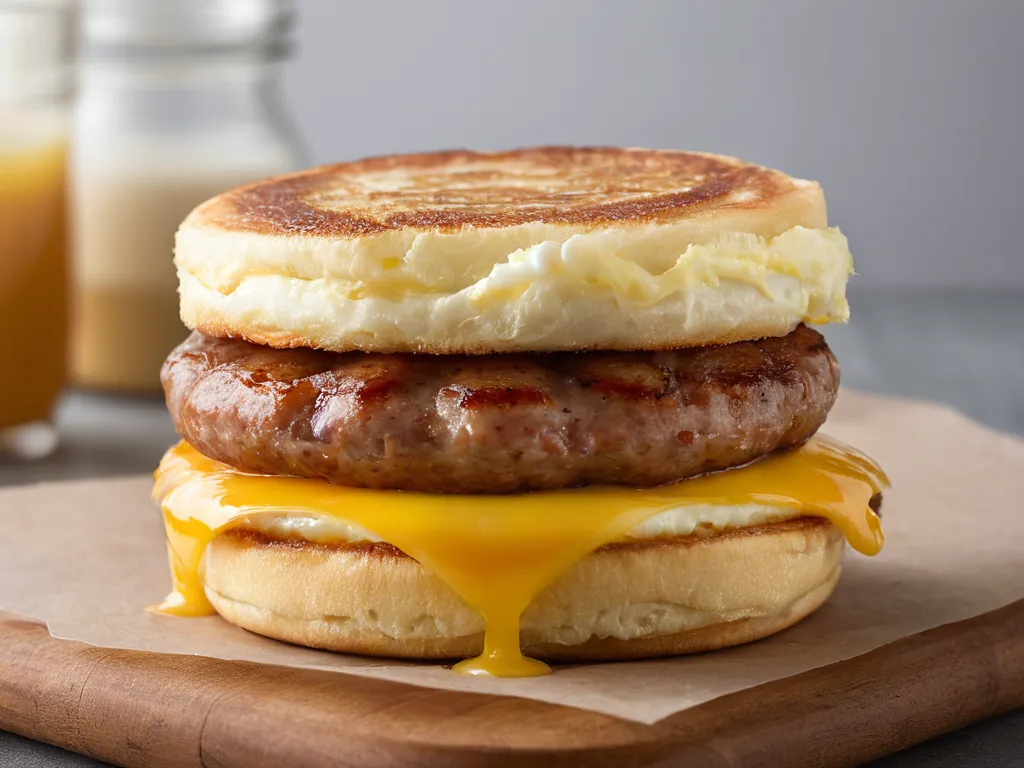
Copycat McDonald’s Sausage Egg McMuffin
The Egg McMuffin was invented in January 1972 by Herb Peterson, a McDonald’s franchisee in the Santa Barbara area of California. Peterson was trying to replicate eggs benedict at fast-food speed; he developed custom Teflon egg rings that let a fresh-cracked egg set into a perfect circle on a flat griddle. It debuted at the Goleta, CA location on January 31, 1972 — priced at 63 cents. The sausage version arrived when McDonald’s expanded breakfast nationally in 1977, adding a seasoned pork patty to the same structure: toasted English muffin, round egg, American cheese.
The premise hasn’t changed. Where the original Egg McMuffin is lean and mild (Canadian bacon is essentially lunch meat), the Sausage Egg McMuffin is richer and more savory — defined by a sage-forward pork patty that makes the sandwich eat completely differently.
Most copycat recipes either underseason the sausage or use the wrong seasoning entirely. Italian sausage is the most common mistake — it’s heavily fennel-forward, which is a completely different flavor from what McDonald’s uses. The McDonald’s patty reads as classic sage-forward American breakfast sausage, with black pepper as the secondary note, and fennel doesn’t appear anywhere in the chain’s disclosed ingredients.
The second gap is the egg. A Sausage Egg McMuffin egg is not a fried egg — it’s steamed in a ring mold with a broken yolk, which produces a flat, fully-cooked disc with an even texture throughout. The ring gives it the circular shape that fits the muffin; the broken yolk gives it the uniform appearance and mess-free bite. Missing either element produces an egg that looks and eats differently from the original.
TL;DR
Season 80/20 ground pork with salt, pepper, and rubbed sage — no fennel. Form into 4-inch patties and cook in a dry skillet over medium-high heat, 3–4 minutes per side, until 160°F internal. Butter-toast the English muffin halves in the same skillet. Cook eggs in greased ring molds: crack in, break the yolk, add a splash of water, lid on, 2–3 minutes. Stack sausage + cheese + egg on the toasted muffin. Wrap in parchment for 60 seconds. Unwrap and eat.
The Sausage: Sage, Not Fennel
The most important distinction between McDonald’s sausage and every wrong version of this recipe: sage is the primary herb, not fennel.
Fennel seed is the defining herb in Italian sausage — it’s what makes a breakfast sausage taste Italian. McDonald’s sausage does not use fennel. The flavor profile is classically American breakfast sausage: sage-forward, with black pepper and salt as the secondary notes. Some home copycat recipes add fennel seed because it “feels right” or because they’re working from Italian sausage or a generic breakfast sausage blend that happens to include it — but it changes the flavor profile enough to be wrong.
McDonald’s publicly lists the patty’s ingredients as pork, water, salt, dextrose, sugar, rosemary extract, spices, and natural flavor. The chain doesn’t itemize which spices are in that “spices” line, so no ingredient label will literally spell out “sage” — but the profile it produces is the standard sage-forward breakfast-sausage taste, which is exactly what a home sage-and-pepper blend nails. What matters for getting it right at home is the negative fact: fennel is not among McDonald’s disclosed ingredients, so leave it out.
One more note on the McDonald’s production method: McDonald’s sausage patties arrive at the restaurant pre-cooked from a central production facility; they’re reheated on the flat-top griddle for service, not formed fresh in-store. The home version — made from raw ground pork — produces a fresher, juicier patty that the restaurant version can’t match. It’s one of the genuine advantages of making this at home.
At home, the right approach is to season plain ground pork yourself:
| Ingredient | Amount (per 8 oz pork) | Role |
|---|---|---|
| Kosher salt | 1/2 tsp | Primary seasoning |
| Black pepper | 1/4 tsp | Secondary heat |
| Rubbed sage | 1/2 tsp | Defining herb |
| Garlic powder | 1/8 tsp | Background depth |
Use rubbed sage, not powdered sage. Rubbed sage is made from dried whole sage leaves crumbled into a coarse powder — it has a stronger, more pronounced flavor than the finely milled powdered sage sold in some spice aisles. The difference in 1/2 teaspoon is noticeable. If you have only powdered sage, use 1/4 teaspoon.
Fat ratio matters. 80/20 ground pork is the correct ratio for a sausage patty that stays juicy through cooking. Leaner ground pork (90/10 or leaner) dries out at medium-high heat and produces a patty that’s chalky in texture by the time it’s cooked through. McDonald’s uses a standard pork patty — not a reduced-fat version. If you’re buying pre-seasoned bulk breakfast sausage instead, look for one with sage listed early in the ingredients and 20–25% fat in the nutrition label.
Sizing the patty to the muffin. McDonald’s sausage patty fits the English muffin — not because they trim it, but because they form it to the right diameter before cooking. Ground pork contracts roughly 10% in diameter as it cooks, so the raw patty should be slightly larger than the muffin face (about 4 inches across, vs. 3.75 inches for a standard English muffin). Press it to about 3/8-inch thickness. If it’s too thick, the center won’t cook through in the same time it takes the outside to brown.
The Ring-Mold Egg: Steamed, Not Fried
McDonald’s does not use a fried egg in the Egg McMuffin or Sausage Egg McMuffin. The egg is cooked in a circular metal ring mold that’s placed in a flat griddle, filled with a cracked egg, then finished with a brief steam (water added to the griddle, heat trap placed on top).
At home, this translates to:
- A ring mold in a non-stick skillet. Any round metal ring 3–3.5 inches in diameter works — dedicated egg rings, large round cookie cutters, the ring from a mason jar lid. Lightly butter the inside of the ring so the egg doesn’t fuse to it.
- Break the yolk immediately. Crack the egg into the ring and pierce the yolk once with a fork. The yolk spreads slightly and lies flat.
- Add water for steam. Add a tablespoon of water to the edge of the skillet — not into the ring. Cover with a tight-fitting lid. The steam that builds underneath cooks the top of the egg from above while the skillet heat cooks the bottom. Result: a fully set, uniformly cooked egg in 2–3 minutes.
- Remove the ring carefully. Slide a thin spatula or butter knife around the inside edge of the ring to free the egg before lifting the ring off. The egg should be a clean disc.
The steam method produces a texture that a fried egg cannot: the white is fully set but tender throughout, with no browned, lacy fried edges. That tenderness is what makes the egg work structurally in the sandwich — it compresses slightly when you bite without tearing apart.
For the full technique breakdown on the egg (including what muffin toaster temperature McDonald’s targets and how to handle multiple orders), see Copycat McDonald’s Egg McMuffin — the technique is identical between the two sandwiches.
Butter-Toasting the English Muffin
McDonald’s switched from a liquid margarine blend to real butter for their English muffins around 2015–2016 — a change they credited with driving double-digit growth in McMuffin sales. The butter is applied lightly via a squeeze bottle in a circular pattern; McDonald’s employees do not slather the muffin, they apply a thin, consistent coat. The difference between a butter-toasted muffin and a dry-toasted one is noticeable: butter-toasting produces a more even golden color across the cut face, a slight richness that dry toasting doesn’t add, and a surface that holds the toppings slightly better because the butter creates a thin, slightly tacky barrier.
In a skillet at home, butter-toasting takes 2–3 minutes on medium heat. The muffin half should be pressed gently against the skillet with a spatula to get full contact. You want golden brown — not pale yellow (no Maillard reaction) and not deep brown (bordering on burnt).
A toaster works if you’re in a hurry, but the butter step is worth doing. It’s the difference between a breakfast sandwich muffin that tastes purposeful and one that’s just a bread delivery vehicle.
The Assembly Order and the Wrap
Assembly order for a Sausage Egg McMuffin:
- Bottom muffin half (cut face up)
- Sausage patty
- American cheese slice
- Steamed egg (yolk side down, if visible)
- Top muffin half
The cheese goes between the hot sausage patty and the hot egg — both sides of the cheese are touching a hot protein surface, which maximizes melt speed. Don’t put the cheese on top of the egg, where only one side has a heat source.
The 60-second wrap. Immediately after assembly, wrap the sandwich loosely in a piece of parchment paper (or foil) and let it sit for one minute. This is the same principle as the drive-through wrapper: trapped steam from the hot components melts the cheese completely and softens the muffin slightly. Without the wrap, the cheese often stays unmelted at the edges. Don’t skip it — it takes 60 seconds and makes a meaningful difference.
McDonald’s vs. Home: What Changes
| McDonald’s | This Recipe | |
|---|---|---|
| Price | ~$4.79–$6.49 (varies by market) | ~$2.50–$3.50 for 2 |
| Sausage fat | Consistent production spec | 80/20 ground pork |
| Sausage seasoning | Proprietary blend (sage-forward) | Sage + black pepper + garlic powder |
| Egg | Ring-mold steamed, broken yolk | Identical technique |
| Muffin toast | Flat griddle, butter blend | Skillet butter-toast |
| Cheese | American (process) | American (Kraft singles or deli) |
| Assembly → service lag | Often 3–10 minutes under heat lamp | Zero lag; eat immediately |
The “eat immediately” point is material: a drive-through Sausage Egg McMuffin that’s been under a heat lamp for 8 minutes has a different muffin texture than a fresh one. At home, you eat it within 60 seconds of assembly. The muffin is crispier, the egg is hotter, and the patty hasn’t steamed in the wrapper.
Variations
Sausage McMuffin (no egg): The Sausage McMuffin is the same sandwich without the egg — sausage patty, American cheese, buttered English muffin, no egg. It’s about 400 calories lighter than the Sausage Egg McMuffin. Follow this recipe and simply skip the ring-mold egg step.
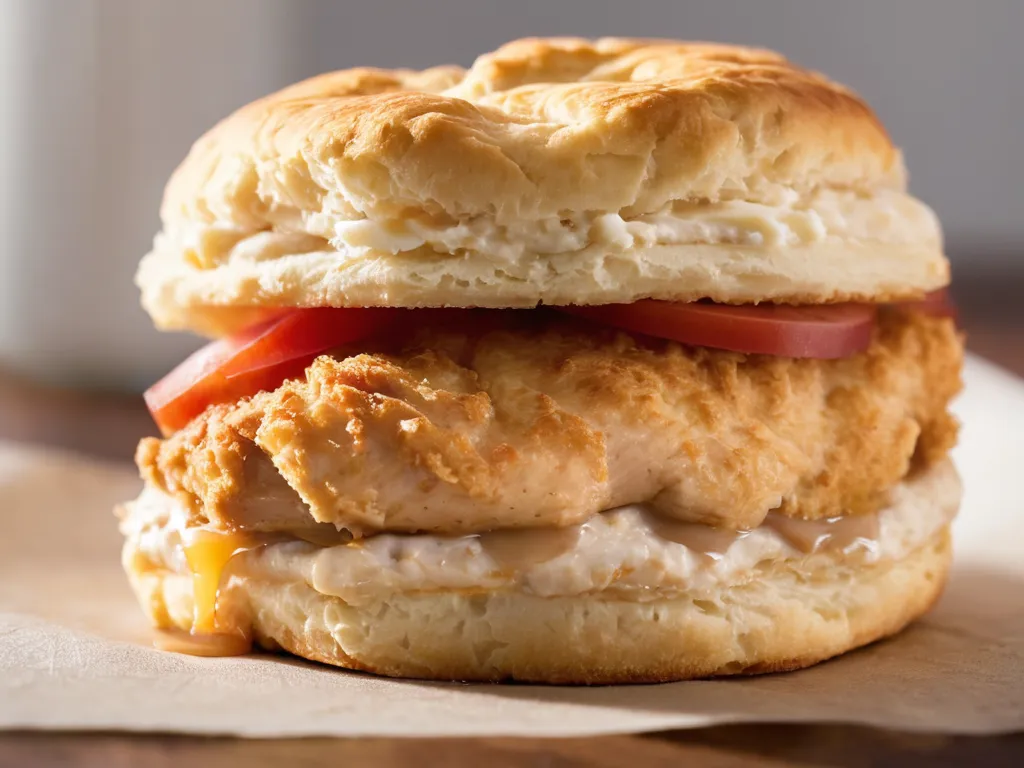
Sausage, Egg & Cheese Biscuit: Swap the English muffin for a drop biscuit and build the same stack. The biscuit version is a Southern fast food staple (Hardee’s, Bojangles’) and has a richer, more buttery base than the McMuffin. Use any buttermilk drop biscuit recipe — the sausage patty technique is identical.
Turkey or chicken sausage: Use ground turkey (85/15) or ground chicken breast with an added teaspoon of olive oil to compensate for the lower fat. Use the same sage/pepper/garlic seasoning ratio. The patty will be slightly drier than the pork version but the flavor profile is correct.
Double protein: Add a second sausage patty for a 1/2-pound sandwich. You’ll need to adjust the assembly order: bottom muffin → sausage → cheese → sausage → egg → top muffin. The extra cheese from the second patty melts into both meat layers.
What to Serve With a Sausage Egg McMuffin
The full McDonald’s breakfast at home:
- Copycat McDonald’s Hash Browns — the par-cook-and-freeze method that produces the right crispy exterior and steamed interior
- Copycat McDonald’s Hotcakes — the slightly sweet, fluffy diner-style pancakes from the McDonald’s breakfast menu
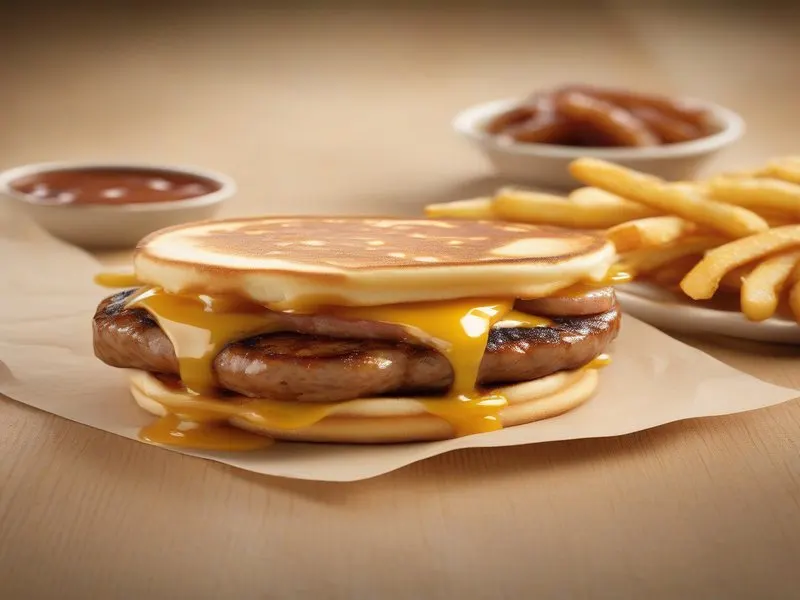
- McDonald’s Sausage McGriddle — the maple-batter griddle cake version of this sandwich; the pancake flavor is baked into the cakes, not drizzled on
Or build the other McMuffin variant:
- Copycat McDonald’s Egg McMuffin — the Canadian bacon and egg version without sausage; lighter and different enough to keep both recipes