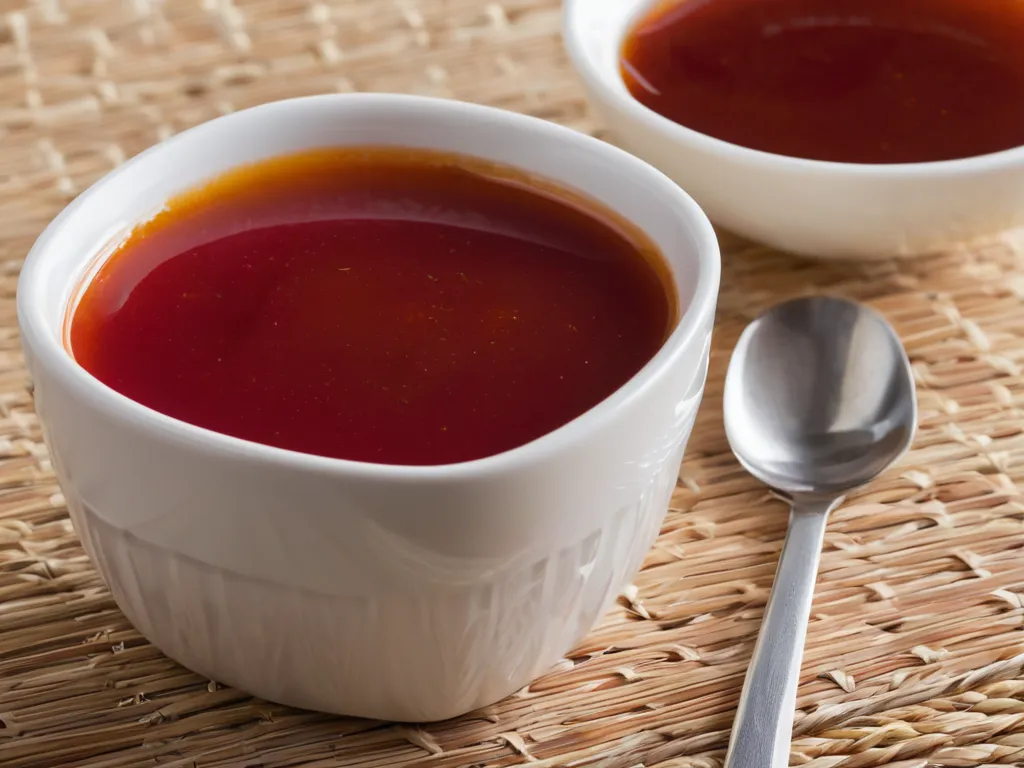
Copycat McDonald’s Sweet and Sour Sauce
Prep time: 5 minutes | Cook time: 0 minutes | Servings: About 1 cup (8–10 dipping portions)
McDonald’s Sweet ‘N Sour Sauce has been on the menu since 1983 — introduced the same year as Chicken McNuggets, specifically as a pairing for them. More than 40 years later, it’s still the most-requested dipping sauce at McDonald’s, and most people have no idea what’s actually in it.
The answer is simpler than you’d expect: apricot and peach purée concentrate, distilled vinegar, soy sauce, chili spice, and — the detail nobody else mentions — dried sherry wine powder, which adds a subtle fermented depth that separates the real sauce from every generic copycat.
That’s also the detail most copycat recipes get wrong in a different way. They reach for pineapple juice or plum sauce and end up with something that tastes like Chinese takeout dipping sauce. The McDonald’s version leans stone fruit, not tropical fruit. Start there and you’re already ahead of 90% of the recipes online.
What McDonald’s Actually Puts In Their Sauce
McDonald’s publishes a full allergen and ingredient list. In order, the Sweet ‘N Sour Sauce contains: high fructose corn syrup, water, apricot puree concentrate and/or peach puree concentrate, distilled vinegar, and — at 2% or less each — soy sauce, salt, modified food starch, sherry wine powder, dextrose, soybean oil, xanthan gum, spices, sodium benzoate (preservative), natural flavors, garlic powder, cellulose gum, dried chili peppers, onion powder, caramel color, and extractives of paprika (for color).
The first four ingredients carry almost all the flavor; everything after “2% or less” is there for texture, color, shelf stability, and small savory accents. That’s good news for a home cook — you only need to nail the top of the list.
Breaking that down ingredient by ingredient explains why the sauce tastes the way it does:
High fructose corn syrup + stone fruit concentrate — this is the sweet and the body. The HFCS dissolves smoothly without crystallizing; the apricot/peach concentrate gives the sauce its characteristic stone-fruit aroma and slightly jammy texture. At home, apricot preserves (which are essentially sugar + fruit, close to what HFCS + concentrate produces) are the right substitute.
Distilled vinegar — the sour component. McDonald’s uses standard distilled white vinegar, which is sharper and cleaner than rice vinegar. Rice vinegar works well at home too, but for the most authentic result, use distilled white vinegar at the same volume.
Soy sauce — a small amount, but it does a lot. It adds umami depth and a savory backbone that keeps the sauce from tasting like fruit candy. Without it, the sauce is one-dimensional.
Sherry wine powder — this is the sleeper ingredient. Dried sherry adds a gentle fermented complexity — something between a wine and a vinegar without being either. Most home copycat recipes omit it entirely (because dried sherry powder isn’t in most pantries), which is why they taste slightly flat. A reasonable substitute is ½ teaspoon of dry sherry (the cooking wine variety, not drinking sherry) or a splash of apple cider vinegar for the fermented note.
Modified food starch + xanthan gum — these are the thickeners that give McDonald’s sauce its semi-gel consistency at room temperature, thicker than water but thinner than jam. At home you don’t need either: apricot preserves are already thick from pectin, and a brief 2-minute simmer tightens the texture further if you want it.
Garlic powder, onion powder, dried chili peppers, and paprika — the savory-and-color layer near the bottom of the list. The garlic and onion powder are why the sauce reads as a sauce and not just sweetened jam; the dried chili gives faint background heat (not spicy, just enough to round the flavor); the paprika extractive is purely for the warm orange color. This is why the home recipe below includes all four — small amounts, but they’re genuinely in the original.
Why Most Copycat Recipes Get It Wrong
Search “McDonald’s sweet and sour sauce copycat” and you’ll find three versions that dominate:
- Pineapple juice base — this produces a tropical-tasting sauce that’s good, but clearly not McDonald’s
- Plum sauce base — plum sauce is dark, earthy, and more complex than the original; a different sauce entirely
- Generic sweet-and-sour (sugar + ketchup + pineapple + vinegar) — a Chinese-American restaurant sauce that shares a name but not a flavor
McDonald’s sauce is lighter and more delicate than any of these. The apricot-peach base reads as bright and floral, not heavy or tropical. Once you identify this, you taste it every time.
Ingredient Notes
Apricot preserves: The quality of your preserves determines the quality of your sauce. A grocery-store-brand apricot jam works fine; a high-pectin premium preserve (Bonne Maman, St. Dalfour) gives a slightly more complex flavor. Avoid “apricot spread,” which uses apple juice as a filler and tastes noticeably thin.
The apricot-peach split: McDonald’s ingredient list says “apricot puree concentrate and/or peach puree concentrate” — the “and/or” suggests the formula adjusts with availability. Using half apricot and half peach preserves at home produces a slightly more layered flavor than straight apricot alone. If you can only find apricot, it’s still 90% of the flavor.
Vinegar: Rice vinegar (milder, slightly sweet) or distilled white vinegar (sharper, authentic) both work. The difference is subtle. Start with rice vinegar if you’re unsure.
Soy sauce: Use the smallest amount that adds depth without making the sauce taste savory-forward. One teaspoon per cup of preserves is the right ratio. Low-sodium soy sauce works and reduces the sodium from 60mg per serving to around 35mg.
The sherry substitution: If you want to approximate the dried sherry wine powder, add ½ teaspoon of dry sherry cooking wine to the mixture, or swap 1 teaspoon of the rice vinegar for apple cider vinegar (the fermented-apple note is in the same family as sherry).
Why Apricot (Not Pineapple or Plum)
McDonald’s published its official ingredient list, and it’s specific: the sauce uses “apricot puree concentrate and/or peach puree concentrate” — not pineapple juice, not plum sauce, not orange marmalade. The stone-fruit combination creates a particular flavor: fruity but not tropical, sweet but with a slightly floral tartness that pineapple can’t replicate.
If you’ve ever made a generic sweet-and-sour sauce and thought “this tastes like every other sweet-and-sour, not like McDonald’s” — that’s why. Use apricot preserves and the flavor shifts into recognizable territory immediately.
The Soy Sauce Is the Depth Layer
Without soy sauce, the sauce tastes flat and candy-sweet. One teaspoon won’t make it taste Asian or umami-forward — it disappears into the background and just makes everything else taste more like a real sauce and less like warm jam. Don’t skip it, and don’t double it. One teaspoon is calibrated.
How to Use It
The Obvious: Chicken Nuggets
The pairing McDonald’s designed it for. Dip homemade chicken nuggets in it exactly as you would at the drive-thru.
Beyond McNuggets
- Chicken McNuggets — the intended pairing since 1983. McDonald’s gives 1 packet per 4–6 piece order and 2 packets per 10-piece. Make a batch at home and serve this alongside.
- Spring rolls and egg rolls — this is genuinely better than the glop that comes with takeout spring rolls.
- Fried shrimp — works as a cocktail sauce alternative that’s sweeter and less horseradishy.
- Pork dumplings — a tablespoon in the dipping bowl alongside chili oil.
- Grilled chicken marinade — thin it with a tablespoon of water and use as a glaze in the last few minutes of grilling.
- Stir-fry sauce — add 2 tablespoons to any wok dish along with a teaspoon of cornstarch dissolved in water. The result is a glossy, restaurant-style finish.
- Dipping sauce for McDonald’s fries — sweet-and-sour on fries is underrated.
For other McDonald’s dipping sauce options, see McDonald’s Big Mac Sauce — it’s the sauce for burgers and salads.
The More Authentic Version (From-Scratch)
The preserves-based recipe above takes 5 minutes and is very close to the original. If you want to get even closer — closer enough that it could genuinely fool someone who eats McDonald’s regularly — use dried apricots instead of preserves and reduce the vinegar first.
Ingredients:
- ½ cup dried apricots (about 10–12 pieces), roughly chopped
- ½ cup distilled white vinegar
- ½ cup granulated sugar
- ¼ cup water
- 1 tablespoon soy sauce
- ½ teaspoon garlic powder
- ¼ teaspoon onion powder
- ¼ teaspoon chili powder
- Pinch of paprika
Method:
- Combine the dried apricots, vinegar, sugar, and water in a small saucepan. Bring to a simmer over medium heat.
- Reduce heat to low and simmer uncovered for 12–15 minutes, stirring occasionally, until the apricots are completely soft and the liquid has reduced by roughly one-third. The mixture will look concentrated and jammy.
- Transfer to a blender or use an immersion blender. Blend until completely smooth, 30–45 seconds.
- Pour through a fine mesh strainer into a bowl, pressing the solids through with a spoon. Discard the fibrous pulp that doesn’t pass through.
- Stir in the soy sauce, garlic powder, onion powder, chili powder, and paprika. Taste: it should land sweet-forward with a clean sour finish. If the vinegar still dominates, stir in another tablespoon of sugar while the sauce is warm so it dissolves fully.
- Cool to room temperature. The sauce thickens noticeably as it cools — this is correct, and it will loosen slightly when served at room temperature.
Why this works better: Dried apricots have a more concentrated stone-fruit flavor than preserves, and reducing the vinegar gives the sour component the same weight as the sweetness. The straining step removes the texture of fresh fruit and produces the smooth, semi-transparent look of the actual sauce.
The Apricot-Peach Split
McDonald’s specifies “apricot puree concentrate and/or peach puree concentrate” — the “and/or” likely means the formula shifts based on availability. Using half apricot and half peach preserves gets you closest to the real thing and adds a slight complexity over pure apricot. If you can only find apricot, that’s fine — it’s 90% of the flavor anyway.
Avoid: Generic “apricot flavor” jam or any spread that uses apple juice as a filler. The real sugar content matters for the consistency and sweetness level.
Thickness Adjustments
McDonald’s sauce packet has a specific semi-gel consistency — thicker than water, thinner than jam, slightly translucent. Straight from the jar, most apricot preserves are thicker than this.
To thin it: Add 1–2 tablespoons of warm water and whisk to incorporate. This brings it closer to the packet consistency.
To thicken it: Combine everything in a small saucepan and simmer over low heat for 2–3 minutes, stirring constantly. The mixture reduces slightly and thickens as it cools.
Variations
Ginger-Forward Version
Add ½ teaspoon of freshly grated ginger and ¼ teaspoon of sesame oil. This leans the sauce more clearly toward Chinese-American sweet-and-sour territory — less McDonald’s, more Chinese takeout. Good in its own right.
Extra-Spicy Version
Double the chili powder and add ¼ teaspoon of cayenne. The heat takes a few seconds to build and then persists through the sweetness. This version is good as a wing sauce.
Plum Sauce Blend
Use ½ cup apricot preserves and ¼ cup store-bought plum sauce. The plum adds earthiness and a deeper sweetness. Not the McDonald’s flavor, but genuinely good with Peking duck or mu shu pork.
Cost Breakdown
| McDonald’s | Homemade | |
|---|---|---|
| Single dipping packet | $0.50–$1.00 | — |
| 1 cup (8–10 portions) | $4–$8 in packets | ~$1.80 |
| 2 cups (enough for a party) | $8–$16 | ~$3.50 |
The math gets compelling fast if you go through more than one or two packets per order — which, if you’re making nuggets at home for a family, you will.
One note on nutrition: A McDonald’s packet (1 oz / 28g) is 50 calories, 12g total carbs, and 11g sugar, which is lower than the homemade version per ounce. The reason is that the restaurant version uses high fructose corn syrup plus diluted puree concentrate, while the homemade version starts from full-sugar apricot preserves. The homemade version is also using a full cup (enough for 8 portions) vs. a single tiny packet — per-tablespoon, the calorie count is similar. If you want to get closer to the restaurant numbers, use a reduced-sugar or no-sugar-added apricot preserve.
Storage
- Refrigerator: 2–3 weeks in a sealed glass jar.
- Room temperature: Remove from the fridge 10 minutes before serving — cold jam-based sauces thicken and lose their pour.
- Freezer: Not necessary, but possible for up to 3 months. Thaw in the refrigerator overnight.
For more McDonald’s copycat sauces, see our full McDonald’s restaurant hub.