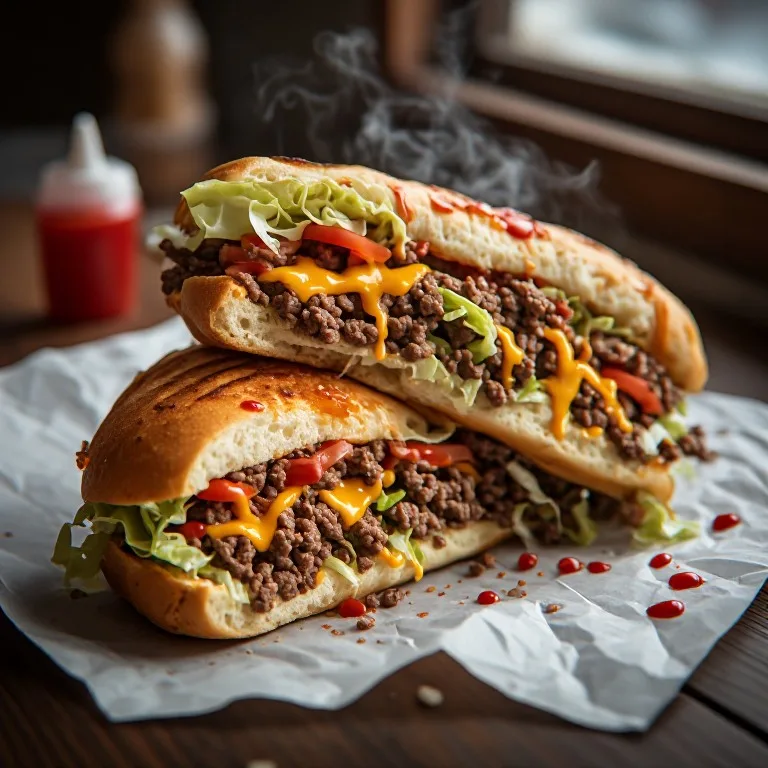


The chopped cheese is New York City’s answer to the Philly cheesesteak — but the technique is different, the beef is different, and the cheese isn’t Cheez Whiz. It’s ground beef chopped directly on a flat-top griddle with a metal spatula while it cooks, mixed with softened onion, piled into a mound under melted American cheese, and served on a soft hero roll with mayo, ketchup, and hot sauce.
The word “chopped” is not a descriptor of the raw ingredient. It’s what you do to it while it’s cooking.
What the chopping technique actually does
When you take ground beef and break it apart into small pieces while it cooks, three things happen that don’t happen with standard ground-beef browning:
More surface area equals more caramelization. Pieces the size of a pea have exponentially more surface area in contact with the hot griddle than the same mass of beef in large crumbles. More surface area means more Maillard reaction — more browned, savory crust on each tiny piece.
The beef integrates with the onion. The chopping mixes diced onion into the beef during cooking, not after. By the time the beef is done, the onion is cooked into it rather than sitting alongside it. Every bite has both.
The mound holds together. Fine-chopped beef compacts tightly when you push it into a mound with the spatula. It holds its shape under the cheese and during the scoop onto the roll. Large crumbles fall apart the moment the roll is closed.
This is why the chop is not optional or cosmetic. It’s the mechanism.
The beef choice
Use 80/20 ground beef — the fat percentage you’d use for a burger. The fat renders during cooking and is part of what caramelizes the beef surface and keeps it juicy after chopping. Leaner beef (93/7 or 90/10) dries out faster as the pieces get smaller and more surface area is exposed to heat. If you only have lean beef, add a teaspoon of butter to the pan.
Don’t use pre-seasoned or flavored ground beef. Season it yourself, during the chop.
The roll choice and why soft beats crusty
The hero roll in a chopped cheese should be soft — the kind of sub roll that compresses slightly when you close the sandwich. A crusty baguette or sourdough creates a structural problem: the hardness resists the soft beef, and every bite slides or compresses unevenly. The soft roll wraps around the filling and holds together from first bite to last. Martin’s Potato Rolls (long version) work well. Most grocery store “sub rolls” or “hero rolls” are appropriately soft. Italian bread rolls from a bakery are ideal if you can find them fresh.
Toast it cut-side down on the griddle for 45 seconds — that light browning is all you want.
The dome step — why it’s non-negotiable
American cheese melts from heat above, not just heat below. When you lay two slices of American cheese flat on top of a beef mound and leave the pan open to the air, the cheese sits there. The residual heat from the beef softens it slightly, but it doesn’t truly melt into the crevices of the meat.
When you cover the mound with a lid, bowl, or tented foil, the rendered beef fat creates steam that heats the air above the cheese. In 30–45 seconds, the cheese goes from rigid slices to a smooth, even layer draped over every contour of the mound. When you scoop that mound onto the roll, the cheese comes with it as a whole unit.
Skipping the dome produces a slab of cheese that slides off the beef during the scooping move. Doing the dome correctly produces the integrated beef-and-cheese unit that’s the visual signature of the sandwich.
The NYC origin
The chopped cheese is specifically tied to Harlem and the bodega culture of upper Manhattan. The most famous example is Blue Sky Deli — better known to regulars as Hajji’s — at 1st Avenue and 110th Street in East Harlem, a small corner store that gained national attention when food media began covering what had been a neighborhood staple for years.
Bodegas in New York City are small, neighborhood-serving grocery stores that typically include a deli counter with a griddle. The chopped cheese evolved as a fast, filling, affordable hot sandwich that could be made quickly on a flat-top for a line of regulars at lunch. The sandwich cost around three to four dollars when it was still mostly a neighborhood secret.
Its virality cycle on TikTok began in earnest when creators outside New York — and outside the US — discovered the technique and realized it was reproducible at home with equipment most people already have.