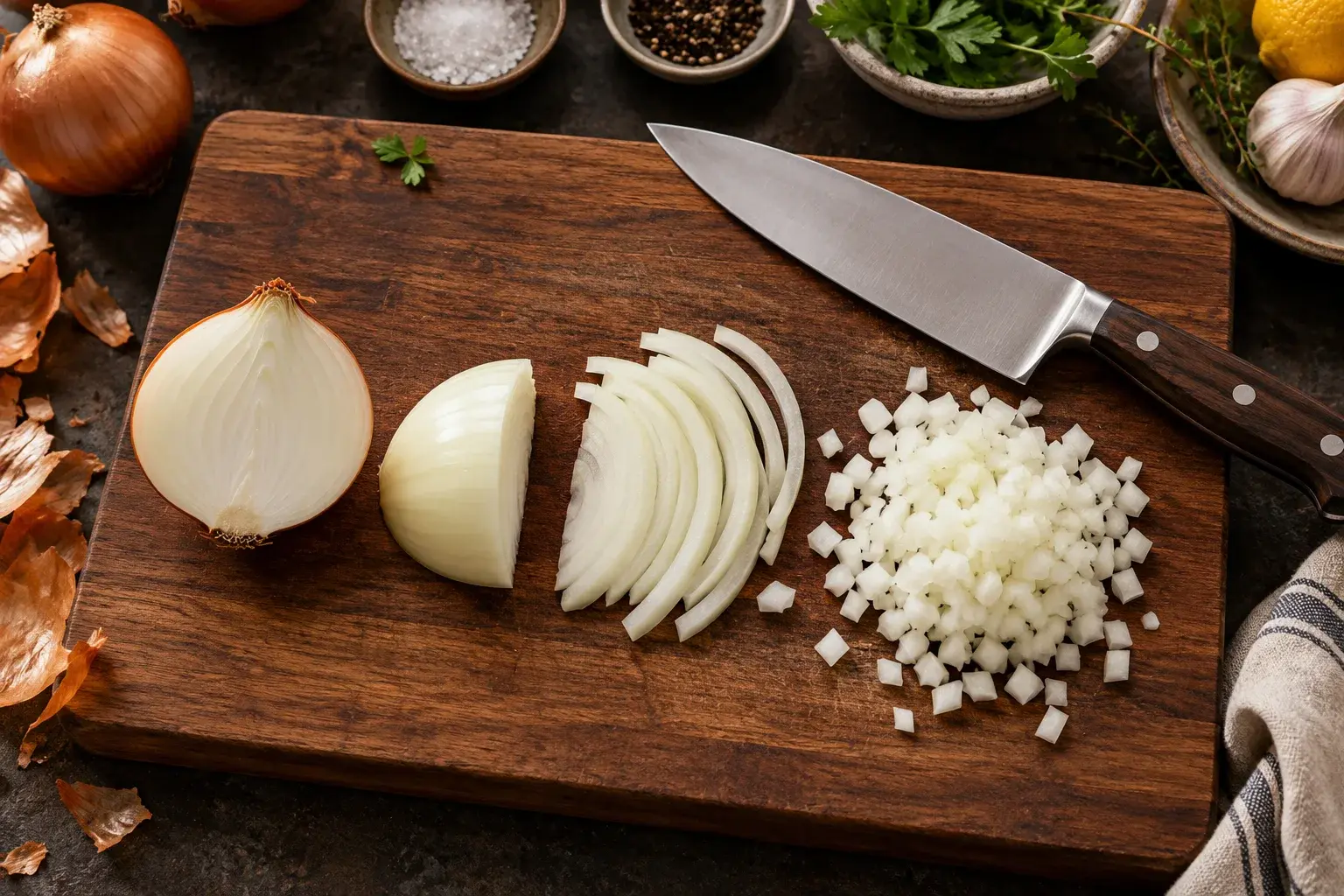
Knife skills are not about chopping as fast as a television chef. They are about making the same controlled cut again and again. Speed arrives later, mostly as a side effect of good technique.
Start with an onion because it teaches nearly everything at once: how to hold a knife, how to guide it, how to stabilize round food, and why even pieces cook better.
Set up a safe cutting station
Use a cutting board large enough to hold the onion and the finished pile without crowding. If the board moves, place a damp paper towel underneath it. Clear the area around your dominant hand so the knife cannot hit a bowl, bottle, or pan handle.
Use a sharp chef’s knife. A dull blade feels less threatening, but it requires more force and slips more easily. The knife should cut an onion skin without crushing it.
Learn the pinch grip
Do not squeeze the handle like a hammer. Pinch the blade itself between your thumb and the side of your index finger, just in front of the handle. Wrap the other three fingers around the handle.
This brings your hand closer to the knife’s center of balance. The blade feels less wobbly, and you can guide it with small movements instead of forcing it down from the wrist.
Make a claw with your guide hand
Your other hand controls the food. Curl its fingertips inward so the flat middle sections of your fingers face the blade. Rest the side of the knife lightly against those knuckles as you cut.
The knuckles become a guide rail. Your fingertips stay behind them, away from the cutting edge. Move the claw backward a little at a time as the knife advances.
How to dice an onion
- Cut the onion in half from stem to root.
- Peel away the papery skin and the first damaged layer, if needed.
- Place one half cut-side down. A flat side makes the onion stable.
- Keep the root end intact. Make vertical slices from the stem end toward the root, stopping just before the root.
- Turn the onion and slice across those cuts. The layers create the horizontal divisions for you, so a beginner does not need to make a risky sideways cut.
- Stop when you reach the root and discard it.
For a small dice, space the first cuts about 1/4 inch apart. For soup or roasting, 1/2-inch pieces are usually better. The exact number matters less than keeping the pieces close to the same size.
Why even cuts matter
An uneven pile contains tiny pieces that burn and large pieces that stay raw. Even pieces reach the same stage at roughly the same time. This is why knife work changes flavor, not just appearance.
When caramelizing onions, consistent slices soften and brown together. In a salsa, a uniform dice distributes onion through every bite instead of creating sharp pockets.
Build speed without chasing it
Practice slowly with one onion. Keep the knife tip near the board and use a smooth forward-and-down motion. After ten onions, your hands will naturally travel a shorter, cleaner path.
If you feel rushed, reset your grip. A cook who makes 30 calm, even cuts is faster than one who makes 50 frantic cuts and then has to fix the pile.
Your five-minute practice
Dice one onion, then sort a few pieces by size. Notice where they became uneven. On the next onion, reduce the distance between cuts or slow down as you approach the root.
That small feedback loop is how knife skills improve. No tricks, no flying blade, just control.