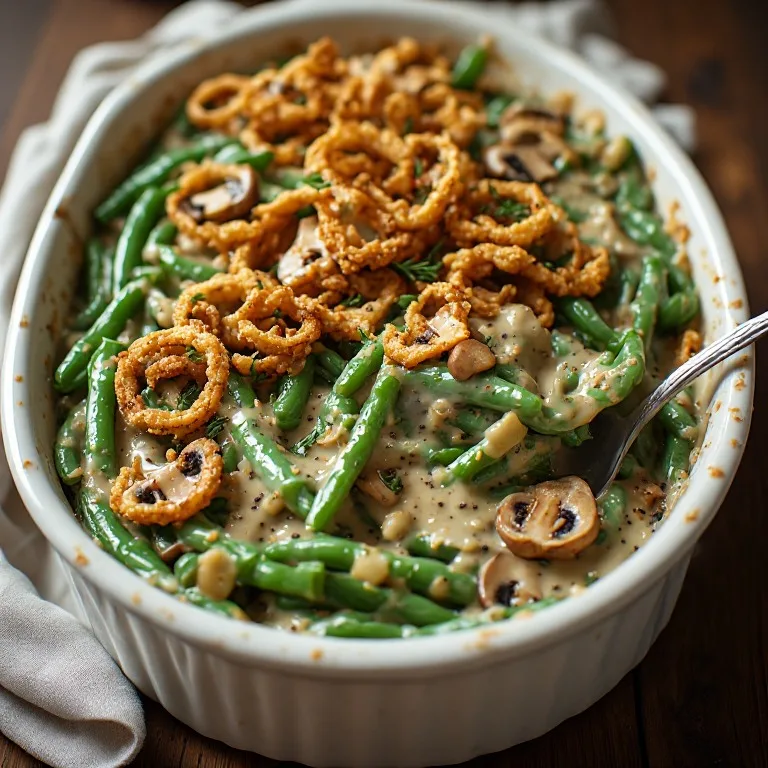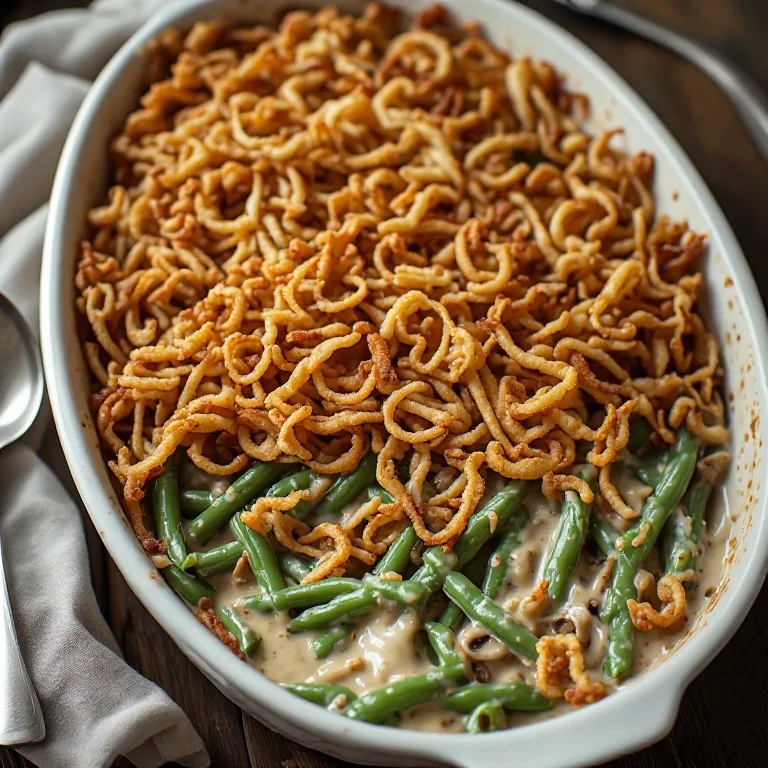

Campbell’s Classic Green Bean Casserole
Prep time: 10 min
Cook time: 30 min
Yield: 6 servings
In 1955, a Campbell’s food scientist named Dorcas Reilly put five ingredients together in a baking dish and accidentally created the Thanksgiving side dish that would eventually land on 20 million American tables every November. The recipe has never changed. It doesn’t need to.
This is the original, faithful recreation: condensed cream of mushroom soup, milk, soy sauce, cooked green beans, and French’s Crispy Fried Onions. Nothing more, nothing fewer.
What Dorcas Reilly Actually Built
The recipe started as a promotional assignment: create a dish that uses both condensed cream of mushroom soup and green beans. Reilly and her colleague Ann Raffetto tested combinations until landing on a formula that worked at scale — one that a home cook with no culinary training could assemble in minutes and bake in an oven already running at turkey temperature.
The five-ingredient structure is intentional. Every element serves a specific role:
| Ingredient | Role in the dish |
|---|---|
| Condensed cream of mushroom soup | The sauce base — thickens during baking into a creamy coating |
| Milk | Thins the condensed soup to the right consistency; whole milk adds richness |
| Soy sauce | Umami amplifier — deepens the mushroom flavor without adding mushroom flavor |
| Cooked green beans | The vegetable — tender enough to absorb the sauce, firm enough to hold shape |
| French’s Crispy Fried Onions | Texture, salt, and the characteristic crunchy topping |
The soy sauce is the ingredient home cooks most often question or skip. It doesn’t make the casserole taste like soy sauce — you can’t identify it in the finished dish. What it does is add glutamates, the same compounds responsible for the savory depth in aged cheese, mushrooms, and meat broth. Without it, the soup base tastes flat. With it, the sauce tastes like it has been cooking for hours.
Canned, Fresh, or Frozen: Which Green Beans to Use
The original recipe was written for canned green beans, and canned beans remain the most faithful version of the dish.
| Bean type | Texture | Notes |
|---|---|---|
| Canned (2 × 14.5 oz cans) | Soft, uniform, tender | True to original; drain very thoroughly |
| Fresh (1½ lbs, blanched) | Firmer, brighter green | Blanch 3–4 min, ice bath, dry completely |
| Frozen (16 oz, thawed) | Between canned and fresh | Thaw fully; press dry to prevent watery sauce |
If you prefer more vegetable bite, fresh beans are the best upgrade. The technique: bring a large pot of salted water to a rolling boil, add trimmed beans, cook exactly 3–4 minutes, transfer to a bowl of ice water, drain, and dry thoroughly with paper towels. Excess water from undried beans is the primary reason casseroles turn out thin and watery.
The French’s Fried Onion Question
French’s Crispy Fried Onions were introduced in 1954, a year before the casserole recipe. They were designed specifically as a versatile pantry item, and the green bean casserole gave them their defining use case. The partnership became so embedded in American cooking that Campbell’s estimates roughly 40% of its cream of mushroom soup sales now end up in green bean casserole, and French’s sells the majority of its fried onions during the November–December holidays — overwhelmingly for this one dish.
The recipe uses the onions in two ways: stirred into the casserole before the first bake (where they soften and add body and saltiness throughout), and scattered on top for the final 5 minutes (where they stay crunchy and form the golden crust). Both steps are important. Adding all the onions at the start means they’ll burn. Adding them only at the end means the sauce inside the casserole misses their flavor and texture contribution.
Make-Ahead Instructions
Green bean casserole is one of the most practical make-ahead Thanksgiving dishes because it holds well and reheats cleanly.
Day before: Assemble the entire casserole (soup base + beans + first ⅔ cup of fried onions) in the baking dish. Do not add the topping onions yet. Cover tightly with plastic wrap and refrigerate up to 24 hours.
Day of: Remove from the refrigerator 30 minutes before baking to reduce the cold-center problem. Bake uncovered at 350°F for 30–35 minutes (an extra 5–10 minutes versus the standard because it’s starting cold). Add the topping onions and bake a final 5 minutes.
The only rule: add the fried onion topping only when you’re about to do the final bake. Onions stored on top of the casserole overnight absorb moisture and become soggy — they lose the crunch that defines the dish.
Substitutions
Soup: Golden Mushroom Soup (also Campbell’s) produces a darker, richer sauce with a savory umami depth closer to French onion soup than cream of mushroom. Many cooks prefer it as an upgrade. Cream of Chicken Soup works but produces a lighter result that moves away from the mushroom character. Cream of Celery is a neutral option. For a fully scratch version without any canned soup, see the from-scratch recipe.
Fried onions: French’s is the classic. Store brands work. If unavailable, you can use shallots thinly sliced and fried in oil until crispy, though the flavor will be sharper and less sweet than the French’s version.
Milk: Whole milk produces the creamiest sauce. 2% works without noticeable difference. Non-dairy milks (oat, almond) can substitute — use the unsweetened plain variety. The sauce may be slightly thinner.
See the rest of the holiday table at Copycat Stove Top Stuffing, Karo Classic Pecan Pie, and King’s Hawaiian Sweet Rolls.