Marea Halloween Black Squid Ink Pasta (Made at Home)
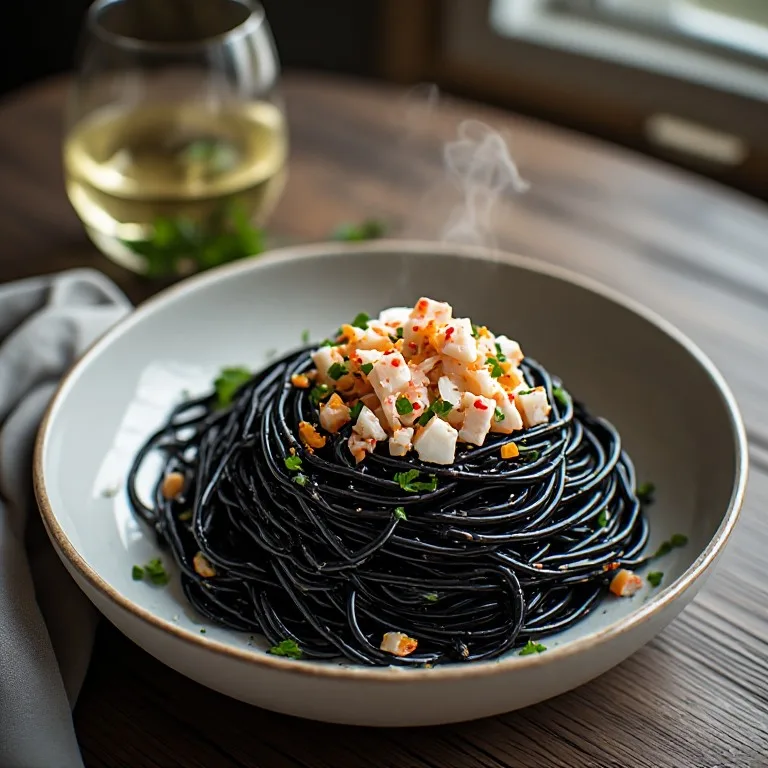
Quick answer: Bring a large pot of heavily salted water to a boil. Cook 12 oz squid ink spaghetti (De Cecco Nero or Rustichella d'Abruzzo) 1 minute less than the package directs; reserve 1 full cup of the black pasta water before draining. Meanwhile, warm ¼ cup extra virgin olive oil in a wide skillet over medium-low heat. Add 5 thinly sliced garlic cloves and cook until fragrant and very lightly golden, 2–3 minutes — do not brown. Add ½ teaspoon red chili flakes, stir once, then pour in ½ cup dry white wine and let it reduce by half, about 2 minutes. Add the drained pasta to the skillet with ½ cup of the reserved black pasta water. Toss vigorously over medium heat for 2 minutes until the sauce is glossy and coats the noodles, adding more pasta water a splash at a time if needed. Remove from heat. Fold in 8 oz fresh Dungeness lump crab meat (or quality canned lump crab, picked for shells), a squeeze of lemon juice, and 3 tablespoons fresh flat-leaf parsley. Taste, adjust salt and chili, and serve immediately — the pasta waits for no one.
Shop the tools
Gear matched to this recipe. These are Amazon affiliate links — we may earn a small commission if you buy, at no extra cost to you.
 Illustrative imageLodge 10.25" Cast Iron SkilletThe restaurant-grade sear most copycats depend onCheck price on Amazon →
 Illustrative imageInstant-Read Digital ThermometerNail fry-oil and doneness temps every timeCheck price on Amazon →
 Illustrative imageNordic Ware Half Sheet PanCommercial-quality aluminum, bakes dead evenCheck price on Amazon →
As an Amazon Associate, Copycat Spices earns from qualifying purchases. Product images are generic illustrations, not the exact item listed.
Marea Halloween Black Squid Ink Pasta (Made at Home)
A jet-black squid ink pasta with sweet lump crab, inspired by Marea's celebrated squid ink and crab pastas, made at home for Halloween. Minimal ingredients: squid ink spaghetti, garlic, white wine, crab, and good olive oil. Costs about $16 per serving vs. ~$42 for a pasta at Marea, and makes the most dramatic Halloween dinner party centerpiece imaginable.
Medium
Prep: 15 min
Cook: 20 min
Total: 35 min4 servings
~$3.85/serving
At home~$3.85/serving
vs
Restaurant~$17.32/serving
You save ~78%
The Story Behind the Recipe
Marea opened on Columbus Circle in 2009 under Chef Michael White and immediately became one of New York City's most celebrated Italian restaurants — two Michelin stars in its first year, the James Beard Award for Best New Restaurant in 2010, and a pasta menu that critics still talk about fifteen years later. Its handmade pastas run from the famous fusilli with braised octopus and bone marrow to a rotating lineup of jet-black squid ink pastas (squid ink ravioli with lobster and bottarga; garganelli neri with seppia and scallop) and delicate crab pastas (spaghetti with crab and sea urchin; casarecce with lump crab and uni). This home recipe marries two of those Marea signatures — the drama of the squid ink pasta and the sweetness of the crab — into one Halloween-black centerpiece. In the ink pasta itself, the ink is folded into the dough, not the sauce, so the noodles are deeply, dramatically black, the way a Halloween dinner table centerpiece should look. A pasta at Marea runs $38–$48 per order in 2026; made at home, with imported squid-ink spaghetti and good crab, it lands around $16 per serving.
The sauce is what makes the dish approachable at home: it is essentially aglio e olio — garlic, olive oil, white wine, and a splash of pasta water — with sweet crab folded in at the end. No cream, no tomato, no cheese (never add cheese to seafood pasta). Two things determine whether it succeeds. First: reserve at least a cup of the pasta cooking water before you drain. The water has absorbed squid ink from the pasta and turns deep charcoal-black; it is also starchy, and adding it to the pan transforms a greasy garlic-oil pan into a silky, coating sauce. Second: add the crab at the very end, off the heat. Crab is already cooked, it heats through in thirty seconds, and anything longer turns the meat rubbery.
Nutrition Facts
Per serving (4 servings)Calories580
Total Fat24g
Total Carbs52g
Dietary Fiber2g
Sugars2g
Protein32g
Sodium890mg
* Estimated values based on standard recipe preparation. Actual values may vary.
Ingredients
- For the sauce
Instructions
Pro tip: This recipe tastes even better the next day. The flavors need time to meld together in the fridge.
Storage: Keeps in an airtight container in the fridge for up to 2 weeks. Freezer-friendly for up to 3 months.
Free PDF — instant download. We'll also send new seasonal copycat recipes now and then; unsubscribe anytime. Or just download it →
🎉 Your Halloween Cookbook is ready!
It's free — but if it's worth something to you, you can pay what you want. It keeps the recipes coming.
$
✓ Downloading your free Halloween Cookbook — check your downloads folder. Happy cooking!
Make It Healthier
Love Marea Halloween Black Squid Ink Pasta (Made at Home) but want a lighter version? Try these simple swaps:
- ✓Cut olive oil to 3 tablespoons and extend the sauce with ½ cup reserved black pasta water — saves about 60 calories per serving without losing the silky texture.
- ✓Swap Dungeness crab for good-quality canned lump crab meat (King Oscar or Chicken of the Sea) — same protein, about $3 per serving less, and the finished dish is indistinguishable.
- ✓Toss in 2 cups baby arugula with the finished pasta off heat — it wilts slightly, adds iron and vitamin K, and the peppery bite cuts through the richness of the olive oil.
- ✓Use a high-protein squid ink pasta like Garofalo brand for an extra 3–4g of protein per serving at no calorie cost.
Frequently Asked Questions
What is squid ink pasta and where do I buy it?
Squid ink pasta (spaghetti al nero di seppia in Italian) is wheat pasta made with cephalopod ink — either from squid or cuttlefish — kneaded directly into the dough. The ink turns the noodles jet black and adds a faint brininess, a mild umami depth that tastes more oceanic than fishy. It does not taste strongly of squid. The best imported dried brands widely available in the US are De Cecco Nero di Seppia spaghetti (around $4–$6 a box, widely stocked at Whole Foods, specialty Italian markets, and Amazon), Rustichella d'Abruzzo (higher price, excellent quality), and Garofalo (solid, protein-forward, and easy to find at Costco and Italian delis). Fresh squid ink pasta from a pasta shop or Italian grocery case also works and takes about half the cooking time — follow package timing. Avoid squid ink pasta in generic store-brand packages that do not specify the ink source; quality varies wildly. The pasta stays black after cooking: do not try to rinse the 'color' off — it is in the noodle, not on it.
Does Marea actually serve a squid ink crab pasta?
Marea's menu features both jet-black squid ink pastas and crab pastas, though not always combined into a single dish — this home recipe merges the two into one dramatic plate. On the squid ink side, Marea has served squid ink ravioli stuffed with lobster and topped with bottarga, and garganelli neri with a seppia (cuttlefish) and scallop ragù. On the crab side, it has served fresh semolina spaghetti with crab, sea urchin, and basil, and casarecce with lump crab and uni. The house style is consistent across all of them: minimal, ingredient-forward Italian seafood cooking that lets the pasta and the shellfish carry the plate, bound only by good olive oil, a little chili, and the starch of the pasta water — no cream, no cheese. A pasta at Marea runs roughly $38–$48 as of 2026; with a glass of wine and tip, ordering a pasta and dessert lands around $90–$110 per person. This recipe delivers the same clean, briny-sweet flavor and the same jet-black drama at home for about $16 a serving.
Why can't I add Parmesan or cheese to seafood pasta?
This is a real Italian culinary rule, not arbitrary tradition. The deep umami funk of aged cheese — Parmigiano-Reggiano, Pecorino, Grana Padano — is built from long-chain fatty acids, amino acids like glutamate, and volatile aromatic compounds that developed over months of aging. When you combine those compounds with the delicate briny sweetness of fresh seafood, you do not get a richer flavor — you get muddy, conflicting notes where each element obscures the other. The fish tastes less like itself and more like aged cheese; the cheese tastes less clean and more marine. Italian coastal cooking understood this long before food science described it: pasta served with shellfish, clams, mussels, crab, or sea urchin does not get cheese. The dish already has richness from good olive oil and body from pasta water; it does not need more. If you feel the dish needs something more savory at the end, add a squeeze of lemon or a dash of good fish sauce rather than cheese.
Can I use fresh crab vs. canned lump crab for this?
Both work, and the finished dish is closer than you'd expect. Fresh Dungeness crab (in season October through January on the West Coast) is the top choice — its sweet, slightly nutty meat matches the mild brininess of the squid ink perfectly, and the larger lump pieces give texture to the bowl. A whole cooked Dungeness crab (about 1.5 lbs cooked weight) yields roughly 8–10 oz of usable meat for this recipe. Blue crab lump meat or king crab legs, cut into pieces, are both excellent substitutes. For canned: use refrigerated pasteurized lump crab meat (not shelf-stable canned crab — the texture is fine for crab cakes but gets mushy in a hot pan). Phillips, Crown Prince, and Blue Star are reliable brands. Drain and pick through for shells before using. The key either way: add the crab completely off heat in the last 30 seconds, just folding it in. It is already cooked; you are warming it, not cooking it.
What dry white wine should I use for this pasta?
Use any dry, unoaked white wine you would actually drink — Pinot Grigio, Vermentino, Albariño, or a dry Sauvignon Blanc are all good. The wine reduces in the pan for about 2 minutes, so the dominant flavor is acidity and a little sweetness from the alcohol burning off, not the varietal character. Avoid oaked Chardonnay (the oak and butter notes read oddly in a seafood pasta), sweet Riesling or Moscato (too sweet, disrupts the salinity balance), and 'cooking wine' from a bottle labeled as such — it contains added salt and poor-quality grape product that won't make a better dish than a $9 bottle of actual wine. The half-cup of wine per recipe means one bottle makes this dish 15 times, so there is no reason to use inferior wine.
How do I make the sauce glossy instead of greasy?
Glossy pasta comes from emulsification — fat and water combining into a unified sauce that coats the noodles rather than pooling at the bottom of the bowl. Three things produce it here. First: reserve the pasta water. The starch it carries is the emulsifier; without it, the olive oil and wine separate and the dish reads greasy. Use at least ½ cup and add more as needed. Second: toss the pasta in the pan vigorously and continuously — the mechanical action of tossing breaks the fat into small droplets and distributes them through the starchy water. Use tongs and keep the pan moving over medium heat; do not just stir. Third: pull the pasta off the heat 30 seconds before it looks done. Carryover heat in the pan finishes it and the sauce tightens as it rests; overcooked pasta loses the starch on its surface that holds the emulsion together. If the dish looks too dry after tossing, add pasta water a tablespoon at a time over heat. If it looks too wet (soupy), toss over slightly higher heat for another minute.
Love this recipe? Share it!
Made it? Buy us a coffee
Every recipe here is free, with no paywalls. If this one was a hit at your table, a small tip keeps new copycats coming.
$
💛 Support checkout is coming soon — the cookbook stays free either way.
Marea is a trademark of its owner, used here only to describe the dish this recipe recreates. This is an independent copycat written in our own words — Copycat Spices is not affiliated with, endorsed by or sponsored by Marea.

Ratings & Reviews
Rate this recipe
Click a star to rate