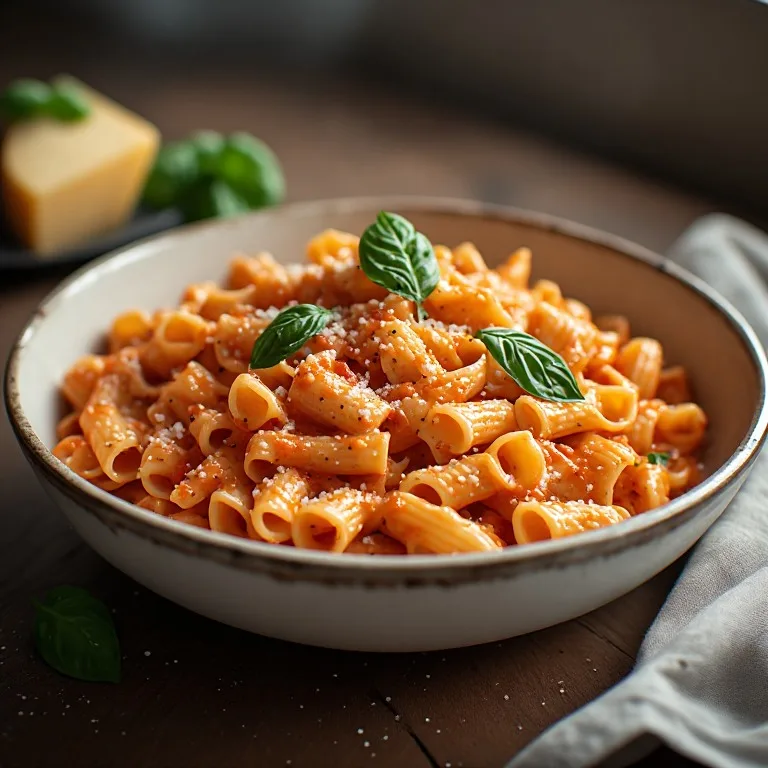



Copycat Carbone Spicy Rigatoni Vodka (The Famous One, Made at Home)
Prep time: 10 min Cook time: 30 min Servings: 4
Carbone opened in 2013 at 181 Thompson Street in Greenwich Village — in the former Rocco’s space, a classic red-sauce Italian-American restaurant that had been there for decades. Mario Carbone, Rich Torrisi, and Jeff Zalaznick of Major Food Group designed it as a modern take on that tradition: mid-century Italian-American cooking done with fine-dining technique. The New York Times gave it three stars within three months of opening.
The spicy rigatoni vodka was already a signature by the time the restaurant went viral in 2020, when Gigi Hadid posted a photo of her homemade version on Instagram Stories. The dish hadn’t changed. The audience for it suddenly got much larger. Since then, the Carbone reservation — always difficult — has become one of the hardest in New York City. The phone-in system opens limited slots at specific times; celebrities from Rihanna to the Obamas are regulars; and the restaurant seats roughly 90 people. For most people, the most realistic path to this rigatoni is to make it at home.
The recipe is not complicated. What it requires is a specific technique — and one specific ingredient — that most versions leave out.
The Foundation: Tomato Paste, Not Crushed Tomatoes
Standard vodka sauce is made with crushed or whole canned tomatoes and requires 20 to 30 minutes of simmering to concentrate the flavor. Carbone builds the sauce from a full tube of tomato paste cooked directly against a hot pan until it darkens to brick-red — a process that takes about 5 minutes and produces flavor that no amount of simmering crushed tomatoes can match.
Tomato paste is already concentrated. When heat hits it in a butter-coated pan, the sugars in the paste caramelize against the metal the same way onion sugars do. The color deepens from bright red to a darker, more muted brick. The aroma shifts from sharp and acidic to rounded and almost savory-sweet. That transformation is what makes the sauce taste like something from a restaurant rather than something from a can.
The Calabrian chili paste goes in with the tomato paste. Calabrian chilis — grown in the southern tip of Italy — have a fruity, moderately hot character that is genuinely different from generic red pepper flakes. The heat is present but not harsh; the flavor underneath is complex in a way that flakes are not. The brand that shows up most consistently in professional copycat versions is Tutto Calabria, available at Whole Foods, specialty Italian markets, and online. There is no substitution that replicates it, though a small amount of chili flakes plus a pinch of smoked paprika gets reasonably close.
Cost Comparison: Home vs. Restaurant
Carbone charges approximately $34 for a single plate of spicy rigatoni — per person, dinner only, assuming you were able to secure a reservation.
| Carbone | Homemade (4 servings) | |
|---|---|---|
| Per plate | ~$34 | — |
| Full batch (4 plates) | ~$136 | ~$30–34 |
| Per serving | ~$34 | ~$8 |
| Savings per plate | — | ~$26 |
The tomato paste and Calabrian chili paste are the two specialty items. Everything else — butter, cream, rigatoni, Parmesan, vodka — is standard grocery territory. A jar of Calabrian chili paste costs about $7 and lasts for multiple batches.
The Three Techniques Most Copycat Versions Get Wrong
1. Cook the tomato paste until it darkens — do not just stir it in
This is the most commonly skipped step and the most consequential. When a recipe says “add the tomato paste and cook for 5 minutes,” most home cooks add it and cook for 90 seconds until it’s heated through. That produces a sauce that tastes like tomato paste cooked in cream — which is fine but not the same thing.
The caramelization that happens between minutes 3 and 6 changes the character of the paste fundamentally. You will see the color shift. You will smell the transformation — from acidic to savory. You will notice the paste starting to stick slightly to the pan bottom and forming a thin crust that dissolves back into the sauce when the vodka goes in. Let all of that happen before you move to the next step.
2. Let the vodka fully evaporate
The vodka goes in as a small splash — 1/4 cup — and needs 1 to 2 minutes over low heat to lose its alcohol. The test is not time; it is smell. When the sharp, boozy edge disappears from the aroma, the vodka has done its job. If the sauce still smells aggressively of alcohol, keep stirring. A sauce that rushes this step tastes boozy and unintegrated.
3. Finish the pasta in the sauce, not the strainer
Pull the rigatoni 2 minutes early and transfer it directly to the sauce with a cup of pasta water. The starchy water is what turns a pan of thick sauce-coated pasta into a cohesive dish where every piece is evenly glazed. Without this step, the sauce breaks and pools at the bottom of the bowl. The 90 seconds of tossing over medium heat is also where the rigatoni finishes cooking — the center, which was still slightly underdone in the pot, completes in the sauce.
Tips & Variations
- Bronze-die rigatoni makes a difference. The rough surface created by bronze-die extrusion catches sauce in a way that smooth, Teflon-extruded pasta does not. Rustichella d’Abruzzo and Setaro are the premium options; Barilla Collezione is the widely available middle ground. Worth the extra dollar.
- One Calabrian chili tablespoon for mild, three for hot. The standard recipe calls for 2 tablespoons of Calabrian paste, which produces a moderate heat that most people would call “spicy but comfortable.” One tablespoon is detectably warm but not spicy. Three tablespoons is a noticeable burn. Adjust to your table.
- Add a small knob of butter off the heat for gloss. Stirring in an additional half tablespoon of cold butter with the Parmesan at the end — a classic Italian technique called mantecatura — gives the sauce a silky finish and an appealing sheen on the plate.
- The sauce holds well; the pasta does not. Make the sauce entirely in advance and refrigerate for up to 3 days. Reheat gently with a splash of water, then cook fresh rigatoni to order and toss it in. Leftover dressed pasta reheats poorly — the sauce absorbs into the rigatoni and thickens awkwardly.
- Shrimp or scallops work well as an add-in. Carbone’s menu does not include protein in the spicy rigatoni, but seared shrimp or scallops added at the toss step make it more substantial. Season them simply, sear briefly in butter, and fold in just before plating.
Storage & Reheating
Store leftover pasta in an airtight container in the refrigerator for up to 2 days. To reheat: add the pasta to a saucepan with 2 to 3 tablespoons of water or chicken broth, cover, and warm over medium-low heat, stirring occasionally. Do not microwave — the cream sauce will separate and go greasy. If you stored the sauce separately from the pasta (which is the smarter approach), reheat the sauce over low heat with a splash of water, then add freshly cooked rigatoni.
More Restaurant-Famous Italian-American Pastas
- Copycat Maggiano’s Rigatoni D — balsamic-glazed mushrooms, caramelized onions, and dry Marsala cream sauce from the dish that has never left Maggiano’s menu since 1991
- Copycat Cheesecake Factory Chicken Madeira — Madeira wine sauce with mushrooms and melted mozzarella, the Factory’s most-copied chicken pasta
- Copycat Olive Garden Chicken Marsala — how OG’s simpler Marsala approach differs from the more complex Italian-American tradition
- Viral TikTok Spicy Vodka Pasta — the TikTok take on the same vodka-cream format, with a different technique and ingredient ratio