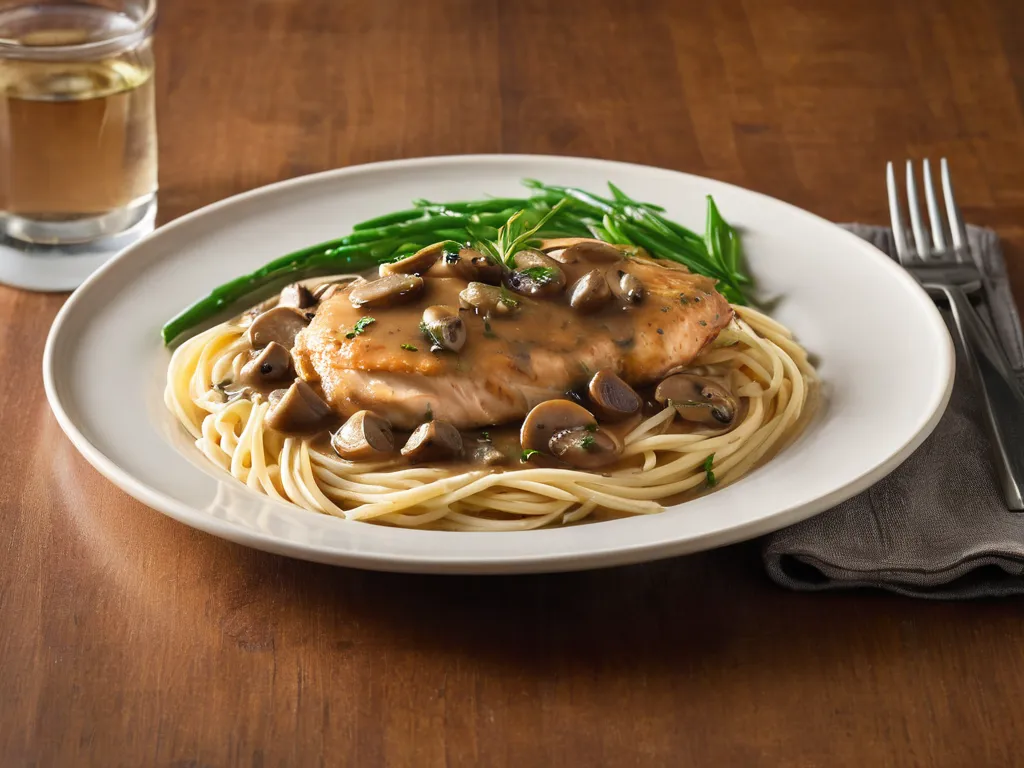
Copycat Olive Garden Chicken Marsala
Olive Garden’s Chicken Marsala is one of the most reliably good things the chain has served — tender, pan-seared chicken breast in a dark, silky sauce of Marsala wine, cremini mushrooms, and a touch of cream. Per Olive Garden’s published nutrition data the plate runs 1,080 calories and 2,690mg sodium. This version makes four servings for about $24 total, takes 45 minutes, and comes in at roughly 460 calories and 580mg sodium — the same flavor, a fraction of the sodium.
One thing worth knowing before you start: the Marsala dish on Olive Garden’s current menu is the Stuffed Chicken Marsala ($20.79) — a grilled breast filled with Italian cheeses and sun-dried tomatoes under a creamy Marsala-mushroom sauce, served with mashed potatoes (1,170 calories, 3,020mg sodium). The recipe below is the classic, non-stuffed Chicken Marsala — the leaner, mushroom-forward version Olive Garden has long been known for and the one most copycat searches are after. If you’d rather make the stuffed restaurant version, there’s a variation for it near the end.
TL;DR
Pound 4 chicken breasts to an even 1/2-inch, dredge in seasoned flour, sear golden in a stainless-steel skillet (3–4 min per side). Rest off heat. In the same pan: sauté 8 oz sliced cremini mushrooms until golden (5–7 min), add garlic (30 sec), deglaze with 3/4 cup dry Marsala, reduce by half (4–5 min), add 1/2 cup chicken broth, simmer 3 min, add 1/3 cup heavy cream, simmer until sauce coats a spoon. Off heat, whisk in 1 tbsp cold butter. Nestle the chicken back in. Serve over mashed potatoes or fettuccine. Active time: 45 minutes.
What Olive Garden’s Chicken Marsala Actually Is
Chicken Marsala is an Italian-American dish, not an Italian one. It developed in the U.S. — most likely in New York in the mid-20th century — as Italian immigrants applied their home winemaking tradition (Marsala from Sicily) to the chicken sautéed preparations they already knew. The name directly references the wine: the dish cannot be Chicken Marsala without Marsala wine.
The traditional Italian-American version uses no cream. It is a pure wine reduction: flour-dredged chicken seared golden, deglazed with Marsala, finished with chicken broth and butter. The butter emulsifies with the reduced wine to create a glossy, amber sauce.
Olive Garden’s version adds heavy cream. That is the defining difference — cream rounds the acidity of the wine, adds body, and creates the opaque, satin-smooth sauce that looks and feels distinctly like the restaurant version rather than the leaner classic. If you make the recipe without cream, you will get an excellent, more austere chicken marsala that is arguably more “authentic.” If you want the dish that tastes like Olive Garden, keep the cream in.
The Wine: What Marsala Actually Is
Marsala is a fortified wine with DOP (Protected Designation of Origin) status, made exclusively in and around the town of Marsala in western Sicily. The DOP framework was formalized in 1969, though the wine has been produced in the region since at least the late 18th century.
The primary white grape varieties are Grillo, Inzolia, and Catarratto — the same grapes used in much of Sicilian white wine production. Like sherry and port, Marsala is fortified with grape spirit (brandy) to reach 15–20% ABV, which gives it extended shelf life and a deeper, more complex flavor than an unfortified wine.
The key distinction for cooking is sweetness:
- Secco (Dry): Maximum 40g/L residual sugar. This is what you want for savory dishes. It concentrates beautifully as it reduces, picking up nutty, caramelized notes without becoming sweet.
- Semisecco (Semi-dry): 41–100g/L residual sugar. Works but can tip the sauce too sweet.
- Dolce (Sweet): Over 100g/L residual sugar. For desserts — zabaglione, tiramisu — not for chicken.
The major producers are Florio (est. 1833 in Marsala), Lombardo (est. 1881 in Marsala), and Cantine Pellegrino — all from the town itself. Any of these in the Secco style costs $8–$12 and will last for multiple batches. Do not substitute “cooking wine” labeled Marsala — it contains added salt and preservatives that produce a significantly worse sauce.
Why This Recipe Works
The flour dredge does double duty. Pan-frying the flour-coated chicken builds a golden crust and releases starch into the pan drippings. That starch thickens the sauce passively as it simmers — no separate roux needed.
Deglazing is the flavor step most people skip. The browned bits stuck to the pan after searing the chicken (the fond) contain concentrated caramelized proteins. When the Marsala wine hits the hot pan, it dissolves all of that into the sauce. Starting with a clean pan means losing roughly half the flavor.
Dry Marsala, not sweet. Olive Garden’s sauce has a subtle sweetness from the reduction, not the wine. Dry Marsala concentrates into a nutty, caramelized base as it reduces. Sweet Marsala is made for desserts and will make the sauce cloying.
Cream makes it Olive Garden. Classic Italian-American Chicken Marsala contains no dairy — it is a pure wine reduction. Olive Garden’s version is visibly richer and more opaque because cream is in the sauce. One-third cup is enough to create that silky texture without making the dish heavy.
The cold butter finish. Whisking one tablespoon of cold butter into the sauce off heat — monter au beurre — is what gives the sauce its glossy, restaurant-quality sheen. It takes ten seconds and is a noticeable difference.
Pro Tips
- Pound the chicken to an even 1/2-inch. Thick spots cook slower; thin spots overcook. A few minutes with a mallet or the bottom of a heavy pan eliminates the dry-edges problem.
- Don’t crowd the pan. If your skillet won’t fit all four breasts without touching, cook them in two batches. Crowded chicken steams instead of sears, and you’ll lose the golden crust.
- Let the mushrooms get golden before deglazing. Mushrooms need 5 to 7 minutes to release water and then brown. Add the Marsala too early and you’ll steam them instead. The color on the mushrooms carries directly into the sauce’s flavor.
- Reduce the wine fully. The alcohol smell should be completely gone before you add the broth. This takes 4 to 5 minutes over medium-high heat. Underreduced Marsala sauce has a raw, boozy edge that dominates the mushroom flavor.
- Never boil after adding cream. A hard boil breaks an emulsified cream sauce, leaving an oily surface. Keep it at a gentle simmer — small bubbles at the edge, not a rolling boil.
Troubleshooting
| Problem | Cause | Fix |
|---|---|---|
| Sauce too thin | Chicken not dredged, or not reduced long enough | Simmer uncovered 5 more minutes; or whisk in 1 tsp cornstarch dissolved in 1 tsp cold water, simmer 2 min |
| Sauce too thick | Reduced too far | Add 2–3 tbsp chicken broth, stir over low heat until right consistency |
| Sauce broke (oily surface) | Boiled after adding cream | Off heat, whisk in 1 tbsp cold butter; milk solids help re-emulsify |
| Chicken dry | Uneven thickness or overcooked | Pound to even 1/2-inch; pull at 163°F internal — carryover brings it to 165°F |
| Sauce tastes boozy/acidic | Wine not reduced long enough | Simmer on medium-high until the alcohol smell is completely gone (4–5 min minimum) |
| Mushrooms watery in sauce | Pan not hot enough, or added before it was ready | Cook mushrooms on medium-high with space between pieces; don’t salt until golden |
| Garlic burned | Added at the start with mushrooms | Add garlic in the last 30 seconds of mushroom cooking only |
Restaurant vs. Home: What You’re Getting
| Olive Garden | Cheesecake Factory | Home (this recipe) | |
|---|---|---|---|
| Calories | 1,080 | 1,510 | ~460 |
| Sodium | 2,690mg | 4,150mg | ~580mg |
| Fat | 56g | 72g | ~26g |
| Protein | 69g | 87g | ~38g |
| Cost | ~$20 | ~$25+ | ~$6/serving |
The Cheesecake Factory’s Chicken Marsala & Mushrooms (1,510 cal / 4,150mg sodium) is an illustration of how much the same dish can vary between chains. Olive Garden’s version is actually restrained by comparison. The home version achieves the same flavor profile at less than half the calories and less than a quarter of the sodium of either restaurant, largely because the portion is smaller and the kitchen uses less added salt. (The Olive Garden column reflects the classic Chicken Marsala’s published nutrition; the cost is benchmarked to the current Stuffed Chicken Marsala at $20.79.)
Variations Worth Making
No-Cream Classic. Skip the cream and double the broth reduction time. Bring the wine and broth together to a concentrated sauce, then finish with 2 tablespoons of cold butter whisked in off heat. This is the traditional Italian-American preparation — leaner, more acidic, and more wine-forward. Excellent, and noticeably different from Olive Garden.
Porcini Upgrade. Soak 1/2 oz of dried porcini mushrooms in 1/2 cup of warm water for 15 minutes. Drain, squeeze dry, and add them to the cremini when sautéing. Add the strained soaking liquid to the broth. The porcini add a meaty, deeply savory depth that makes the sauce noticeably more complex.
Turkey Marsala. Substitute pounded turkey breast cutlets for the chicken — they are naturally thinner and cook in 2 to 3 minutes per side. The sauce is identical. A good use for turkey cutlets outside of Thanksgiving.
Stuffed Chicken Marsala. Pound chicken breasts thinner (1/4 inch), spread with a mixture of ricotta, shredded mozzarella, and chopped sun-dried tomatoes, roll tightly, and secure with toothpicks. Sear the rolls (5–6 min per side over medium heat) then braise covered in the Marsala sauce for 12–15 minutes. This is the home version of Olive Garden’s Stuffed Chicken Marsala.
Portobello Marsala (Vegetarian). Replace the chicken with 2 large portobello mushroom caps per person. Wipe clean, remove gills, sear 3–4 minutes per side in the olive oil-butter combination. Remove and rest; build the Marsala cream sauce with cremini mushrooms and garlic, then plate the portobellos over the sauce. Use vegetable broth instead of chicken broth.
Storage and Reheating
Storing: Refrigerate the sauce and chicken separately for up to 3 days. The sauce freezes well for up to 3 months; the chicken does not freeze after cooking.
Reheating: Warm the sauce over low heat, adding a splash of broth if it has thickened. Add the chicken and heat through on the lowest setting for 4 to 5 minutes. Do not microwave — the rapid heat can break the cream emulsion and leave an oily surface.
More Olive Garden at Home
- Olive Garden Chicken Alfredo — the most-ordered item on the Olive Garden menu, a cream-Parmesan sauce over fettuccine with the same pan-seared chicken breast. A natural weeknight companion to Marsala.
- Olive Garden Fettuccine Alfredo — the definitive version of the base Alfredo sauce, with detailed notes on why the sauce works and how to keep it from breaking.
- Olive Garden Chicken Scampi — garlic butter, white wine, and cream over angel hair with tri-color bell peppers. A lighter, more herbal dish than either Marsala or Alfredo.
- Olive Garden Breadsticks — garlic-buttered rolls for scooping the extra Marsala sauce from the plate.
- Olive Garden Zuppa Toscana — spicy Italian sausage, kale, and potato soup; the right first course before any of these chicken dishes.
See all Olive Garden copycat recipes →