restaurant: “pok-pok” title: “Pok Pok Fish Sauce Wings (Ike’s Vietnamese Wings, Made at Home)” seoTitle: “Copycat Pok Pok Fish Sauce Wings — The Exact Recipe from Andy Ricker’s Cookbook” description: “Pok Pok’s legendary fish sauce wings made at home — the James Beard-winning dish that closed when Andy Ricker shuttered all his restaurants in 2020. Fish sauce + superfine sugar marinade, cornstarch-fried until crisp, then tossed in a caramelized glaze with crispy fried garlic. The only dish at the restaurant people ordered every single time.” tags: [“pok-pok”, “vietnamese”, “chicken”, “wings”, “fried-chicken”, “fish-sauce”, “asian”, “party-food”, “make-ahead”, “famous-restaurant”, “copycat”, “game-day”, “appetizer”] date: “2026-09-25” dateModified: “2026-09-25” lane: “famous-copycat” prepTime: “20 min (plus 4-hour marinade)” cookTime: “25 min” servings: “4 as an appetizer” difficulty: “Medium” howToEnabled: true quickAnswer: “Make the marinade first: mince 8 medium garlic cloves with 1 teaspoon kosher salt, then mix with 1/4 cup warm water in a small bowl. Let sit 5 minutes, then strain through a fine-mesh sieve into a bowl, pressing the garlic solids firmly to extract every drop. Save the garlic solids for the garnish. Add 1/2 cup Vietnamese fish sauce (Red Boat is ideal) and 1/2 cup superfine sugar to the strained garlic water; stir until sugar dissolves. You now have about 1 cup of marinade. Put 2 pounds of split chicken wings in a zip-lock bag or bowl and pour in 1/2 cup of the marinade. Seal and refrigerate at least 4 hours, or overnight. Reserve the other 1/2 cup separately. When ready to cook: drain the wings, pat completely dry, toss in 1/4 cup cornstarch, and shake off the excess. Heat at least 4 cups of neutral oil in a heavy pot or wok to 350°F. Fry wings in batches without crowding, 10 to 12 minutes per batch, until deep golden brown and cooked through. Drain on a wire rack. Meanwhile, fry the reserved garlic solids in 2 tablespoons of oil in a small skillet over medium heat, stirring, until evenly golden, about 5 minutes — watch closely, they burn fast. Remove to paper towels. To glaze: pour the reserved 1/2 cup marinade into a large skillet or wok over high heat. Let it come to a boil and reduce for 2 to 3 minutes until syrupy. Add all the fried wings and toss every 15 seconds until the glaze clings and caramelizes, about 1 minute total. Scatter the fried garlic over the top and toss 30 seconds more. Serve immediately with fresh mint leaves alongside.” seeAlso:
- “copycat-momofuku-pork-buns”
- “copycat-nobu-rock-shrimp-tempura”
- “viral-tiktok-katsu-sando”
- “copycat-ippudo-akamaru-modern-ramen”
- “copycat-din-tai-fung-soup-dumplings” faq:
- question: “What is the right fish sauce to use — Vietnamese or Thai?” answer: “Andy Ricker’s cookbook specifies Vietnamese fish sauce, not Thai. Vietnamese and Thai fish sauces taste different: Vietnamese versions (Red Boat is the gold standard) are typically two-ingredient — anchovies and salt — with a clean, deeply savory flavor and no added sugar or preservatives. Thai fish sauces (like Tiparos or Megachef) are lighter in color and slightly milder. Red Boat 40°N is the premium choice and exactly what Pok Pok used in Portland; Three Crabs (Vietnamese, widely available) works well and is more affordable. Avoid Thai fish sauce here if you can — the flavor difference is noticeable once the glaze caramelizes.”
- question: “Why superfine sugar and not regular granulated or palm sugar?” answer: “Superfine sugar dissolves immediately in the cold fish sauce without heat, which matters because you want the marinade fully dissolved before it goes on the raw wings. Regular granulated sugar works but takes more stirring and sometimes leaves small undissolved crystals. Palm sugar — which is common in Thai cooking — is a home-cook substitution that some copycat recipes use; it is not what the original recipe calls for. Palm sugar adds a molasses-like complexity that is not part of Pok Pok’s wing flavor. Stick with white superfine for the original result. You can make superfine at home by blitzing granulated sugar in a food processor for 30 seconds.”
- question: “Can I bake or air-fry these instead?” answer: “You can, but the result will be noticeably different. Deep frying at 350°F gives the wings a very specific crisp, thin shell that holds up when tossed in the caramelizing glaze. Baked wings release steam, which softens the crust before you can get the glaze on. Air-fried wings come closer — toss in cornstarch, cook at 400°F for 20 to 22 minutes, flipping halfway — but the skin texture is drier and less cohesive than deep fried. If you do air-fry, let the wings sit uncovered in the refrigerator for 30 minutes after cornstarch coating to help the coating set. The glaze step is the same regardless of cooking method.”
- question: “Why does the recipe strain the garlic out of the marinade rather than leaving it in?” answer: “Two reasons. First, wet garlic morsels on raw chicken during a long marinade can develop an off-flavor — the aromatic compounds in garlic break down into sulfur compounds when left to macerate in an acid-and-salt environment for hours. Straining them out keeps the marinade tasting clean and fresh. Second, the strained garlic solids get reserved and fried separately as a garnish — crispy fried garlic scattered over the finished wings is a flavor layer in its own right, distinct from the glaze. If you left the raw garlic in the marinade and tried to caramelize it in the finishing step, it would burn before the glaze comes together.”
- question: “What does ‘caramelizing’ the glaze actually mean — how do I know when it’s done?” answer: “The reserved fish sauce and sugar mixture, when reduced in a hot skillet, goes through a color and texture transformation: it starts looking thin and amber, then within 2 to 3 minutes of high heat it darkens to a deeper brown and starts to look syrupy rather than watery. When you drag a spatula through it and the trail holds for a second before closing, it is ready for the wings. Once the wings go in, the goal is to toss every 15 seconds so the glaze coats without burning — the high sugar content means it scorches fast. The finished wings should look lacquered rather than wet: the glaze is set on the surface, slightly sticky, with a faint sheen. If the glaze starts smoking heavily, lower the heat immediately.”
- question: “What is Vietnamese mint and where can I find it?” answer: “Vietnamese mint (rau ram, also called Vietnamese coriander) is a leafy herb with a distinct flavor — sharp, peppery, and faintly citrusy, with none of the cool menthol of regular spearmint. It is standard in Vietnamese cooking for spring rolls and herb plates. At Pok Pok, a small pile of fresh Vietnamese mint leaves was served alongside the wings so you could pick up a wing, wrap it loosely in a leaf, and eat it together — the herb cuts through the fat and the salty-sweet glaze. Find rau ram at Asian grocery stores (especially Vietnamese-run ones) year-round; in a pinch, a mix of regular fresh mint and fresh cilantro approximates the cooling-plus-green-herbal effect, though it is not the same.”
- question: “Why did Pok Pok close, and can I still visit?” answer: “All Pok Pok locations — including the original on SE Division in Portland — permanently closed in October 2020. Andy Ricker cited the pandemic as the immediate cause, but also wrote in his farewell that he had long felt the business had grown beyond the point where it could be about the food and culture rather than profit. He moved to Thailand, where he had been spending part of each year, and has no plans to reopen. At its peak, Pok Pok had locations in Portland, Brooklyn, Los Angeles, and Las Vegas. The 2013 cookbook, Pok Pok: Food and Stories from the Streets, Homes, and Roadside Restaurants of Thailand, remains in print and is the closest thing to the restaurant’s actual recipes — these fish sauce wings are in it.”
- question: “The glaze burnt before it coated the wings — what went wrong?” answer: “The most common cause is a pan that is too thin or hot spots that concentrate heat. Use a wide, heavy skillet or a well-seasoned wok so heat distributes evenly. Reduce the reserved marinade to syrupy consistency over medium-high heat before adding the wings — if you add the wings to a still-liquid marinade, they need to cook in the pan longer, and the glaze reduces and scorches before it coats. Once wings go in, keep them moving constantly — tossing every 15 seconds is not decorative. If the glaze starts to smoke heavily, pull the pan off heat for 15 seconds, toss, then return to medium heat. You can also add a tablespoon of water to the glaze if it tightens too fast.” ingredients:
- “Marinade and Glaze:”
- “8 medium garlic cloves (about 1 oz / 28g), peeled”
- “1 teaspoon kosher salt”
- “1/4 cup warm water”
- “1/2 cup Vietnamese fish sauce (Red Boat 40°N recommended; Three Crabs is a good budget alternative)”
- “1/2 cup superfine sugar (or blitz regular granulated sugar in a food processor 30 seconds)”
- “Wings:”
- “2 pounds chicken wings, split into drumettes and flats (tips removed)”
- “1/4 cup cornstarch”
- “Neutral oil for deep frying (canola, peanut, or vegetable — at least 4 cups)”
- “Garnish:”
- “Reserved strained garlic solids (from making the marinade)”
- “2 tablespoons neutral oil (for frying the garlic garnish)”
- “Fresh Vietnamese mint (rau ram), or regular fresh mint” instructions:
- “Make the garlic marinade: Finely mince the garlic cloves. Sprinkle the kosher salt over the minced garlic and chop together for about 15 seconds until well combined. Transfer to a small bowl, add the warm water, and stir. Let sit for 5 minutes. Set a fine-mesh strainer over a medium bowl and pour the garlic mixture through it, pressing the garlic firmly with the back of a spoon to extract every drop of liquid. Reserve the strained garlic solids on a small plate for the garnish — do not discard them.”
- “Mix the marinade: Add the fish sauce and superfine sugar to the garlic water in the bowl. Stir until the sugar is completely dissolved — about 1 minute. You should have just under 1 cup of marinade. Divide it in half: put 1/2 cup in a large bowl or zip-lock bag for marinating, and reserve the other 1/2 cup in a separate small container for the finishing glaze.”
- “Marinate the wings: Add the split chicken wings to the marinade bowl. Toss well to coat every surface. Cover and refrigerate for at least 4 hours, or overnight. Toss once or twice during marinating. The longer they marinate, the more flavor they absorb.”
- “Set up for frying: When ready to cook, drain the wings and spread them on a clean surface or tray lined with paper towels. Pat them completely dry — moisture prevents the cornstarch from adhering and steams the wings rather than frying them crisp. Let them air-dry for 10 minutes if time allows. Toss the dried wings with the cornstarch in a bowl, coating all surfaces. Shake off any excess.”
- “Fry the wings: Pour at least 4 cups of neutral oil into a heavy pot, Dutch oven, or deep wok. Heat to 350°F over medium-high heat (use a thermometer). Working in batches of 5 to 6 wings so the oil temperature stays stable, fry until deep golden brown and cooked through, 10 to 12 minutes per batch. Do not crowd the pot. Transfer to a wire rack set over a baking sheet. Let all wings finish frying before glazing.”
- “Fry the garlic garnish: While the wings fry, heat 2 tablespoons of oil in a small skillet over medium heat. Add the reserved garlic solids. Cook, stirring constantly, until evenly light golden brown, about 5 minutes — they go from golden to burnt very quickly, so do not walk away. Remove with a slotted spoon to a paper towel–lined plate. Set aside.”
- “Make the finishing glaze: Pour the reserved 1/2 cup of marinade into a large skillet or wok over high heat. Bring to a boil, then reduce the heat slightly and cook until the marinade reduces and thickens to a syrupy consistency, about 2 to 3 minutes. It should coat the back of a spoon.”
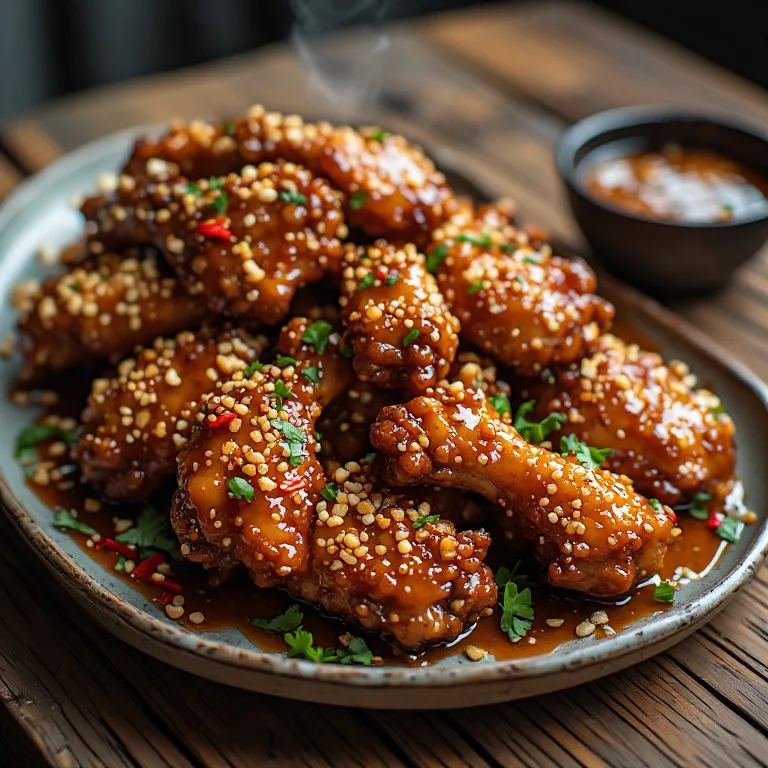
- “Glaze and serve: Add all the fried wings to the skillet with the glaze. Toss every 15 seconds, working quickly to coat every surface. After about 1 minute, the glaze should cling and caramelize on the wings — they will look lacquered rather than wet. Scatter the fried garlic over the top and toss for 30 seconds more. Transfer immediately to a serving plate. Serve with fresh Vietnamese mint or regular mint leaves for wrapping alongside.” body: |
The One Dish That Made Pok Pok Impossible to Close
When Andy Ricker opened Pok Pok in Portland in 2005 — in a converted house on SE Division Street — he was selling Thai street food from a cart to passing cyclists. The restaurant that grew from that cart eventually earned him the James Beard Award for Best Chef Northwest in 2011 and had locations in Brooklyn, Los Angeles, and Las Vegas before the pandemic ended all of it in 2020.
The dish itself was not Ricker’s invention. He first ate fish sauce wings — gà chiên nước mắm — at a bia hoi (fresh-beer) stand in Hanoi and wanted to put them on his menu. His early attempts came out too salty. So he asked Ich “Ike” Truong — a recent arrival from Vietnam who had worked on Ricker’s house-painting crew and became one of Pok Pok’s first employees — whether he knew how to make them right. Ike’s fixes were simple and decisive: soak the garlic in water and strain it into the marinade, add a little more sugar, and glaze the fried wings in that same reduced marinade. By Ricker’s own telling it was one afternoon, maybe an hour of Ike’s time — but it was the difference, and so the wings carry Ike’s name. The dish was later named one of Food & Wine’s Top 10 Restaurant Dishes of 2007. It was the one thing at Pok Pok that people who had been once — or had only heard about the restaurant secondhand — knew they were going to order before they sat down.
When Andy Ricker closed the last Pok Pok location permanently in October 2020 and moved to Thailand, the wings became a recipe people had to make at home if they wanted to taste them again.
Why These Wings Taste Like Nothing Else
The flavor profile is built around a structural paradox: fish sauce is one of the saltiest, most intensely savory ingredients in any pantry. Sugar is sweet and neutral. Combined in a 1:1 ratio — equal parts by volume — they do something unexpected: neither the salt nor the sweetness dominates. What emerges is umami. Not the polite umami of a parmesan rind in tomato sauce, but something louder and more insistent, with a caramel edge from the reduction.
The garlic plays a supporting role, but it is not simply minced into the marinade and left to sit. It gets soaked in warm water first, then strained — leaving the marinade clear and clean, with garlic flavor but without raw garlic’s sharpness. The strained garlic solids get fried separately and scattered over the finished wings as a garnish. This is a two-stage garlic application: flavor in the marinade, crunch and richness on top.
The chicken marinates for at least four hours. This is not optional. The fish sauce is aggressive; it penetrates deeply and changes the character of the meat from the surface in — the finished wing is seasoned through, not just coated.
The Three Steps Most Copycat Recipes Get Wrong
They skip the garlic-water technique. Mincing garlic directly into the marinade produces a different result than straining it through water. The warm water draws out the water-soluble flavor compounds while leaving the coarser pungent aromatics behind. The resulting liquid has a gentler garlic presence that amplifies the fish sauce without competing with it. This step takes five minutes and matters.
They don’t dry the wings before frying. Marinated wings emerge from the refrigerator wet. If you put wet wings into hot oil, the surface steams instead of frying, and the cornstarch coating turns paste-like instead of crispy. Pat them dry, let them air-dry for 10 minutes, then coat in cornstarch immediately before frying.
They rush the glaze. The reserved marinade needs to actually reduce before the wings go in. An unreduced, thin marinade cannot coat and caramelize in the time the wings are in the pan — it just steams them. Reduce until syrupy first, then add the wings and keep them moving every 15 seconds. Thirty to sixty seconds of tossing is all it takes once the glaze is ready.
The Cookbook
Andy Ricker published Pok Pok: Food and Stories from the Streets, Homes, and Roadside Restaurants of Thailand (Ten Speed Press, 2013) while the restaurant was still at its peak. The fish sauce wings recipe in the cookbook is the authoritative version — it is the recipe these instructions are based on. The cookbook remains in print and is worth owning; the food it documents is not available anywhere in the United States anymore.
Ricker is currently in Thailand and has said publicly that he has no plans to reopen. The wings are the one part of what he built that you can still make exactly as he served it.