


Crispy Rice — The Technique Behind TikTok’s Most-Replicated Bite
The crispy rice bite went viral somewhere around 2021, and it’s never really left. It shows up in restaurant menus disguised as high-concept appetizers, in home cooking videos with millions of views, and in meal-prep content as a satisfying way to resurrect leftover rice. The technique looks difficult. It’s genuinely one of the more forgiving things you can do in a kitchen.
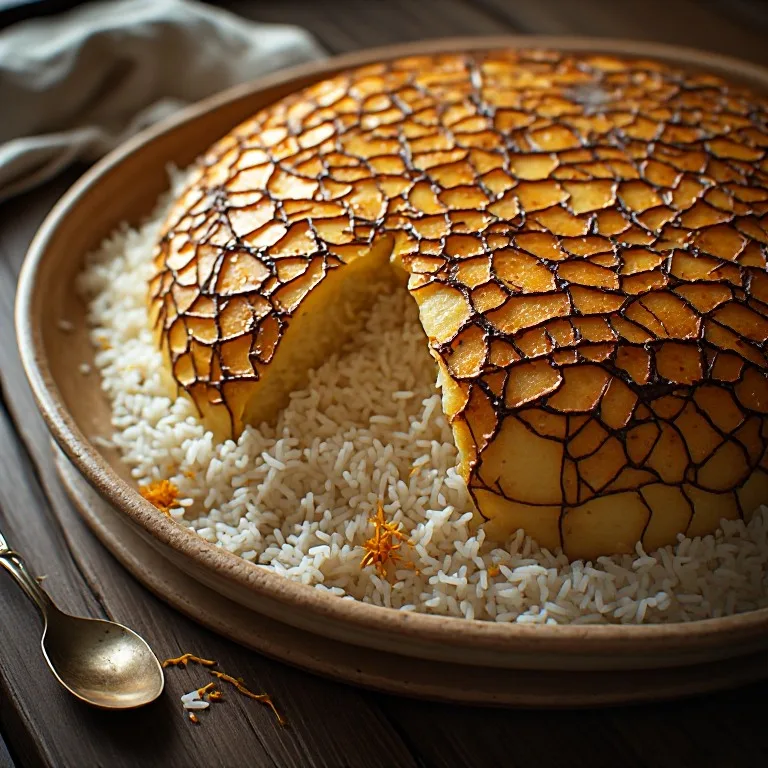
The fundamental idea is ancient — crispy rice appears in Persian tahdig, Korean nurungji, and Japanese okoge, all of which intentionally create a browned, crunchy crust at the bottom of the rice pot. The TikTok version adapts that principle into something portable and toppable, turning day-old rice into a vehicle for everything from spicy tuna to mango salsa.
The Science of Rice Starch Retrogradation
The reason day-old rice is non-negotiable is chemistry. Rice starch exists in an amorphous (disordered) state when hot and freshly cooked. As it cools, particularly overnight in the fridge, the starch molecules realign into a more crystalline, ordered structure — a process called retrogradation.
Retrograded rice is firmer, less sticky on the surface (because the outer starch molecules have locked up), and better able to form a cohesive structure. When you press it into a pan and refrigerate it further, those starch molecules compact and bind. The resulting block cuts cleanly and holds together in the frying pan long enough to develop a full crust.
Fresh rice hasn’t retrograded. Its starch is loose, wet, and disordered. Press it into a pan and it’ll be gummy rather than firm. Try to fry it and it steams in its own moisture, softens further, and falls apart.
This is a case where impatiently using fresh rice doesn’t produce a slightly worse version of the same result — it produces a fundamentally different and unsuccessful result.
Why the Pan Temperature Matters
The crust formation on crispy rice is the Maillard reaction happening at the rice starch surface. Maillard requires high heat and relatively dry conditions. A pan that’s too cool produces two problems: insufficient heat for browning, and too much time in the pan, which means steam from the rice’s moisture softens the bottom before a crust can form.
A properly hot pan (oil shimmering, verging on smoking for high-smoke-point oils) immediately contacts the cold rice surface and begins rapid starch gelatinization and browning at the interface. The crust sets quickly before significant moisture can escape. You’re racing the clock, and a hot pan wins that race.
The test: if you can hear aggressive sizzling immediately when the rice cake hits the oil, your pan is ready. Gentle sizzling or no sizzling means the pan needs more time.
The Patience Problem
The single most common mistake in crispy rice is flipping too early. The rice cake will genuinely stick to the pan for the first 2–3 minutes of frying. This is expected and not a problem. The starch on the bottom surface is still gelatinizing and hasn’t formed the cohesive crust that allows clean release.
If you try to flip and it’s sticking, leave it. A properly crunchy base will release from even a stainless skillet with minimal encouragement. If it’s still sticking, it isn’t done. The golden rule of pan frying: if it doesn’t release, it’s not ready.
At 3–4 minutes you should be able to slide a spatula under the edge and feel it lift cleanly with a papery crunch. That sound — that crackle — is what you’re waiting for.
Building the Perfect Topping
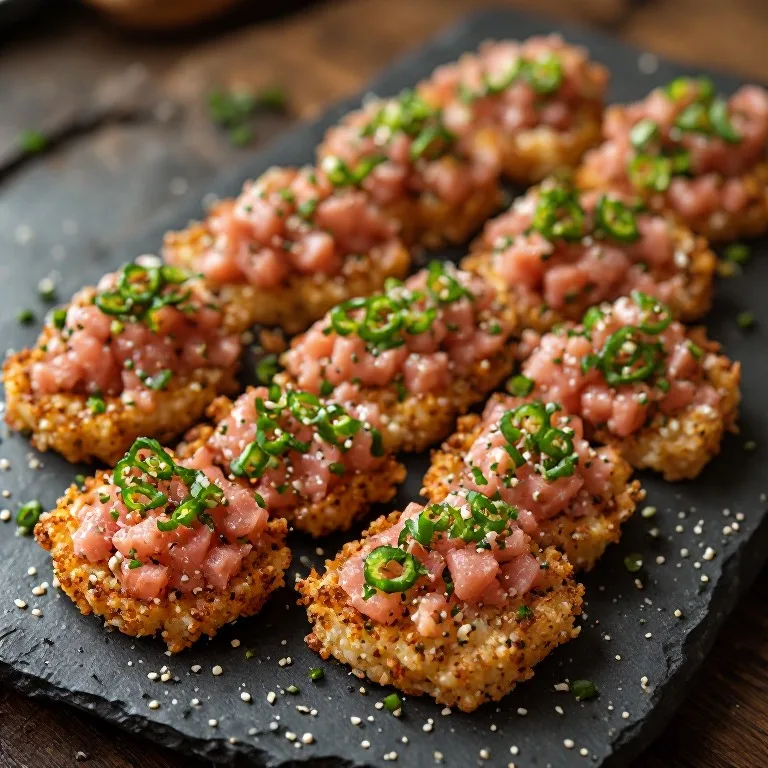
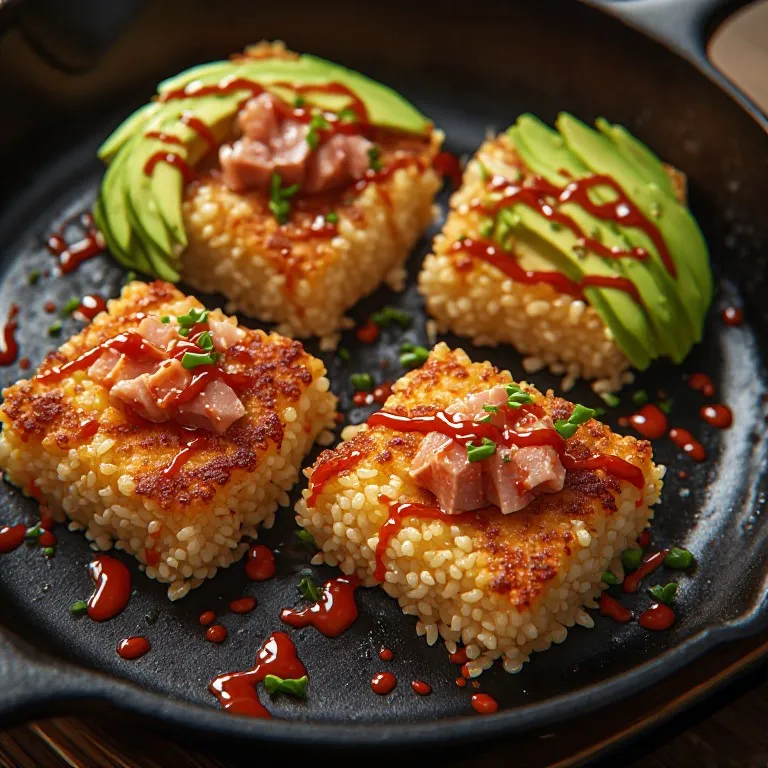
The spicy tuna is the canonical TikTok version, and it works because of contrast. The rice is hot, crunchy, savory, neutral. The tuna mixture is cool, creamy, spicy, and rich. The avocado adds a third layer: fatty, buttery, and cooling against the sriracha heat.
The proportions matter for the topping too. You want enough mayo to bind and lubricate, not so much that it overwhelms the tuna. Start with 1:3 mayo-to-tuna ratio and adjust. The sriracha should be present but not the dominant flavor — it’s heat and brightness to cut the richness.
Apply the topping the moment the rice cakes come out of the pan, while they’re still crackling hot. The temperature differential between hot rice and cool tuna is part of the appeal. Serve immediately — crispy rice cakes begin softening within 5 minutes at room temperature, and the crunch is the entire point.
Beyond Spicy Tuna: Where This Technique Goes
The crispy rice base is neutral enough to go anywhere. Korean-inspired versions top with gochujang beef and kimchi. Mexican-adjacent versions use black beans, corn, and chipotle crema. Pure comfort versions get a fried egg and chili crisp. The technique is the foundation — the topping is a canvas.