


Viral TikTok Tahdig (Persian Crispy Rice)
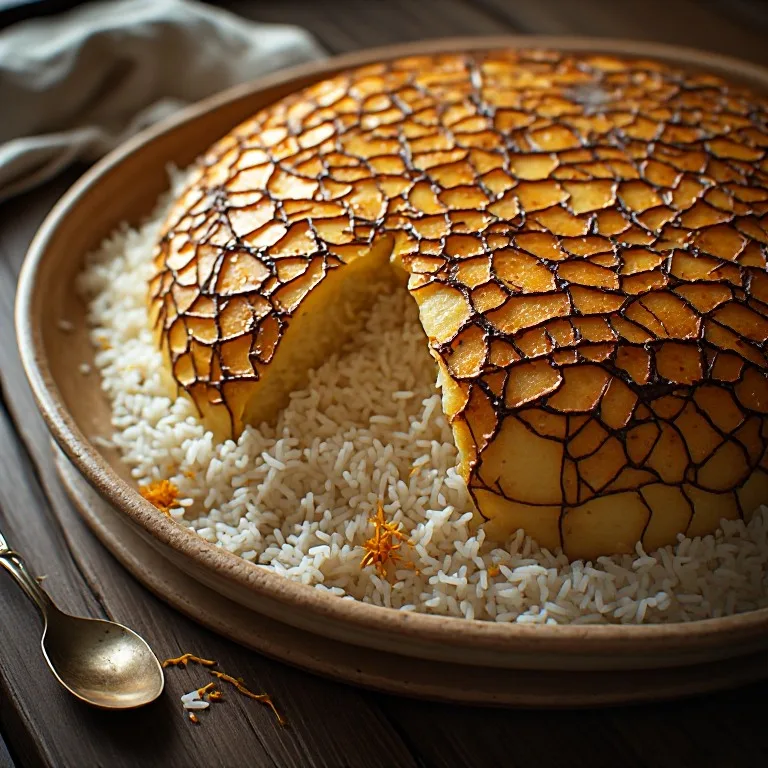
The clip is always the same: a nonstick pot on a stovetop, a towel-wrapped lid, and then — a platter placed on top, a confident flip, the pot lifted slowly. A golden dome slides out, caramelized potato crust facing upward, saffron-tinted fluffy rice surrounding it. The creator presses the crust once with a finger. It crackles.
Tahdig has been part of Persian cooking for centuries. It has spent the last several years being discovered by the rest of the world via TikTok, where the inversion reveal — one of the most satisfying single actions in all of cooking — has attracted tens of millions of views. The word itself means “bottom of the pot.” In Persian households, that bottom layer is historically the prize: the most coveted bite, given to guests of honor, fought over by children.
The technique has a reputation for being difficult. It is not — but it does require understanding why each step exists. The parboil stage is where most home cooks fail. The towel-on-the-lid step is the one most people skip until they’ve had a steam-soaked failure. The thermal shock before inversion is the step that determines whether the crust releases or tears.
Why TikTok Found Tahdig
Every tahdig video follows the same arc: the ordinary-looking stovetop moment, then the flip, then the reveal. The crust is always slightly improbable-looking — too golden, too intact, too architectural for something made in a regular pot. The reason it reads as a reveal rather than just a finished dish is the inversion: the cook makes something that cannot be seen until the last moment, and then shows it all at once.
This is also why tahdig tutorials perform better on TikTok than almost any other rice dish. There’s a clear before and after, a moment of tension during the flip, and an unambiguous visual payoff. Creators from Iranian-American families began sharing their grandmother’s technique in 2020 and 2021; by 2023, the format was being attempted by home cooks who had never made Persian food at all.
The Two-Phase Cooking Logic
Most recipes describe tahdig as a single process: put it on the stove, walk away. The two-phase approach makes the result more reliable.
Phase 1 (high heat, 3 minutes) is when the crust actually forms. The oil in the pot is hot enough during this phase to fry the potato base and sear the bottom layer of rice. If you go straight to low heat, the oil never gets hot enough to initiate crisping — you get a soft, pale bottom instead of a golden crust.
Phase 2 (lowest heat, 35 to 40 minutes) is when the rice steams through. The residual heat from the pot and the trapped steam in the enclosed pot cook the rice grains the rest of the way. The oil around the potatoes keeps the bottom crisping slowly at a rate that produces color without burning.
The transition between phases is where beginners make mistakes. Reducing too slowly means the crust scorches during Phase 1. Reducing too late means the same. Set a timer for 3 minutes after the lid goes on; the moment it goes off, move the dial to its lowest setting.
The Three Most Common Failures
Mushy rice: The parboil went too long. The rice entered the pot already fully cooked, and the steaming phase pushed it over the edge. Taste at 5 minutes. The grain should be cooked on the outside but have a faint chalky resistance at the very center — not hard or raw, but not fully yielding either. Drain the moment you hit that window.
Wet patches in the crust: The towel was either absent, too thin, or terrycloth (which doesn’t absorb steam efficiently). A folded cotton dish towel, pressed firmly under the lid and tucked so all corners are secured on top of the lid, is the fix. The towel must cover the entire interior surface of the lid — moisture drops from the edges count as moisture.
Crust tears on inversion: Skipped the thermal shock. The brief cold exposure — setting the pot on a cold wet towel for 30 seconds, or running cold water over the bottom — contracts the metal slightly and breaks the suction between the crust and the pot surface. Without it, the crust is still adherent and pulls apart when you try to lift the pot.
The Potato Layer and Its Alternatives
Potato tahdig is the most beginner-friendly version because the potato gives you a visual indicator of progress (golden potato = successful crust), acts as a buffer that prevents the rice from burning, and produces the most photogenic reveal — thin rounds of caramelized potato draped over the dome.
Lavash tahdig skips the potato and uses a cut sheet of lavash or thin flatbread on the bottom. The bread crisps into something like a giant cracker. Many Iranians prefer this version — it’s crunchier than potato, shatteringly thin, and the bread soaks up a little of the saffron and oil from above.
Plain rice tahdig requires the most control. The bottom layer of the parboiled rice itself crisps directly against the oil, producing a lacey, translucent crust that shows individual grain structure. It’s the most delicate of the three and the least forgiving of overcooking during Phase 1, but produces the purest flavor — just rice and saffron.
What the Saffron Is Actually Doing
Saffron in tahdig is used for color and aroma, not flavor saturation. You are adding just enough to color the top portion of the dome a warm amber-gold so that when you invert and cut into the rice, you see the gradient — white at the bottom, golden-tinted where the saffron water reached.
The bloom temperature matters: use water around 175°F (from a just-boiled kettle cooled for two minutes). Boiling water at 212°F starts to break down the crocin compounds in saffron that produce color, and can introduce bitterness. Cold water barely extracts anything. The five-minute steep in warm water extracts maximum color. A few threads go a long way — you do not need much.
If you want to make tahdig without saffron: it tastes identical, looks uniformly white, and is completely authentic. Saffron is the showpiece addition, not the backbone of the dish.
Serving Tahdig
Tahdig is a side dish — it accompanies a Persian stew (khoresh) like ghormeh sabzi (herb and lamb), fesenjan (walnut-pomegranate chicken), or gheymeh (split-pea and beef, often topped with fried potato). It also works alongside any braised meat or roasted chicken where you want a starchy side that provides crunch as well as substance.
Serve the same day it’s made. Cut into wedges at the table — each wedge should have a layer of golden crust on one face and fluffy separate grains inside. The contrast between crispy and fluffy in a single bite is the reason the dish has been refined for centuries.