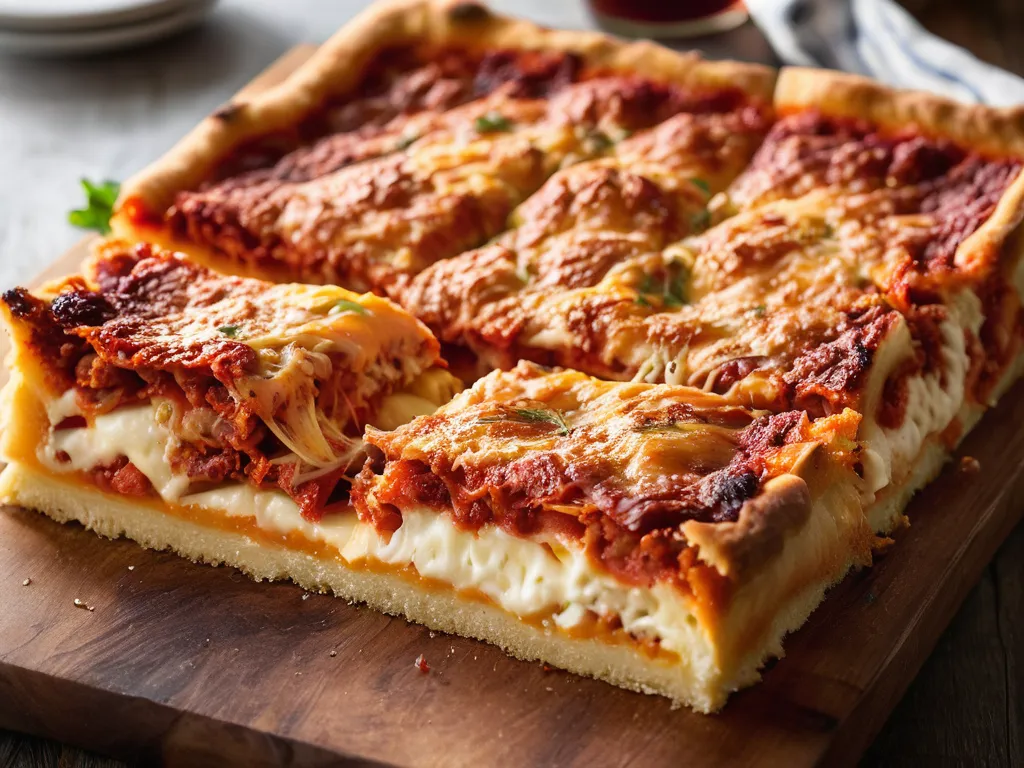
Detroit-Style Pizza — The Crispy Cheese-Edge Pizza That Took Over TikTok
Detroit-style pizza is one of those foods where a single detail changes everything: the cheese goes all the way to the edges of the pan. Not “close to the edges.” Touching the metal. As the pizza bakes, that cheese melts down the sides, fries against the hot steel, and caramelizes into a golden-brown, crispy lace border that shatters when you bite it.
That moment — pulling a rectangular slice and hearing the crispy cheese crown crack — is why this pizza went from a regional Detroit institution to TikTok’s most shared pizza content.
TL;DR: High-hydration dough proofed in a well-oiled steel pan. Shredded brick cheese (or mozzarella + Muenster) pressed all the way to the pan edges. Baked at 500°F+. Sauce applied on top in stripes after baking. The result: a thick, airy, focaccia-like interior with a fried, crispy bottom and caramelized cheese edges on all four sides.
The Origin: A Detroit Bar and Some Auto Parts Trays
Detroit-style pizza traces directly to Buddy’s Rendezvous, a former speakeasy at 17125 Conant Street in Detroit, where owner Gus Guerra served the first square pizza in 1946. The recipe was a regional take on Sicilian sfincione, based on the family recipe of Guerra’s wife, Anna, and later refined by longtime employee Connie Piccinato. The original pans were blue steel automotive parts trays from the city’s auto factories — rectangular, heavy-gauge steel trays used to hold bolts and components on the factory floor. Those industrial pans conducted heat brilliantly and gave the pizza its signature fried crust.
Buddy’s is still open. The recipe has barely changed in 80 years.
For most of those 80 years, Detroit-style pizza remained a regional thing. It wasn’t until Jet’s Pizza expanded nationally (now 400+ locations) and Pizza Hut launched a Detroit-style option in 2021 that the style hit mass awareness — and then TikTok did the rest. The cheese-edge caramelization photographs spectacularly, and the close-up shots of that crispy lace border generated hundreds of millions of views.
What Makes It Different From Other Pan Pizza Styles
Detroit-style is often lumped with “thick pizza” but it’s a distinct style with specific characteristics that set it apart:
vs. Sicilian: Sicilian is also rectangular, but sauce goes under the cheese (conventional order), the dough is denser and less oily, and the cheese doesn’t reach the edges. No lace border. Sicilian also bakes at lower heat. The textures are different — Sicilian is chewier; Detroit is airier with a crispier bottom.
vs. Chicago deep dish: Chicago deep dish has tall pan walls, a thick buttery crust that goes up the sides, and layers stacked cheese-then-toppings-then-sauce bottom-to-top. It’s essentially a savory pie. Detroit pizza is a flat-pan pizza with an open focaccia crumb — much lighter and crispier. Bake time for Chicago can be 45 minutes; Detroit is done in 12–15.
vs. New York/Neapolitan: Both are thin, round, high-heat, minimal dough. Detroit is the opposite on every axis. The only shared element is a hot oven.
For a thinner pan-pizza comparison, Pizza Hut pan pizza uses a similar oiled pan technique but at lower hydration and with sauce underneath — a useful baseline for understanding how the two methods differ.
The Dough: High Hydration Is the Key
The Detroit dough is wetter than most home pizza doughs — 65–68% hydration (that’s 1¼ cups water per 3 cups bread flour). The extra water creates a looser gluten network that produces an open, airy crumb — more like focaccia than a chewy NY slice. This is intentional.
Bread flour (not all-purpose) is important here. Bread flour has more protein (12–13% vs. 10–11%), which gives the dough enough strength to hold the gas produced during proofing without collapsing. The result is large, irregular air pockets in the crumb.
The dough should feel tacky and slightly sticky — don’t add more flour to fix it. If it tears when you stretch it, cover it and rest 10 minutes. Gluten needs time to relax.
Cold proof option: Mix the dough, oil the pan, place the dough in the pan, cover with plastic, and refrigerate overnight (8–24 hours). The long cold fermentation develops significantly better flavor — more complex, slightly tangy. Pull from the fridge 1 hour before baking.
The Cheese: Why Brick Cheese and Why the Edges
Wisconsin brick cheese is the traditional choice and worth seeking out. It’s a mild, semi-soft cheese with a fat content high enough to melt smoothly without breaking. The key property: when it touches a hot metal pan wall, it fries in the fat and caramelizes rather than burning. That’s the “lace” — those golden, crispy, slightly charred cheese ruffles along all four edges.
If you can’t find brick cheese, use a 50/50 mix of low-moisture mozzarella and Muenster. Low-moisture mozzarella provides the familiar pizza stretch; Muenster adds the fat content and mild flavor that gets closest to brick. Don’t use fresh mozzarella (too much water — it will steam instead of fry) and don’t use pre-shredded bags (anti-caking coating prevents proper melting).
Shred your own cheese from a block. The difference is meaningful here because the edges need to fuse and fry, not stay as dry individual shreds.
When applying cheese, cover the surface generously, then use your fingers to push cheese firmly against the metal walls on all four sides. It should be touching metal, not just near the edge. This is the entire technique — everything else supports it.
The Sauce: It Goes on Top
Sauce under the cheese is standard for most pizza styles. In Detroit, sauce goes on top, applied after the cheese has already baked.
Why: the cheese needs to make contact with the oiled pan to fry and caramelize. If sauce is underneath, it creates steam that lifts the cheese off the surface and prevents the lace edge from forming. Sauce on top also keeps the crust from getting soggy during the bake.
The traditional application is two or three horizontal stripes (“racing stripes”) of sauce across the finished pizza, then 2 more minutes in the oven to warm them through. Some shops spoon the sauce before baking for a more integrated flavor — either approach works, but the post-bake stripe method is the Buddy’s-original technique.
Use a slightly chunky, cooked tomato sauce — not a thin pizza sauce. San Marzano tomatoes crushed by hand with garlic and olive oil work well. Avoid watery fresh tomato sauce; it pools and steams.
The Pan: Oil It More Than You Think
The pan is not just a vessel — it’s part of the cooking method. 3–4 tablespoons of oil pool slightly in the corners and bottom of the pan. As the pizza bakes, this oil fries the bottom crust until it’s golden-brown and crispy, almost like the bottom of a good focaccia. This is different from the greased-then-no-oil method used for most pan pizzas.
The Lloyd Pans Detroit Pizza Pan (hard-anodized aluminum, 10x14 inches, ~$45–65) is the closest thing to the original automotive trays and is what most serious home pizza makers use. It conducts heat quickly and evenly, and its PSTK coating is non-stick out of the box — no seasoning required.
A heavy 9x13-inch metal baking pan (aluminum or steel) is a practical substitute. Avoid glass baking dishes — glass is a poor conductor and won’t produce the crispy fried bottom that defines the style.
Baking: Heat and Rack Position
The oven needs to be as hot as possible — 500°F at minimum, 550°F if your oven reaches it. But the oven air temperature alone isn’t the full story. You need the oven walls, floor, and rack to be saturated with heat, not just the air. That means a 30-minute preheat after the indicator light says it’s ready.
Rack position: lower third of the oven, close to the heat source at the bottom. This maximizes bottom-crust heat and gives the edges maximum caramelization time.
Bake 12–15 minutes total. Signs it’s done:
- The cheese edges are deeply golden to medium-brown (not pale yellow)
- The lace border has set and looks slightly caramelized, not wet
- Lifting a corner with a metal spatula shows a brown, not white or beige, bottom crust
After adding the sauce stripes, 2 more minutes finishes the job.
Common Mistakes (and How to Fix Them)
Not enough oil in the pan. The most common mistake. If the bottom crust is pale and soft, you used too little oil. 3 tablespoons is the minimum; 4 tablespoons is better.
Cheese not touching the pan walls. If the edge isn’t caramelized, the cheese wasn’t pressed firmly enough against the metal. Use your fingertips to really push it in.
Sauce under the cheese. This steams the cheese and prevents the lace. Always add sauce on top, at the end.
Under-proofed dough. Dough that springs back when pressed and doesn’t fill the pan will bake dense and bready, not airy. Give it the full 2+ hours, or until the dough is visibly puffed and fills every corner.
Oven too cold. Under 450°F, the cheese will melt without caramelizing and the bottom won’t fry. Commit to 500°F+ and the full 30-minute preheat.
Cost Comparison
A Detroit-style pizza at Jet’s Pizza (the major chain, 400+ locations nationally) runs $18–23 for a large. A 10x14 pan at home — bread flour, yeast, a pound of brick cheese, canned tomatoes, olive oil — runs about $8–10 total for 6 generous servings. The home version also lets you get the cheese-edge ratio right, which no chain delivery pizza can match (the lace fuses to the pan and doesn’t survive delivery intact).
Variations
Classic pepperoni cups: Press quartered pepperoni directly into the dough before the cheese goes on. The pepperoni cups crisp and render fat upward into the cheese during baking — this is the Detroit “cup and char” style. (For another pizza style worth having in your rotation, see copycat Domino’s pizza.)
Sausage and mushroom: Brown Italian sausage, add to the dough layer before cheese. Slice mushrooms thin and add them under the cheese as well — they release moisture but it goes into the crust, not onto the top.
Jalapeño and honey: After adding sauce, drizzle a tablespoon of honey and scatter sliced jalapeños. The honey caramelizes in the final 2 minutes and the sweet-heat contrast against the savory cheese edge is striking.
White pizza version: Skip the tomato sauce entirely. Use garlic-herb olive oil as the “sauce” (2 tbsp olive oil + minced garlic + dried oregano applied to the dough before cheese), load the cheese edge-to-edge, and add fresh basil after baking.
Storing and Reheating
Store: Refrigerate leftover slices for up to 3 days in an airtight container or wrapped in foil.
Reheat: The only correct method is a dry skillet. Heat a cast iron or stainless pan over medium heat, add the slice, cover with a lid, and heat 4–5 minutes. The bottom re-crisps in the dry pan; the lid traps steam to heat the top. Microwave makes the crust rubbery and the cheese lace goes soggy. Do not microwave Detroit pizza.
Freeze: Freeze fully baked slices, well-wrapped, for up to 2 months. Reheat from frozen in a 400°F oven for 10 minutes directly on the rack.