Pin It

Viral TikTok Everything Bagel Avocado Egg Toast

Viral TikTok Everything Bagel Avocado Egg Toast
Jump to Recipe
Prep 5 min Cook 5 min Serves 1
Quick answer: Everything bagel avocado egg toast is made by smashing half a ripe Hass avocado with lemon juice and salt onto thick toasted sourdough, topping it with a fried egg cooked medium (runny yolk, set white), and finishing with everything bagel seasoning, red pepper flakes, and flaky sea salt. Total time is 10 minutes. Use the stem test to verify avocado ripeness (stem pops off, green underneath = ready). For the runny yolk, cook on medium heat in a small nonstick pan and baste the white with hot oil, or add a splash of water and cover for 30–45 seconds. Eat within 3 minutes before the bread softens.
Viral TikTok Everything Bagel Avocado Egg Toast

Viral TikTok Everything Bagel Avocado Egg Toast

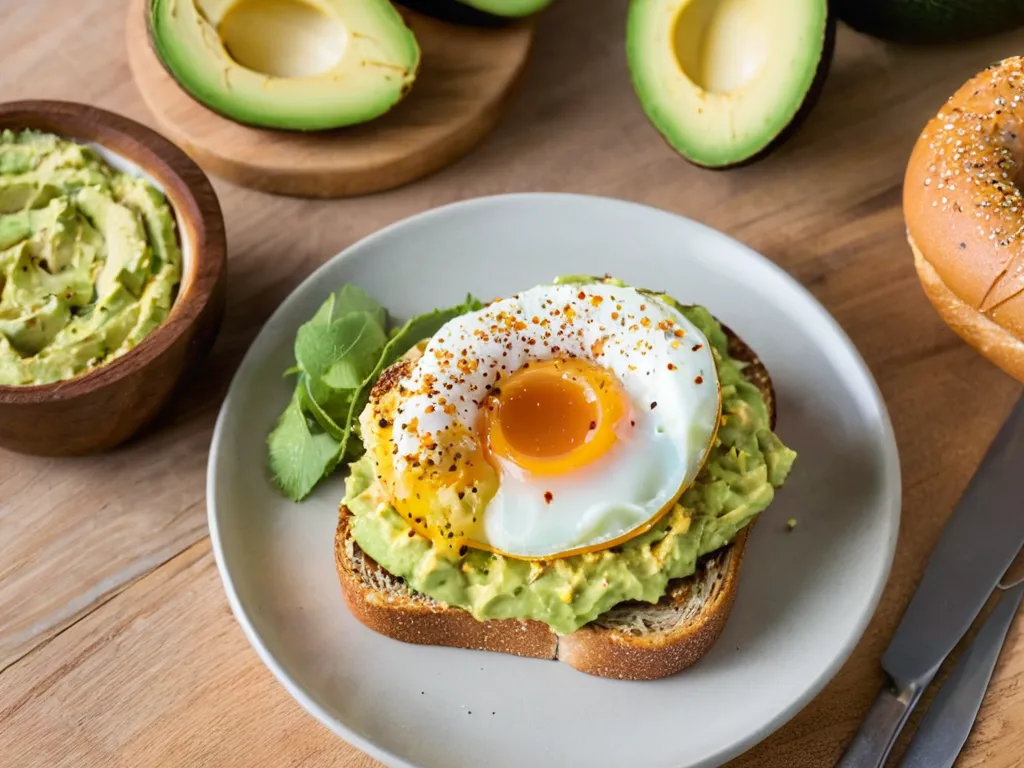
Smashed avocado on crunchy sourdough, topped with a fried egg and everything bagel seasoning. The avocado toast that TikTok upgraded — with the technique, avocado ripeness guide, and egg-frying science to get it right every time.

Easy Prep: 5 min Cook: 5 min Total: 10 min1 servings ~$3.15/serving
Prep5 min
Cook5 min
Total10 min
Servings
1
At home~$3.15/serving
vs
Restaurant~$14.17/serving
You save ~78%

Ingredients

Instructions

💡
Pro tip: This recipe tastes even better the next day. The flavors need time to meld together in the fridge.
❄️
Storage: Keeps in an airtight container in the fridge for up to 2 weeks. Freezer-friendly for up to 3 months.
~350-550 cal/serving · Rich & Indulgent🔥

The Story Behind the Recipe

Avocado toast was already a cult brunch item before TikTok existed. Australian chef Bill Granger has claimed the original version at his Sydney café Bills since 1993 — avocado quarters on sourdough with lime juice and olive oil, before the smashed version became standard. The dish spread through the café culture of London, New York, and Los Angeles throughout the 2010s.

TikTok upgraded it with two additions that made it something else entirely: a properly fried egg with a runny yolk, and a shower of everything bagel seasoning. The yolk break — that moment when the golden yolk cascades across the green avocado and soaks into the sourdough — is one of the most satisfying food videos on the internet. Combined with the crunchy, savory, aromatic EBS, it transformed a café staple into a home-cook recipe with visual and flavor payoff that genuinely earns the $18 brunch plate price it replicates.

Ten minutes. Three dollars. One skill worth learning correctly.

How to Pick a Ripe Avocado

The avocado is the entire point of this dish. Get it wrong and everything else is wasted.

For Hass avocados — the most common variety at US grocery stores, with the distinctive pebbly dark skin — start with color. Hass avocados shift from bright green to deep purplish-black over 8–12 days after harvest as they ripen. Near-black skin means the avocado is in the ripe window; bright green means it needs more time. But color is a first filter, not a final answer, because avocados from different growing regions ripen at slightly different color stages. Two additional checks confirm:

Gentle pressure is the most practical test. Hold the avocado in your palm and apply light pressure at the fattest point — near the middle, not the top or bottom. A ripe avocado yields slightly and springs back. If it feels firm with no give, it’s underripe. If it feels mushy or collapses under light pressure, it’s overripe. A just-right avocado has a definite give without being squishy.

The stem test is the secondary confirm — and often the most reliable single check. Pop off the small stem nub at the top of the avocado with your thumb. If it comes off easily and the flesh underneath is green, the avocado is ripe and ready. If the flesh underneath is brown, it’s overripe (the browning has already started inside). If the stem won’t budge, the avocado is still underripe and needs a day or two more.

To ripen a firm avocado faster, leave it at room temperature — a day at room temperature equals roughly three days in the refrigerator. To slow an almost-ripe avocado from going over, put it in the fridge; the cold dramatically slows the enzymes driving softening. Once cut, place plastic wrap directly against the cut surface (not just loosely over the bowl — direct contact) to limit oxidation.

What Is Everything Bagel Seasoning?

Everything bagel seasoning is the blend of toppings found on an everything bagel — the “everything” version that combines all the classic bagel seasonings in one. The standard blend contains:

  • White and black sesame seeds — toasted and nutty; different colors for visual texture
  • Poppy seeds — subtle, slightly bitter depth
  • Dried minced garlic — the most aromatic component; blooms when it hits hot egg or warm bread
  • Dried minced onion — sweet and savory, complementary to the garlic
  • Coarse salt — usually a sea salt or kosher salt

Some versions add caraway seeds (a more traditional bagel spice with a rye-like flavor). The ratio varies by brand; Trader Joe’s “Everything But the Bagel” sesame seasoning, which launched in February 2017 and repeatedly sold out in its first year, is the version most commonly photographed in TikTok content and the one that put the blend into mainstream home kitchen use. Before that, everything bagel seasoning existed primarily as a bagel topping at bakeries; TJ’s made it a pantry staple.

To make your own: Combine 2 tablespoons white sesame seeds, 1 tablespoon black sesame seeds, 1 tablespoon poppy seeds, 1 tablespoon dried minced garlic, 1 tablespoon dried minced onion, and 1 teaspoon coarse salt. Mix and store in a sealed jar. It keeps for months and costs a fraction of the pre-made version per ounce. You can also adjust the salt level (store-bought versions vary from moderate to very salty) — making your own lets you control this directly.

Why Sourdough

The bread choice is structural, not just aesthetic.

Dense crumb holds up. Avocado smash contains moisture, and a fresh runny egg yolk releases more moisture when you cut it. Sandwich bread or soft white toast absorbs this immediately and goes limp within 90 seconds. A thick sourdough slice has a tight, dense crumb that resists moisture penetration long enough to eat the toast as intended — crunchy, with a clean bite through to the avocado layer.

The crust is load-bearing. A properly toasted sourdough slice develops a rigid crust that doesn’t flex or crack when you cut it diagonally or pick up half the slice. The egg and avocado have weight; soft bread bends under it.

The tang balances the fat. Sourdough develops its characteristic mild sourness from lactic acid produced by lactobacillus bacteria during the long fermentation process. That acidity does the same job that lemon juice does in the avocado smash — it cuts through richness. Avocado is fat. Egg yolk is fat. Olive oil is fat. The sourdough’s tang is the acid counterpoint that makes each bite feel complete rather than cloying.

If you don’t have sourdough: Use any sturdy, thick-sliced country loaf or rustic bread with a solid crust. Avoid brioche, sandwich bread, or anything soft — they fail structurally. A pumpernickel or whole-grain rye works and adds flavor complexity.

Toast on the second-to-highest setting, or double-toast if your toaster runs mild. You want the bread rigid and deeply golden, not merely warm.

The Perfect Fried Egg

The fried egg here is not an afterthought — it’s the primary protein, the visual centerpiece, and the yolk is effectively the sauce that ties the dish together. Getting the technique right matters.

Use a small pan. An 8-inch nonstick skillet is ideal for a single egg. A 10-inch or 12-inch pan spreads the white into a thin, wide wafer that overcooks at the edges before the center is set. A small pan keeps the egg compact and thick.

Medium heat, not high. High heat crisps the bottom edge quickly and produces lacy, browned whites — a valid aesthetic and texturally appealing. But high heat also risks setting the yolk before the thick portion of the white near the yolk is cooked through. Medium heat gives more control.

Two methods for runny yolk with set white:

Basting method: Tilt the pan so the oil pools at one side and use a spoon to baste the hot fat over the unset white near the yolk. The hot oil cooks the top surface of the white without touching the yolk directly. This produces lacy, slightly crispy-edged whites and a fully fluid yolk. It takes 30–45 seconds of active basting after the first minute.

Steam method: Once the white edges have begun to set (about 90 seconds), add 1 teaspoon of water to the pan (away from the egg) and immediately cover with a lid. The water vaporizes instantly and the steam cooks the top of the white through in 30–45 seconds. Remove the lid and the egg immediately — leaving the lid on too long sets the yolk. This produces a cleaner, more opaque white surface with no browning.

Both methods work. The steam method is more foolproof for beginners; the basting method is faster and gives the egg more visual character.

How to know it’s done: The white is fully set (opaque throughout, no translucent jiggling patches near the yolk) and the yolk is still glossy, domed, and jiggly when you shake the pan. Remove the egg when the white at the edge of the yolk is just barely opaque — if you wait until it’s definitively set, the yolk will have started to thicken.

Slide the egg directly from the pan onto the avocado toast rather than plating it separately. The heat from the egg warms the avocado layer slightly.

The Avocado Smash

Technique here is more important than it looks.

Season before smashing, not after. Add lemon juice and flaky salt to the bowl before you use the fork — it distributes more evenly through the avocado than seasoning on top.

Chunky, not pureed. Press and drag with the fork in short strokes rather than mashing in circles. Aim for a spread that’s 70% smashed and 30% small chunks. A completely smooth avocado paste is texturally boring; a chunky smash has variance in each bite.

Use flaky salt, not table salt. Flaky sea salt (Maldon, Fleur de Sel) dissolves unevenly across the avocado, creating pockets of salt intensity rather than uniform saltiness throughout. The variance is the point — some bites have a salt crunch, some don’t. Fine table salt dissolves immediately and makes the whole thing uniformly salty, which is less interesting.

Lemon juice over lime. Both work, but lemon juice has a cleaner acid that doesn’t compete with the everything bagel seasoning’s garlic and onion character. Lime juice is bolder and slightly sweeter, which works well if you’re doing a more Mexican-leaning version (hot sauce, cotija, cilantro). For the everything bagel seasoning version, lemon is the more harmonious choice.

Variations Worth Making

Poached egg instead of fried: A perfectly poached egg has no crispy edges and a more delicate texture than a fried egg. Bring a small saucepan of water to a low simmer (just below boiling — 180°F, not 212°F), add a splash of white vinegar (helps the white coagulate around the yolk), and slide the egg in from a small cup held close to the water surface. Cook 3–4 minutes for a runny yolk. The poached version looks more elegant on the toast and reads as more restaurant-quality, but it takes practice to get right. The vinegar taste doesn’t linger in the finished egg if you use less than 1 tablespoon in about 3 inches of water.

Soft-boiled sliced egg: Boil eggs for 6 minutes from boiling water, then immediately transfer to an ice bath for 1 minute. Peel and slice. The yolk will be jammy and bright orange-yellow — similar to ramen egg. Slice and fan across the avocado. This version is easier to control timing-wise and holds better if you’re making multiple portions.

Add red onion: Thinly slice 1/8 of a small red onion. Scatter over the avocado before the egg. The sharpness of raw red onion cuts the richness similarly to lemon juice and adds crunch. Soaking the onion slices in cold water for 5 minutes first mutes the harshest bite while keeping the flavor.

Cherry tomatoes: Halved cherry tomatoes added alongside or under the egg add freshness and acidity. Particularly good in summer when tomatoes are ripe and sweet.

Smoked salmon addition: A fold of hot-smoked salmon (not cold-smoked lox, which is too thin and delicate here) laid over the avocado before the egg adds protein and umami depth. This version pairs exceptionally well with the everything bagel seasoning, which already tastes like a bagel. It also cross-links to the everything bagel salmon recipe technique.

Chili crisp finish: Replace the red pepper flakes with a small spoonful of chili crisp oil (Lao Gan Ma or Fly By Jing). The fermented chili and oil add heat with depth rather than just dry heat from flakes. This works especially well on the everything bagel version — the garlic in the EBS and the garlic in chili crisp reinforce each other.

Cottage cheese base instead of avocado: Spread 3–4 tablespoons of full-fat cottage cheese directly on the hot toast before adding the egg. The cottage cheese melts slightly on the warm bread, developing a creamy, mild base. Top with everything bagel seasoning the same way. This variation has its own TikTok moment from the cottage cheese trend of 2023.

The Ripeness Window

Avocados are ready for a narrow window — sometimes just 24 hours between underripe and overripe, especially in warm kitchens. Here’s how to manage the window:

  • Two days before: Rock-hard, won’t press at all — leave on counter
  • Day before: Slight give at stem end only — leave on counter
  • Ready: Stem pops off cleanly, green underneath; uniform slight give throughout — use immediately or refrigerate to slow by 1–2 days
  • Starting to turn: Soft in one spot, firm elsewhere; flesh may have small brown streaks — use the good portion, avoid brown areas
  • Overripe: Collapses under light pressure; stem pulls off and flesh underneath is brown — discard or use only in smoothies where color and texture don’t matter

If you buy avocados hard from the grocery store and want to accelerate ripening: keep at room temperature (65–75°F) away from direct sunlight. Adding a banana nearby in a paper bag speeds it further — the ethylene gas bananas emit acts as a ripening agent for other fruit. Refrigeration stalls ripening once the avocado reaches the ready stage; use this to time brunch preparation.

Other Egg and Avocado Variations on the Site

The avocado-and-egg combination is one of the strongest flavor pairings in casual breakfast cooking. Other recipes that work with the same flavor logic:

Nutrition Facts

Per serving (1 servings)
Calories420
Total Fat26g
Total Carbs30g
Dietary Fiber8g
Sugars3g
Protein15g
Sodium480mg

* Estimated values based on standard recipe preparation. Actual values may vary.

🥗

Make It Healthier

Love Viral TikTok Everything Bagel Avocado Egg Toast but want a lighter version? Try these simple swaps:

  • Use whole-grain sourdough for significantly more fiber — most good bakeries offer a whole wheat sourdough that toasts just as well as white.
  • Reduce olive oil to a spray (avocado oil spray gives good coverage with minimal calories) — the avocado already contributes plenty of fat.
  • Use only half the everything bagel seasoning to cut sodium by about 200mg; the flavor is still noticeable at half the amount.
  • Add a handful of arugula or microgreens under the avocado layer — they add iron, peppery flavor, and nutrients that you barely notice texturally but are eating.

Equipment You'll Need

Nonstick skillet (8-inch)

Small enough that the egg fills the pan and doesn't spread thin; a 10-inch spreads the white into a wafer

Toaster or toaster oven

For sourdough — deeper browning than a regular toaster cycle; aim for the second-to-darkest setting

Fork

For smashing; a fork gives you more chunk control than a spoon

Frequently Asked Questions

Who invented avocado toast and when did it go viral?

Avocado toast's earliest modern restaurant version is most widely attributed to Australian chef Bill Granger, who has claimed to have served avocado on toast at his Sydney café Bills since 1993. The dish spread through café culture in Australia, the UK, and the US in the early 2010s; by 2015 it was appearing in mainstream US food media (Bon Appétit, January 2015), and by 2016 it had become a cultural shorthand for millennial spending habits. Trader Joe's 'Everything But the Bagel' sesame seasoning launched February 2017 and put the EBS blend in home kitchens. TikTok creators began adding it to avocado toast alongside a fried egg, producing the definitive upgraded format seen in TikTok content from 2020 onward. The EBS and runny egg combination is what transformed a café brunch item into a replicable, photogenic home recipe.

What's in everything bagel seasoning and can I make my own?

The standard everything bagel seasoning blend — the same core ingredients in Trader Joe's 'Everything But the Bagel' sesame seasoning, which launched in February 2017 and repeatedly sold out in its first year — contains white and black sesame seeds, poppy seeds, dried minced garlic, dried minced onion, and coarse salt. Some versions add caraway seeds. Trader Joe's 'Everything But the Bagel' sesame seasoning is the version most credited with popularizing home use — it's the blend most TikTok recipes are photographed with. To make your own: mix 2 tablespoons white sesame seeds, 1 tablespoon black sesame seeds, 1 tablespoon poppy seeds, 1 tablespoon dried minced garlic, 1 tablespoon dried minced onion, and 1 teaspoon coarse salt. Store in a sealed jar; it keeps for months. The homemade version costs a fraction of the store price and lets you control the salt level.

How do I get a perfectly runny yolk every time?

Use a small nonstick pan (8-inch) so the white doesn't spread thin. Cook on medium — not high — so the white sets before the yolk cooks through. The key technique is either basting or steaming: basting means tilting the pan and spooning the hot oil over the unset white near the yolk (cooks the white without touching the yolk); steaming means adding 1 teaspoon of water and putting the lid on for 30–45 seconds (the steam cooks the top of the white). Both methods give you a fully set white with a runny yolk. High heat crisps the edges faster but risks catching the yolk before the thick white near it sets — it works, but medium heat gives more control. Remove the egg as soon as the white at the edge of the yolk is opaque and no longer translucent.

How do I pick a ripe avocado?

For Hass avocados (the most common variety in US grocery stores), skin color alone is unreliable because ripeness depends on the particular avocado. The most reliable method is the stem test: pop off the small stem nub at the top. If it comes off easily and the flesh underneath is green, the avocado is ripe and ready. If the flesh underneath is brown, the avocado is overripe. If the stem won't pop off, it's underripe. The secondary check is gentle pressure at the thickest point of the avocado — a ripe avocado yields slightly under thumb pressure without denting deeply. If it's rock-firm, it needs 1–2 days on the counter. If it collapses under light pressure, it's overripe. To ripen faster, keep at room temperature. To slow ripening, refrigerate. Once cut, press plastic wrap directly against the exposed flesh (not just over the bowl) to limit air exposure.

Why sourdough and not regular toast or sandwich bread?

Three reasons. First, structure: sourdough has a dense, tight crumb that holds up under a layer of wet avocado and a runny egg without becoming soggy for 2–3 minutes after assembly — sandwich bread wilts almost immediately. Second, crust: a properly toasted thick sourdough slice develops a rigid crust that doesn't flex or break when you cut it or pick it up. Third, flavor: sourdough's mild fermented tang (lactic acid from lactobacillus bacteria during the long fermentation) adds a brightness that balances the fat in the avocado and egg. The combination of fat (avocado, egg yolk, olive oil) needs acid to balance it; sourdough provides this structurally and flavorfully. If you don't have sourdough, use any sturdy, thick-sliced country loaf. Avoid sandwich bread, brioche, or anything too soft.

Can you make avocado egg toast ahead of time?

No — avocado toast is inherently a make-and-eat-immediately dish. The toast softens within minutes of contact with the avocado. Cut avocado browns within 20–30 minutes even with lemon juice (acid slows but doesn't stop oxidation). The runny egg yolk should be eaten warm, not cold. If you're making brunch for multiple people, prepare each component separately (toast a batch of bread, fry eggs one at a time, pre-smash avocado with lemon) and assemble immediately before serving — that's the only practical prep-ahead approach. The assembled toast does not keep.

Love this recipe? Share it!

Shop the tools

The right tools make all the difference. We earn a small commission if you buy through these links — at no extra cost to you.

Free PDF: our 12 most-wanted copycat recipes — instant download.

Ratings & Reviews

No ratings yet

Rate this recipe

Click a star to rate

Leave a Review

0/500

CS

Copycat Spices Test Kitchen

Every recipe on Copycat Spices is developed and tested in our home test kitchen. We reverse-engineer beloved restaurant dishes and refine each one until the flavors and the instructions work reliably for home cooks of all skill levels.

Learn more about our mission →