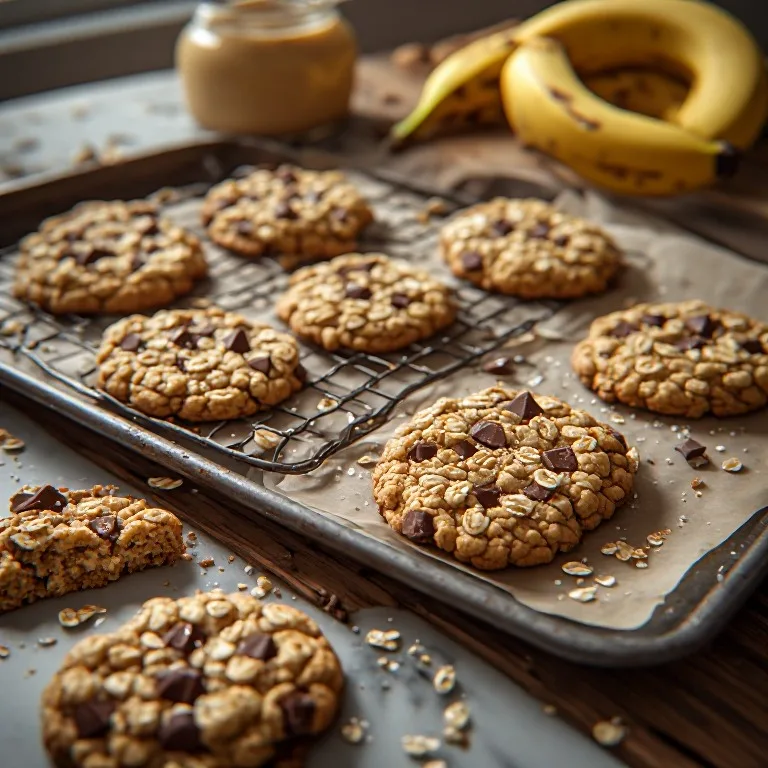


Why These Actually Taste Good (Not Like Sad Health Food)
Most “healthy cookie” recipes use such small amounts of fat and sweetener that the result tastes like something you eat because you have to, not because you want to.
This recipe works differently. The banana is doing double duty as both the sweetener (a very ripe banana has 14+ grams of natural sugar) and the binder (banana’s pectin acts like a light egg wash, helping the oats stick together). The tahini provides the fat that gives the cookie its satisfying richness — and it’s more fluid than peanut butter, which means it distributes more evenly through the dough and produces a more consistent texture bite to bite.
Dark chocolate chips at 60–70% cacao bring bitterness that counterbalances banana’s sweetness — the same reason banana splits use plain vanilla ice cream, not sweetened whipped cream. The sesame-banana-dark-chocolate combination is an underrated flavor trio, closer to a Mediterranean halva than a standard PB-banana cookie.
The Four-Ingredient Logic
Banana: The sweeter and the binder. Must be very ripe — spotted, soft, turning brown. As a banana ripens, enzymes break down the starch into free sugars (primarily glucose and fructose). A very ripe banana has roughly 3× the free sugar of an underripe one. That sugar is what makes these taste sweet without a single tablespoon of maple syrup, honey, or coconut sugar. The banana also releases moisture as it mashes, which is what hydrates the oats and creates dough cohesion.
Tahini: The fat and the depth. Tahini is ground sesame seeds — more fluid than peanut butter, more neutral, with a faint sesame-bitter note that rounds out sweetness rather than piling onto it. Unlike butter, tahini fat stays liquid at room temperature, which is why the dough chill is essential. At baking temperature, the tahini’s water content (tahini is about 3% water) steams slightly, helping the interior set and keeping the cookies from drying out.
Oats: The structure. Rolled oats absorb the moisture from mashed banana and form the backbone of the cookie. They’re not raw when eaten — they soften fully during baking as they absorb the banana liquid. Instant oats (pre-cut smaller) over-absorb and turn mushy; steel-cut oats (larger, harder) under-absorb and stay chewy in a gritty way. Old-fashioned rolled oats are the right cut for this recipe.
Chocolate chips: The reason people eat these twice. 60–70% dark chocolate is not an arbitrary choice. Milk chocolate adds more sugar on top of the banana’s natural sweetness — too sweet, too flat. Semi-sweet is fine. Dark chocolate’s bitterness provides contrast and is why the cookies taste sophisticated rather than sugary.
The Two Technique Details Most People Skip
1. Chill the Dough
Tahini at room temperature is nearly as fluid as olive oil. Put it in the oven and it flows before the structure can set — you get flat, greasy cookies that harden into a thin disk.
A 10-minute chill in the freezer drops the dough temperature enough that the tahini’s fat solidifies slightly — enough to hold shape through the first 5 minutes of baking, by which point the oats have absorbed enough moisture to build structure on their own. This is the same logic behind chilling chocolate chip cookie dough: butter in CCC dough is solid when cold, slowing spread and producing a thicker cookie.
2. Flatten Before Baking
There is no leavening in this recipe — no baking soda, no baking powder, no beaten eggs. The cookies will not puff, rise, or spread during baking. What you shape before they go in the oven is what you get out of it.
Flatten each cookie to about ½ inch thick with your palm or the bottom of a glass. Wet your hand slightly to prevent sticking. The target is a flat disc, not a hemisphere. If they come out looking like hockey pucks, you’ll know for next time.
The Most Common Failure: Overbaking
The cookies will look underdone when the timer goes off. The centers will appear soft and slightly wet. Do not put them back in.
During the 10-minute rest on the hot pan, residual heat continues cooking the cookies off the rack, and the oats finish absorbing the remaining banana moisture — the same process that turns rice pudding from loose to thick as it cools. A 12-minute cookie at 350°F is not a 12-minute cookie; it’s a 12+10 minute cookie, and those extra 10 minutes on the pan are as important as the bake time.
Baking until the center looks set = overbaked. You’ll get dry, crumbly cookies that fall apart when you pick them up.
Variations
Peanut butter swap: Substitute peanut butter 1:1 for the tahini. Thicker texture (PB has less water than tahini), more classic PB-banana-chocolate flavor. Still chill the dough.
Cinnamon-cardamom: Add 1 teaspoon cinnamon + ½ teaspoon ground cardamom to the dough. This leans into tahini’s Middle Eastern flavor lineage — cardamom and sesame appear together throughout Lebanese and Israeli baking.
Protein-boosted: Replace ½ cup of the oats with 1 scoop of vanilla or unflavored protein powder. Add 1 tablespoon of water to compensate for the drier protein powder. Yields ~7–8g protein per cookie.
No-bake: Skip baking entirely. Roll chilled dough into 12 balls, flatten, refrigerate 30 minutes. Works because the oats absorb enough moisture from the banana without heat. Keep refrigerated — the no-bake version needs the cold to hold shape.
Chunky chocolate: Swap chips for a roughly chopped dark chocolate bar. Larger chocolate pieces create pockets of melted chocolate that pool slightly on top during baking — better visual, better payoff per bite.
Nutrition Per Cookie
Based on: 2 medium bananas (180g) + ½ cup tahini (120g) + 2 cups rolled oats (160g) + ¾ cup dark chocolate chips (105g) / 12 cookies.
| Per Cookie | |
|---|---|
| Calories | ~170 |
| Protein | 4g |
| Carbohydrates | 20g |
| Fat | 9g |
| Fiber | 2g |
| Natural Sugar | ~6g |
| Added Sugar | 0g |
No flour, no butter, no refined sugar. The natural sugar is split roughly evenly between the ripe banana (~2–3g per cookie) and the sweetened dark chocolate chips (~3g per cookie) — the tahini and oats add almost none. Macros are whole-food estimates; exact values vary by banana size and the cacao percentage of your chocolate.