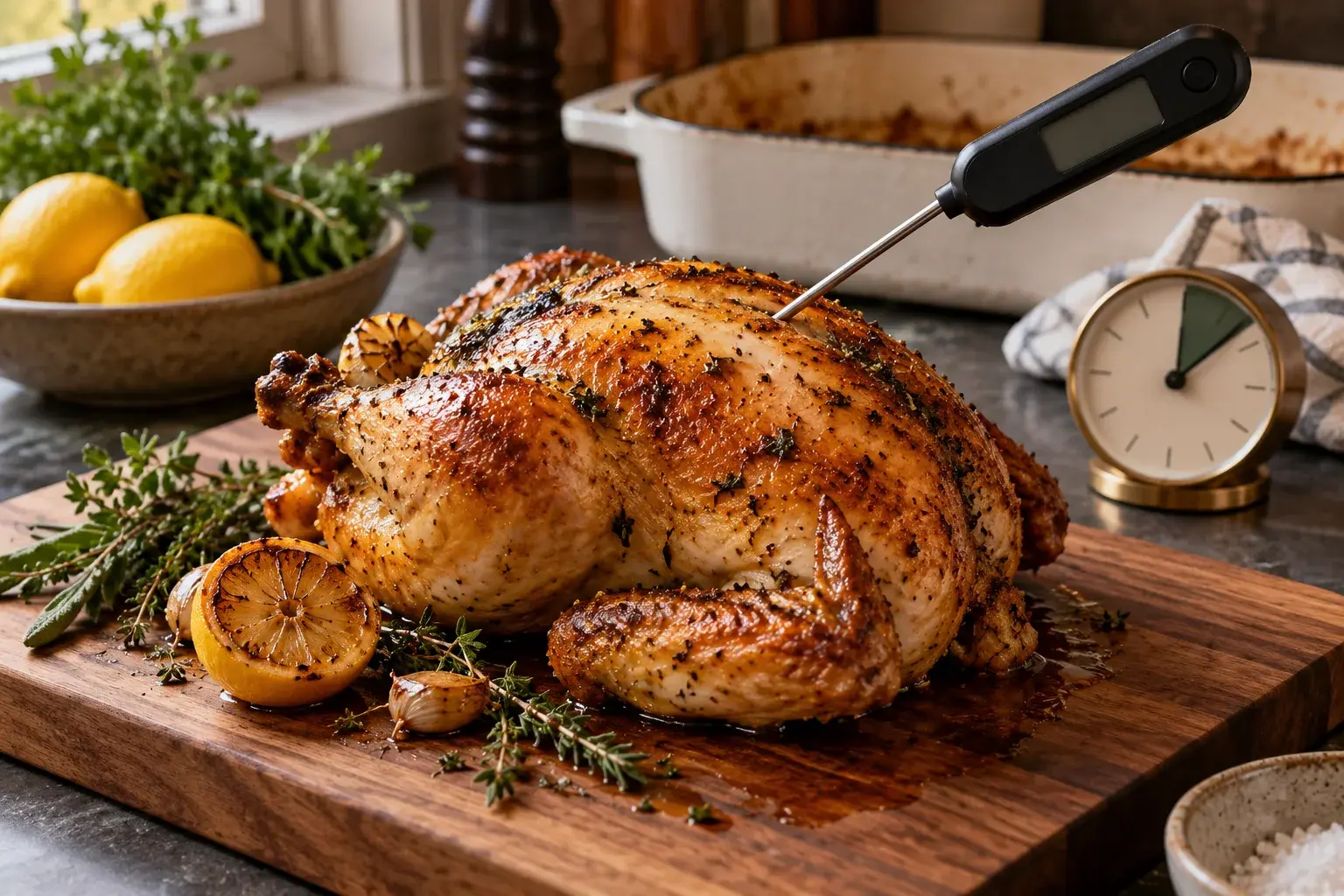
Meat does not stop cooking when the burner turns off. Heat stored near the surface continues traveling toward the cooler center. That after-cooking rise is called carryover cooking, and ignoring it is one of the easiest ways to overshoot a perfect steak or dry out a roast chicken.
The solution is not guesswork. It is learning where to measure and when to pull the food.
How carryover cooking works
During cooking, the outside of a roast can be hundreds of degrees hotter than the center. Once the food leaves the oven or pan, that temperature difference begins to equalize.
The exterior cools while heat moves inward. The center temperature continues climbing until the food approaches a more even temperature throughout.
Large, thick foods carry over more than thin ones. A chicken cutlet has little stored heat and a short path to the center. A whole roast has a hot exterior and a large thermal mass.
Use the thermometer correctly
Insert an instant-read thermometer into the thickest part of the food. For a steak, chop, or chicken breast, enter from the side so the sensing area reaches the true center.
Avoid touching bone or the cooking surface. Check more than one spot in irregular foods. A whole chicken should be checked in the deepest breast area and the inner thigh.
Do not leave the oven door open while deciding. Pull the food, close the door, take a quick reading, and return it if needed.
Think in ranges, not one magic number
Carryover depends on thickness, cooking temperature, and shape. Useful starting points:
- Thin cutlets and burgers: pull 2°F to 5°F early.
- Thick steaks and chops: pull about 5°F early.
- Whole poultry and medium roasts: pull 5°F to 10°F early.
- Large, high-heat roasts: carryover can reach 10°F to 15°F.
Use these as planning ranges, then learn how your usual cuts behave in your kitchen.
Follow current food-safety guidance for minimum temperatures and rest times, especially for poultry and ground meat. Carryover can be part of reaching the final safe temperature, but only when you verify it with a thermometer.
Resting protects texture
Resting is not only about carryover. Muscle fibers contract during cooking and push liquid toward cooler areas. Cutting immediately releases more of that liquid onto the board.
A rest gives temperature and moisture time to redistribute. Small cuts need about 5 to 10 minutes. A large roast may need 20 to 40 minutes.
Tent loosely with foil if needed. A tight wrap traps steam and softens a crisp crust or chicken skin.
Track the rise once
The fastest way to learn carryover is to measure it. Pull a thick steak, record its temperature, and check again after five minutes. Do the same with a roast chicken.
You will quickly build a mental model for your pans, oven, and preferred cuts. After that, pulling early stops feeling risky and starts feeling precise.
The practical rule
Cook to the temperature you want after the rest, not the temperature you want when the food leaves the heat. Measure the center, allow for the size of the food, and give it time before slicing.