


Pin It

Au Cheval Cheeseburger (Bon Appétit's Best Burger in America, Made at Home)

Au Cheval Cheeseburger (Bon Appétit's Best Burger in America, Made at Home)
Jump to Recipe
Prep 10 min Cook 12 min Serves 2
Quick answer: Make the Dijonnaise first: stir together 3 tablespoons of mayonnaise, 1.5 tablespoons of Dijon mustard, and 1 tablespoon of finely chopped fresh chives in a small bowl. Set aside. Divide 1 pound of 80/20 ground beef into four loose 4-ounce balls — do not compact them. Heat a cast iron or carbon steel skillet over high heat for at least 4 minutes until it is ripping hot. No oil. Add a beef ball to the pan and immediately smash it flat and thin with a stiff spatula — press hard, hold for 5 seconds, then leave it completely alone. Season the top with a pinch of kosher salt and cracked pepper. Cook untouched for 2.5 to 3 minutes, until the edges are lacey-brown and the top looks mostly cooked through. Flip once. Immediately lay one slice of American cheese on top. Cover with a metal mixing bowl or the pan lid for 30 seconds to trap steam and fully melt the cheese. Remove. Repeat for all four balls. Stack: on the bottom half of each Martin's Potato Roll (toasted cut-side down in butter), spread Dijonnaise on both halves. Add a cheesed patty, then a second cheesed patty on top. Scatter thinly sliced sour pickles, minced red onion, and a pinch of fresh chives over the stack. Close the bun. If adding the famous egg: fry two eggs in a butter-slicked pan over medium heat until whites are just set and yolks are still fully runny. Slide one on top of each assembled burger, season, and serve immediately.

Au Cheval Cheeseburger (Bon Appétit's Best Burger in America, Made at Home)

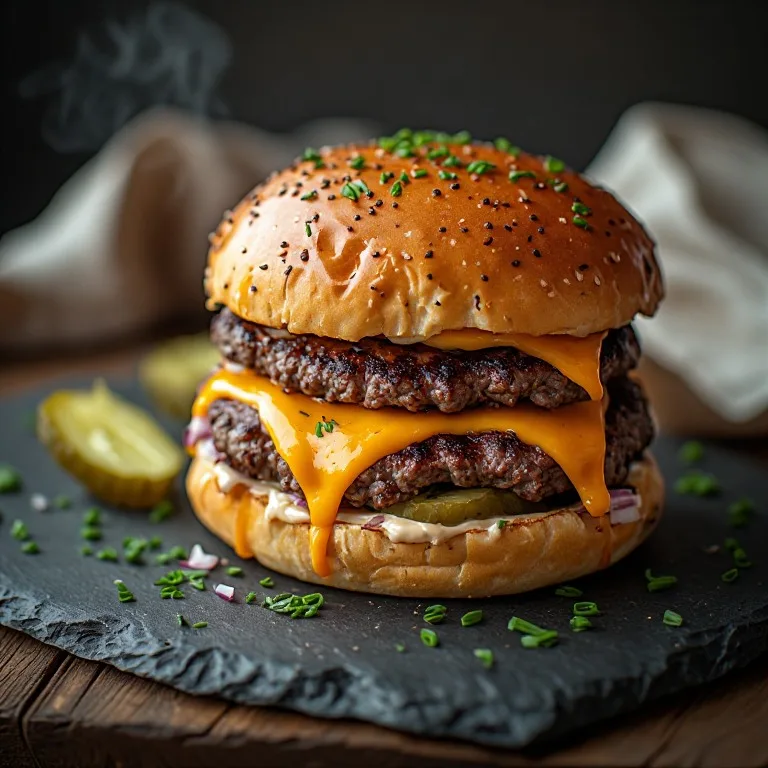
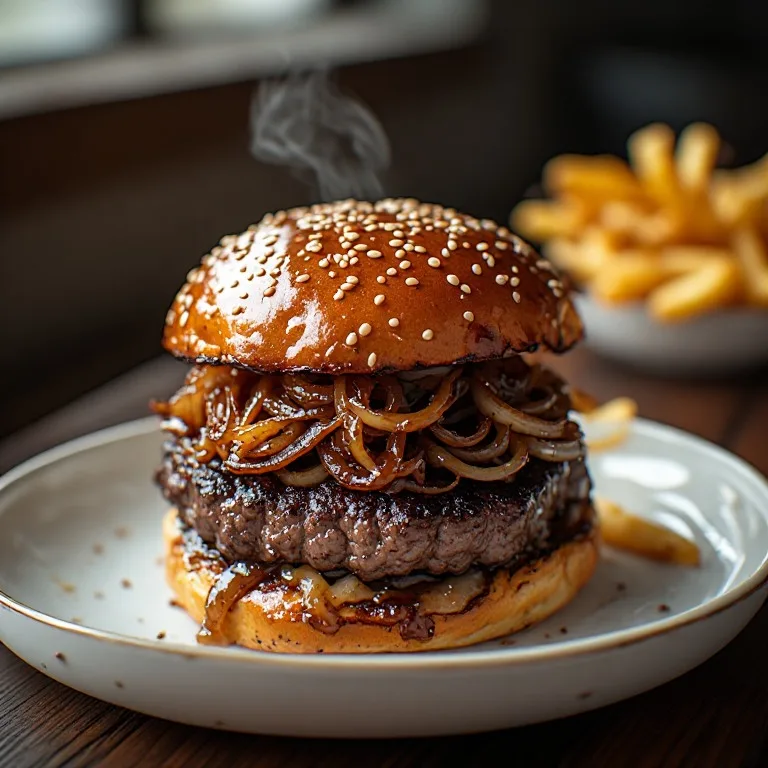
Au Cheval's 'single' cheeseburger is two smashed thin patties stacked with American cheese at every layer, a Dijonnaise sauce (mayo + Dijon), sour pickles, red onion, and fresh chives. Bon Appétit named it the best burger in the country in 2012. Here is the exact technique.

Intermediate Prep: 10 min Cook: 12 min Total: 22 min2 servings ~$4.50/serving
Prep10 min
Cook12 min
Total22 min
Servings
2
At home~$4.50/serving
vs
Restaurant~$20.25/serving
You save ~78%

The Story Behind the Recipe

Au Cheval's 'single' cheeseburger is two smashed thin patties stacked with American cheese at every layer, a Dijonnaise sauce (mayo + Dijon), sour pickles, red onion, and fresh chives. Bon Appétit named it the best burger in the country in 2012. Here is the exact technique.

Nutrition Facts

Per serving (2 servings)
Calories760
Total Fat46g
Total Carbs38g
Dietary Fiber1g
Sugars5g
Protein44g
Sodium1080mg

* Estimated values based on standard recipe preparation. Actual values may vary.

Ingredients

  • Dijonnaise sauce
  • Patties (makes 2 singles, 2 patties each)
  • Assembly
  • Optional but highly recommended

Instructions

💡
Pro tip: This recipe tastes even better the next day. The flavors need time to meld together in the fridge.
❄️
Storage: Keeps in an airtight container in the fridge for up to 2 weeks. Freezer-friendly for up to 3 months.
🎃 Free Halloween cookbook — download now The Copycat Halloween Cookbook A ready-made, photo-illustrated PDF of our best halloween copycat recipes — free to download, no building required. Pay what you want to support if you love it.

Free PDF — instant download. We'll also send new seasonal copycat recipes now and then; unsubscribe anytime. Or just download it →

Copycat Au Cheval Cheeseburger (Bon Appétit’s Best Burger in America, Made at Home)

Prep time: 10 min Cook time: 12 min Servings: 2

The line outside Au Cheval at 800 W. Randolph Street in Chicago’s West Loop has been a feature of the neighborhood since Brendan Sodikoff opened it in 2012. On weekend evenings, a one-to-two-hour wait is not unusual for a restaurant with roughly 50 seats. In 2012, Bon Appétit named Au Cheval’s burger the best in the country. The Food Network ranked it first in America. The Thrillist, Forbes, and GQ lists followed. Fourteen years later, people are still waiting outside.

The burger that earned those titles looks, on paper, like it should not be that special. It is a smash-style double cheeseburger — two thin patties smashed onto a flat-top griddle, stacked with American cheese, dressed with a sauce of mayo and Dijon mustard, topped with sour pickles and minced red onion. Nothing on that list is exotic. The ingredients you can source at any grocery store. The technique is what you cannot buy.

The Naming Confusion: A “Single” Is Already Two Patties

Before the recipe, the most important thing to know about Au Cheval: if you order the “single” cheeseburger, you will receive a burger with two patties. Their “double” has three. This is not a mistake.

Sodikoff and his team built the menu on the logic of the classic American smash burger, which has always held that a single thin patty is too flimsy on its own — it needs a partner. One thin smash patty is mostly crust with little interior. Two thin smash patties stacked together, each with their own seared surface and a slice of American cheese melted between them, form a coherent bite: crust on the outside, yielding interior in the middle, cheese running through every layer.

This means that for two people, you are making four patties. Keep that in mind before you portion.

The Smash: Technique Over Ingredients

The lacey, brown, irregular edge that photographs all over food media — the feature that made Au Cheval famous — is a function of physics, not ingredients. When a cold ball of 80/20 ground beef hits a screaming-hot dry iron surface and is immediately pressed flat under hard pressure, the fat at the edge of the patty is forced outward. It hits the pan surface directly, with maximum contact, and fries in place before the meat protein has time to set a barrier. The result is a thin, cracker-like rim of crisped fat around the perimeter of the patty that has almost no equivalent in conventional thicker-patty cooking.

This does not happen if the pan is not hot enough. It does not happen if you wait even 10 seconds before smashing — by then the exterior protein has begun to set and resists the pressure. It does not happen if you press the patty a second time after the first smash, which compacts the interior and pushes the remaining fat out as grease rather than crisping it at the edge. The smash is one hard, fast motion, immediately, and then you leave it alone.

Four minutes of preheating on high heat, a dry pan, and a stiff metal spatula. That is the whole technique.

The Dijonnaise: The Sauce That Seems Too Simple

A lot of Au Cheval analysis has gone looking for a complex secret-sauce formula — hidden spices, a proprietary fermented something, a finishing ingredient that explains why the burger works. There is not one. The sauce is Dijonnaise: good mayonnaise and Dijon mustard, roughly two parts mayo to one part Dijon, with finely chopped fresh chives stirred in.

The freshness of the chives is not trivial. They add a thin onion flavor that cuts through the richness of the fat without adding bulk, and the green color distinguishes the sauce visually from plain mayo on the bun. The ratio of mayo to mustard can flex depending on your preference — more Dijon gives it a sharper, more acidic punch; more mayo rounds it out into something richer. What the sauce does not need is augmentation. The American cheese, the smash-crust, and the sour pickles are doing a lot of work. A simple sauce lets them do it.

The Bun: Z Bakery and What Works at Home

Au Cheval’s official bun is from Z Bakery, a Chicago wholesale operation that does not sell to the general public. The buns are not true brioche — they are softer, less enriched, closer to a high-quality white sandwich roll. They compress when you press down on the burger stack without gumming up or tearing.

The standard recommendation for a home approximation is Martin’s Potato Rolls, which have earned their reputation: the potato flour gives them a faintly sweet, pillowy crumb and they are sturdy enough to hold a double stack with a running egg without disintegrating before the second bite. A soft supermarket brioche bun is a fine alternative. The qualities to avoid are a bun that is too large (it throws off the ratio), too dense and doughy (it competes with the patty), or too crusty (the first bite shears the stack apart).

The Fried Egg: The $2 Add-On That Defines the Experience

The egg is listed as optional. It is not really optional.

What the fried egg does when you press down on the assembled burger: the yolk breaks, runs down through the stack, and combines with the Dijonnaise into something that is neither sauce nor yolk but somewhere between them — fat-rich and tangy and warm. It coats the inside of the bun, pools at the base of the stack, and ties every other element together in a way that the burger does not quite achieve on its own. The bite without the egg is clean and structured. The bite with the egg is a little chaotic in the best way.

The mechanics: fry in butter, medium heat, baste the whites with the foaming butter until they are just set. Leave the yolk completely runny. Slide it directly onto the finished burger and get the plate to the table within 90 seconds, before the yolk sets from carryover heat.


Au Cheval occupies the corner of Randolph and Green in Chicago’s West Loop, which has evolved from a meatpacking district into the city’s most-watched restaurant corridor. Sodikoff’s Hogsalt Hospitality group has since opened several Chicago restaurants under the same umbrella, and the brand runs Small Cheval, a casual counter-service spinoff, at roughly ten locations across the Chicago area. The formula — a specific griddle technique, American cheese, a simple sauce, and the patience to not press the patty twice — has not changed.
🥗

Make It Healthier

Love Au Cheval Cheeseburger (Bon Appétit's Best Burger in America, Made at Home) but want a lighter version? Try these simple swaps:

  • ✓Use two 3-ounce balls instead of 4-ounce balls to stay with two patties but cut roughly 100 calories per burger. The smash technique still works at 3 ounces — the patty just ends up thinner, which actually increases the lacy edge-to-center ratio.
  • ✓Skip the egg and use one patty instead of two for a lighter single — around 520 calories. The Dijonnaise and the sear still deliver the Au Cheval flavor at smaller scale.
  • ✓Serve on a bed of dressed greens instead of the bun — the Dijonnaise works as a dressing alternative and the patty stack holds up as a salad protein.

Frequently Asked Questions

What is in Au Cheval's Dijonnaise sauce?

The Dijonnaise is the simplest part of the recipe — and one of the things that catches people off guard. It is mayonnaise and Dijon mustard, roughly two parts mayo to one part Dijon, with finely chopped fresh chives stirred in. That is it. No ketchup, no relish, no Worcestershire, no garlic. The chives add a faint onion note and a green color that distinguishes the sauce visually from standard mayo. Some home cooks add a small splash of white wine vinegar to sharpen the mustard flavor slightly, which is not far off from the restaurant version. What Au Cheval does not do is build a complex secret sauce — the burger is already carrying plenty of flavor from the sear and the American cheese, and an aggressive sauce would muddy it.

Why does ordering a 'single' get you two patties at Au Cheval?

This is the most common source of confusion about Au Cheval, and it is worth knowing before you visit or replicate the burger. Au Cheval's menu uses 'single' to mean one portion of the burger, which is built from two thin smashed patties stacked together. Their 'double' is three patties. The logic — borrowed from In-N-Out's and old diner culture — is that a single-patty smash burger is too thin to carry a full serving on its own; two thin patties layered with cheese between them create a more cohesive stack than one thick patty, and they each develop independent seared crust on both sides. You end up with more sear surface area, more cheese, and a more satisfying bite. So if you are making this recipe for two people, you need four patty balls — two patties per burger.

What is the secret to the lacey, crispy edges?

The lacy-brown edge is the Au Cheval signature, and it has nothing to do with the beef and everything to do with the smash and the heat. You need three things: a pan preheated to ripping hot (5 full minutes over high heat, until a drop of water instantly evaporates on contact), a beef ball with no added binders or fillers — just ground beef — and a smash that is hard and immediate. You drop the ball on the dry skillet and press it flat in the first 3 to 4 seconds, before the exterior protein has time to set. The pressure forces the fat out to the edges of the patty, and when that fat hits the screaming-hot iron, it fries in place and crisps into a thin, irregular, cracker-like border. This does not happen on a warm pan. It does not happen if you press the patty more than once. It does not happen with extra-lean beef. The lace is fat hitting heat fast — and the only way to get it is to not hesitate.

What bun does Au Cheval use?

Au Cheval uses buns from Z Bakery (formerly Z Baking), a Chicago wholesale operation that is not available outside the city. The buns are softer than brioche and less enriched — closer to a well-made white sandwich roll than to a croissant-style bun — with just enough structure to absorb drippings without falling apart after the first bite. For home cooks outside Chicago, Martin's Potato Rolls are the most widely cited approximation, and they genuinely work: the potato flour gives them a soft, slightly sweet interior, and they are sturdy enough to hold a double stack with egg. A soft brioche bun from any grocery store is a fine alternative. The qualities to avoid: a bun that is too thick and doughy (it competes with the burger), too crusty (it tears the stack apart when you bite), or too large (the bun-to-meat ratio is a real factor in how the burger eats).

Should I add the fried egg?

Yes. The fried egg is listed as a $2 add-on on the menu, but it is so central to how people describe and remember the Au Cheval experience that 'the egg is optional' understates things. What the egg does mechanically: a runny yolk breaks when you press down on the burger with your first bite and flows down through the stack with the Dijonnaise. The richness of the yolk — pure fat and lecithin — coats everything and rounds out the sharpness of the Dijon and the saltiness of the American cheese. Without the egg, the burger is a very good smash burger. With the egg, it is something different. Cook it butter-side in a non-stick pan over medium heat, leave the yolk completely runny, season lightly, and slide it directly onto the assembled burger right before serving. Eat it quickly; the window before the yolk sets is about 90 seconds.

What beef does Au Cheval use?

The restaurant has not published the specific fat ratio of their ground beef, and no verified source confirms whether they use a proprietary blend. Credible copycat recipes consistently use 80/20 ground chuck, and there is good reason for this: the burger is a smash burger, which means the fat renders and crisps against the hot iron rather than pooling inside a thick patty. 80/20 provides enough fat to create the lacy edge and enough flavor to stand up against the Dijonnaise and American cheese without being greasy. 85/15 works but produces a slightly drier, less flavorful crust. Anything leaner than that misses the point entirely. Unlike the Minetta Tavern Black Label burger, which sources from Pat LaFrieda's dry-aged program and makes the beef the entire story, Au Cheval's greatness is the technique — a quality 80/20 from any good butcher or grocery store gets you where you need to go.

Is Au Cheval still open?

Au Cheval's flagship at 800 W. Randolph Street in Chicago's West Loop has been the center of the city's food scene since 2012, and it has periodically closed briefly for maintenance and refreshes over the years, most recently in May 2025 for cosmetic updates. As of this writing, the restaurant's website (auchevaldiner.com) shows Chicago and New York locations. If you are planning a trip, check current hours directly — the restaurant operates with limited seatings, and waits of one to two hours are normal on weekends. The brand has also spawned Small Cheval, a casual counter-service spinoff with roughly ten Chicago-area locations, which serves the same core burger without the wait.

Love this recipe? Share it!

Free PDF: our 12 most-wanted copycat recipes — instant download.

Made it? Buy us a coffee

Every recipe here is free, with no paywalls. If this one was a hit at your table, a small tip keeps new copycats coming.

$

Au Cheval is a trademark of its owner, used here only to describe the dish this recipe recreates. This is an independent copycat written in our own words — Copycat Spices is not affiliated with, endorsed by or sponsored by Au Cheval.

Ratings & Reviews

—
No ratings yet

Rate this recipe

Click a star to rate

Leave a Review

0/500

CS

Copycat Spices Editorial

Researched + fact-checked. Every recipe on Copycat Spices is built from published sources — official ingredient lists, brand-published recipes, interviews and food-science references — and fact-checked before it goes live, then written as clear, step-by-step instructions for home cooks of all skill levels.

Learn more about our mission →