


Copycat Minetta Tavern Black Label Burger (NYC’s Most Storied Burger, Made at Home)
Prep time: 15 min active + 90 min for onions Cook time: 10 min Servings: 4
The bar at 113 MacDougal Street in Greenwich Village has been called Minetta Tavern since 1937 — back when the neighborhood was the center of New York’s literary and bohemian world. Ernest Hemingway drank here. E.E. Cummings kept a stool. The walls are covered in hand-drawn caricatures of regulars who have been dead for decades. The building holds more lore per square foot than almost anywhere else in Manhattan.
The restaurant that opened in 2009 shares the address but almost nothing else. Keith McNally — who built Balthazar into one of New York’s most enduring rooms — took over the space and installed chefs Riad Nasr and Lee Hanson, who proceeded to create the burger that would make the place famous in an entirely different way than it had been before. Sam Sifton gave it two stars in the New York Times almost immediately. Anthony Bourdain put it on his essential New York list. It has stayed there.
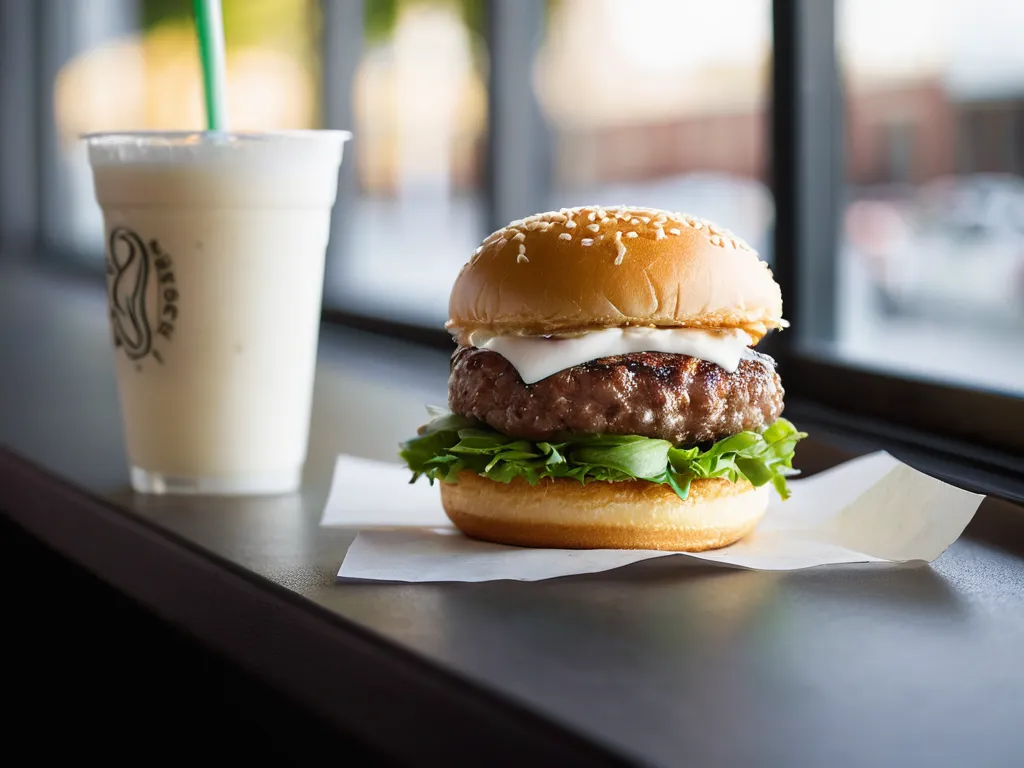
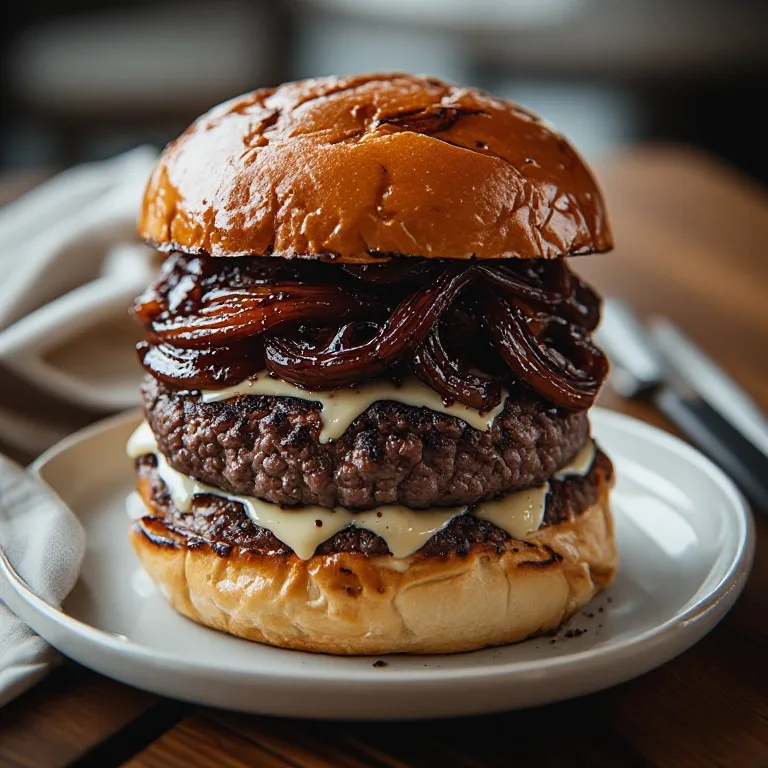
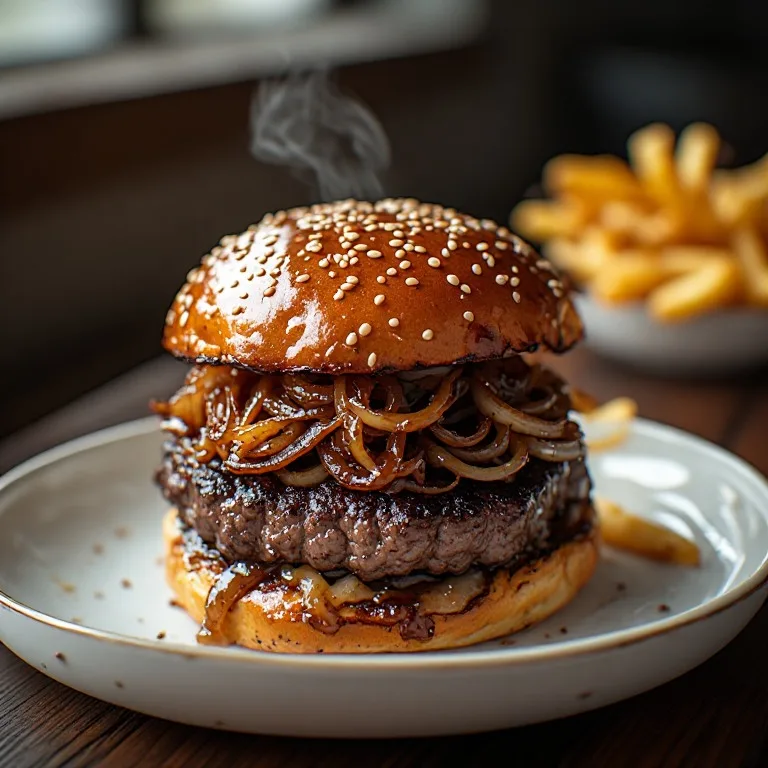
The Black Label Burger — named for the grade of beef it uses — is built on a principle of deliberate restraint: the best possible beef blend, cooked in a cast iron skillet with butter, and topped with exactly one thing. No cheese. No condiments. Just 90 minutes’ worth of caramelized onions and a brioche bun from Balthazar’s own bakery.
The Beef Blend: Pat LaFrieda and 45-Day Dry-Aged Rib-Eye
The Black Label exists because of one phone call. Nasr and Hanson knew they wanted a burger, knew it would be the most scrutinized thing they served, and spent weeks tasting different beef blends before settling on one: 50 percent 45-day dry-aged prime rib-eye and 50 percent a blend of short rib, chuck, skirt steak, and brisket, all sourced from Pat LaFrieda Meats.
The LaFrieda family has been supplying New York restaurants for decades. Their dry-aged beef goes through six weeks of careful temperature and humidity management, during which moisture evaporates from the muscle, concentrating flavor, and natural enzymes break down tough connective tissue into gelatin and tenderize the meat. The result tastes fundamentally different from fresh-ground beef — richer, more complex, with a deep savory funk that has no analog in supermarket ground beef.
For the home cook, sourcing this blend takes a phone call to a butcher. Any butcher that dry-ages beef in-house can grind dry-aged rib-eye trimmings together with short rib or chuck in roughly equal proportions. In major cities, at least one local butcher will do this on request. Pat LaFrieda also sells retail ground beef through Whole Foods and online, though their retail blends are not the same proprietary composition as the restaurant blend.
The Caramelized Onions: Why This Takes 90 Minutes
The single topping on the Black Label is a deeply caramelized yellow onion — not a quickly softened onion, not a lightly browned onion, but an onion that has spent 90 minutes in a heavy pan over medium-low heat until it is glossy, dark amber, and nearly jammy in texture.
This process is almost universally rushed by home cooks, and the difference between the rushed version and the real version is the entire burger. Onions contain sucrose — table sugar — that does not caramelize until it passes 320°F, which takes time over low heat and cannot be shortcut by raising the temperature (which only burns the exterior while the interior remains underdeveloped). The 90-minute timeline is when the onions move through the three stages that actually matter: wilting, shrinking, and finally developing the concentrated depth that makes them taste nothing like raw onion.
Four large yellow onions produce only about 1½ cups of fully caramelized onions — they shrink to roughly one-eighth of their original volume. This is not a side dish; it is a condiment-density reduction, and it is why each serving of onions carries so much flavor.
Cost Comparison: Home vs. Restaurant
The Black Label Burger currently runs approximately $38 on the Minetta menu — per burger, at dinner (it does come with fries).
| Minetta Tavern | Homemade (4 burgers) | |
|---|---|---|
| Per burger | ~$38 | — |
| Full batch (4 burgers) | ~$152 | ~$40–55 |
| Per serving | ~$38 | ~$10–14 |
| Savings per burger | — | ~$24–28 |
The dry-aged beef is the variable cost — a quality butcher’s dry-aged blend runs higher than standard ground chuck. Standard 80/20 from a grocery butcher brings the per-burger cost down to roughly $8. Either way, you are making four burgers for less than the price of one at the restaurant.
The Three Things Most Versions Get Wrong
1. Caramelized onions stopped too early
A pale golden onion is not a caramelized onion. It is a softened onion. The transformation that makes the Black Label’s topping taste the way it does happens in the final 30 minutes of cooking, when the onions go from gold to deep amber and develop a concentrated sweetness that reads as almost winey. If your onions took less than 60 minutes, they did not finish.
2. Cold skillet or oil in the pan
A cold cast iron skillet produces steaming, not searing. The patty releases moisture as it heats up, and that moisture — in a cold pan — creates steam that essentially poaches the outside of the burger instead of browning it. Preheat the skillet for 3 full minutes over medium-high before the first patty touches it. No oil — the fat in the beef renders immediately on contact with a properly hot dry cast iron pan, and oil would only add a layer of flavor that competes with the beef.
3. Cheese added “to be safe”
The restraint of the original Black Label is not an omission; it is a statement about the beef. The dry-aged rib-eye component develops a flavor profile that most cheeses — even aged Gruyère — will overpower or mute. The first time you make this, make it straight. Once you understand what the beef tastes like on its own, you will understand why Nasr and Hanson left the cheese off.
Tips & Variations
- Make the onions up to 3 days ahead. They reheat beautifully in a small pan with a splash of water and actually deepen in flavor after a day in the refrigerator. Doing them ahead removes the main time commitment from the day-of cook.
- The Minetta Burger is the accessible alternative. Minetta also serves a Minetta Burger at roughly half the price, made with a fresh-ground blend rather than dry-aged beef, with Cheddar cheese and caramelized onions. If the dry-aged beef is unavailable, the home version of this — quality 80/20 chuck, sharp Cheddar, the same 90-minute onions — is excellent.
- A deglaze adds depth to the onions. In the last 5 minutes of cooking, add 1 tablespoon of dry sherry, brandy, or Cognac and stir. The alcohol evaporates quickly but leaves behind a layer of complexity that balances the sweetness.
- Rest the patty; always. A rested patty holds its juice internally. An unrested patty releases it into the board the moment you cut it. Three to four minutes is not optional.
- If you add cheese, use it thoughtfully. Gruyère, aged Fontina, or Comté complement dry-aged beef better than American or standard Cheddar — their nuttiness echoes the dry-aged funk rather than muting it. If you add it, add it in the last 30 seconds before the butter baste, covered, so it melts fully.
Storage & Reheating
Fully assembled burgers do not reheat well. The components store separately: cooked patties keep in the refrigerator for 2 days (reheat in a cast iron pan over medium heat until warmed through, 2 minutes per side); caramelized onions keep for up to 5 days refrigerated. Make extra onions — they are excellent on eggs, pizza, steak, pasta, and sandwiches.
More NYC Restaurant Classics Made at Home
- Copycat Shake Shack Burger — the ShackSauce formula, the smash technique, and why the griddle gap matters
- Copycat Peter Luger Porterhouse — the 80-year-old broiler method and how to replicate the char on a home grill
- Copycat Balthazar French Onion Soup — Keith McNally’s other institution, the soup that’s been on the menu since 1997
- Copycat Katz’s Deli Pastrami Sandwich — the cure, the smoke, the steam, and why you need 10 days
- Copycat Carbone Spicy Rigatoni — the tomato paste technique that is the entire foundation of NYC’s hardest reservation