Jollibee Chickenjoy with Mushroom-Chicken Gravy
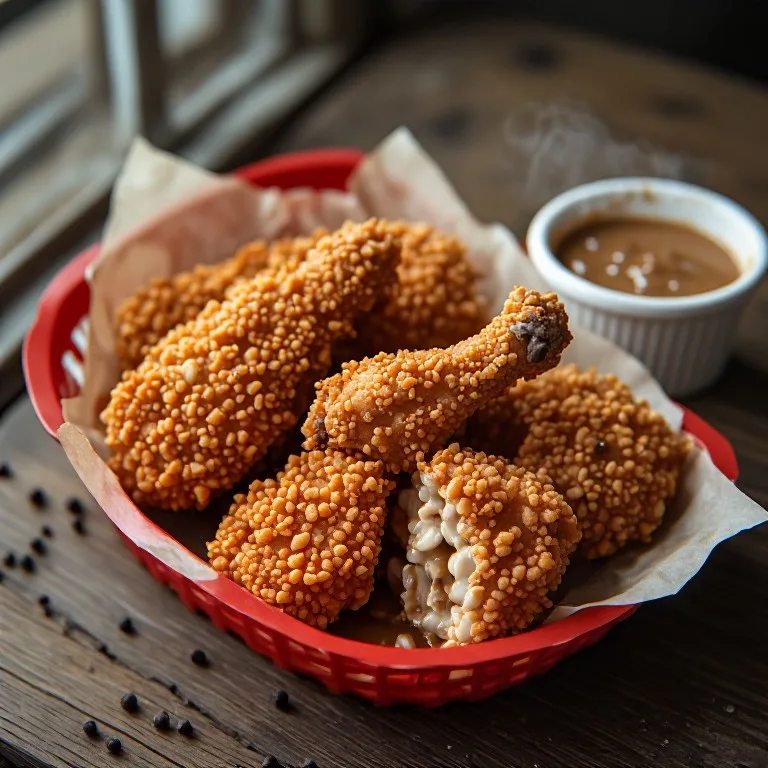
Quick answer: Marinate 3 lbs bone-in, skin-on chicken thighs and drumsticks overnight in 1 cup water + 3 tbsp soy sauce + 1 tbsp lemon juice + 1 tsp salt + ½ tsp each garlic powder, white pepper, coriander + 2 bay leaves. Whisk together the dredge: 2 cups flour + ¼ cup cornstarch + 1 tsp each salt, MSG, garlic powder, onion powder, white pepper + ½ tsp coriander + ½ tsp ginger. Remove chicken from marinade; splash 3–4 tbsp of the reserved marinade into the flour mixture and toss to create shaggy clusters. Dredge the chicken, pressing firmly so clusters adhere. Rest 15 min on a wire rack. Fry at 325°F for 12–15 min, turning once, until golden and cooked through (165°F internal). For the gravy, cook minced mushrooms in butter, add flour, whisk in chicken stock + soy sauce + evaporated milk, simmer until pourable-thick. Serve over steamed rice.
Shop the tools
Gear matched to this recipe. These are Amazon affiliate links — we may earn a small commission if you buy, at no extra cost to you.
 Illustrative imageLodge 10.25" Cast Iron SkilletThe restaurant-grade sear most copycats depend onCheck price on Amazon →
 Illustrative imageInstant-Read Digital ThermometerNail fry-oil and doneness temps every timeCheck price on Amazon →
 Illustrative imageNordic Ware Half Sheet PanCommercial-quality aluminum, bakes dead evenCheck price on Amazon →
As an Amazon Associate, Copycat Spices earns from qualifying purchases. Product images are generic illustrations, not the exact item listed.
Jollibee Chickenjoy with Mushroom-Chicken Gravy
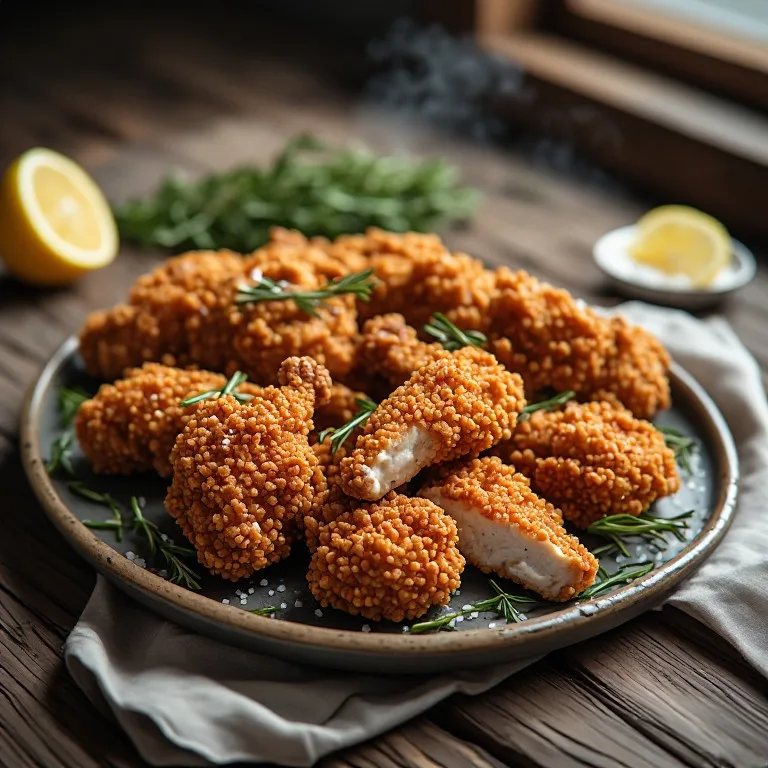
The legendary Jollibee Chickenjoy at home: bone-in chicken in a shaggy, extra-craggy soy-garlic crust with Jollibee's signature mushroom-chicken gravy. The key technique — splashing wet marinade into the dry dredge — creates the jagged, ultra-crispy coating that makes Chickenjoy unlike any American fried chicken. About $4 per serving vs. $9–$11 at the restaurant.
Medium
Prep: 20 min (plus 4–12 hr marinade)
Cook: 30 min
Total: 12h 50m6 servings
~$4.50/serving
At home~$4.50/serving
vs
Restaurant~$20.25/serving
You save ~78%
The Story Behind the Recipe
Jollibee started in 1975 as a Magnolia ice cream parlor in Cubao, Quezon City, opened by 22-year-old Tony Tan Caktiong. When he noticed his customers wanted hot food alongside the ice cream, he converted to fast food in 1978. Chickenjoy was the signature from the start — bone-in dark meat with a craggy, irregular coating and a thin mushroom-chicken gravy that tasted unlike anything from McDonald's or KFC. It worked. Jollibee now operates 1,600+ locations across 17 countries and has consistently outsold McDonald's in the Philippines for decades. For Filipino-Americans, it is part comfort food and part cultural pride — new US openings in Los Angeles, New York, and Chicago routinely draw hour-long lines. The first US location opened in Daly City, California in 1988. A two-piece Chickenjoy with gravy and steamed rice at the restaurant runs $9–$11 in 2026; making it at home costs roughly $4 per serving.
The technique that separates Chickenjoy from every American fried chicken chain is the marinade-splash method. After an overnight soy-garlic brine — no buttermilk, which is the American standard — a few spoonfuls of the wet marinade get deliberately tossed into the dry flour-and-cornstarch dredge just before coating. The liquid hits the dry mixture and forms shaggy, irregular flour clusters. When those clusters fry, they become the jagged, extra-craggy surface visible in every Chickenjoy photo — unlike the smooth, even coating of KFC or Popeyes. The gravy is equally specific: a soy-and-mushroom-forward hybrid that is thinner and silkier than American brown gravy, finished with evaporated milk. Frying temperature matters too: 325°F is intentionally lower than the 350–375°F of most American fried chicken, because bone-in pieces need time to cook through without burning the crust.
Nutrition Facts
Per serving (6 servings)Calories460
Total Fat33g
Total Carbs13g
Dietary Fiber1g
Sugars2g
Protein27g
Sodium860mg
* Estimated values based on standard recipe preparation. Actual values may vary.
Ingredients
- For the chicken and soy-garlic marinade
- For the shaggy dredge
- For the mushroom-chicken gravy
- For frying
- To serve
Instructions
Pro tip: This recipe tastes even better the next day. The flavors need time to meld together in the fridge.
Storage: Keeps in an airtight container in the fridge for up to 2 weeks. Freezer-friendly for up to 3 months.
Free PDF — instant download. We'll also send new seasonal copycat recipes now and then; unsubscribe anytime. Or just download it →
🎉 Your Halloween Cookbook is ready!
It's free — but if it's worth something to you, you can pay what you want. It keeps the recipes coming.
$
✓ Downloading your free Halloween Cookbook — check your downloads folder. Happy cooking!
Make It Healthier
Love Jollibee Chickenjoy with Mushroom-Chicken Gravy but want a lighter version? Try these simple swaps:
- ✓Skip the double-fry and go single-fry at 325°F — the first fry already delivers serious crunch; the second fry adds about 40 calories per piece from extra oil absorption with diminishing textural returns.
- ✓Swap bone-in, skin-on thighs for boneless, skinless thighs (cut thick) — you keep the soy-garlic flavor and shaggy crust while cutting about 90 calories and 10g of fat per piece.
- ✓The evaporated milk in the gravy is responsible for the silky richness — use 2 tablespoons instead of 4 (add extra chicken stock to compensate) to cut the gravy to roughly 50 calories per serving without sacrificing the soy-mushroom depth.
- ✓Oven version: after dredging, spray liberally with cooking oil and bake at 425°F on a wire rack for 35–40 minutes — the crust isn't as shattery but the flavor holds up, and you cut about 120 calories per piece.
Frequently Asked Questions
What makes Jollibee Chickenjoy different from KFC or Popeyes?
Three things: the marinade, the coating technique, and the gravy. American fried chicken chains use buttermilk, which tenderizes with lactic acid and produces a smooth, uniform coating. Jollibee uses a soy-water brine — the soy sauce is a flavor ingredient rather than a tenderizer — and creates the coating texture by splashing wet marinade directly into the dry dredge. The resulting coating is rougher, more irregular, and shatters differently when you bite through it. The gravy is also a different category: a soy-and-mushroom umami hybrid, thinner and silkier than the gravy-packet-style brown gravy common at American fried chicken chains. KFC and Popeyes are great; Chickenjoy tastes like a different thing entirely.
Is MSG really in Jollibee Chickenjoy?
Yes. MSG — monosodium glutamate, sold in the Philippines as Ajinomoto — is a standard ingredient in Filipino fast-food cooking and appears in both Jollibee's coating and its marinade. It produces the savory depth that makes Chickenjoy taste distinctively richer than seasoned flour alone. MSG is chemically identical to the glutamate found naturally in parmesan cheese, soy sauce, tomatoes, and mushrooms; the scientific consensus is that it is safe in cooking quantities for the vast majority of people. Including it here is not a shortcut — it is what Jollibee uses, and leaving it out produces noticeably flatter flavor.
What is the marinade-splash technique and why does it create a craggier crust?
The marinade-splash technique means deliberately adding a few tablespoons of wet marinade into the dry flour-cornstarch dredge just before coating the chicken. The liquid hits the dry mix and clumps it into shaggy, irregular clusters — like the texture of crumble topping rather than smooth sand. When those clusters fry, the moisture in the irregular lumps turns to steam, which puffs the coating into the jagged peaks you see on a Chickenjoy piece. A standard dredge (dry flour with no liquid mixed in) produces a smooth, even coating with no peaks. The jagged surface also has significantly more surface area to fry, which means more crunch per bite. The technique is the single most important step in this recipe.
Can I substitute calamansi juice and where do I find it?
Calamansi is a small Philippine citrus that tastes like a cross between lime and lemon with a hint of mandarin orange. Fresh calamansi is available at most Filipino and Asian grocery stores; bottled calamansi juice (Tropics brand is common) is easier to find. If unavailable, substitute key lime juice (closest match), equal parts lemon and lime juice, or just regular lemon juice. The citrus adds brightness to the marinade rather than a dominant flavor, so the substitution barely affects the final chicken.
Why does this recipe fry at 325°F instead of the 350–375°F used for most fried chicken?
Bone-in chicken thighs and drumsticks are 1–1.5 inches thick at their center. At 375°F, the coating browns and crisps before the interior near the bone has had time to reach a safe temperature. At 325°F, the cooking is slower and more gradual, allowing heat to penetrate to the bone before the outside burns. The optional double-fry at 375°F happens after the interior is already fully cooked — its only job is to maximize surface crunch. Many home fried chicken failures come from frying bone-in pieces at too high a temperature, producing a gorgeous golden exterior surrounding undercooked pink meat near the bone.
What is the Jolly Meal that Filipinos pair with Chickenjoy?
The classic Jollibee combo is Chickenjoy + Jolly Spaghetti + a Peach Mango Pie. Jolly Spaghetti is not Italian-style — it is Filipino fast-food spaghetti: a sweet tomato sauce made with banana ketchup, sliced hot dog rounds (what Filipinos call the 'toppings'), ground beef, and shredded cheddar cheese scattered over the top. The sweet-savory combination is unexpected for first-timers but is childhood comfort food for anyone who grew up with Jollibee birthday parties — which are a genuine cultural institution in the Philippines and in Filipino-American communities.
Can I bake or air-fry Chickenjoy instead of deep-frying?
Both work with flavor intact, though neither replicates the deep-fried shatter of the original. Air fryer: spray dredged chicken generously with cooking oil and cook at 400°F for 22–25 minutes, turning once at the 12-minute mark. Oven: place dredged chicken on a wire rack set over a sheet pan, spray generously with oil, and bake at 425°F for 35–40 minutes. Both methods benefit from the same marinade-splash technique — the craggy clusters still form and still crisp up, even without full submersion in oil. The mushroom-chicken gravy is the same regardless of cooking method.
How many Jollibee locations are in the United States?
As of 2025–2026, Jollibee has around 100+ US locations, concentrated in metro areas with large Filipino-American populations: Greater Los Angeles (Long Beach, Carson, Torrance), the San Francisco Bay Area (Daly City, Milpitas, Union City), New York City (Midtown Manhattan and Woodside, Queens), Chicago, Las Vegas, and Houston. The chain continues expanding into mid-size markets. New openings consistently attract long lines — the Woodside, Queens location is known for waits of 45 minutes to over an hour during weekend dinner service.
Love this recipe? Share it!
Made it? Buy us a coffee
Every recipe here is free, with no paywalls. If this one was a hit at your table, a small tip keeps new copycats coming.
$
💛 Support checkout is coming soon — the cookbook stays free either way.
Jollibee is a trademark of its owner, used here only to describe the dish this recipe recreates. This is an independent copycat written in our own words — Copycat Spices is not affiliated with, endorsed by or sponsored by Jollibee.


Ratings & Reviews
Rate this recipe
Click a star to rate