

Panera launched the PB&J Cookie on September 2, 2026 as part of a broader fall menu drop that also introduced Cinnamon Croissant Bites and Three-Cheese Lasagna Soup. The cookie takes the most elemental school-lunch combination — peanut butter, grape jelly, powdered sugar — and converts it into a bakery-format soft thumbprint cookie. It’s not complicated, but that’s the point: the appeal is the nostalgia of a PB&J sandwich repackaged as something you’d find behind glass at a bakery counter.
At Panera, one cookie is about $2.79. A batch of 18–20 at home costs about $6 in ingredients. The cookies take 30 minutes start to finish with no chilling required.
What the Cookie Actually Is
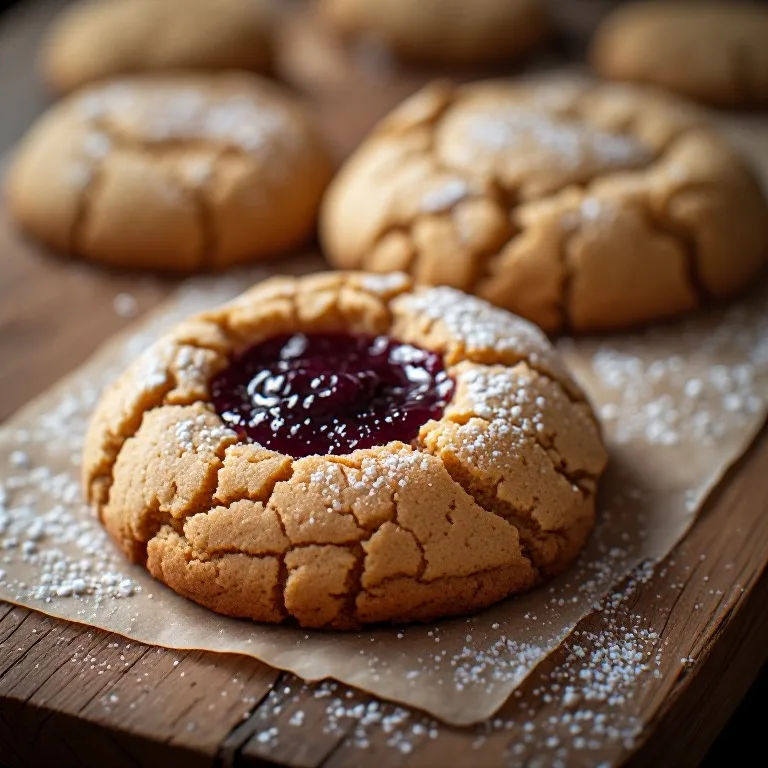
Panera describes it as a soft peanut butter cookie with a gooey grape jelly filling, dusted with powdered sugar. That’s the thumbprint format: a ball of soft peanut butter dough, pressed with an indentation, filled with preserves, baked until the edges set and the jelly bubbles, then dusted with powdered sugar once cool.
It’s not a sandwich cookie. It’s not a stuffed cookie where the jelly is hidden inside (those require a more complex pinch-and-seal step). The jelly is visible in the center, which is part of the visual — the deep purple-red of the grape filling against the white powdered sugar and golden-tan cookie is the distinctive look.
Jam vs. Jelly vs. Preserves: This Actually Matters
The filling in this recipe calls for grape preserves or grape jam — not grape jelly — and the distinction is structural, not taste-based.
Grape jelly is smooth and clear. In the oven, it heats rapidly, turns liquid, and tends to bubble and flow out of the well onto the cookie surface. The result: a flat, caramelized smear of jelly rather than a contained, gooey center.
Grape jam contains crushed fruit solids. Grape preserves contain larger fruit pieces. Both have more body than jelly and hold their shape much better when heated. They still bubble — preserves at 350°F will be visibly active in the oven — but they set back down when they cool, leaving a thicker, gooey center rather than a spread.
Smucker’s Concord Grape Jam or Welch’s Grape Jam both work well. If you use jelly, reduce the fill to about 1/3 teaspoon per well instead of 1/2 to compensate for the extra spread.
Why Commercial Peanut Butter Makes Better Cookies
This recipe specifies commercial-style peanut butter (Jif, Skippy, or similar) rather than natural peanut butter. It’s a practical note, not a snobbery call.
Natural peanut butter separates — the oil floats to the top and the solids compact at the bottom. Unless you stir it very thoroughly and use it while well-mixed, the ratio of oil to solids can vary from batch to batch, which changes cookie texture. Commercial peanut butter is emulsified: the oil and solids are uniformly combined and stay that way. The result is a more consistent dough.
Natural peanut butter works fine here if you stir it very well first and make sure it’s at room temperature. Expect slightly softer cookies and a richer peanut flavor — natural PB is less sweet than commercial and has a more pronounced roasted-peanut taste.
The Indentation Technique
The thumbprint indent needs to be deep enough to hold the preserves through baking. As the cookie spreads and puffs around the edges, the well partially closes — so a well that looks too deep before baking ends up correct after.
A few methods work:
- Thumb: The classic. Press firmly and rotate slightly to smooth the walls. If your dough sticks to your skin, dampen your thumb slightly.
- Back of a 1/2 teaspoon measuring spoon: Creates a round, smooth-walled well without cracking the edges as much as a thumb.
- Wooden spoon handle (rounded end): Good for a narrower, deeper well.
Cracks at the edges of the well are normal and close somewhat during baking. What to avoid: pressing so hard you break through to the parchment (the bottom of the well becomes too thin and the preserves can leak through).
The Powdered Sugar Timing
Dust the cookies after they’ve cooled completely — not when warm, and not right out of the oven.
Powdered sugar on warm cookies dissolves into the surface within minutes and becomes invisible. The moisture from the warm cookie absorbs the sugar. The coating that makes the visual pop — the white dusting against the grape center — only stays if the cookies are fully at room temperature.
Wait at least 30 minutes on a wire rack after transferring from the baking sheet. The jelly center also needs time to set from bubbling-liquid back to gooey-soft before dusting.
Cost Breakdown
| Cost | Panera | Homemade |
|---|---|---|
| Per cookie | ~$2.79 | ~$0.35 |
| A batch of 18 | ~$50 | ~$6 |
The biggest cost in the home version is the peanut butter — a jar of Jif or Skippy at $4–5 at most grocers yields well more than the half-cup needed here. The rest (butter, flour, sugar, egg, grape preserves) are standard pantry staples. Total ingredient cost across a batch runs $5–7 depending on what you have on hand.
Make-Ahead and Storage
These cookies keep well at room temperature in an airtight container for 4–5 days. The jelly center stays gooey rather than drying out (the fruit solids in jam or preserves retain moisture). The powdered sugar dusting fades visually as the cookies sit — re-dust before serving if appearance matters.
Avoid the refrigerator: humidity causes the powdered sugar to absorb quickly, and the cold makes the cookie texture denser.
For freezing: bake the cookies and cool completely, but don’t dust with powdered sugar yet. Freeze in a single layer on a baking sheet until solid (1–2 hours), then transfer to a sealed freezer bag or container. Frozen for up to 2 months. Thaw at room temperature for 20–30 minutes, then dust with fresh powdered sugar before serving.