Pin It

Red Robin Bottomless Steak Fries

Red Robin Bottomless Steak Fries
Jump to Recipe
Prep 15 min Cook 30 min Serves 4
Quick answer: Red Robin's bottomless steak fries are thick-cut, skin-on russet potato wedges seasoned with Red's Original Seasoning (a paprika-garlic-tomato blend with natural smoke flavor) and deep-fried to a crispy exterior with a fluffy interior. At home, cut each large russet into 8 wedges, soak in cold water for 30 minutes (starch removal = crispier crust), pat bone dry, toss with oil, and bake at 425°F for 25–30 minutes flipping once. For restaurant texture, double-fry: 325°F for 6–8 minutes until cooked through, then 375°F for 2–3 minutes until golden and crispy. Season immediately. Serve with Campfire Sauce — 1/2 cup mayo, 1/4 cup smoky BBQ sauce, 1 tbsp Dijon, 1/2 tsp chipotle powder, 1/2 tsp smoked paprika.
Red Robin Bottomless Steak Fries

Red Robin Bottomless Steak Fries

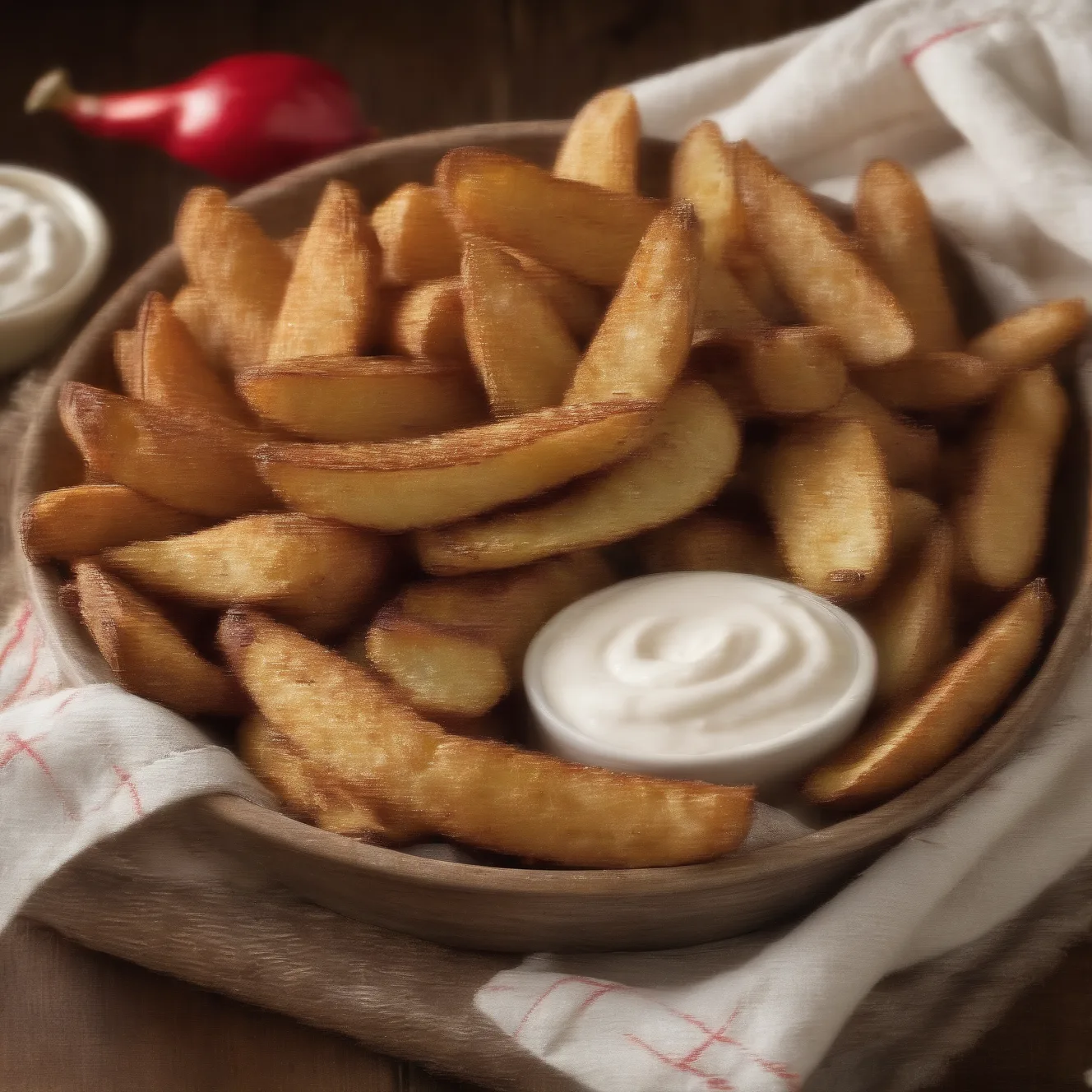
Red Robin's bottomless steak fries are thick-cut, skin-on russet wedges seasoned with a paprika-garlic blend and deep-fried until golden. Three methods — oven, air fryer, and from-scratch deep-fried — plus the science of a crispy wedge fry and the real Campfire Sauce ratio.

Easy Prep: 15 min Cook: 30 min Total: 45 min4 servings ~$3.85/serving
Prep15 min
Cook30 min
Total45 min
Servings
4
At home~$3.85/serving
vs
Restaurant~$17.32/serving
You save ~78%

Ingredients

Instructions

💡
Pro tip: This recipe tastes even better the next day. The flavors need time to meld together in the fridge.
❄️
Storage: Keeps in an airtight container in the fridge for up to 2 weeks. Freezer-friendly for up to 3 months.
~200-400 cal/serving

The Story Behind the Recipe

Copycat Red Robin Bottomless Steak Fries (Oven, Air Fryer & Deep-Fry)

Prep: 15 min | Soak: 30 min | Cook: 25–30 min | Serves: 4

Red Robin’s bottomless steak fries are a simple concept executed well: thick-cut, skin-on russet potato wedges, seasoned with a warm paprika-garlic blend, fried until the outside is golden and the inside is fluffy and steamy. The “bottomless” part — unlimited refills included with any Gourmet Burger order — is the signature, but the fry itself is what keeps people ordering refills in the first place.

The home version can get 90 percent of the way there with an oven, and all the way there with a deep fryer. The difference is physics: an oven drives off surface moisture with hot dry air over 25–30 minutes; frying does it in under 3 minutes with 375°F oil that envelops the wedge on all sides simultaneously. Both work. This guide covers both, plus the air fryer for a middle-ground result.

What Red Robin Actually Makes

Red Robin’s restaurant fries are deep-fried thick-cut russet wedges — skin on, not peeled. The seasoning is their branded “Red’s Original Seasoning,” which Red Robin sells at retail. The current label lists: salt, dried cane syrup, sea salt, spices, dried vegetables (garlic, onion, tomato), paprika, yeast extract, and natural smoke flavor. Those last two — tomato and yeast extract — are what give it savory depth beyond a standard seasoning salt. That’s the full picture: thick russet, skin on, Red’s Original, deep-fried. The quality of the execution is in the details.

The bottomless program has been a Red Robin signature since the brand’s founding. The original location opened in 1940 in Seattle as Sam’s Red Robin — a tavern owned by Sam, who frequently sang “When the Red, Red Robin (Comes Bob, Bob, Bobbin’ Along)” with his barbershop quartet. Gerry Kingen bought the restaurant in 1969, dropped “Sam’s,” and rebuilt it as a burger-focused concept. In 1979 he franchised the brand for the first time, selling the rights to the Snyder Group Company, which opened the first franchised Red Robin in Yakima, Washington. The unlimited fry refills were part of the value proposition from the chain’s early expansion. Red Robin is headquartered in Greenwood Village, Colorado.

The Soaking Step: Why It Matters

Most home cooks skip soaking. Most home cooks end up with wedge fries that are golden on the outside but slightly gummy or chewy rather than crispy. The soaking step is the reason restaurant-quality steak fries have a hard, set crust.

When you cut a raw potato, the exposed starch cells release amylose and amylopectin molecules that coat the cut surface. During cooking, those starch molecules hydrate and gelatinize — forming a sticky, soft layer that blocks Maillard browning. Maillard browning (the reaction that creates golden, crispy crust on any cooked food) requires a dry, hot surface. A starchy wet surface never gets there.

Cold water soaking pulls that surface starch off the potato in 20–30 minutes. The water turns milky-cloudy — that’s the starch leaving the potato. Drain it, pat the wedges bone dry, and now the potato surface is raw carbohydrate with less interfering starch, ready to take on color and crunch. Every extra minute of soaking beyond 20 minutes is diminishing returns; there’s no benefit to soaking overnight in cold water (although briefly parboiling in salted water for 5–6 minutes before drying and frying produces even better interior texture — see the Deep-Fry section).

Drying is just as important as soaking. A wedge that looks dry on the surface may still have moisture trapped in the skin and cut faces. Put them on a kitchen towel, lay another towel on top, and press. Flip them. Press again. Any visible surface moisture is oil displacement insurance you’re throwing away.

The Seasoning Blend

Red Robin’s retail seasoning (Red’s Original Seasoning) is the most faithful starting point and is genuinely worth buying if you make steak fries often — it runs about $4–6 at grocery stores and lasts for dozens of batches. The bottle is available at Kroger, QFC, and on Amazon.

If you want to make your own equivalent: combine 1 teaspoon kosher salt, 1/2 teaspoon paprika, 1/4 teaspoon garlic powder, 1/4 teaspoon onion powder, 1/4 teaspoon black pepper, 1/4 teaspoon tomato powder, and 1/8 teaspoon cayenne. The tomato powder is the differentiator — the retail blend includes dried tomato and yeast extract, which give it savory-umami depth that a plain paprika-garlic salt doesn’t have. If tomato powder isn’t in your pantry, a small dash of Worcestershire sauce whisked into the oil before tossing achieves a similar effect. Some copycat testers use a packet of instant tomato soup mix as a full shortcut — it captures the tomato, yeast, and smoke profile accurately.

This is not a bold spice blend — it’s a warm background note, not a flavor punch. The goal is to enhance the potato, not compete with it.

Season after cooking, not before. Salt applied before oven-baking draws moisture out of the potato surface (osmotic pressure) and slightly inhibits crisping. Wait until the fries come out of the oven, toss in the seasoning while they’re still hot, and the residual oil acts as adhesive. The difference is most noticeable on the oven method; for the deep-fry method, a pre-salt of the par-fried wedges is fine since the second fry seals the surface quickly.

The Three Methods

Method 1: Oven (Most Accessible)

The oven method gets you a well-done baked steak fry — crispy on the cut faces where the potato contacts the baking sheet, with the skin developing a nice chew. It is not as uniformly crispy as deep-frying, but it is significantly better than the stub version with one change: a wire rack set inside the baking sheet. The rack lifts the wedges off the pan so hot air circulates under each piece. Without the rack, the bottom face sits in pooled oil and steams rather than crisps.

425°F is the right temperature. At 400°F, the wedges cook through before the surface can brown properly — you get a done fry that looks pale. At 450°F, the outside darkens faster than the interior cooks, and you can end up with burned skin around an undercooked center. 425°F is the balance.

Method 2: Air Fryer (Best Oven-Alternative Result)

Air-fry at 400°F for 18–22 minutes, shaking or flipping once. The air fryer’s rapid circulation strips surface moisture faster than an oven, producing a crispier crust with less oil. The main limitation is batch size: a full batch of 32 wedges from 4 large potatoes requires 2–3 air fryer loads. Rushing batches by stacking the wedges defeats the purpose — steam trapped between stacked wedges prevents crisping.

For a household where air fryer meals are the norm, this is the method to default to. The results genuinely approach the deep-fried texture.

Method 3: Deep-Fry (Restaurant-Quality)

This is how Red Robin makes theirs. The technique that matters is the double-fry:

First fry at 325°F — the par-fry. Lower wedges into oil at 325°F for 6–8 minutes. At this temperature, the interior cooks through (the center reaches about 200°F) while the exterior turns only lightly golden. The wedge looks underdone. That is correct — you’re cooking the inside without crisping the outside yet.

Remove to a wire rack (not paper towels — the paper absorbs oil from the bottom but traps steam, softening the crust). Rest for 10 minutes. The wedge continues to cook from residual heat; the surface firms up as it cools.

Second fry at 375°F — the finish. Return the wedges to oil at 375°F for 2–3 minutes. The surface is now drier and firmer than it was when raw. It crisps rapidly and uniformly. Total crust formation time drops from 25 minutes to under 3. Season immediately, eat within 5 minutes — wedge fries stale faster than thin fries due to their large interior mass continuing to off-gas steam.

An alternative first-stage technique is brief parboiling: bring a pot of salted water to a boil, add wedges, cook 5–6 minutes until just fork-tender but not falling apart, drain and cool on the rack for 20 minutes, then single-fry at 375°F for 3–4 minutes. Parboiling produces an even fluffier interior than the par-fry method — closer to a loaded-potato texture inside a crispy shell.

Campfire Sauce: The Essential Pairing

Red Robin’s Campfire Sauce is a creamy, smoky BBQ-mayo hybrid — the specific dipping sauce the restaurant serves with steak fries and burgers. The formula is built around the combination of mayonnaise (rich, neutral base), a smoky BBQ sauce (sweet-smoke backbone), and chipotle (adds heat and a deeper smoke note without going hot-sauce sharp).

For the home version: whisk together 1/2 cup full-fat mayo, 1/4 cup hickory or smoky BBQ sauce, 1 tablespoon Dijon mustard, 1/2 teaspoon chipotle chili powder, 1/2 teaspoon smoked paprika, 1/4 teaspoon garlic powder, and a pinch of onion powder and black pepper. Refrigerate for 20–30 minutes before serving — this rest period matters. The garlic and chipotle sharpen when freshly mixed and mellow when they’ve had time to integrate into the mayo.

The full recipe and ratio breakdown is on the Red Robin Campfire Sauce page.

Troubleshooting

Fries are golden on the outside but soft and chewy inside. The wedges were either too thick, undercooked, or the surface starch wasn’t removed fully. Check that you soaked for the full 30 minutes and dried completely. For the oven method, go longer — 30 total minutes if needed — and don’t rush the flip.

Skin separates and peels away during cooking. The skin was too dry or the cut was made at a poor angle relative to the skin. Cut parallel to the potato’s long axis so the skin stays attached to one of the flat faces of the wedge, not floating on its own.

Oil soaks into the wedge and makes it greasy (deep-fry). Oil temperature dropped when the cold wedges entered the pot. Cold potatoes absorb oil readily when the oil isn’t hot enough to immediately seal the surface. Keep the pot away from overfilling and add wedges in small batches to maintain temperature. A thermometer is not optional for the deep-fry method.

Seasoning doesn’t stick. The wedges cooled before seasoning was applied. Season within 30 seconds of removing from heat — the residual oil on the surface is the adhesive window. Season in a bowl, not on the pan, so every surface gets coated.

Red Robin vs. Homemade: Cost and Nutrition

Red Robin’s official nutrition guide shows one serving (8 oz) of Bottomless Steak Fries at 570 calories, 25g fat, 610mg sodium, 77g carbs, 8g fiber, and 8g protein. Those are restaurant deep-fried numbers, and a bottomless meal can easily involve 2–3 servings. The baked home version runs considerably leaner — about 350 calories, 16g fat, and 420mg sodium per serving — because oven-baking uses a fraction of the oil.

On cost: a typical Red Robin Gourmet Burger runs $12–16; bottomless fries are included, so the marginal cost of the fries is zero once you’ve ordered an entrée. At home, 4 large russet potatoes cost about $2–3. Oil, seasoning, and mayo for Campfire Sauce add another $2–3. Total: around $5 for 4 generous servings (32 wedges), or about $1.25 per serving. The home version is also genuinely bottomless — double the batch, cook it in two rounds, and you have 64 wedges for about $8.


More from our fries and sides collection: Red Robin Campfire Sauce (the exact ratio for the dipping sauce), Copycat Five Guys Cajun Fries (the bright-orange seasoned fry), Copycat Arby’s Curly Fries (the spiral fry with seasoned batter), Copycat Chili’s Texas Cheese Fries (loaded with poured nacho cheese), and Copycat McDonald’s Fries (the thin-crispy classic).

Nutrition Facts

Per serving (4 servings)
Calories350
Total Fat16g
Total Carbs49g
Dietary Fiber4g
Sugars1g
Protein5g
Sodium420mg

* Estimated values based on standard recipe preparation. Actual values may vary.

🥗

Make It Healthier

Love Red Robin Bottomless Steak Fries but want a lighter version? Try these simple swaps:

  • Skip the oil toss and use a light oil spray instead — saves about 60–80 calories per serving with only a minor crispiness trade-off.
  • Air-fry at 400°F instead of oven-baking — the circulating heat crisps the exterior with roughly 30% less oil than the oven method.
  • Use sweet potato wedges instead of russets for more fiber, beta-carotene, and a lower glycemic load; the soaking and seasoning technique is identical.
  • Swap Campfire Sauce for a plain Greek yogurt dip with smoked paprika and garlic — cuts the dipping sauce calories from ~120 to about 25 per tablespoon.

Equipment You'll Need

Large baking sheet(s)

Two sheet pans for the oven method — overlapping fries never crisp properly

Large mixing bowl

For soaking and then seasoning; large enough to toss everything without crushing the wedges

Kitchen towels or paper towels

For patting wedges completely dry before oiling — the most important prep step

Tongs

For flipping and for handling wedges in hot oil safely

Heavy pot or Dutch oven (for deep-fry method)

At least 4-quart capacity; cast iron or enameled cast iron holds temperature well

Instant-read thermometer (for deep-fry method)

Essential for accurate 325°F par-fry and 375°F finish temperatures

Wire cooling rack (for deep-fry method)

For draining between par-fry and finish; keeps crust from going soggy on a paper towel

Frequently Asked Questions

What makes Red Robin steak fries different from regular wedge fries?

Three things: the cut, the skin, and the seasoning. Red Robin's fries are cut from large russet potatoes into thick 1-inch-wide wedges — roughly 8 per potato — which gives them a higher interior-to-exterior ratio than thinner fries. More interior means a fluffy, steamy inside that contrasts with the crispy outside. The skin stays on, adding a slightly earthy flavor and a sturdier shell that holds up to the bottomless refill pace. And they're seasoned with a proprietary blend built around paprika, garlic, onion, and salt — a warmer, more savory profile than a plain salted fry. The bottomless factor is the marketing; the fry itself is a genuinely well-executed thick wedge.

How does Red Robin's bottomless fry program work?

Bottomless Steak Fries come free with any Gourmet Burger order at Red Robin — unlimited refills, no extra charge. Other bottomless sides include Yukon Chips, Steamed Broccoli, and Side Salad. Premium sides (Garlic Fries, Sweet Potato Fries, Coleslaw) cost a small upcharge on the first order, but refills on those are also free once you've paid it. Refills are genuinely unlimited during your meal; you cannot order a standalone unlimited side without a qualifying entrée. The bottomless program has been a Red Robin trademark since Gerry Kingen began building the chain in 1969 — the unlimited side model was central to the brand's value proposition from the start.

What seasoning does Red Robin put on their fries?

Red Robin uses 'Red's Original Seasoning' — their branded blend, sold at retail. The current label lists: salt, dried cane syrup, sea salt, spices, dried vegetables (garlic, onion, tomato), paprika, yeast extract, and natural smoke flavor. The tomato and yeast extract are the differentiators that give it savory depth beyond a basic paprika-garlic salt. At home, the closest match is 1 teaspoon kosher salt, 1/2 teaspoon paprika, 1/4 teaspoon garlic powder, 1/4 teaspoon onion powder, 1/4 teaspoon black pepper, 1/4 teaspoon tomato powder (or 1/2 teaspoon Worcestershire as an umami substitute), and 1/8 teaspoon cayenne. Some copycat testers use a packet of instant tomato soup mix as a shortcut that captures the tomato-yeast-smoke profile well. Season immediately after cooking while the fries are still hot.

Why soak potato wedges in water before baking or frying?

Soaking removes surface starch. When you cut a raw potato, the exposed cells release starch granules that coat the surface. During cooking, that surface starch gelatinizes and stays soft, blocking the Maillard browning reaction that creates a crispy crust. Soaking in cold water for 20–30 minutes pulls that surface starch off the potato and into the water (the water turns cloudy — that's the starch). After soaking, pat the wedges completely dry before adding oil and seasoning. The result: a harder outer shell that crisps instead of going gummy. This step doubles the crispiness of an oven-baked wedge fry and is non-negotiable for the deep-fried version.

How do I make the Red Robin Campfire Sauce?

Campfire Sauce is a smoked mayo-BBQ hybrid: whisk together 1/2 cup full-fat mayonnaise, 1/4 cup smoky BBQ sauce (hickory-style gives the strongest smoke), 1 tablespoon Dijon mustard, 1/2 teaspoon chipotle chili powder, 1/2 teaspoon smoked paprika, 1/4 teaspoon garlic powder, and a pinch each of onion powder and black pepper. Rest it in the refrigerator for 20–30 minutes before serving — the flavors blend and the garlic mellows from sharp to warm. It keeps refrigerated for up to 2 weeks. The restaurant version is slightly sweeter than this recipe; if you want to push it that direction, add a teaspoon of honey.

What's the difference between oven, air fryer, and deep-fried steak fries?

Oven gives you the most hands-off result but the least crispy exterior — thick wedges have a lot of moisture to drive off, and an oven isn't circulating air fast enough to do it aggressively. Air fryer is noticeably crispier because the rapid air circulation mimics frying conditions; it works very well for wedge fries if you keep batches small (single layer, no stacking). Deep-frying is the closest to the restaurant result — the oil envelops the entire wedge simultaneously, driving off surface moisture instantly from all sides and creating a uniform golden crust. The double-fry technique (first fry at 325°F to cook through, second at 375°F to crisp) is what gives the restaurant steak fry its contrast between fluffy interior and crisp shell.

Love this recipe? Share it!

Shop the tools

The right tools make all the difference. We earn a small commission if you buy through these links — at no extra cost to you.

Free PDF: our 12 most-wanted copycat recipes — instant download.

Ratings & Reviews

No ratings yet

Rate this recipe

Click a star to rate

Leave a Review

0/500

CS

Copycat Spices Test Kitchen

Every recipe on Copycat Spices is developed and tested in our home test kitchen. We reverse-engineer beloved restaurant dishes and refine each one until the flavors and the instructions work reliably for home cooks of all skill levels.

Learn more about our mission →