

Copycat Starbucks Eggnog Latte
The Starbucks Eggnog Latte launched in 1986 — before the Gingerbread Latte, before the Peppermint Mocha, before the red cups became a cultural event. It is the oldest espresso-based holiday drink Starbucks ever made. After more than 30 years as a red cup staple, it was discontinued after the 2020 season. It returned December 2, 2025 after a four-year absence — a comeback Starbucks credited to fan demand. At home, store-bought eggnog is on shelves from late September through December 31, so there is no seasonal limitation to making it yourself — and no waiting on whether it lands on a given year’s menu.
The drink costs under $1.50 to make at home versus $5.75–$6.25 at Starbucks.
The One Rule: Never Steam Pure Eggnog
The Eggnog Latte has one technical requirement that separates a good one from a bad one: the eggnog must be blended with milk before steaming.
Eggnog contains egg yolks, cream, and sugar — all ingredients that respond poorly to sustained heat in a steam wand. Above 155°F, the yolk proteins coagulate (the same process that thickens hollandaise on a stove) and the sugars begin to caramelize. What you get is a thick, gluey, slightly scorched liquid that smells faintly of overheated custard.
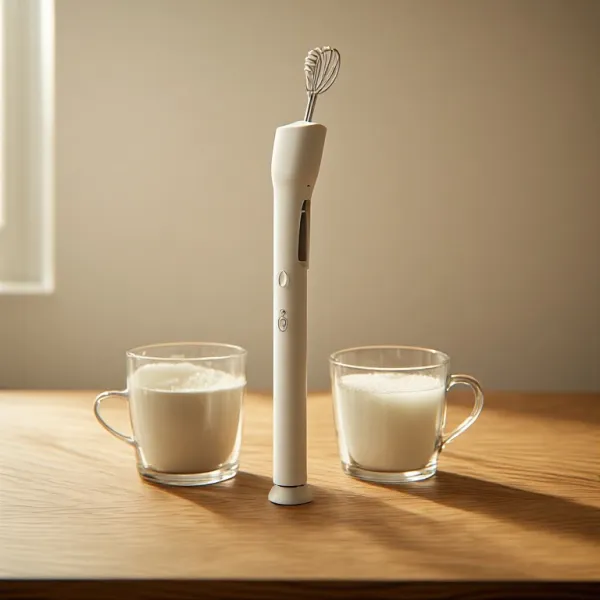
The 50/50 fix: Blending equal parts eggnog and whole milk or 2% milk before steaming drops the concentration of heat-sensitive egg proteins per ounce. The blend steams more like flavored milk than custard, letting you hit the 145–150°F target that produces silky microfoam without any scorching.
Temperature ceiling: 150°F is the hard ceiling for the eggnog-milk blend. This is 10–15°F lower than the standard latte steaming target (160–165°F). On a steam wand, this means a shorter steam: pull the pitcher the moment holding your palm against it becomes uncomfortable (about 5 seconds of contact). On the stovetop, pull the saucepan off the burner the moment you see wisps of steam rising — before any small bubbles form at the edges.
What Ratio to Use
The 50/50 ratio is the Starbucks default, and it produces a latte where the eggnog flavor is clearly present but the drink is not heavy or cloying. The milk contribution keeps it light enough to drink comfortably and lets the espresso read clearly through the eggnog.
Want more eggnog flavor: Use a 60/40 ratio (6 oz eggnog + 4 oz milk). This produces a noticeably richer, more custardy drink. Keep the steaming temperature below 145°F at this ratio — the higher eggnog concentration scorches more easily.
Want a lighter drink: Use a 30/70 ratio (3 oz eggnog + 7 oz milk). The eggnog flavor is subtle but still present. This is the lowest ratio where the drink still tastes recognizably like an eggnog latte rather than just an unusually sweet latte.
The Nutmeg — Fresh Only
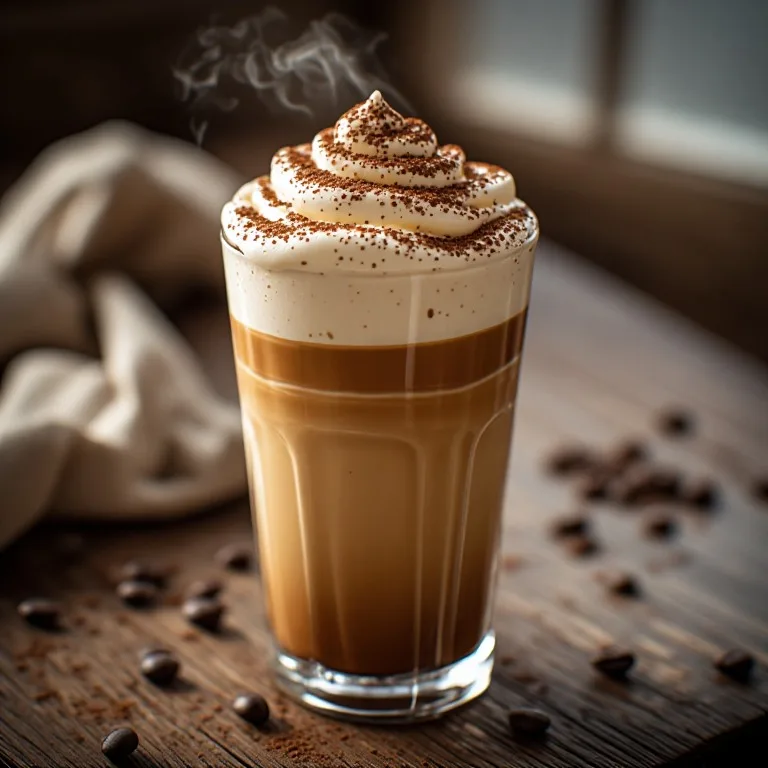
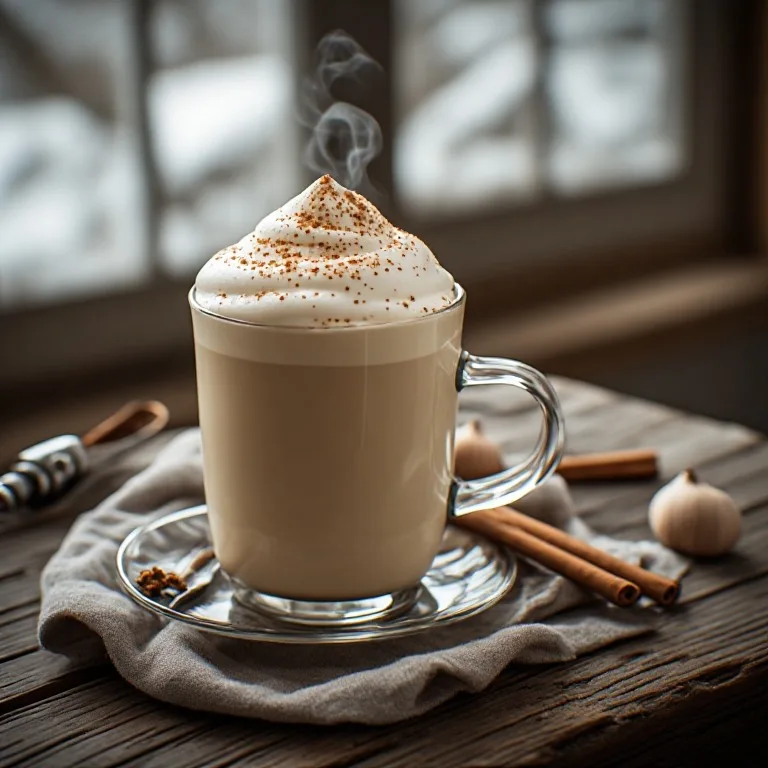
The topping is freshly grated nutmeg. This is not a decoration. Freshly grated nutmeg releases aromatic volatile oils — myristicin, safrole, elemicin — that give nutmeg its characteristic warm, slightly piney, slightly floral character. Pre-ground nutmeg from a jar has lost most of these volatiles through oxidation; what remains is a dusty, flat brown powder that contributes very little flavor or aroma.
A whole nutmeg costs $1–2 at most grocery stores. Four or five passes over a microplane covers one drink’s worth. The same whole nutmeg will last through dozens of Eggnog Lattes.
Eggnog Brand Notes
Most major grocery brands produce reliable results: Horizon Organic, Organic Valley, Hood, Borden’s, Trader Joe’s. Avoid two product types:
“Eggnog blend” or “eggnog-flavored dairy drink” — These are cheaper products (often labeled in fine print as “eggnog blend”) that replace much of the egg yolk content with thickeners and artificial flavoring. They taste thinner and more artificial, and they don’t produce the same creamy, slightly rich finish when steamed.
Ultra-pasteurized eggnog — Ultra-pasteurization (UHT) extends shelf life by heating the product to a higher temperature during processing. UHT-treated dairy foams less consistently than standard pasteurized dairy, and the high-heat processing slightly alters the flavor. Most large grocery-store brands are conventionally pasteurized; organic brands are more likely to be ultra-pasteurized (check the label). Either works for this recipe, but conventional pasteurized produces the better steam.
Hot vs. Iced
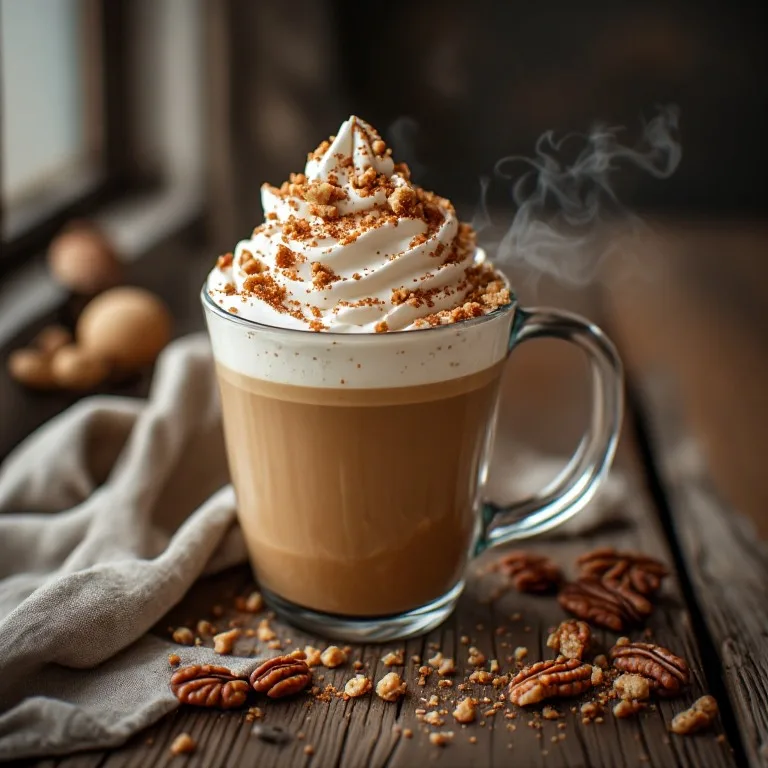
Hot Eggnog Latte: Steamed eggnog-milk blend produces a silky, mildly frothy base. The heat amplifies the nutmeg and spice notes in the eggnog. The espresso is slightly muted by the richness of the eggnog.
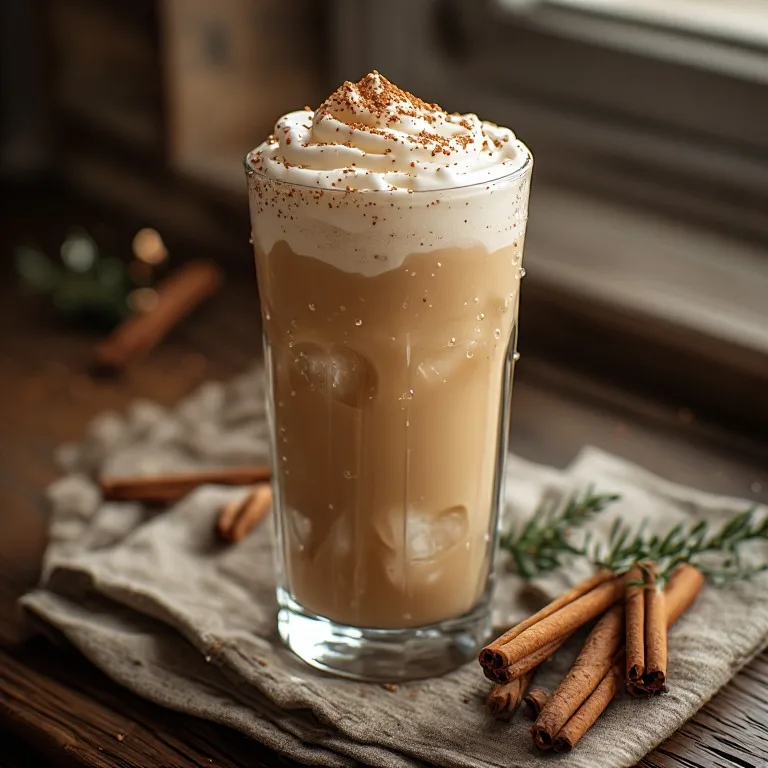
Iced Eggnog Latte: Eggnog and cold milk combined over ice, espresso poured over the top. Cold suppresses some of the eggnog’s richness, making the drink feel lighter and more refreshing. The coffee flavor reads more clearly in the iced version. The nutmeg on top is more aromatic when grated over cold foam than over steamed milk.
Both versions are equally valid — the choice is personal preference and season. Hot is the traditional holiday fireplace version; iced works better as a morning drink in warmer weather.
History: The Original Starbucks Holiday Espresso Drink
The Eggnog Latte was invented by Dave Olsen at Il Giornale, the espresso bar concept Howard Schultz launched in Seattle in 1986 before acquiring Starbucks in 1987. When Schultz converted Starbucks to an espresso bar format, the holiday menu came with it, and the Eggnog Latte was there from the beginning.
For more than three decades it ran as a red cup standard alongside the Gingerbread Latte (2000), the Peppermint Mocha (2002), and the Caramel Brulee Latte (2009). Starbucks discontinued it in the US after the 2020 season, citing pandemic-era supply-chain difficulties — it had been one of the more complex seasonal items to source and stock. It continued to appear on holiday menus in Canada and some international markets during the absence.
Fan demand drove it back. It returned to the US on December 2, 2025 — added to the holiday menu several weeks after the main November 6 launch, alongside the Chestnut Praline Latte. Starbucks framed both returns explicitly as responses to customer requests. Some 2025 coverage noted the in-store version came back using a powdered eggnog mix rather than the liquid eggnog of earlier years — one more reason the homemade version, steamed from real dairy eggnog, has the edge on flavor.
Neither drink is among the confirmed opening-day lineup for the 2026 holiday menu, which launches November 5, 2026. In 2025 both were December additions rather than opening-day items, so if they return, expect them a few weeks after the main launch rather than on day one.
Cost Breakdown
| Ingredient | Amount | Cost |
|---|---|---|
| Espresso (ground coffee) | 2 shots | $0.25 |
| Eggnog | 5 oz | $0.55 |
| Whole milk | 5 oz | $0.25 |
| Whipped cream | per serving | $0.18 |
| Whole nutmeg (grated) | light dusting | $0.05 |
| Total | $1.28 |
Compare to approximately $5.75–$6.25 at Starbucks for a Grande — save roughly 80%
See Also
- Starbucks Peppermint Mocha — the most popular Starbucks holiday drink ever, launched 2002: mocha sauce + peppermint syrup + dark chocolate curls
- Starbucks Caramel Brulee Latte — brulée-stage caramel sauce + crunchy caramel bits topping; on the 2026 US holiday menu
- Starbucks Tiramisu Velvet Latte — the new 2026 US holiday drink (in stores November 5, 2026): espresso, velvet mascarpone cold foam, cocoa-coffee dusting
- Starbucks Chestnut Praline Latte — returned December 2, 2025 alongside the Eggnog Latte after its own multi-year absence; chestnut praline syrup + spiced praline pecans topping
- Starbucks Sugar Cookie Latte and Iced Gingerbread Chai — two more returning 2026 holiday drinks
- Southern Comfort Eggnog — classic spiked eggnog for holiday parties; the base to make if you want homemade eggnog in your latte