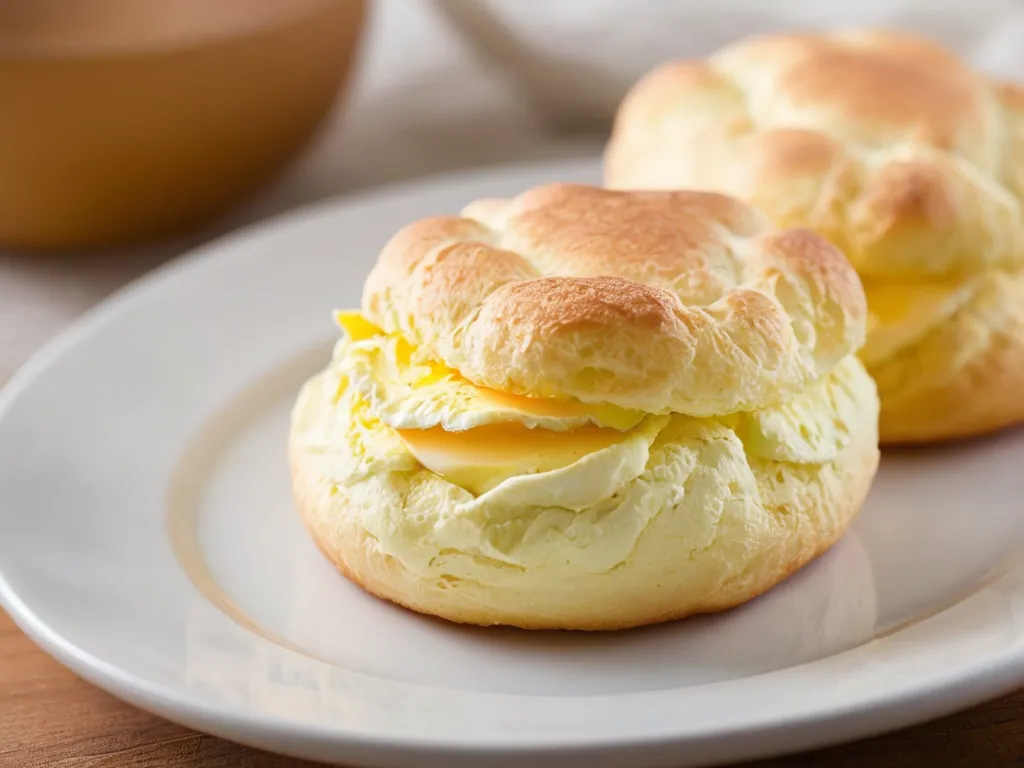
Cloud Bread — The 3-Ingredient TikTok Meringue
Cloud bread isn’t bread. It’s a baked meringue that looks like a pastel dream, tears apart like spun sugar, and tastes faintly of cotton candy and vanilla. It has no flour, no butter, no leavener — just egg whites, sugar, and cornstarch, shaped into a cloud and baked at low heat until it puffs into something that looks like it shouldn’t exist.
It went viral in July 2020 when a TikTok creator posted a recipe under the handle @linqanaaa. A few days later, Abi Hwang-Nable (@abimhn) — a UC Berkeley student — remade it explicitly crediting @linqanaaa in blue food coloring, and that video accumulated tens of millions of views. The #cloudbread hashtag accumulated hundreds of millions of combined views, and it’s been remade in every pastel color imaginable since. It became the defining food aesthetic of that summer: three ingredients, no skill floor, endlessly photogenic.
TL;DR: Three ingredients. Whip egg whites to stiff peaks, fold in cornstarch, shape into a cloud, bake at 300°F for 22–25 minutes. Eat within 2 hours — deflation is part of the deal. The experience is mostly visual and textural, not culinary. If you want something that photographs like a Studio Ghibli still, this is it.
What Is Cloud Bread, Actually?
It’s a meringue — the same technique used for pavlova, French macarons, and baked Alaska — but shaped into a free-form cloud instead of shells or discs. Meringue is egg white proteins stabilized by sugar and heat into a foam structure. Cornstarch acts as a binder, coating the protein network and helping the structure hold during baking so you get that distinctive hollow, airy center with a barely-set exterior.
The TikTok version is not the “cloud bread” from keto diet blogs. That version uses cream cheese and egg yolks to make a savory bread substitute. This is a sweet meringue snack — they share a name and not much else. If you searched “cloud bread” looking for the low-carb sandwich replacement, scroll to the comparison table below.
TikTok Cloud Bread vs. Keto Cloud Bread vs. Pavlova
All three involve whipped egg whites. The similarities end there.
| TikTok Cloud Bread | Keto Cloud Bread (Oopsie Bread) | Pavlova | |
|---|---|---|---|
| Main ingredients | Egg whites, sugar, cornstarch | Egg whites, cream cheese, egg yolks | Egg whites, sugar, cornstarch or vinegar |
| Carbs per serving | ~8g (sugar + cornstarch) | ~1g | ~25g (more sugar) |
| Protein per serving | ~3g | ~5–6g | ~2g |
| Texture | Marshmallow-airy, tears apart | Slightly rubbery, holds shape | Crispy shell, marshmallow interior |
| Flavor | Lightly sweet, mild | Neutral/savory | Sweet, served with cream + fruit |
| Baking temp | 300°F, 22–25 min | 300°F, 25–30 min | 250°F, 90 min + oven-dry |
| Shelf life | 1–2 hours best | 3–5 days refrigerated | 1 day (softer after) |
| Primary purpose | Social media aesthetic | Low-carb bread substitute | Dessert centerpiece |
If you want the keto bread substitute, this is the wrong recipe. If you want the pastel cloud that looks like it floated in from a Studio Ghibli movie, keep reading.
The Three Ingredients (and Why Each One Matters)
Egg whites are the entire structure. The protein in the whites, when beaten with air, forms a foam. Heat sets that foam into a stable solid. Without egg whites there is no cloud bread.
Sugar is what makes this a meringue and not just baked foam. It dissolves into the whites during beating, creating a syrup that coats the air bubbles and makes the foam denser, more stable, and glossy. It also contributes the faint sweetness and that marshmallow-chew texture.
Cornstarch adds structure to the baked result. Its primary job is moisture absorption: it soaks up the liquid that leaches out of a meringue during baking, which prevents the “weeping” (pools of liquid under the cloud) that plagues meringues in humid kitchens. A secondary effect is light structural reinforcement — the starch particles help the foam hold its shape in the oven and slow deflation after baking. It works differently than cream of tartar: starch doesn’t help during whipping, but it stabilizes the final baked structure.
The Optional Fourth Ingredient (It’s More Important Than It Sounds)
Cream of tartar is an acid that stabilizes egg white foam during whipping. It lowers the pH of the whites, which makes the proteins unfold more readily and form a finer, more stable foam. The result: higher volume, glossier peaks, and better deflation resistance. Add ¼ teaspoon when the whites first start to foam (before adding sugar).
You don’t need it — the recipe works without it. But if your whites have ever deflated before getting into the oven, this is the fix.
Choosing Your Bowl: Why It Matters More Than You Think
Meringue is allergic to fat, and bowl material directly affects how well egg whites whip.
Copper bowl (best): Copper ions bond with the sulfur proteins in egg whites (conalbumin), making the foam more stable and resistant to overwhipping. Professional pastry kitchens use copper bowls for a reason. If you have one, use it — and skip the cream of tartar (the copper provides the same stabilization chemistry).
Stainless steel (standard): Works well. It holds temperature well and has no porosity to trap grease. This is what most home bakers use, and it’s perfectly fine.
Glass or ceramic: Also works, but glass is harder to keep grease-free (it’s porous at the microscopic level) and ceramic retains cold temperature from the refrigerator, which can slow whipping if the bowl was just washed in cold water.
Plastic: avoid. Even clean plastic can hold microscopic fat residue in its surface scratches. A single prior use with any fat means your meringue may never reach stiff peaks.
Before using any bowl: wipe it with a paper towel dampened with white vinegar or lemon juice and let it dry completely. The slight acidity removes any trace fat.
The Pastel Coloring
The color is optional but it’s why most people make this. A few things to know:
Use gel food coloring, not liquid. Liquid food coloring adds water, which destabilizes the meringue. Gel coloring is concentrated — 2–3 drops is plenty.
More drops ≠ deeper color in meringue. The air bubbles scatter light and lighten any color. To get a deeper blue, you’d need so many drops that you’d collapse the foam. Accept the pastel — it’s the point.
For a marble effect: Add the coloring in the last 2–3 folds and stop before it’s uniform. The streaks of white and color look better than solid anyway.
For two-tone: Divide the batter in half before adding color. Drop spoonfuls of each color alternately onto the parchment, then use a skewer to swirl once.
What Stiff Peaks Actually Look Like: The Four Stages
Most flat-cloud-bread failures come from stopping too early. Here’s what to watch for:
Stage 1 — Foamy (1 minute): Large, translucent bubbles. The mixture is still mostly liquid. Not ready — keep going.
Stage 2 — Soft peaks (2 minutes): The foam is white and opaque. When you lift the beater, the peak forms but droops over. If you mounded cloud bread now, it would spread flat.
Stage 3 — Firm peaks (3 minutes): The peak holds its shape when the beater is lifted, but the tip curls slightly. Getting close, but not there for cloud bread — the structure needs to be stiffer to hold the cloud shape.
Stage 4 — Stiff, glossy peaks (3–4 minutes): The peak stands straight up when the beater is lifted. The meringue is dense and glossy, not dull. When you tilt the bowl sideways, the meringue doesn’t move. This is the target. Stop here — overbeaten meringue becomes dry, lumpy, and weeps liquid.
The difference between Stage 3 and Stage 4 is about 30 seconds on high speed. Watch closely once you approach Stage 3.
Five Mistakes That Cause Flat or Watery Cloud Bread
1. Any yolk in the whites. Even a trace of yolk — or butter, oil, or water on the bowl — prevents stiff peaks. Fat breaks the foam. Separate eggs over a separate bowl before adding whites to your mixing bowl, so one broken yolk doesn’t ruin the whole batch.
2. Underwhipping. Soft peaks (peaks that curl over when the beater is lifted) are not enough. You need stiff, glossy peaks that stand straight up. This takes 3–4 minutes on high speed. When you tip the bowl sideways, the whites shouldn’t move.
3. Overmixing after the cornstarch. The fold is the most fragile step. Count your strokes — 15–20 slow folds should be enough. Stop the moment you can’t see dry cornstarch.
4. Wrong oven temperature. 325°F or higher browns and cracks the exterior before the interior sets. 300°F is not a suggestion.
5. Too much food coloring. Three drops is the ceiling. More liquid = collapsed foam before it even gets into the oven.
Flavor Variations
The base recipe is lightly sweet and vanilla-adjacent. These variations stay within the spirit of the recipe — none require more than one add-in, and all are folded in with the cornstarch:
| Variation | Add-In | Food Coloring | Notes |
|---|---|---|---|
| Classic vanilla | ½ tsp vanilla extract | None or light pink | The baseline — works every time |
| Strawberry | ½ tsp freeze-dried strawberry powder | 2 drops pink | Actual strawberry flavor, not artificial |
| Matcha | ½ tsp ceremonial-grade matcha | None needed | Turns pale dusty green naturally |
| Lemon | ½ tsp lemon extract (not juice) | None or pale yellow | Extract = flavor without liquid |
| Almond | ½ tsp almond extract | None or lavender | The scent makes this one feel special |
| Lavender | 2 drops food-grade lavender extract | 2 drops purple | Subtle and elegant; don’t overdo it |
Use gel food coloring for any colored variation. Liquid extracts add flavor without destabilizing the meringue — unlike juice, which adds too much water.
What Happens After It Comes Out of the Oven
The cloud deflates. This is not a mistake. Meringue is a foam — heat expands the air inside, then cooling contracts it. A baked cloud bread will lose maybe 20–30% of its height in the first 15 minutes out of the oven.
What doesn’t come back: the airy interior structure. Once it deflates past a certain point (about 2 hours at room temperature), the interior becomes dense and chewy rather than airy. Still edible, just different.
Storage reality:
- Best eaten within 1–2 hours of baking, still slightly warm
- Room temperature for up to 2–3 hours; it becomes chewy but not bad
- Refrigerator: technically possible for 1 day, but the humidity makes it weep and get sticky
- Freezer: do not freeze — the ice crystals collapse the foam structure; it thaws as a dense flat disc
Making Cloud Bread for a Group
Cloud bread doesn’t wait for anyone. Build your timeline around the 2-hour window.
If you’re baking for a group of 4–8 people, make two batches back-to-back rather than one large batch. Doubling the meringue in a single bowl means more volume to fold without deflating, and a single large mound bakes unevenly (the outside sets before the center). Two normal-sized clouds baked on the same sheet pan take the same time and come out better.
Party timing guide:
- 45 minutes before serving: preheat oven, separate eggs, let whites come to room temperature
- 30 minutes before serving: whip, color, shape, go into oven
- 5 minutes before serving: pull from oven, let rest briefly, bring to the table
If guests are coming at 7:00 PM, put the cloud bread in the oven at 6:30 PM. Serve it at 6:57 and let people tear into it while it’s still warm.
How It Compares to Other Viral TikTok Bakes
If you like the cloud bread aesthetic but want something you can actually eat the next day, cottage cheese flatbread has a similar minimal-ingredient approach with much better staying power. For other egg-white-based viral bakes from TikTok, frog bread uses a similar shaping idea with yeasted dough. For a quick fix that requires no technique at all, chocolate mug cake is 90 seconds and reliably satisfying. And if you want to keep riding the miniature-food aesthetic, pancake cereal hits the same visual sweet spot from a completely different angle. For another quarantine-era foam technique that went viral around the same time as cloud bread, dalgona coffee applies the same “whip something ordinary into a cloud” logic to instant coffee.
Frequently Asked Questions
What does cloud bread taste like? Like a very light, slightly sweet meringue — airy and marshmallow-soft inside, barely crispy outside. Mild vanilla if you add extract. The flavor is almost beside the point; the texture and visual are the draw.
Why did mine turn out watery or flat? Most likely cause: yolk contamination, underwhipping, or too much food coloring. See the five mistakes section above for the full list.
Can I use cream of tartar instead of cornstarch? They do different things. Cream of tartar stabilizes during whipping; cornstarch adds structure during baking. Use both if you can. If you have to choose, cream of tartar gives better volume; cornstarch gives better post-bake structure.
Is cloud bread gluten-free? Yes. No flour of any kind. Check your cornstarch brand for cross-contamination if celiac disease is a concern — most mainstream brands (Argo, Bob’s Red Mill) are certified gluten-free.
Can I make it savory? Technically yes — skip the sugar and add a pinch of salt and herbs. But unsweetened egg white meringue is very flat-tasting, and the structure depends partly on the sugar. It’ll bake, but it won’t be very good.
What is the difference between TikTok cloud bread and keto cloud bread? Completely different recipes that share a name. TikTok cloud bread is egg whites + sugar + cornstarch — a sweet meringue snack. Keto cloud bread (oopsie bread) is cream cheese + egg yolks + whipped egg whites — a savory bread substitute with minimal carbs. Same name, different universe.