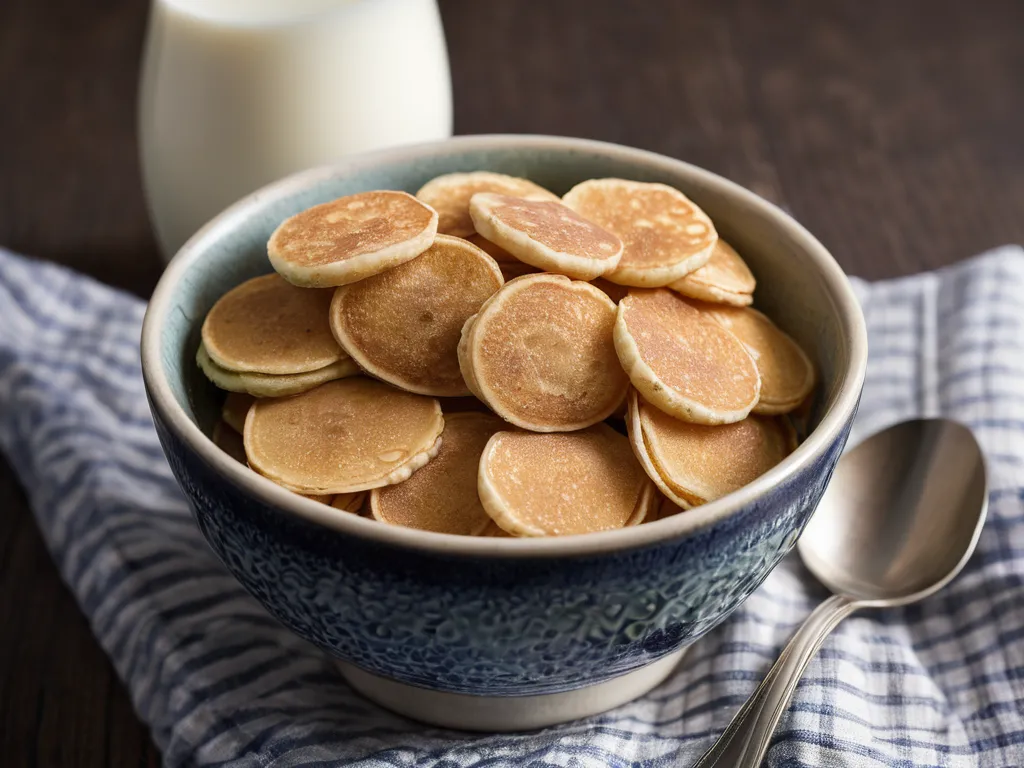
In April 2020, when everyone was stuck at home and had nothing but time, pancake cereal appeared on TikTok and spread faster than almost any food trend before it. The concept: make pancakes the size of a nickel and eat them in a bowl with milk like cereal. It was absurd, time-consuming, and completely impractical — which is exactly why millions of people made it immediately.
The hashtag accumulated over a billion views. Grocery brands tried to ride the trend. Even IHOP posted about it. All because someone decided that regular-sized pancakes were simply too normal.
TL;DR
| Situation | Recommendation |
|---|---|
| Classic TikTok look | Squeeze bottle, nickel-sized, maple syrup + cold milk |
| Fastest cooking | Large electric griddle, batch size 30+, skip milk |
| Best flavor | Brown the butter first, real maple syrup, serve immediately |
| For kids | Birthday cake version (vanilla batter + rainbow sprinkles) |
| Lower-calorie | Whole wheat flour, honey instead of maple syrup, almond milk |
| Meal prep | Batter keeps 2 days refrigerated; cooked pancakes reheat in oven |
Where Pancake Cereal Came From
The trend traces to April 20, 2020, when a video by @sydneymelhoff showing tiny pancakes eaten in a bowl accumulated tens of thousands of likes within days. Within a week, the format cascaded: similar videos from multiple creators generated hundreds of thousands of likes each as the hashtag took on a life of its own. The format had all the ingredients for a viral food moment: a simple idea anyone could execute with pantry staples, a satisfying ASMR quality (dozens of tiny pancakes sizzling on a griddle, each one flipped by hand), and a payoff shot — a bowl full of hundreds of miniature golden rounds — that looked genuinely impressive despite being nothing more than pancake batter portioned into tiny drops.
What distinguished pancake cereal from earlier food trends was the time investment. Making 80–100 individual tiny pancakes takes 20–25 minutes of active cooking. That’s not convenient — it’s the opposite. But quarantine had removed the usual constraint of “I don’t have time for this,” and the deliberate, repetitive process of squeezing and flipping became its own reward. It’s the food equivalent of a puzzle or a craft project.
The trend stayed primarily visual. The #pancakecereal hashtag attracted views not because people needed a new pancake recipe but because watching the process was satisfying in its own right.
The Squeeze Bottle Is the Whole Recipe
Everything about making pancake cereal well comes down to how you dispense the batter. Using a spoon or a ladle produces irregular blobs that are too big, too thick, and inconsistently sized — they’re just small pancakes, not pancake cereal. A squeeze bottle is what creates the uniform, nickel-sized dots that produce the signature look.
You don’t need a specialized tool. A clean ketchup bottle, a plastic condiment bottle from a restaurant supply store or dollar store, or a heavy-duty zip-lock bag with one corner snipped to about a 4mm opening all work. The piping-bag approach (a pastry bag with a small round tip) gives the most control and lets you refill quickly, but any squeeze bottle is fine.
The technique: hold the bottle straight up and down, tip just above the pan surface. Squeeze steadily with consistent pressure. Release pressure before lifting the bottle — this stops a thread of batter from trailing across adjacent pancakes.
The target size: nickel to quarter, roughly 2 to 2.5 cm in diameter. This is the range where the pancakes cook through fast enough (45–60 seconds per side), look like actual cereal in the bowl, and fit on a spoon in groups of 3–4. Go bigger than a quarter and they’re just small pancakes. Go smaller than a nickel and they stick together, dry out, and are nearly impossible to flip individually.
Heat and Timing
Medium-low heat is correct — not medium, not medium-high. This is the mistake most first-timers make: they use the same temperature they’d use for regular pancakes and end up with brown exteriors and raw centers, because the heat is high enough to set the outside in 20 seconds but not long enough to cook through.
At medium-low, the exterior browns gradually while the interior cooks through at the same pace. A well-sized mini pancake at medium-low heat takes 45–60 seconds on the first side and 20–30 seconds on the second.
The flip signal: watch for bubbles to form across the entire surface (not just the edges) and the top to stop looking shiny. This is the same cue you use for full-size pancakes, just compressed into a smaller window. Don’t flip early — a pancake that hasn’t fully set on the bottom will stick to your flipping implement and tear.
How to Flip Them
This is the second technique challenge of pancake cereal, and it’s where most people slow down. A standard spatula is too wide — trying to slide it under a 1 cm pancake either pushes the surrounding ones out of place or misses entirely.
Three tools work well:
Chopsticks — the most popular method. Hold one chopstick in each hand, use them like tweezers to grip the edge of a pancake, and flip with a quick flick of the wrist. You can develop a rhythm that lets you flip 6–8 pancakes per 10 seconds once you’re comfortable.
A cocktail pick or toothpick — slower but very precise. Good for a single starting batch while you calibrate the heat and timing. Impractical if you’re making 6 batches.
A small offset spatula — the thin, flexible blade used for frosting cakes. It can slide under 3–4 mini pancakes at once if you angle it carefully, making it faster than chopsticks once you get used to it. Worth trying if you plan to make pancake cereal more than once.
Batter Science
Standard pancake batter works exactly as-is for pancake cereal. The ratios in the recipe above (1 cup milk per cup of flour) are the tested consensus across multiple recipe developers — thick enough to hold a dot shape without spreading flat, thin enough to flow freely from a squeeze bottle. No special formulation is required.
Two common adjustments:
Too thick for your bottle: Add milk 1 tablespoon at a time until the batter flows freely. The target is a consistency slightly thicker than heavy cream — it should fall off a spoon slowly rather than drizzling. If it flows as freely as water, it’s too thin and your dots will spread into each other.
Want more browning: Brown the butter before adding it to the batter. Browning butter (cooking it over medium heat until the milk solids turn golden brown and it smells nutty, about 3–4 minutes) adds a noticeable depth of flavor and helps the exteriors achieve a deeper golden color. Let it cool for 2 minutes before adding to the batter so it doesn’t scramble the egg.
One note on lumps: don’t overmix trying to eliminate them. A few small lumps in pancake batter are fine — they’re pockets of flour that will cook through. Overmixed batter develops gluten, which makes the finished pancakes tough and chewy. Stir until just combined.
Serving Options
| Style | What to do | Notes |
|---|---|---|
| Classic cereal bowl | Maple syrup + cold milk poured over | Eat within 2 min before soaking gets heavy |
| Dry with syrup | Skip the milk, drizzle maple syrup | Stays crispier; better for meal prep |
| Butter + syrup | Add a small pat of butter to the hot bowl | The butter melts from residual heat; richer |
| Berry bowl | Fresh strawberries or blueberries + honey | Lighter, less sweet |
| Chocolate drizzle | Drizzle of Nutella or chocolate syrup | Kids’ favorite |
| Savory | Skip the sugar in batter, top with butter and salt | Surprisingly good as a side dish |
The nutrition figures above are for the pancakes alone, before maple syrup and milk — a generous drizzle of syrup adds roughly 50–100 calories, and a splash of milk another 15–30.
The cold-milk serving is the defining TikTok presentation — the contrast of warm mini pancakes and cold milk, and the way the milk picks up a faint maple-pancake flavor as you eat, is genuinely good. The window is short: they stay crispy for about 2 minutes before softening, and fully soft after 5. Eat fast or add milk incrementally as you go.
Variations
Chocolate pancake cereal: Replace 2 tablespoons of flour with 2 tablespoons of unsweetened cocoa powder and increase the sugar to 2 tablespoons. Serve with powdered sugar, milk, and a drizzle of chocolate syrup. Tastes like eating tiny chocolate cake rounds.
Birthday cake pancake cereal: Add 1/2 teaspoon of vanilla extract and 2 tablespoons of rainbow sprinkles to the batter. The sprinkles in the batter create a confetti-cake visual; add more as a topping. Popular for kids’ breakfasts.
Red velvet pancake cereal: Add 1 tablespoon of cocoa powder, 1 teaspoon of red food coloring, and 1/2 teaspoon of vanilla. Serve with a drizzle of cream cheese glaze (4 oz cream cheese + 2 tbsp powdered sugar + 1 tbsp milk, whisked smooth).
Protein pancake cereal: Replace 2–3 tablespoons of flour with the same amount of vanilla or unflavored protein powder. Add 1 extra tablespoon of milk to compensate for the extra absorbency. The texture is slightly denser but the extra 10–15g protein per serving makes it a legitimately nutritious breakfast. Serve with Greek yogurt and berries instead of syrup.
Whole wheat pancake cereal: Swap half the all-purpose flour for whole wheat. The mini size makes the denser texture less noticeable than it would be in a full pancake — a good everyday option that adds fiber without significantly changing the experience.
Common Mistakes
Heat too high. The single most common issue. If your pancakes brown on the outside before bubbles form on the surface, turn the heat down. You want slow, even browning while the interior cooks through.
Pancakes too big. Anything much larger than a nickel behaves like a regular small pancake, not pancake cereal. Keep the dot size tight.
Eating too slowly. Pancake cereal in milk has a 2-minute window before it goes fully soggy. Have your bowl, maple syrup, and milk ready before you cook the final batch, and serve immediately.
Not resting the batter. Let the batter sit for 3–5 minutes after mixing. This gives the baking powder time to activate and the gluten time to relax, producing fluffier mini pancakes with better lift.
Overcrowding the pan. Leave at least 1 cm between each dot. Too close and they spread into each other, creating connected clusters that are impossible to flip individually.
Cost Comparison
| Source | Cost per serving |
|---|---|
| Box of Cheerios (name brand) | ~$1.00–1.25 |
| Box of generic cereal | ~$0.50–0.75 |
| Homemade pancake cereal | ~$0.80–1.00 |
| Pancake cereal at a brunch café | $8–14 (where offered) |
Pancake cereal costs about the same as a bowl of name-brand cereal once you account for the ingredients. The real cost is time — 35 minutes for a recipe that a standard cold cereal replaces in 2. But the point was never efficiency.
Storage and Make-Ahead
Batter: Cover and refrigerate for up to 2 days. The baking powder will lose some lift by day 2 (expect slightly flatter pancakes), but the batter will still work fine. Bring to room temperature and give a gentle stir before using — don’t remix aggressively.
Cooked pancakes: Cool completely on a wire rack or baking sheet (don’t stack while hot — they’ll steam and get soggy). Store in an airtight container at room temperature for up to 2 days. To reheat: spread on a baking sheet and warm at 300°F for 6–8 minutes. They won’t be quite as fluffy as fresh, but they’re better than the microwave alternative (which makes them rubbery). Don’t try to reheat them in milk — they’ll absorb the liquid and dissolve.
For more TikTok breakfast trends: the mini croissant cereal uses the same bowl-of-tiny-rounds concept with puff pastry instead of pancake batter; nature cereal is a cold fruit-based version that requires zero cooking. For the original fluffy pancake comparison, the IHOP buttermilk pancake copycat covers the science of achieving restaurant-level fluffiness in a full-size stack. And if you want a quicker TikTok-viral breakfast, baked oats takes 25 minutes mostly hands-off and tastes like cake.