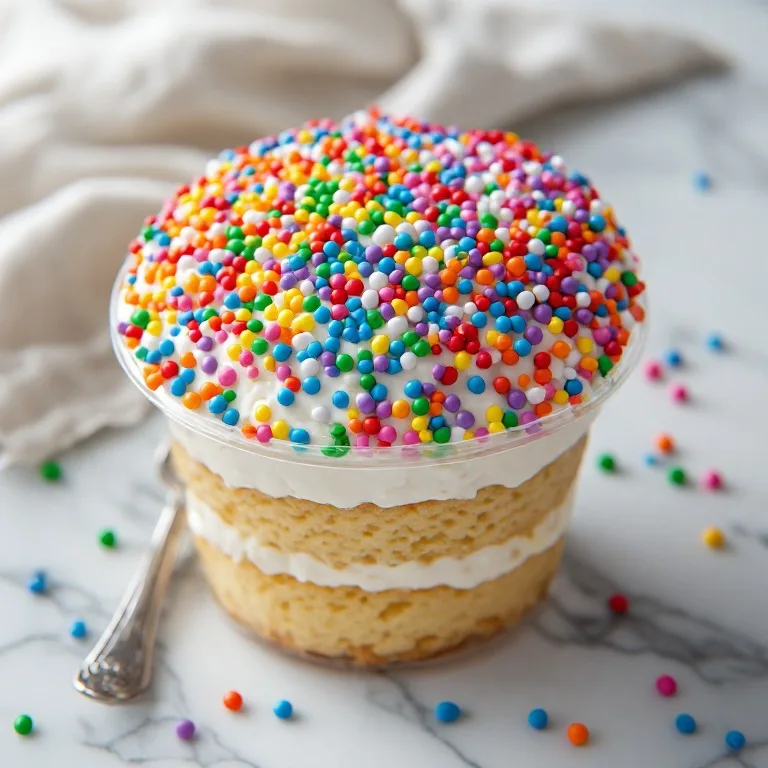



Butterfield Market on Manhattan’s Upper East Side started selling small clear cups of cake topped with a solid dome of rainbow nonpareils sometime in early 2026. By May, the line was out the door. By June, TikTok had millions of views of people running the spoon across the crunchy top, and every food blogger in the country was posting a copycat recipe.
The cakes are $11 each. The ingredients cost about $30 and make eight.
The technique is simpler than most cakes: bake thin in a sheet pan, cut rounds, layer into cups with buttercream, and press the frosted top into a bowl of tiny sprinkle balls. The secret is one step most home bakers skip — and skipping it is why their nonpareils slide off.
What Is a Dot Cake?
A dot cake is a layered vanilla cake served in a small clear cup (4–5 oz) with vanilla buttercream filling and a top completely encased in rainbow nonpareils. The nonpareils are small, perfectly round sugar balls — not the cylindrical jimmies or flat confetti sprinkles — and they pack so densely into the chilled buttercream that the top looks like a solid surface of color.
The cake comes from Dotcakes, a mother-daughter business out of Roslyn, New York. The recipe dates back to 2017, when founder Alex Posner made one as a gift for a friend; demand turned it into a business a few years later. It found its way to Butterfield Market on the Upper East Side, where the two locations get 600 cakes each every Wednesday and Saturday and sell out within about two hours. Influencers discovered them there and posted the ASMR spoon-scrape videos that launched the trend. The visual is obvious once you see it: the drag of a spoon across a sphere of rainbow dots, the crack and give of cold buttercream under sprinkles, the reveal of white frosting underneath. The shop sells them in classic vanilla, chocolate, vanilla chip, and red velvet — the vanilla version is the one this recipe recreates.
The nostalgia angle matters too. Rainbow nonpareils are the sprinkles on every grocery-store birthday cake you ate as a kid. The dot cake reframes them as the entire point.
The One Technique That Makes or Breaks the Dot Cake
Every failure in a dot cake — sliding sprinkles, patchy coverage, bald spots — traces back to buttercream temperature.
The buttercream must be cold and firm when you dip it into the nonpareils.
At room temperature, buttercream is soft enough that the tiny nonpareils press in but don’t stay. They roll around, slide to the edges, and fall off the moment you lift the cup. After 15–20 minutes in the refrigerator, the buttercream firms up to a consistency closer to cold clay — and at that temperature, the nonpareils press in and lock. They don’t move.
The full chill after assembly (2+ hours) sets the buttercream further and cements everything permanently. This is also the step that builds the ASMR crunch — cold, dense buttercream under a solid layer of pressed sugar balls gives the spoon resistance that soft, warm buttercream never can.
Everything else in the recipe is forgiving. This step is not.
There’s a second timing rule almost every copycat recipe misses: apply the nonpareils within 1–2 hours of serving, not the day before. Rainbow nonpareils have a food-color coating that bleeds into buttercream on contact. The first hour looks fine. After two hours refrigerated, the dye migrates outward and the white frosting turns murky pastel. After overnight, the dome looks like a tie-dye accident. The buttercream tastes fine either way — the bleed is purely visual — but the whole point of the dot cake is the visual.
Why Nonpareils, Specifically
Nonpareils are round. When you press a flat surface into a bowl of round balls, they pack themselves — each ball fills the gap between its neighbors in a pattern that looks intentionally dense. Jimmies (the long rod sprinkles) can’t do this: they stack in random angles and create an uneven surface. Confetti sprinkles (the flat disc ones) flip onto their edges and stick out at random angles.
The dot effect — the visual that defines this cake — only exists with nonpareils. They’re labeled “Nonpareils” or “Rainbow Nonpareils” in the baking aisle, or sold in the UK as “Hundreds and Thousands.” The jar with the small round balls. That’s the one.
Sheet Pan vs. Cup-Baked
The cleanest approach is baking one thin sheet cake and cutting rounds. The sheet pan method gives you even, consistent cake discs with flat surfaces that sit level in the cup — important when you’re stacking two rounds with buttercream in between.
Baking batter directly in cups is faster but produces thicker, less even cakes that are hard to get out without tearing.
Bake thin, cut clean, stack level.
The Buttercream: Stiff Is the Goal
Dot cake buttercream is stiffer than a typical frosting — closer to what you’d use for piped flowers than for spreading on a layer cake. You need this stiffness because the weight of the nonpareils pushes down on the frosting, and soft buttercream lets them sink and migrate.
Six cups of powdered sugar to 2 cups of butter is the right ratio for stiff buttercream. If your butter was warm when you started (not cool-room-temperature), the buttercream may end up too loose — refrigerate it for 10 minutes and re-beat. If it’s still too soft after that, add another ¼ cup of powdered sugar and beat again.
Beat the butter alone for 3 minutes before adding any sugar. This step builds the air structure that makes the final buttercream fluffy rather than dense. Skipping it gives you a heavier, greasy-feeling buttercream that doesn’t hold the nonpareils as cleanly.
What to Expect When You Eat One
The ritual is part of the experience. Drag a spoon across the dome of nonpareils — the crunching sound is satisfying in a way that’s difficult to describe. Then go straight down through the sprinkle layer into the buttercream, through the first cake round, through the filling, to the bottom.
The ratio is the thing: more buttercream than you expect, two thin tender cake layers, and sprinkles in every bite because the buttercream carries them down as you scoop.
Variations
Funfetti inside and out: Use a Funfetti box mix or stir rainbow jimmies (the rod-shaped sprinkles, NOT nonpareils) into the scratch batter before baking. The jimmies hold their color in the oven; nonpareils bleed and turn the batter grey if added to the raw batter. The colored crumb visible through the clear cup side + the nonpareil dome on top = maximum birthday cake energy.
Chocolate base with vanilla frosting: Substitute 3 tablespoons of cocoa powder for 3 tablespoons of the flour in the scratch recipe (use Dutch-process for deeper color). The white buttercream against chocolate cake visible through the cup side is a strong visual contrast.
Lemon: Add 2 tablespoons of fresh lemon zest to the batter and 1 tablespoon of fresh lemon juice to the buttercream. Use yellow nonpareils instead of rainbow for a monochrome version.
Gold nonpareils: Swap rainbow nonpareils for gold nonpareils for an elegant single-color version — works particularly well for bridal showers, New Year’s parties, or any event where “sophisticated sprinkles” is a concept you’re willing to sell.
Strawberry buttercream: Add 2 tablespoons of freeze-dried strawberry powder (blended to fine dust) to the buttercream when beating in the powdered sugar. The pink tint shows through the clear cup side and pairs well with rainbow nonpareils on top.
Making Them as Gifts
The cups are already the container. No box, no wrapping — put a clear plastic cup in a small gift bag and you have a portable, visual, non-melty dessert gift. The catch is the same color-bleed rule: dip the nonpareils on within an hour or two of handing them over, not days ahead. The assembled-but-undipped cups keep refrigerated for 3–4 days, so make and frost a batch on Friday, then dip the sprinkles the moment before you deliver each one over the weekend.
If you’re making a large batch (for a party, bake sale, or all eight at once), the assembly line method is fastest: cut all the rounds at once, assemble all the cups at once, frost all the cups at once, chill all at once, then dip all at once. Total active time is about 30 minutes once the cake is cooled.
The cups are better cold than at room temperature — the nonpareils stay crisper, the buttercream holds shape, and the layers are cleaner. Serve straight from the refrigerator.