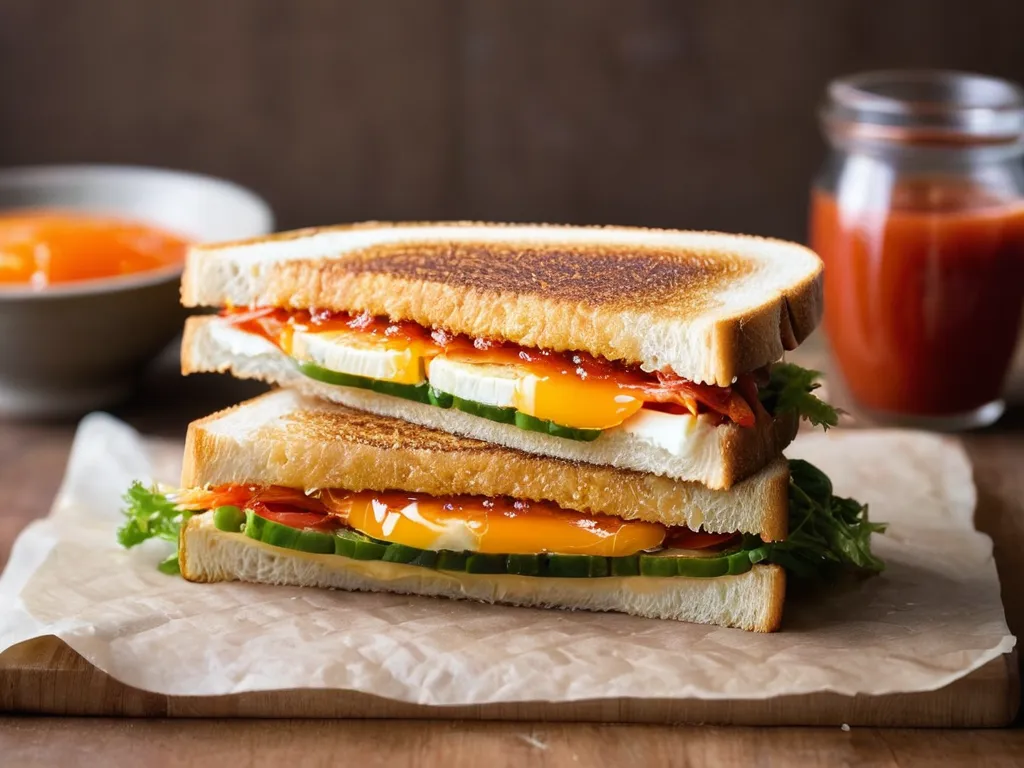
Korean street toast — gilgeori toast (길거리 토스트) — has been sold at outdoor food stalls across South Korea for decades. TikTok discovered it in 2022 and decided it was the best egg sandwich on earth. After one bite, the reaction is hard to argue with.
The combination is deceptively simple: a fluffy egg-vegetable omelet, soft buttery white bread, and a sweet-savory ketchup-sugar sauce. What makes it unlike any Western breakfast sandwich is the technique and the sauce. The bread cooks on top of the egg, bonds to it, and flips with it — the bread and egg become one unit. The sweet ketchup sauce is not optional, not an Americanization, and not weird once you taste it.
TL;DR: Beat eggs with shredded cabbage, carrot, and green onion. Cook in butter, spread into a rectangle. Lay bread on top, let it bond, flip the whole unit. Sauce the egg side with ketchup + sugar. Stack and cut diagonally. Done in 15 minutes.
What Is Gilgeori Toast?
Gilgeori (길거리) means “street” in Korean. Gilgeori toast is Korean street toast — not a toast that’s simply toasted bread, but a full egg sandwich assembled at outdoor food stalls and tented eateries (pojangmacha, 포장마차) that have been fixtures of Korean city life since the 1980s.
The format emerged as cheap, fast, filling breakfast food for commuters and students. The ingredients are economical: eggs, cabbage, carrot, bread, butter. The technique makes the most of them — the vegetables extend the egg into a more substantial omelet, and the partial bread-on-egg cooking method creates a unified sandwich that holds together and eats cleanly.
The Isaac Toast chain (아이작토스트) industrialized the format and became the definitive commercial version. The chain grew from a single stall concept to more than 900 locations across South Korea, with international expansion into Macau, Taiwan, Malaysia, and the Philippines. Their signature is a proprietary “Magic Sauce” — a sweet-tangy, mayonnaise-based blend — and layered versions that include ham, cheese, and egg together. The original street stall version is egg-vegetable with ketchup and a direct sugar sprinkle on the hot egg, and that’s the version most Koreans grew up eating.
Why TikTok Lost Its Mind Over This
Korean food content exploded on TikTok around 2022, and gilgeori toast was a perfect fit for the format. The bread-on-egg flip is mesmerizing to watch: pour the egg, spread the vegetables, lay two slices of bread on top, flip the whole unit at once. It takes 30 seconds on camera and reads like a magic trick.
Beyond the visual hook, the sweet ketchup sauce surprised Western viewers. Sugar on an egg sandwich sounds wrong until you taste it. The concept of sweet-savory combinations isn’t unfamiliar in Western cooking (honey on fried chicken, maple syrup on bacon), but applying it directly to a breakfast egg sandwich landed as a revelation.
And the economics resonated. Korean street toast costs the equivalent of $1–2 at a street stall. Isaac Toast charges more as a franchise, but still well under $5. Making it at home costs about 75 cents per sandwich. For something that tastes this specific and satisfying, that arithmetic gets people’s attention.
The Technique: Why You Put Bread on the Egg
The defining feature of gilgeori toast is not the sauce — it’s the construction method. In a Western egg sandwich, you cook eggs separately and put them on bread. In Korean street toast, you cook the bread on top of the eggs.
Here’s why this matters:
The bread bonds to the egg. When you lay soft white bread directly onto a still-cooking egg, the steam and residual moisture from the egg are absorbed by the porous bread crumb. As the egg finishes setting, the two surfaces bond. When you flip the unit, the bread and egg flip together as one piece.
The bread gets egg on one side. After the flip, the bread side that was against the egg is moist and slightly eggy. The bread side touching the pan gets a light golden crust from the butter. You end up with layered texture: golden exterior, soft bread interior with egg flavors throughout.
The egg cooks more evenly. Spreading the egg into a flat rectangle before adding the bread means the egg is fully cooked through before you flip — no raw spots, no wet center. Compare this to folded scrambled eggs in a Western sandwich, which can be rubbery or unevenly cooked.
The critical moments:
- Before adding bread: the egg bottom must be fully set. The top can still look slightly wet — that’s fine. If the bottom is still liquid, the bread can’t bond.
- After adding bread: press down gently and let it sit for a full minute. Rushing the flip before the bond forms means the egg and bread separate mid-flip.
- The flip: use a wide spatula and move with confidence. Slow, hesitant flips invite disaster.
Pan size matters more than you’d expect. A 10-inch skillet is ideal for a 2-egg sandwich with 2 standard bread slices. Smaller than 8 inches and the egg will be too thick to cook through before the bread goes on. Larger than 12 inches and the egg spreads so thin it tears when you flip.
Vegetable Guide: What Goes In and Why
The three-vegetable base (cabbage, carrot, green onion) is not arbitrary — each plays a specific role.
| Vegetable | How to cut | Why it works | Substitutes |
|---|---|---|---|
| Green cabbage | Fine shred, 1/16-inch | Extends the egg volume; cooks through in 2 min when thin | Napa cabbage (slightly softer); bean sprouts (crunchier) |
| Carrot | Julienne or grate fine | Adds color, subtle sweetness, structural texture | Yellow or red bell pepper (sweeter, more color) |
| Green onion | Thin rounds | Sharp allium flavor without overwhelming onion taste | Chives; small dice of white or yellow onion |
| (Optional) Spinach | Rough chop | Wilts into egg; adds color and nutrition | Baby arugula; thinly sliced kale |
| (Optional) Bell pepper | Fine dice | Adds color and mild sweetness | N/A |
The key constraint: all vegetables must cook through in approximately 2 minutes inside a thin egg layer. That means nothing thicker than 1/16-inch. Use the fine side of a box grater for carrots and cabbage. A mandoline set to the thinnest setting also works.
Do not use dense vegetables like broccoli florets, potato, or thick bell pepper rings — they won’t cook through and the egg will be done before the vegetable is edible. Bean sprouts (sukju namul, 숙주나물) are a traditional substitute for carrot in many Korean households and cook to tender in the same time window.
The Sauce: Why Sugar Is Not Optional
The ketchup-sugar sauce is the most surprising element for first-timers and the hardest to understand without tasting it.
Korean cuisine has a well-established tradition of sweet-savory balance — what Koreans call 단짠단짠 (dan-jjan-dan-jjan, literally “sweet-salty-sweet-salty”) — seen in gochujang-based sauces, teriyaki-adjacent glazes, and the sweet-salty flavor profile of many banchan side dishes. The ketchup-sugar sauce in gilgeori toast sits in this tradition. The ketchup contributes tomato sweetness, mild acidity, and umami. The sugar amplifies the sweetness slightly, rounds out the acidity, and caramelizes very slightly when it hits the hot egg surface.
The result is not a sweet sandwich. It’s a savory egg sandwich with a low hum of sweetness that balances the salty-buttery omelet. The moment it makes sense is when you compare it to a completely unsauced version — without the sauce, the sandwich is good. With it, the sandwich is complete.
Ratio: 1 tablespoon ketchup to 1 teaspoon sugar. This gives you a sauce that’s noticeably sweet but not overwhelming. Some recipes use 1:1 (equal parts ketchup and sugar), which produces a markedly sweeter result — closer to a barbecue sauce in the sweetness range, not wrong, but more intense.
Traditional street stall technique: street vendors in Seoul often sprinkle the sugar directly onto the hot egg surface, then apply ketchup over the top — the two ingredients are added sequentially rather than pre-mixed. The home-cook pre-mixed approach (1 tablespoon ketchup + 1 teaspoon sugar stirred together) achieves the same result more conveniently.
Isaac Toast’s “Magic Sauce” is a proprietary sweet-tangy blend. The closest copycat formula — based on widely shared Korean recipe recreations — is blended kiwi + mayonnaise + a small amount of pineapple + honey + a pinch of salt, pureed smooth. The result is fruity, creamy, and noticeably different from the street stall ketchup version: lighter, more acidic, and almost salad-dressing-like in texture. Worth trying once you’ve made the ketchup version and want to compare. The kiwi’s natural acidity and enzymes (actinidin) also slightly tenderize the egg if you marinate for more than a few minutes, though at Isaac Toast it’s applied after cooking, not before.
Bread Matters More Than You Think
White sandwich bread is the traditional choice for a reason beyond tradition. The mechanics of the bread-on-egg technique depend on bread with these properties:
Soft, absorbent crumb. The bread needs to absorb steam from the egg as it cooks. The open, soft crumb of standard white sandwich bread does this efficiently. Dense or tight-crumbed breads (sourdough, ciabatta, whole wheat with visible bran) absorb less moisture and don’t bond as strongly.
No thick crust. A hard crust on the exterior resists the gentle press-down that creates the bond. Soft-crust sandwich bread has no meaningful crust resistance.
Plain flavor. The sandwich has its own flavor profile from egg, butter, vegetables, and sauce. A strongly flavored bread (sourdough’s tang, rye’s earthiness) competes with those flavors instead of supporting them.
Size. Standard sandwich bread slices (roughly 4.5 x 4 inches) match a 2-egg omelet spread in a 10-inch skillet. The egg and bread should be roughly equal in dimension so the unit flips as a matched pair.
Potato bread works well and gives a slightly softer, pillowy result. Hawaiian sweet rolls are sometimes used for an even sweeter version, though the smaller size means you’d use four rolls instead of two slices. Brioche works but is rich enough that the sandwich can feel heavy. If you only have sourdough, trim off the crust, press the bread down more firmly, and add 30 extra seconds of cook time before the flip.
Variations
Ham version. The most common upgrade — a slice of deli ham or thin-cut spam pressed onto the egg after the bread goes on, before the flip. The ham ends up sandwiched between the egg and one bread slice after assembly. This is the standard Isaac Toast version.
Cheese version. A slice of American or processed cheddar laid on the bread (before the flip) melts against the egg when the sandwich is assembled. The cheese goes in right after you lay the bread on the egg, so it has time to soften before the flip. American cheese melts faster and more evenly than cheddar.
Ham and cheese. Both of the above together — spam/ham on the egg, cheese on the bread. The most substantial version and the closest to Isaac Toast’s flagship.
Spicy version. Add 1/2 teaspoon gochujang to the ketchup-sugar sauce. The gochujang adds fermented chili heat that builds over a few bites. Also good: add a sprinkle of gochugaru (Korean chili flakes) to the egg mixture before cooking.
Mushroom vegetarian version. Replace ham with thinly sliced king oyster mushrooms sautéed briefly in butter until golden. Press them onto the egg before adding the bread. They contribute umami and a meaty texture.
Multi-vegetable version. In addition to the standard cabbage-carrot-green onion, add finely diced bell pepper and a handful of baby spinach to the egg mixture. The spinach wilts into the egg as it cooks and adds color and nutrition without affecting the technique.
Cost Comparison
| Version | Cost per sandwich |
|---|---|
| Korean street stall | ~$1–2 USD equivalent |
| Isaac Toast (franchise) | ~$3–5 USD equivalent |
| Homemade (this recipe) | ~$0.75–1.00 |
The homemade version uses 2 eggs ($0.30), 2 slices bread ($0.15), butter ($0.10), vegetables ($0.15), and ketchup + sugar (~$0.05). Total: under $1 per sandwich at current grocery prices.
Make-Ahead and Storage
Prep components in advance: The egg-vegetable mixture can be beaten, covered, and refrigerated overnight. The ketchup-sugar sauce keeps indefinitely in the fridge. Both are ready to pour and cook the next morning, cutting active time to under 10 minutes.
The sandwich itself does not store well. The bread absorbs moisture from the egg and sauce and becomes soggy within 20–30 minutes of assembly. Korean street stalls cook to order for this reason — the sandwich is made fresh, handed over, and eaten while walking.
If you need it to travel: wrap tightly in foil immediately after cooking, before the sauce soaks in. It holds reasonable texture for about 20 minutes. After that the bread begins to deteriorate. Not ideal for a 45-minute commute.
Freezing: not recommended. The egg texture becomes rubbery on reheating, and the bread softens to mush.
Troubleshooting
| Problem | Likely cause | Fix |
|---|---|---|
| Egg and bread separate during flip | Egg wasn’t fully set before bread went on; or didn’t wait long enough for bond to form | Wait until all edges are visibly set and center bottom is opaque; press bread down and hold 60 full seconds before flipping |
| Vegetables still crunchy | Cut too thick | Use the fine side of a box grater; pieces should be thread-thin, not matchstick-sized |
| Bottom of bread burned | Heat too high; butter too hot before egg went in | Use medium heat only; let butter foam and foam settle before pouring egg |
| Egg sticks to pan | Pan not truly nonstick, or butter insufficient | Use a dedicated nonstick skillet; wipe it clean between uses; don’t use metal tools |
| Egg spreads too wide and tears | Skillet too large; egg mixture too thin | Use a 10-inch skillet; if egg spreads past bread size, use spatula to push edges back in first 30 seconds |
| Sandwich is soggy | Sauce applied too early and allowed to sit | Eat immediately after assembly; don’t let sauced sandwich rest more than 5 minutes |
| Egg tastes flat | Forgot salt; not enough butter in pan | Season the egg mixture before cooking; use a full tablespoon of butter, not less |
For more Korean-inspired recipes, see Viral TikTok Korean Corn Dogs. For other egg-forward breakfasts, see Pesto Eggs and Viral TikTok Avocado Egg Toast. For breakfast sandwich comparisons, see Copycat McDonald’s Egg McMuffin, Copycat Dunkin Bacon Egg Cheese, and Copycat Starbucks Bacon Gouda Sandwich.