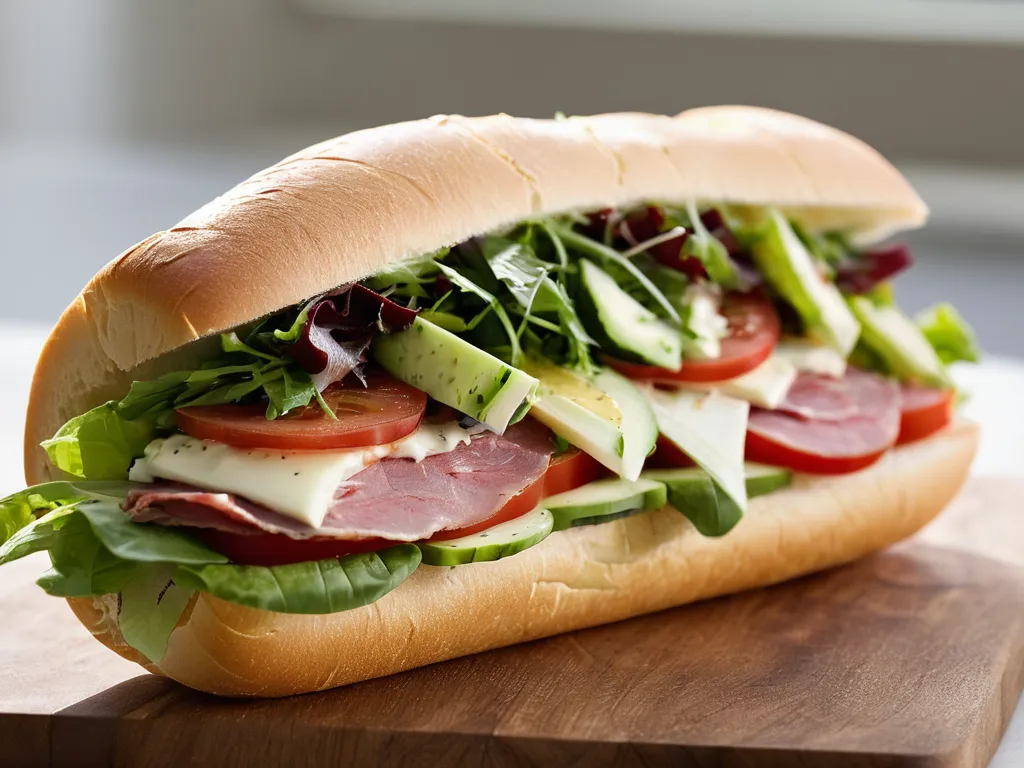
Viral TikTok Grinder Salad Sandwich (The Right Way)
Prep time: 15 min | Cook time: none | Makes: 2 large sandwiches
The grinder salad sandwich went viral on TikTok in spring 2022, when Virginia chef Josh Wright’s girlfriend Gray Fultz filmed him building it and posted the clip on March 28, 2022. She had barely 70 followers at the time; the video took off once other cooking creators started copying it. The method deconstructs an Italian sub — chopping every ingredient into small uniform pieces, tossing them in a creamy mayo-based dressing, and stuffing the dressed mixture back into a hollowed hero roll. The cross-section shot — layers of dressed meat and cheese and vegetables visible in every bite — made the whole thing feel like a revelation.
It is a revelation — but not because it is new. New England sandwich shops, particularly in Connecticut, have been making chopped-salad grinders for decades. TikTok didn’t invent it; TikTok discovered it and showed the rest of the country why it works.
The word “grinder” is New England’s term for a submarine sandwich, used primarily in Connecticut, Rhode Island, Vermont, New Hampshire, and western Massachusetts. The exact origin is debated — one theory traces it to Italian-American dockworkers in New England; another credits the thick, crusty bread that requires genuine jaw work — but the term has been used in the region for over a century. Elsewhere it’s a “sub” (most of the country), a “hero” (New York City), a “hoagie” (Philadelphia), a “po’boy” (Louisiana), or an “Italian sandwich” (Maine specifically). That regional vocabulary is part of why the dish felt exotic to viewers outside New England: they were seeing their Italian sub, built correctly, called something different.
Why Chopping Changes Everything
A standard Italian sub layers meats, cheese, and vegetables in horizontal sheets. Each bite passes through those layers unevenly — sometimes a mouthful of nothing but iceberg lettuce, sometimes a thick pile of meat with no dressing. The cheese sits in one zone; the tomato sits in another.
Chopping the ingredients and tossing them in vinaigrette solves this entirely. When everything is cut to roughly the same small size and tossed together, every forkful — every bite of the finished sandwich — contains the same ratio of meat, cheese, vegetable, and dressing. The flavor is uniform from the first bite to the last.
The dressing applied to the salad also pre-seasons the filling in a way that layered saucing never achieves. A drizzle of oil and vinegar on top of a built sub sits on the surface; a tossed vinaigrette coats every surface of every chopped piece.
The Meats: What Goes in a Traditional Italian Grinder
The stub version of this recipe used turkey. Turkey is not part of an Italian grinder. An Italian sub — the thing TikTok was recreating — uses cured Italian meats.
The authentic combination:
- Genoa salami — the foundational cured meat, with a mild pork-and-peppercorn flavor and the soft, fatty texture that holds up to chopping
- Capicola (capocollo, coppa) — cured pork neck, spiced with red pepper and paprika; it has more complexity and a slightly firmer texture than salami; look for it sliced at Italian delis, or pre-packaged in the charcuterie section at stores like Trader Joe’s, where it’s often labeled “coppa”
- Ham — most versions use thin-sliced deli ham; some use mortadella (the Italian pork sausage with fat pockets and pistachios) for more complexity
If you cannot find capicola, double the salami and add a few slices of pepperoni. Pepperoni is not traditional in a cold Italian sub, but it holds up to chopping and adds a sharp, oily heat that works in the dressing.
Avoid:
- Turkey — the wrong flavor profile, not Italian
- Roast beef — overpowers the other meats
- Pre-sliced chicken breast — too lean and too bland
The Dressing: Mayo-Based, Not a Vinaigrette
This is the single most important thing to get right. The authentic grinder dressing is mayo-based — not a bottled Italian dressing, not a pure vinaigrette. Mayo is the primary ingredient. The viral videos look creamy and glossy because the dressing coats every piece; a thin vinaigrette pools at the bottom.
Bottled Italian dressing is also wrong for a different reason: it’s too sweet. The sugar in bottled Italian dressing clashes with cured meat in a way that homemade mayo dressing does not.
3 tablespoons mayonnaise — the base that makes everything creamy and cohesive; full-fat mayo only (light mayo thins the dressing)
2 tablespoons red wine vinegar — the tang that cuts through the richness of the mayo and the fat of the cured meats; red wine vinegar has more depth than white vinegar
1 tablespoon olive oil — rounds out the dressing and adds the right richness alongside the mayo
1 teaspoon dried oregano — the defining flavor of Italian-American deli culture; use dried, not fresh (dried blooms in fat and distributes evenly)
1/2 teaspoon garlic powder — not fresh garlic; garlic powder distributes without detectable pieces
1–2 teaspoons pepperoncini brine — a splash from the pepper jar adds brightness and tie-in to the pickled peppers in the salad; optional but a genuine improvement
Optional: 2 tablespoons grated Parmesan — adds savory umami depth; stir it into the dressing so it disperses rather than clumping
Bread: The Structural Element
The right bread for a grinder salad is a hero roll or hoagie roll — the long, oval bread with a firm crust and a soft interior. It needs to be sturdy enough to hold the dressed salad without disintegrating, but soft enough that the dressing can soak into the crumb.
The hollowing step is not optional. A grinder salad has significantly more volume than a standard sub because the ingredients aren’t compressed flat; they’re chunky and filled with air gaps. Without hollowing the top half, the sandwich won’t close, and you’ll lose most of the filling when you cut it.
Use your fingers to pull out and discard a thin layer of the interior crumb from the top half only — about a 1/4-inch layer. Leave the bottom intact: it provides structural support and absorbs the dressing during the 5-minute rest.
Avoid ciabatta. Ciabatta has too many large holes and the filling falls through. Italian bread or hoagie rolls work best.
The Standalone Salad Version
Skip the bread and the grinder salad becomes one of the best Italian chopped salads you can make. Add a little extra dressing (the bread was absorbing roughly one-third of it), serve in a bowl, and top with a few more Parmesan shavings. It’s substantial enough for lunch without the rolls.
Some versions add:
- Chickpeas or white beans — for extra protein and fiber if reducing meat
- Kalamata olives — a richer, brinier option than pepperoncini
- Artichoke hearts (from a jar, drained and chopped) — adds an Italian antipasto dimension
- Roasted red peppers — sweet and slightly smoky, cuts through the acidity
Variations
Hot grinder version — build the sandwich and wrap it in foil, then bake at 375°F for 10 minutes. The cheese melts, the meats warm through, and the bread crisps on the outside. A different dish but excellent.
Wrap version — use a large flour tortilla instead of a hero roll; roll it tightly around the dressed salad mixture. Works well for meal prep since the tortilla holds the dressing better than bread over time.
Spicy version — add a layer of giardiniera (Italian pickled vegetables in oil) alongside the pepperoncini. Giardiniera is chunkier and more complex than pepperoncini, with cauliflower, celery, and carrots pickled in a brine; it adds crunch and heat alongside its acidity.
Tips
Chop everything to the same size. Roughly 1/2-inch pieces is the target. If the meat pieces are much larger than the cheese pieces or the tomato pieces, some bites will be unbalanced. Uniform size means uniform flavor distribution.
Seed the tomato. Tomato seeds and gel are mostly water; they dilute the dressing and make the salad watery within minutes. Cut the tomato in half, squeeze gently to expel the seeds, then dice the flesh.
Taste the dressing before adding it. The meats are already salty; over-dressing kills the salad. The dressing should taste tangy and assertive on its own — it will mellow once it hits the other ingredients.
Dress at the last possible moment. Once the dressing hits the iceberg, it starts to wilt. Make the components, make the dressing, then combine right before assembling the sandwich.
The 5-minute rest matters. After pressing the sandwich closed, resist cutting immediately. The bottom half of the roll absorbs some dressing during those 5 minutes, creating a flavor bridge between the bread and filling that doesn’t happen if you cut right away.
Related Sandwiches and Salads
- Jersey Mike’s Chipotle Cheesesteak — the copycat version of another iconic American sub shop sandwich, with a different flavor profile but the same attention to the right build
- Copycat Subway Meatball Sub — for days you want a hot sub instead of a cold Italian grinder
- Viral TikTok Crunchy Ramen Salad — another TikTok salad that went massive, with a similar crunch-focused approach
- Viral TikTok Green Goddess Salad — the TikTok salad that preceded the grinder in virality, built around a herb-heavy blended dressing