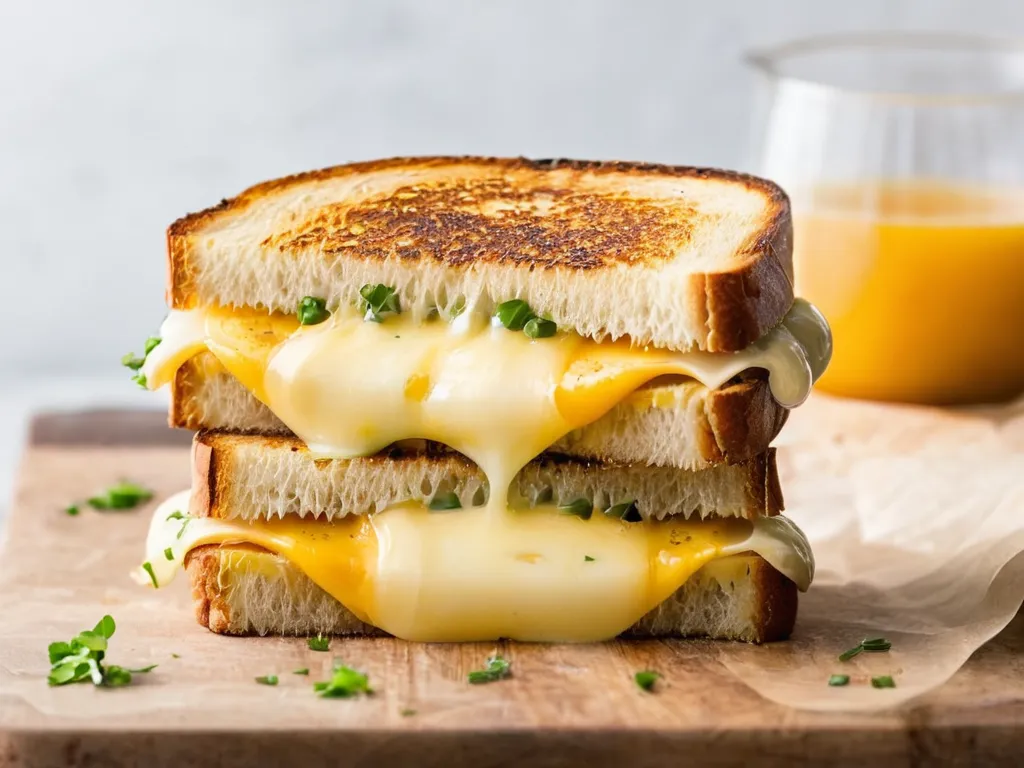
Garlic Bread Grilled Cheese — The TikTok Mashup That Ruined Regular Grilled Cheese
Somebody on TikTok had the obvious-in-hindsight idea to use garlic butter instead of plain butter on a grilled cheese — and the internet responded with collective rage that nobody had thought of it earlier. The video exploded. Millions of recreations followed. The concept seems like it should have always existed.
The reason it works so well: garlic butter isn’t just flavored fat. It creates a fundamentally different crust. The garlic’s natural sugars caramelize and the added proteins trigger a more complex Maillard reaction than plain butter — the result is a deeper, more aromatic brown with a crust that smells like a pizzeria. Inside, the dual-cheese stack melts into gooey ribbons. It’s two comfort foods colliding into something better than either.
TL;DR: Garlic butter on the outside. Mozzarella + cheddar on the inside. Medium-low heat, lid on first, uncovered to finish. 13 minutes. Under $2 per sandwich.
Who Made This Go Viral
The concept of garlic butter on a grilled cheese isn’t new — cooks have been doing it for years — but the single biggest TikTok moment belongs to @bakesbynat, whose air fryer garlic bread grilled cheese posted in June 2025 accumulated nearly 18 million views and close to 1 million likes. Her specific approach: garlic butter spread on both faces, mozzarella inside and layered on top, cooked in an air fryer at 375°F until golden and gooey.
The recipe reignited again when food creator Jordan the Stallion recreated it for his audience, introducing a new wave of people to the format. By that point the #garlicbreadgrilledcheese hashtag had hundreds of millions of combined views across its many versions.
This is a decentralized trend at heart — dozens of creators contributed their own spin — but @bakesbynat’s version is the one that drove the biggest single surge.
The Garlic Butter (The Whole Point)
Everything in this recipe depends on the garlic butter. It’s worth making it right.
Standard ratio:
- 2 tablespoons unsalted butter, fully softened
- 1–2 cloves fresh garlic, minced as finely as possible
- 1 tablespoon fresh flat-leaf parsley, chopped fine
- Optional: 1/4 teaspoon Italian seasoning
The crushing step: After mincing, use the flat of your knife to crush the garlic against your cutting board and drag it into a paste. This breaks down more cell walls than mincing alone, releasing more allicin (the flavor compound) into the butter. The resulting garlic butter is noticeably more aromatic.
Garlic powder vs. fresh: Fresh garlic gives more depth but requires careful heat management — it starts turning bitter around 325°F. Garlic powder distributes more evenly and tolerates heat better. The best approach: 1/4 teaspoon garlic powder as the base, plus one fresh clove for character. This gives you both even coverage and real garlic flavor.
Roasted garlic upgrade: If you have roasted garlic on hand, squeeze 2–3 cloves into the butter and mash them in. The roasting converts sharp, pungent raw garlic into something sweeter and more complex. The resulting garlic butter is exceptional and won’t burn nearly as easily, since roasted garlic has already had its harshest compounds cooked out.
The mayo hack: Stir 1 teaspoon of mayonnaise into your garlic butter before spreading. Mayonnaise is an emulsion of egg yolk and oil — the egg proteins trigger a much stronger Maillard reaction than butter fat alone, creating a deeper, more uniform golden-brown crust. The mayo flavor completely disappears into the garlic, so you won’t taste it; you’ll just notice the crust is more evenly and deeply browned. This is a common restaurant shortcut.
The Science: Why Garlic Butter Crisps Differently
Plain butter on a grilled cheese gives a classic golden crust — that’s pure milk fat toasting bread through direct heat transfer.
Garlic butter does something more complex:
Maillard reaction amplification. Garlic contains proteins and amino acids. When those compounds heat on the bread’s surface, they react with the carbohydrates in the bread more aggressively than butter fat alone, producing a wider spectrum of browning compounds and flavors. The crust isn’t just toasted — it’s roasted in a light chemical sense.
Sugar caramelization. Raw garlic contains small amounts of natural sugars (primarily fructose and glucose). These begin caramelizing around 320°F, adding a faint sweetness and additional aroma alongside the savory depth.
Flavor transfer into the bread. When garlic-infused butter sits on a porous bread surface over moderate heat, the fat carries volatile aromatic compounds from the garlic into the bread’s interior surface. The result is a crust that tastes of garlic all the way through, not just on the surface.
The practical implication: you need to manage this extra browning potential with lower heat and patience. Garlic butter cannot tolerate the same heat a plain butter grilled cheese can.
The Bread Decision
The bread you choose determines whether the garlic butter crisps into a crackling crust or soaks through into a greasy mess.
Sourdough (best for most): Dense crumb, slight chew, and a tang that balances the richness of garlic and cheese. Its structure resists absorbing butter too quickly, which is exactly what you want. Go for a bakery-style loaf sliced thick. The irregular crust gives you some char spots that add textural contrast.
Texas toast (best for maximum thickness): The quintessential comfort choice — thick-cut white bread with an open crumb that drinks in garlic butter. It toasts to a supremely soft-inside, crispy-outside result. The neutral flavor lets the garlic and cheese carry everything.
Brioche: Sweeter than the others, which creates an interesting counterpoint to sharp, salty cheese. Works particularly well with Gruyere or aged cheddar. Toasts to a very deep golden color quickly because of the egg content — watch the heat carefully.
Ciabatta or Italian bread: Irregular holes throughout mean some pockets get more garlic butter than others, creating an inconsistent but often delicious result with crispy edges and chewy centers.
Avoid: Thin pre-sliced sandwich bread. It absorbs butter faster than it can toast, leaving you with soft, greasy bread instead of a crisp crust. If it’s all you have, use a lighter coating of garlic butter and cook the pan slightly hotter to compensate.
The Cheese Formula
Two-cheese blends consistently outperform single-cheese on a grilled cheese. The reason: no single cheese does everything well. Mozzarella stretches beautifully but lacks flavor. Sharp cheddar has great taste but pulls apart in crumbles instead of elegant strings. Combine them and you get both.
The Classic:
- Low-moisture mozzarella: melts into long, gooey strings
- Sharp cheddar: orange, bold, slightly salty and acidic
The Upgraded:
- Gruyere: nutty, smooth melt, slightly earthy depth
- Fontina: arguably the meltiest semi-firm cheese; silkier than mozzarella
The Italian:
- Provolone: slightly sharp, good pull, pairs naturally with garlic
- Fresh mozzarella: more water content, melts differently (creamier, softer)
The Restaurant Cheat: Add one slice of American cheese to any stack. American cheese contains emulsifying salts (sodium citrate) that bind the fat and protein in cheese together as it melts, preventing separation. One slice mixed with other cheeses creates a creamier, more consistent melt — this is why diner grilled cheeses always look perfect.
Critical rule: Grate your cheese fresh from a block. Pre-shredded cheese is coated in anti-caking agents (potato starch or cellulose) that actively resist melting. The difference in melt quality between fresh-grated and pre-shredded is not subtle.
Skillet Method (Step-by-Step)
The assembly order matters:
- Spread garlic butter on the outside face of each slice — generously.
- Place both slices butter-side-down on your cutting board.
- Layer mozzarella on one inner face, cheddar on top, close the sandwich.
- Heat a heavy skillet over medium-low for 2 minutes before the sandwich goes in.
- Place the sandwich in the dry skillet (no added fat — the garlic butter is the fat).
- Cover immediately. Cook covered for 3–4 minutes until the bottom is deep golden.
- Flip, remove the lid, cook uncovered 2–3 minutes more.
- Press occasionally with the spatula — this forces contact and speeds browning.
- Rest 60 seconds before cutting.
The lid rule is the single most important technique. The trapped steam from the melting cheese creates an internal environment that melts the cheese faster than radiant pan heat alone. Remove the lid too early and you risk a fully crisped exterior with cold, solid cheese inside.
Checking doneness: Look for the bread to be the same deep amber on both sides, and for the cheese to have visibly melted to the edges. If you see cheese pushing out from the sides, you’re there.
Air Fryer Method
Preheat your air fryer to 375°F. Assemble the sandwich with garlic butter on both outer faces. Place in the basket — if your basket is small, you may need to cut the sandwich in half diagonally to fit. Cook 4 minutes, flip carefully, cook another 3–4 minutes until both sides are golden and the cheese is melted.
Air fryer advantages: circulating hot air gives extremely even browning without any hot spots. The crust becomes very crispy — arguably crispier than skillet. No lid needed because the enclosed environment acts as one. No pressing needed.
Air fryer disadvantage: you can’t see what’s happening until you check it. Start checking at 3 minutes to avoid burning.
Skillet vs. Air Fryer: Which Should You Use?
Both produce an excellent sandwich. Pick by what you value — control or convenience.
| Factor | Skillet | Air Fryer |
|---|---|---|
| Crust | Even, deep golden; you control the exact color | Extra-crispy, often crispier than skillet |
| Cheese melt | Needs a lid to trap steam and melt the inside | Melts evenly from circulating air — no lid |
| Heat control | Full control; adjust mid-cook | Set-and-forget; harder to course-correct |
| Pressing | Yes — flatten for better bread-to-pan contact | No — assemble tightly so layers don’t shift |
| Visibility | See and adjust as it cooks | Blind until you open the basket |
| Cook time | ~6–7 minutes | ~7–8 minutes |
| Best for | Maximum control and a classic diner crust | Hands-off cooking and the crunchiest crust |
Short version: reach for the skillet when you want to dial in the crust and press the sandwich; reach for the air fryer when you want to walk away and come back to maximum crunch.
Five Variations Worth Making
Classic Garlic Bread Grilled Cheese The base recipe — mozzarella + sharp cheddar on sourdough with garlic-parsley butter.
Italian Caprese Style Swap cheddar for fresh basil leaves (placed inside the sandwich), add a thin layer of sun-dried tomato spread or pesto on the inner bread faces, and use fresh mozzarella instead of block. Finish with a drizzle of balsamic glaze after cutting.
French Bistro Style Replace cheddar with Gruyere. Add a thin swipe of Dijon mustard on the inner bread faces. Use brioche as the bread. The result tastes like a croque monsieur that hit the gym.
Spicy Version Add 2–3 pickled jalapeño slices inside the sandwich alongside the cheese. Mix a pinch of cayenne into the garlic butter. Use pepper jack instead of cheddar.
The Diner Melt Use two slices of American cheese plus one of sharp cheddar. Add caramelized onions (cooked low and slow for 30 minutes in butter until deep golden brown) inside the sandwich. The onion sweetness and the American cheese’s smooth melt create something that tastes better than the individual parts.
Common Mistakes
Heat too high. The most common failure. Garlic butter needs medium-low heat. When in doubt, go lower — you can always add time, but you can’t un-burn garlic. Burnt garlic is irreversibly bitter.
Skipping the lid. Without a lid, the exterior crisps while the interior cheese stays solid. The lid is not optional.
Cold cheese. Cold cheese straight from the fridge takes significantly longer to melt and creates uneven texture. Slice or grate cheese 20 minutes before cooking and let it sit at room temperature.
Using too much cheese. This seems counterintuitive, but overloading creates a thick cold mass that never fully melts before the bread is done. Two ounces total (mozzarella + cheddar) is the right amount for a standard 1-cup-volume sandwich space.
Not letting it rest. Molten cheese is liquid. Cut immediately and it pours out. Rest 60 seconds and it sets into ribbons.
Cost Breakdown
A garlic bread grilled cheese at a restaurant or sandwich shop typically runs $12–16, often higher in cities.
At home:
- Sourdough (2 slices from a $5 loaf, roughly 16 slices): ~$0.63
- Butter (2 tablespoons from a $4 pack): ~$0.25
- Garlic (2 cloves from a $1 bulb): ~$0.08
- Mozzarella (1.5 oz from a $5 block): ~$0.94
- Sharp cheddar (1 oz from a $5 block): ~$0.63
Total: ~$2.53 per sandwich
That’s roughly one-fifth the restaurant price for an objectively better result — you control the garlic ratio, the cheese type, the bread quality, and the cook.
Related Recipes
If you’re in garlic-and-cheese territory, these are worth having on rotation:
- Viral TikTok Caprese Garlic Bread — the garlic bread form factor in open-face format with fresh mozzarella, tomato, and basil
- Copycat Five Guys Grilled Cheese — the diner-style version with American cheese technique
- Copycat Domino’s Garlic Knots — the garlic butter formula in its purest form
- Copycat Benihana Garlic Butter Shrimp — garlic butter used in a savory Japanese-American context