

Pin It

Halloween Spider Web Chocolate Pretzels

Halloween Spider Web Chocolate Pretzels
Jump to Recipe
Prep 15 min Cook 0 min Serves 10 webs
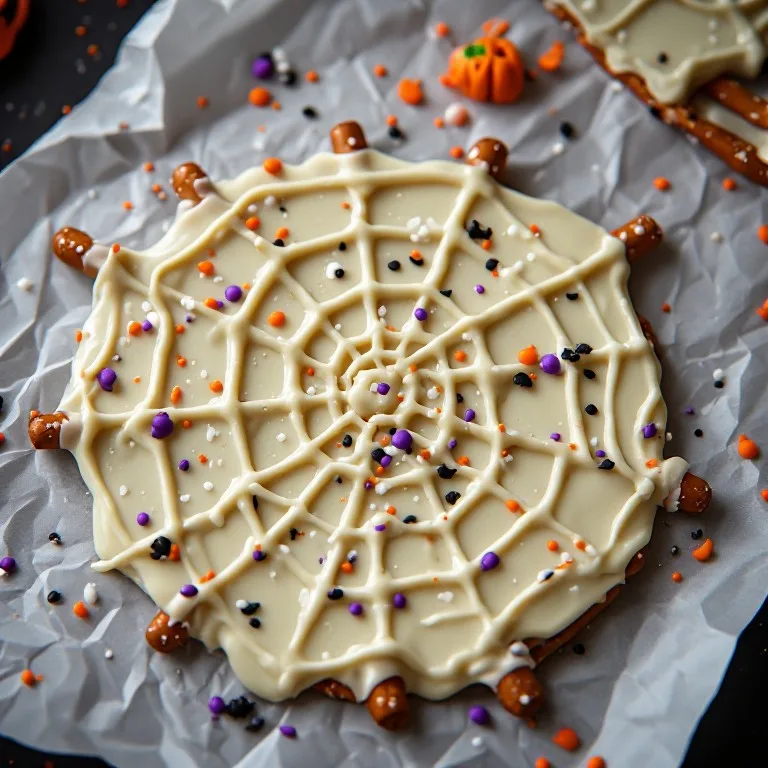
Quick answer: Arrange 8 pretzel sticks in a star shape on parchment paper. Melt 2 cups white chocolate wafers in 30-second microwave intervals, stirring between each, until smooth. Transfer to a piping bag or zip-lock bag with the corner snipped. Pipe a generous center blob to anchor all 8 pretzels, then pipe 3–4 concentric circles outward, crossing every pretzel stick. Within 30 seconds (before the chocolate sets), drag a toothpick from the center straight out to the edge 8 times, spaced like clock hands at 12, 3, 6, and 9 o'clock, then halve each gap. Scatter Halloween sprinkles immediately. Refrigerate 45 minutes until fully firm. Each web peels cleanly off the parchment. The toothpick drag is the entire trick — it only works while the chocolate is still fluid, so set up all your pretzel stars before you melt the chocolate.

Shop the tools

Gear matched to this recipe. These are Amazon affiliate links — we may earn a small commission if you buy, at no extra cost to you.

As an Amazon Associate, Copycat Spices earns from qualifying purchases. Product images are generic illustrations, not the exact item listed.

Halloween Spider Web Chocolate Pretzels

The viral TikTok Halloween spider web chocolate pretzels: 8 pretzel sticks arranged in a star, coated with white chocolate piped into concentric circles, then dragged with a toothpick into a perfect spiderweb. No-bake, 20 minutes, impossible to stop eating.

Easy Prep: 15 min Cook: 0 min Total: 15 min10 webs servings ~$4.50/serving
Prep15 min
Cook0 min
Total15 min
Servings
10
At home~$4.50/serving
vs
Restaurant~$20.25/serving
You save ~78%

The Story Behind the Recipe

The spiderweb decorating technique — pipe concentric circles, drag a toothpick outward through them — is a classic pastry move, the same feathering you've seen on raspberry-swirled cheesecakes and mirror-glazed tarts for decades. TikTok adopted it for Halloween a few years back and it took off because the gap between effort and visual result is enormous: three circles and eight drag lines produce a spiderweb that looks like actual craft skill. The pretzel version has resurged across TikTok food accounts the last couple of Halloweens because it solves a real problem — most Halloween sweet-table items are pure sugar, but the pretzel base adds salt and crunch, and the star arrangement means each web holds together as its own self-contained treat that guests can grab without breaking.

What makes the TikTok version different from old-school chocolate dipped pretzels is the star architecture: instead of dipping individual sticks, you build a web-shaped platform from 8 pretzels and let the chocolate be both the adhesive and the decoration. The result holds together structurally, photographs well from directly above, and costs about 40 cents per web to make — versus $4–6 for equivalent Halloween chocolate bark at a specialty store. The batch multiplies easily: line multiple sheets of parchment, set up all the pretzel stars before you melt anything, and you can make 30 webs in the time it takes to melt chocolate twice.

Nutrition Facts

Per serving (10 webs servings)
Calories148
Total Fat7g
Total Carbs20g
Dietary Fiber1g
Sugars13g
Protein2g
Sodium135mg

* Estimated values based on standard recipe preparation. Actual values may vary.

Ingredients

  • The Pretzel Base
  • The Chocolate Web
  • Decoration
  • Equipment

Instructions

💡
Pro tip: This recipe tastes even better the next day. The flavors need time to meld together in the fridge.
❄️
Storage: Keeps in an airtight container in the fridge for up to 2 weeks. Freezer-friendly for up to 3 months.
🎃 Free Halloween cookbook — download now The Copycat Halloween Cookbook A ready-made, photo-illustrated PDF of our best halloween copycat recipes — free to download, no building required. Pay what you want to support if you love it.

Free PDF — instant download. We'll also send new seasonal copycat recipes now and then; unsubscribe anytime. Or just download it →

Three circles. Eight drag lines. Twenty minutes. The Halloween spider web chocolate pretzel is one of those TikTok recipes where the technique-to-result ratio is almost unfair — you’re doing something dead simple, and what comes off the parchment looks like you spent real time on it.

The secret is all physics. White chocolate stays fluid for about 60 seconds after you finish piping. A toothpick dragged through concentric circles during that window pulls the fluid into V-shapes between drag lines, and concentric circles become a web instantly. French pastry chefs have used the same technique on mirror-glazed tarts for decades. TikTok turned it into a Halloween hack.

The Pretzel Star Architecture

Most chocolate Halloween crafts fail structurally before they reach the serving platter. Bark breaks, meringues crack, truffles stick together. The pretzel spider web survives because of how it’s built: the star-shaped pretzel frame gives the chocolate something rigid to adhere to from below. The finished web is self-supporting rather than freestanding chocolate, which means it travels well and handles like a cookie rather than a candy.

Eight sticks per web is the right number. Six sticks gives too much open space between spokes and the web pattern looks sparse. Ten sticks crowd the center and the drag lines become indistinct. With eight, spaced evenly like the numbers on a clock, the four concentric circles produce clean, distinct V-shapes between every drag line — exactly what reads as a spiderweb in a photo or on a platter.

The sticks should touch at the center but not overlap. If they overlap, the center blob is too thick and takes too long to set. If they don’t meet, the center blob has nothing to grip and the web falls apart when you peel it from the parchment.

White Chocolate vs. Dark Chocolate

Both work, but they have different personalities.

White chocolate produces the classic Halloween look — pale, slightly silvery, stark against a dark plate. It also picks up food coloring well: two drops of black gel color turns white chocolate into a dark gray that photographs like graphite, perfect if you want a truly monochromatic spooky result.

Dark chocolate webs are more dramatic and less sweet. The pattern is slightly harder to see against a dark pretzel (the visual contrast is between the dark chocolate and the pretzel’s salt crystals rather than the outline of the web), but with a white chocolate accent — piped as a second layer while the dark is still wet — you get the sharpest two-tone visual on the whole platter.

The safest beginner move: white chocolate wafers for the base circles, black gel food coloring mixed in, orange sprinkles. Classic Halloween palette, works every time.

The Tempering Shortcut

Real white chocolate has to be tempered — a process of heating, cooling, and reheating to specific temperatures — to set with a snap and a glossy finish. Melting wafers skip all of that. They’re formulated with palm oil instead of cocoa butter, which means they melt at a lower temperature, flow more smoothly out of a piping bag, and set firm at room temperature without any temperature management. The tradeoff is flavor: wafers are noticeably less complex than a good white chocolate baking bar.

For Halloween pretzels going on a party platter, the flavor difference rarely matters — the pretzel salt, the sprinkles, and the visual drama are the dominant experience. For a gift box you’re proud of, use Ghirardelli white baking bar melted in a double boiler at the lowest heat your stove produces. It takes an extra 5 minutes but the taste is noticeably better.

Either way, work in small batches. Melt what you need for 4–5 webs at a time. Chocolate that sits in a warm bowl slowly thickens and eventually becomes too stiff to pipe cleanly. Two small batches work better than one big one.

The Timing Window

This is the one thing that separates good webs from smeared ones: the toothpick drag must happen within 30–60 seconds of finishing the circles. Here’s what to look for:

Ready to drag: surface is glossy and slightly reflective; if you tilt the parchment, the circles shift just slightly; the chocolate flows back for a moment when you drag the toothpick.

Too late to drag: surface has gone from glossy to matte; circles look slightly textured rather than smooth; the toothpick catches instead of glides.

If you miss the window, let that web fully set and start the next one — a circle-covered pretzel star is still a perfectly good treat. The drag pattern on the next one will be sharper because you’ll know exactly how long you have.

Scaling for a Party

A 10-oz bag of pretzel sticks gives you roughly 160 sticks, or 20 complete spider webs (8 sticks each). Two cups of white chocolate wafers covers about 10 webs comfortably. Scale accordingly: 4 cups of wafers for a full bag of pretzels.

The time bottleneck is the set time, not the build time. Line four sheet pans of parchment, build all your pretzel stars at once, melt chocolate in three separate batches to keep each one fluid, work through the pans quickly. Thirty webs takes about 35 active minutes, plus 45 minutes of hands-off refrigerator time.

For storing and transport: stack the finished webs between sheets of parchment in a shallow box. They stack cleanly without sticking because the chocolate surface is fully set and matte after refrigerating. Do not stack more than 3 layers deep — the bottom layer eventually gets the pretzel spokes from the layer above pressed into its surface.

Flavor Variations

Orange-tinted white chocolate: Add 2–3 drops of orange gel food coloring to melted white chocolate. Halloween-orange webs look excellent on a black plate or against dark chocolate.

Two-tone web: Pipe dark chocolate circles first, then immediately overlay white chocolate circles on top while the dark is still wet. Drag the toothpick through both layers together. You get a black-and-white chevron pattern that looks like it took real skill.

Salted caramel: Drizzle a small amount of store-bought caramel sauce into the finished white chocolate web before it sets, then drag the toothpick through both. The caramel streaks create a more irregular, organic-looking web pattern.

Peanut butter accent: Mix 1 tablespoon of smooth peanut butter into 1/2 cup of white chocolate wafers before melting. The result is a tan-colored chocolate with a subtle peanut butter flavor that contrasts well against a dark chocolate pretzel base.
🥗

Make It Healthier

Love Halloween Spider Web Chocolate Pretzels but want a lighter version? Try these simple swaps:

  • ✓Use dark chocolate wafers (70% cacao) instead of white chocolate for the web — the flavor is less sweet, and dark chocolate has more antioxidants and less sugar per ounce than white. The spiderweb technique works identically.
  • ✓Reduce the chocolate per web by making tighter, smaller circles — a web with 2 circles instead of 4 uses about 40% less chocolate and still looks complete, especially if you use bold contrasting colors.
  • ✓Switch to thin rice-cracker sticks instead of pretzel sticks for a gluten-free version that keeps the star structure. The web assembles identically and the rice crackers' neutral flavor lets the chocolate come forward.
  • ✓For parties where kids are eating multiple pieces, use a smaller pretzel star (6 sticks instead of 8) and add just 2 circles — about 100 calories per web — which still photographs well but portioned closer to a single fun-size candy bar.

Frequently Asked Questions

Why use melting wafers instead of regular white chocolate chips?

Melting wafers (also sold as candy melts or chocolate wafers) are specifically formulated to melt smoothly and re-solidify at room temperature without tempering. Regular white chocolate chips contain stabilizers that keep their shape in cookies but can make them grainy or seize up when melted in a microwave. If you want to use real white chocolate (Ghirardelli baking bars are the most forgiving), melt it in a double boiler at low heat rather than a microwave, and work quickly. The flavor of real white chocolate is noticeably better — more buttery and complex — but the wafers are more forgiving for a first attempt or a big batch.

What does 'seizing' mean and how do I avoid it?

Chocolate seizes when moisture gets into it during melting — it goes from smooth and glossy to thick, grainy, and unusable almost instantly. The water can come from steam, a wet bowl, a wet spatula, or even over-microwaving (which causes water to come out of the cocoa butter). To avoid it: make sure your bowl and spatula are completely dry before you start, use 50% microwave power in short intervals, and stop microwaving as soon as most of the wafers have melted — residual heat from stirring will finish the last bits. If your chocolate seizes, there's no real fix for the spider web application; start over with fresh wafers.

Can I make these with dark chocolate instead of white?

Yes, and it's a great variation. A dark chocolate base with a white chocolate web (or vice versa) creates the clearest visual contrast and photographs beautifully. To do the two-tone version: pipe the dark chocolate circles first, then immediately pipe the white chocolate on top of the still-wet dark circles before dragging. The two colors need to be wet simultaneously for the drag to work through both layers. Alternatively, tint white chocolate black using black gel food coloring (use gel, not liquid — liquid seizes chocolate) for a fully dark-colored web.

What's the right timing for the toothpick drag?

Start dragging immediately after piping the last circle. At room temperature around 65–70°F, you have roughly 30–60 seconds before white chocolate begins to set enough to resist the drag. Signs it's still workable: the chocolate flows back slightly where you dragged, and the surface looks glossy. Signs it's setting: the surface looks matte, and the chocolate doesn't move when you drag. If you miss the window on one web, let it set fully and call it a 'chocolate covered pretzel star' — it still tastes good. Next time, melt your chocolate in smaller batches so it stays fluid longer during the piping.

How far ahead can I make these?

Up to 5 days ahead in a cool, dry location. The main enemies of chocolate pretzel webs over time are humidity (causes the chocolate to bloom — develop white streaks) and heat (causes the webs to soften and lose structural integrity). Store them in a single layer between sheets of parchment in an airtight container. At room temperature below 70°F they stay perfectly crisp for 3–4 days. Do not refrigerate for longer than needed — condensation when bringing cold chocolate to room temperature causes the surface to bloom. If you're making them more than 2 days ahead, keep them at room temperature in a cool pantry, not the fridge.

What's the best way to display these at a Halloween party?

Stand them upright in a shallow bowl or platter so each web faces forward — they look like they're crawling out of a dark void. Alternatively, lay them flat on a black plate with extra Halloween sprinkles scattered around. For a party table centerpiece, press a gummy spider into the center of each web while the chocolate is still wet. A baker's rack with multiple tiers displays them at different heights and lets guests see the spiderweb pattern clearly. Avoid stacking them directly on top of each other — the pretzels snag and break the webs.

Love this recipe? Share it!

Free PDF: our 12 most-wanted copycat recipes — instant download.

Made it? Buy us a coffee

Every recipe here is free, with no paywalls. If this one was a hit at your table, a small tip keeps new copycats coming.

$

Halloween is a trademark of its owner, used here only to describe the dish this recipe recreates. This is an independent copycat written in our own words — Copycat Spices is not affiliated with, endorsed by or sponsored by Halloween.

Ratings & Reviews

—
No ratings yet

Rate this recipe

Click a star to rate

Leave a Review

0/500

CS

Copycat Spices Editorial

Researched + fact-checked. Every recipe on Copycat Spices is built from published sources — official ingredient lists, brand-published recipes, interviews and food-science references — and fact-checked before it goes live, then written as clear, step-by-step instructions for home cooks of all skill levels.

Learn more about our mission →