

Pin It

Viral TikTok Japanese Potato Salad — The Kewpie Mayo Secret Most Recipes Ignore

Viral TikTok Japanese Potato Salad — The Kewpie Mayo Secret Most Recipes Ignore
Jump to Recipe
Prep 15 min Cook 25 min Serves 4
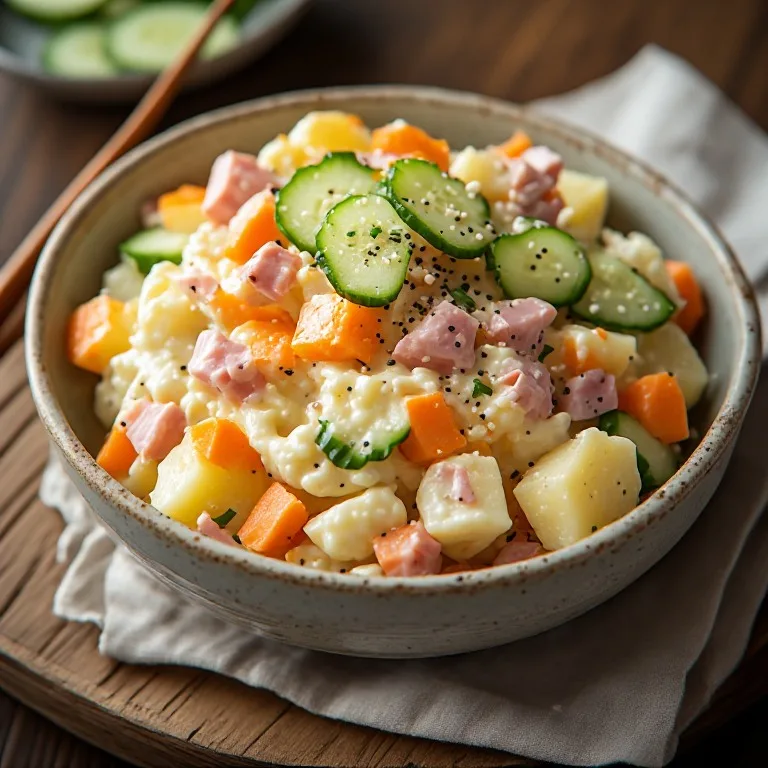
Quick answer: Peel and cut 1.5 lbs (680g) Yukon Gold potatoes into 1-inch chunks. Boil in salted water 18–20 minutes until completely fork-tender — err on the side of soft. Drain and immediately toss the hot potatoes with 1 tablespoon rice vinegar and ½ teaspoon salt while they steam-dry. While still warm, half-mash with a fork: press down firmly on about half the chunks until they collapse, leaving the rest as recognizable pieces. This is the technique that defines Japanese potato salad — creamy base with chunks, not smooth like mashed potatoes or cubed like American potato salad. Meanwhile, slice ½ English cucumber into thin half-moons, toss with ¼ teaspoon salt, and let sit 10 minutes, then squeeze firmly with your hands to wring out all the water. Hard-boil 2 eggs (10 minutes in boiling water, then ice bath), peel and chop roughly. Cube 3 oz deli ham into ¼-inch pieces. Blanch 1 small carrot in the potato water for 2 minutes, then dice small. Once the potatoes are at room temperature, fold in the squeezed cucumber, ham, carrot, and egg with 4 tablespoons Kewpie mayo, 1 teaspoon rice vinegar, ½ teaspoon sugar, and white pepper to taste. Refrigerate at least 30 minutes before serving.

Shop the tools

Gear matched to this recipe. These are Amazon affiliate links — we may earn a small commission if you buy, at no extra cost to you.

As an Amazon Associate, Copycat Spices earns from qualifying purchases. Product images are generic illustrations, not the exact item listed.

Viral TikTok Japanese Potato Salad — The Kewpie Mayo Secret Most Recipes Ignore

The TikTok Japanese potato salad that shocked Americans who thought they knew potato salad: Yukon Gold potatoes half-mashed while hot, Kewpie mayo, salted-and-squeezed cucumber, deli ham, and hard-boiled egg. Three things most copycat recipes get wrong — and the half-mash technique that makes every bite creamy and chunky at once.

Easy Prep: 15 min Cook: 25 min Total: 40 min4 servings ~$4.50/serving
Prep15 min
Cook25 min
Total40 min
Servings
4
At home~$4.50/serving
vs
Restaurant~$20.25/serving
You save ~78%

The Story Behind the Recipe

The TikTok Japanese potato salad that shocked Americans who thought they knew potato salad: Yukon Gold potatoes half-mashed while hot, Kewpie mayo, salted-and-squeezed cucumber, deli ham, and hard-boiled egg. Three things most copycat recipes get wrong — and the half-mash technique that makes every bite creamy and chunky at once.

Nutrition Facts

Per serving (4 servings)
Calories290
Total Fat15g
Total Carbs28g
Dietary Fiber3g
Sugars4g
Protein9g
Sodium550mg

* Estimated values based on standard recipe preparation. Actual values may vary.

Ingredients

  • For the potatoes
  • For the cucumber
  • The rest
  • The dressing
  • Optional additions (pick one or two)

Instructions

💡
Pro tip: This recipe tastes even better the next day. The flavors need time to meld together in the fridge.
❄️
Storage: Keeps in an airtight container in the fridge for up to 2 weeks. Freezer-friendly for up to 3 months.
🎃 Free Halloween cookbook — download now The Copycat Halloween Cookbook A ready-made, photo-illustrated PDF of our best halloween copycat recipes — free to download, no building required. Pay what you want to support if you love it.

Free PDF — instant download. We'll also send new seasonal copycat recipes now and then; unsubscribe anytime. Or just download it →

The Potato Salad Americans Had No Idea They Were Missing

Most people grow up thinking potato salad is cubed potatoes in mayo with mustard. Then they try Japanese potato salad — and the category gets reclassified.

It is not a subtle difference. Japanese potato salad is half-mashed so it’s simultaneously creamy and chunky. It uses Kewpie mayo, which is richer and more savory than American mayo in a way that’s hard to describe until you’ve tasted both side by side. The cucumber goes in salted-and-squeezed, so it’s firm and flavorful instead of watery. The whole bowl tastes balanced — eggy, tangy, slightly sweet, deeply savory — in a way that American potato salad rarely achieves.

TikTok figured this out a few years ago, and the videos keep spreading because the reaction is always the same: “why didn’t I know about this?”

Three Things Most Recipes Get Wrong

1. Using regular American mayo. Hellmann’s is a whole-egg mayo with distilled vinegar. Kewpie is an egg-yolk-only mayo with rice vinegar and a small amount of umami seasoning (MSG). The two are close in total fat per tablespoon, but the yolk-only formula makes Kewpie taste and feel richer, denser, and more custardy — where whole-egg mayo (yolks plus whites) reads lighter and more neutral. The rice vinegar is softer and more rounded than distilled white vinegar. These aren’t subtle differences. Every recipe that says “sub Hellmann’s if you can’t find Kewpie” is technically correct but produces a noticeably different dish.

2. Skipping the salt-and-squeeze step for the cucumber. Raw cucumber is mostly water. You can taste this if you slice one and let it sit on a cutting board for 10 minutes — liquid pools under the slices. All of that water ends up in your potato salad if you skip salting. Fresh, it’s barely noticeable. By the next day (and this is a next-day dish), the dressing is thin and watery and the salad tastes diluted. Salt the cucumber, wait 10 minutes, squeeze it hard. The concentrated cucumber flavor you get after squeezing is distinctly better than raw unsalted cucumber.

3. Not doing the half-mash. Keeping all the potatoes in neat cubes gives you something closer to American potato salad regardless of what mayo you use. The half-mash — pressing down firmly on about half the chunks until they collapse — creates a thick, creamy base that coats every other ingredient and holds the dressing in place. This is the most visually distinct thing about Japanese potato salad and also the most functionally important. It is not an optional flourish.

A Note on Kewpie

Kewpie is widely available now. Most Asian grocery stores carry it. Whole Foods stocks it in the condiment aisle. It’s on Amazon. The 17.6 oz squeeze bottle (the large one with the baby on the label) is the best value and lasts a long time in the fridge. Once you have it, you’ll find yourself reaching for it anywhere you’d use regular mayo — it’s better in coleslaw, better as a dip for fries, and makes an excellent base for aioli.
🥗

Make It Healthier

Love Viral TikTok Japanese Potato Salad — The Kewpie Mayo Secret Most Recipes Ignore but want a lighter version? Try these simple swaps:

  • ✓Reduce the Kewpie to 3 tablespoons and add 1 tablespoon full-fat Greek yogurt to the dressing — the yogurt adds tang and protein while cutting about 40 calories and 4g fat per serving without visibly changing the texture.
  • ✓Use reduced-fat deli ham or substitute an equal amount of thawed edamame for a protein-comparable but lower-calorie option.
  • ✓Leaving the carrot raw (thin-shaved with a peeler rather than blanched and diced) preserves more of its beta-carotene — cooking converts some of it to a form that absorbs better, but raw retains more of the vitamin C.
  • ✓The dish is naturally gluten-free as written (Kewpie mayo is gluten-free; verify your ham's label). It's dairy-free as well.

Frequently Asked Questions

Why does this recipe call for Kewpie mayo? Can I use regular mayo?

Kewpie is made with egg yolks only (not whole eggs like American mayo), along with rice vinegar and a small amount of MSG. The egg-yolk base gives it a distinctly richer, more custardy texture and a deeper savory flavor. The rice vinegar in the mayo itself adds a softer, more rounded acidity than the distilled white vinegar in brands like Hellmann's. Together this means Kewpie mayo has more fat, more richness, and more umami than American mayo — and those three things are precisely what makes Japanese potato salad taste different from American potato salad even when the other ingredients are similar. Using Hellmann's will produce a fine potato salad; it just won't taste like the dish that went viral. Kewpie is now widely available in the US: most Asian grocery stores carry it, Whole Foods typically stocks it, and it's on Amazon. The 17.6 oz squeeze bottle is the best value if you plan to use it regularly (and you will — it's excellent as a dip, in coleslaw, and anywhere you'd use regular mayo).

What's the half-mash technique and why does it matter?

Half-mashing is the defining textural characteristic of Japanese potato salad. Unlike American potato salad (where potatoes are diced and kept whole) or mashed potatoes (fully smooth), Japanese potato salad falls in between: roughly half the potato mass is pressed into a thick, creamy base while the rest stays in recognizable chunks. The mashed portion acts as a binding agent that holds the dressing to every component — no pool of mayo sitting at the bottom. The whole chunks provide textural contrast and make each bite different. Skipping the half-mash and keeping all the potatoes whole gives you a chunkier, less cohesive result that tastes closer to American potato salad regardless of the mayo you use. The half-mash is why videos of people cutting into Japanese potato salad go viral — the texture looks distinctly different from anything Western.

Why do you add vinegar to the hot potatoes before the mayo?

Hot, freshly drained potatoes are highly absorbent — the starch cells are swollen and porous from cooking. Vinegar added at this stage soaks all the way into the potato flesh, seasoning it from the inside out. If you wait until the potatoes are cold before adding any acid, the vinegar coats only the exterior. The difference in depth of flavor is significant: potatoes seasoned hot taste bright and balanced throughout; potatoes seasoned cold taste flat with an acidic surface. This is the same principle behind dressing pasta while it's still wet from the boiling water — you want the starch to absorb the seasoning rather than the seasoning to sit on top of it.

Can I skip salting and squeezing the cucumber?

You can, and the salad will still taste good the day you make it. But by the next day — and Japanese potato salad is definitely a next-day dish — the cucumber will have released all its water into the mayo dressing. A fresh bowl has a thick, creamy texture; an unsqueezed bowl held overnight develops a pool of watery liquid at the bottom that thins the dressing and makes the salad taste diluted. If you're eating the entire batch the same day and know there won't be leftovers, you can skip the step. Otherwise, don't.

Is ham traditional? What are the other options?

Deli ham is by far the most common meat in Japanese household potato salad — thin-cut sandwich ham, cut into small cubes or strips. It's a mild, slightly sweet pork flavor that doesn't compete with the potatoes or the mayo. Authentic homemade Japanese potato salad almost always has ham. That said, the dish is flexible: bacon (cooked and crumbled) adds smokiness; canned tuna (drained and flaked) is a popular lower-cost variation; imitation crab is another common add-in; and omitting meat entirely with extra corn or edamame is completely acceptable. The egg is more load-bearing than the ham — skipping the egg is a bigger departure from the original dish than swapping the protein.

How long does Japanese potato salad keep in the fridge?

Four days comfortably, five days if it was very fresh when made. The texture actually improves on days 2 and 3 as the potatoes fully absorb the dressing and the flavors meld. By day 4, the cucumber softens perceptibly and the salad starts losing its textural contrast. Day 5 is still safe to eat but the texture is noticeably more uniform. Store tightly covered — potato salad picks up refrigerator odors easily. Do not freeze: the mayo breaks and the potato texture turns grainy after thawing.

What's the best potato variety for this?

Yukon Gold is the ideal choice. Its medium-starch, medium-waxy profile means it's soft enough to half-mash cleanly while still holding together in chunks where you haven't pressed. It also has a natural buttery flavor that reduces how much mayo you need to make the salad taste rich. Russet (high-starch, low-waxy) mashes easily but produces a drier, fluffier result that absorbs the mayo differently — more like a potato pancake texture than a creamy salad. Red potatoes (low-starch, high-waxy) resist mashing and give you a chunkier result that holds together well but doesn't produce the signature creamy base. All three technically work; Yukon Gold is the closest to what you'd get at a Japanese family table or a Japanese grocery store deli counter.

Is this the same as the potato salad at Japanese grocery store deli counters?

Very close. Japanese grocery store potato salad (the kind sold in small tubs at places like Mitsuwa or H-Mart) uses the same technique and the same core ingredients: Kewpie mayo, vinegar-seasoned potatoes, salted cucumber, hard-boiled egg, and ham. Some store versions also include corn, which is a popular addition. The main difference is the scale — stores make enormous batches that sometimes taste more heavily seasoned — and some commercial versions add a small amount of prepared mustard to the dressing for added complexity. The recipe here is faithful to the home-cooking version that TikTok has been recreating and is very close to the grocery store version.

Love this recipe? Share it!

Free PDF: our 12 most-wanted copycat recipes — instant download.

Made it? Buy us a coffee

Every recipe here is free, with no paywalls. If this one was a hit at your table, a small tip keeps new copycats coming.

$

Ratings & Reviews

—
No ratings yet

Rate this recipe

Click a star to rate

Leave a Review

0/500

CS

Copycat Spices Editorial

Researched + fact-checked. Every recipe on Copycat Spices is built from published sources — official ingredient lists, brand-published recipes, interviews and food-science references — and fact-checked before it goes live, then written as clear, step-by-step instructions for home cooks of all skill levels.

Learn more about our mission →