


Pin It

Viral TikTok Tanghulu (Chinese Candied Fruit Skewers at Home)

Viral TikTok Tanghulu (Chinese Candied Fruit Skewers at Home)
Jump to Recipe
Prep 15 min Cook 10 min Serves 6 skewers
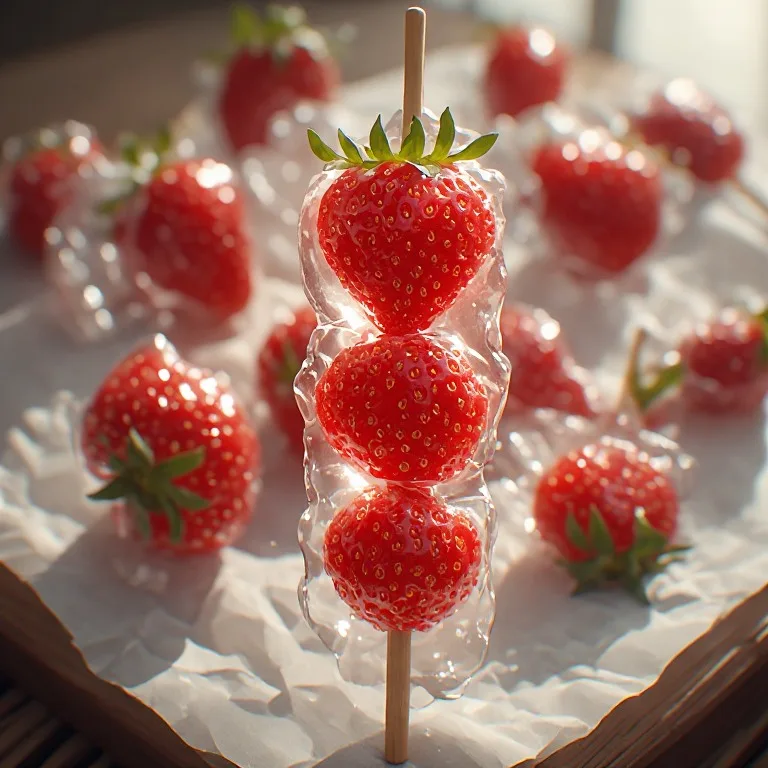
Quick answer: Thread 3–4 dry strawberries (or seedless grapes) onto bamboo skewers. Boil 2 cups sugar + 1 cup water in a wide saucepan — NO stirring — until it hits 300–310°F (hard-crack stage). Working fast, tilt the pan and dip each skewer in one smooth rotation to coat, let the excess drip for 2 seconds, then set on parchment. The coating sets glass-hard in 30 seconds. Eat within an hour — humidity turns the shell sticky. Two non-negotiable rules: the fruit must be bone dry before dipping, and you must not stir the syrup once boiling starts.

Viral TikTok Tanghulu (Chinese Candied Fruit Skewers at Home)

The glossy, glass-cracking Chinese street food that took over TikTok: strawberries (or grapes) on a skewer, dipped in a hard-crack sugar shell that shatters like candy glass. The three technique rules that make the coating flawless — and the humidity mistake that ruins it.

Medium Prep: 15 min Cook: 10 min Total: 25 min6 skewers servings ~$2.10/serving
Prep15 min
Cook10 min
Total25 min
Servings
6
At home~$2.10/serving
vs
Restaurant~$9.45/serving
You save ~78%

The Story Behind the Recipe

The glossy, glass-cracking Chinese street food that took over TikTok: strawberries (or grapes) on a skewer, dipped in a hard-crack sugar shell that shatters like candy glass. The three technique rules that make the coating flawless — and the humidity mistake that ruins it.

Ingredients

Instructions

💡
Pro tip: This recipe tastes even better the next day. The flavors need time to meld together in the fridge.
❄️
Storage: Keeps in an airtight container in the fridge for up to 2 weeks. Freezer-friendly for up to 3 months.
~350-550 cal/serving · Rich & Indulgent🔥
🎃 Free Halloween cookbook — download now The Copycat Halloween Cookbook A ready-made, photo-illustrated PDF of our best halloween copycat recipes — free to download, no building required. Pay what you want to support if you love it.

Free PDF — instant download. We'll also send new seasonal copycat recipes now and then; unsubscribe anytime. Or just download it →

Tanghulu is a Chinese street snack of fruit on a skewer, dipped in a sugar syrup cooked to 300–310°F (hard-crack stage) so it sets into a thin, glass-hard shell that shatters when you bite it. To make it at home: thread bone-dry strawberries or grapes onto skewers, boil sugar and water without stirring until it hits hard-crack, dip fast, set on parchment, and eat within an hour. It fails from exactly two things — syrup that never reached hard-crack, or humidity softening the shell.

What Is Tanghulu?

Tanghulu (糖葫芦, táng hú lu) is a Chinese street food that’s been sold from carts in Beijing and northern China for centuries. The traditional version: hawthorn berries (small, tart, red) threaded on a bamboo stick, dipped in a boiling sugar syrup that sets into a glass-hard candy shell. You bite through the crack, the tart berry hits, and the sweet-tart contrast is the whole point.

In 2023 and 2024 it blew up on TikTok — strawberry tanghulu specifically, because strawberries are easier to find outside China, hold their shape perfectly, and produce the most visually satisfying crack on camera. The ASMR quality of biting through that glassy shell — clean crack, no chew, immediate fruit — became one of the most-shared food sounds on the platform.


The Three Rules That Determine Success

Everything about tanghulu comes down to three things. Get these right and the rest follows.

Rule 1: Bone-dry fruit. Surface moisture is the enemy of hard-crack sugar coating. Water in contact with the 300°F syrup causes the sugar to seize, crystallize, or fail to bond. Wash the fruit, then dry it aggressively — paper towels, then air dry on a clean towel for 10–15 minutes minimum. If you pick up a strawberry and feel any tackiness, it’s not ready.

Rule 2: No stirring after boiling starts. Sugar syrup is metastable — dissolved sugar crystals want to reform, and agitation gives them the opportunity. One stir at the wrong moment seeds crystallization across the entire batch. The pan goes grainy and white and the batch is ruined. Once the syrup is fully dissolved and at a boil, put the spoon down and don’t pick it up again.

Rule 3: Eat it fast. Hard-crack sugar is hygroscopic — it pulls moisture from the air. On a humid day this can mean the coating goes from glass-hard to sticky in 20 minutes. There’s no storage solution: refrigeration is worse than leaving it out. Tanghulu is a make-and-eat-immediately food.


The Fruit Guide
FruitWorks?Notes
StrawberriesExcellentMost popular TikTok version; firm, easy to skewer, classic look
Seedless grapesExcellentNaturally dry skin; very forgiving; round shape coats evenly
Hawthorn berriesTraditionalTart and firm; find at Asian grocery stores; the original
Mandarin/clementine segmentsGoodMust be very carefully dried; don’t pierce the membrane
Pineapple chunksGoodDrain and dry thoroughly; pairs well with the caramel sweetness of the syrup
BananaAvoidGoes soft and releases moisture; coating separates quickly
WatermelonAvoidToo wet; surface moisture even after drying
Cut berries (blueberries, raspberries)AvoidExposed flesh weeps juice into the syrup

Reading the Syrup Temperature

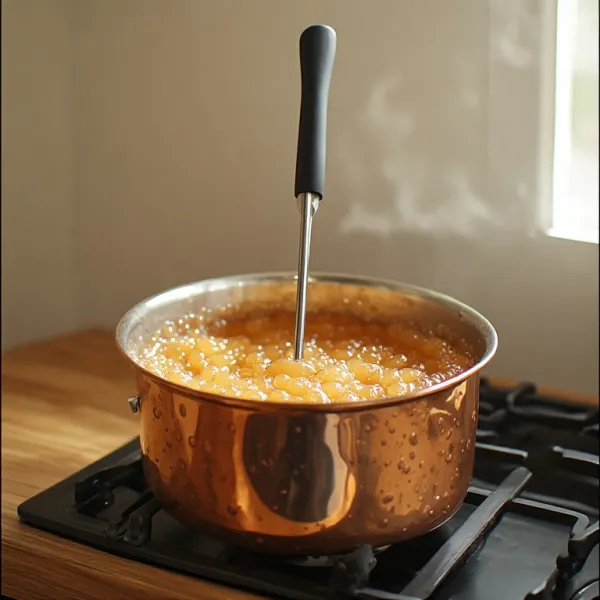
The difference between soft-crack (chewy, bendy) and hard-crack (glass-brittle, shatters) is about 30°F — a gap that passes quickly when the syrup is climbing near the top.

With a thermometer: Remove from heat at 305–308°F. The residual heat in the pan will carry it a few degrees further as you start dipping.

Without a thermometer (cold-water test):

  • 235°F (soft-ball): forms a soft, squishable ball — way too early
  • 270°F (soft-crack): forms pliable threads that bend — not ready
  • 300°F (hard-crack): forms threads that snap cleanly like glass — ready

The hard-crack test is unmistakable once you see it. The threads are rigid and break with a snap, like snapping a thin piece of hard candy. If they bend at all, cook longer.


Why the Syrup Crystallizes (and How to Stop It)

Granulated sugar dissolved in water forms a supersaturated solution. As it cooks and water evaporates, the concentration increases. The dissolved sugar wants to recrystallize — any seed crystal (a grain of undissolved sugar, a sugar crystal on the pan wall, or agitation from stirring) gives it a starting point and the crystallization cascades through the batch.

Three countermeasures:

  1. Cream of tartar or corn syrup: Both are “interfering agents” — they disrupt the ability of sucrose molecules to link into crystals. Cream of tartar (an acid) inverts some of the sucrose into glucose and fructose, which interfere with crystal formation. Corn syrup (already glucose) does the same. Use one, not both.

  2. Don’t stir. Explained above.

  3. Wet brush (optional, advanced): If you see crystals forming on the pan walls above the syrup line, you can brush them down with a pastry brush dipped in water — quickly and once, early in the cooking. The water dissolves the wall crystals before they can drip in. This step isn’t necessary if you use cream of tartar and don’t stir, but it’s the right move if you see wall crystals forming.


Working Fast at the Dip

The syrup is ready and off the heat. You have 60–90 seconds of ideal dipping window before it starts to thicken and the coating goes lumpy.

One safety note first: sugar syrup at 300°F is far hotter than boiling water and it sticks to skin — hot-sugar burns are the most common home-candy injury. Keep kids away from the dipping station, hold skewers only by the dry handle end, never touch the syrup or a freshly dipped shell, and keep a bowl of ice water within reach in case a drop lands on you.

Tilt the pan to pool the syrup. Dip one skewer at a 30-degree angle, rotating slowly — a full rotation should take about 2–3 seconds. Lift out, let drip for 2 seconds (a drip tail will form and set into a little candy point at the base — that’s authentic, not a mistake). Lay on parchment.

If the syrup thickens between dips: return the pan to low heat for 20–30 seconds to loosen it. Don’t let it go back above 320°F or the sugars will start to caramelize and taste bitter.

If the coating is too thin on one side: you rotated too fast or the pan wasn’t tilted enough to pool the syrup.


The Humidity Problem (Why Your Kitchen Day Matters)

If you’ve made tanghulu on a perfect day and it was glassy and crunchy for an hour, then tried it on a muggy day and the coating went sticky in 15 minutes — the recipe didn’t change, the humidity did.

Sugar at hard-crack is essentially anhydrous (almost no water). It’s strongly hygroscopic. When the coating contacts humid air, it absorbs water molecules, softening progressively from the outside in.

Best conditions: air-conditioned kitchen, low humidity, make it and eat it immediately. Worst conditions: open windows in summer, rain outside, anything above 70% relative humidity. No storage technique works — not an airtight container (trapped fruit moisture), not the refrigerator (4°C at high humidity). Tanghulu is not a meal-prep food.


Related Recipes
🥗

Make It Healthier

Love Viral TikTok Tanghulu (Chinese Candied Fruit Skewers at Home) but want a lighter version? Try these simple swaps:

  • ✓Tanghulu is a candy coating on fruit, not a health food — but the fruit itself is nutritious. One 3-strawberry skewer has roughly 100–120 calories, the majority from the sugar shell. The fruit contributes vitamin C, fiber, and antioxidants.
  • ✓If you want less sugar per serving, make smaller skewers with 2 pieces of fruit instead of 3–4. The coating amount per piece stays the same but you eat fewer pieces.
  • ✓The sugar shell from one tanghulu skewer is roughly equivalent to 2–3 teaspoons of sugar — comparable to a few pieces of hard candy.

Frequently Asked Questions

Why did my syrup turn grainy and white instead of clear?

Crystallization — the most common failure. Causes: (1) stirring after the syrup began boiling; (2) sugar crystals on the sides of the pan dripped back in; (3) not using cream of tartar or corn syrup as an interfering agent. Prevention: never stir once boiling, don't let crystals form on the pan walls (you can brush the sides with a wet pastry brush to dissolve them, but do it once early and carefully), and always include cream of tartar or corn syrup. A crystallized batch cannot be saved — start over with a new batch.

Why is my coating sticky and soft instead of hard like glass?

Two possible causes. First: the syrup didn't reach hard-crack temperature. Soft-crack (270–290°F) produces a coating that's chewy and pliable, not glass-hard — use a thermometer. Second: humidity. Even a perfectly made tanghulu will turn sticky if left out in humid conditions. The sugar shell is hygroscopic — it absorbs moisture from the air. On a humid day (above 60% relative humidity) the window can shrink to 15–20 minutes. Make and eat quickly, or make it on a dry day.

Can I make tanghulu without a candy thermometer?

Yes, with the cold-water test. Keep a bowl of ice water nearby. Every few minutes, drop a small amount of syrup from a spoon into the water. At hard-crack stage (300°F), the syrup solidifies into rigid, brittle threads that snap cleanly when you try to bend them — like snapping a piece of candy glass. At soft-crack (270–290°F) the threads are pliable and bend. At soft-ball (235–240°F) the syrup forms a soft ball you can squish. You want the brittle-snap stage. The test is reliable if you drop a small amount and test immediately — let it cool in the water for 5 seconds, then pull it out and try to snap it.

What fruit works best for tanghulu?

Strawberries are the most popular TikTok version and work well for beginners — they're firm, easy to skewer, and their size fits the coating-to-fruit ratio well. Seedless grapes (red or green) are the most forgiving because their skins are naturally dry. Mandarin or clementine segments work but must be very carefully dried since citrus releases juice easily. Traditional Chinese tanghulu uses hawthorn berries (haw berries / shanzha) — very tart, firm, about the size of a cherry — if you can find them at an Asian grocery store, they're worth trying. Avoid: watermelon (too wet), banana (goes soft and releases moisture fast), anything cut to expose the interior flesh (juice drips into the syrup and causes problems).

Why does humidity ruin tanghulu?

Sugar in hard-crack form is hygroscopic — it actively attracts and absorbs water molecules from the surrounding air. The higher the humidity, the faster the shell pulls in moisture and softens. This is the same reason hard candy gets sticky in summer. Tanghulu is best made when humidity is low (under 50% RH ideally). If your kitchen is air-conditioned and dry, you'll have more time. On a rainy or muggy day, the coating may turn sticky within 15–20 minutes. There is no way to store tanghulu: refrigeration introduces moisture even faster than room air, and any airtight container traps the moisture the fruit releases.

Can I use less sugar or a sugar substitute?

No meaningful substitute works for the hard-crack coating. The syrup needs to reach 300°F to form a glass-hard shell, and most sugar substitutes (erythritol, xylitol, allulose) either crystallize differently, don't reach hard-crack, or brown at lower temperatures in ways that produce bitter or gummy coatings. Allulose specifically melts and darkens at much lower temperatures and produces a soft, sticky result. If you want a lower-sugar version, use smaller fruit pieces or fewer per skewer — the coating amount is the same but the ratio of coating to fruit shifts.

Can I add food coloring or flavor to the syrup?

Yes — add gel food coloring (not liquid, which changes the syrup's water content) at the very end, after removing the pan from heat, and stir quickly. Red, orange, and pink are the most popular for strawberry tanghulu. For flavor, a few drops of vanilla extract or 1/4 teaspoon of rose water can be added at the same point — be careful, as any liquid added to hot syrup will cause spattering, so add and stand back. Strawberry or cherry extract (1/2 teaspoon) deepens the fruit flavor.

Love this recipe? Share it!

Free PDF: our 12 most-wanted copycat recipes — instant download.

Made it? Buy us a coffee

Every recipe here is free, with no paywalls. If this one was a hit at your table, a small tip keeps new copycats coming.

$

Ratings & Reviews

—
No ratings yet

Rate this recipe

Click a star to rate

Leave a Review

0/500

CS

Copycat Spices Editorial

Researched + fact-checked. Every recipe on Copycat Spices is built from published sources — official ingredient lists, brand-published recipes, interviews and food-science references — and fact-checked before it goes live, then written as clear, step-by-step instructions for home cooks of all skill levels.

Learn more about our mission →