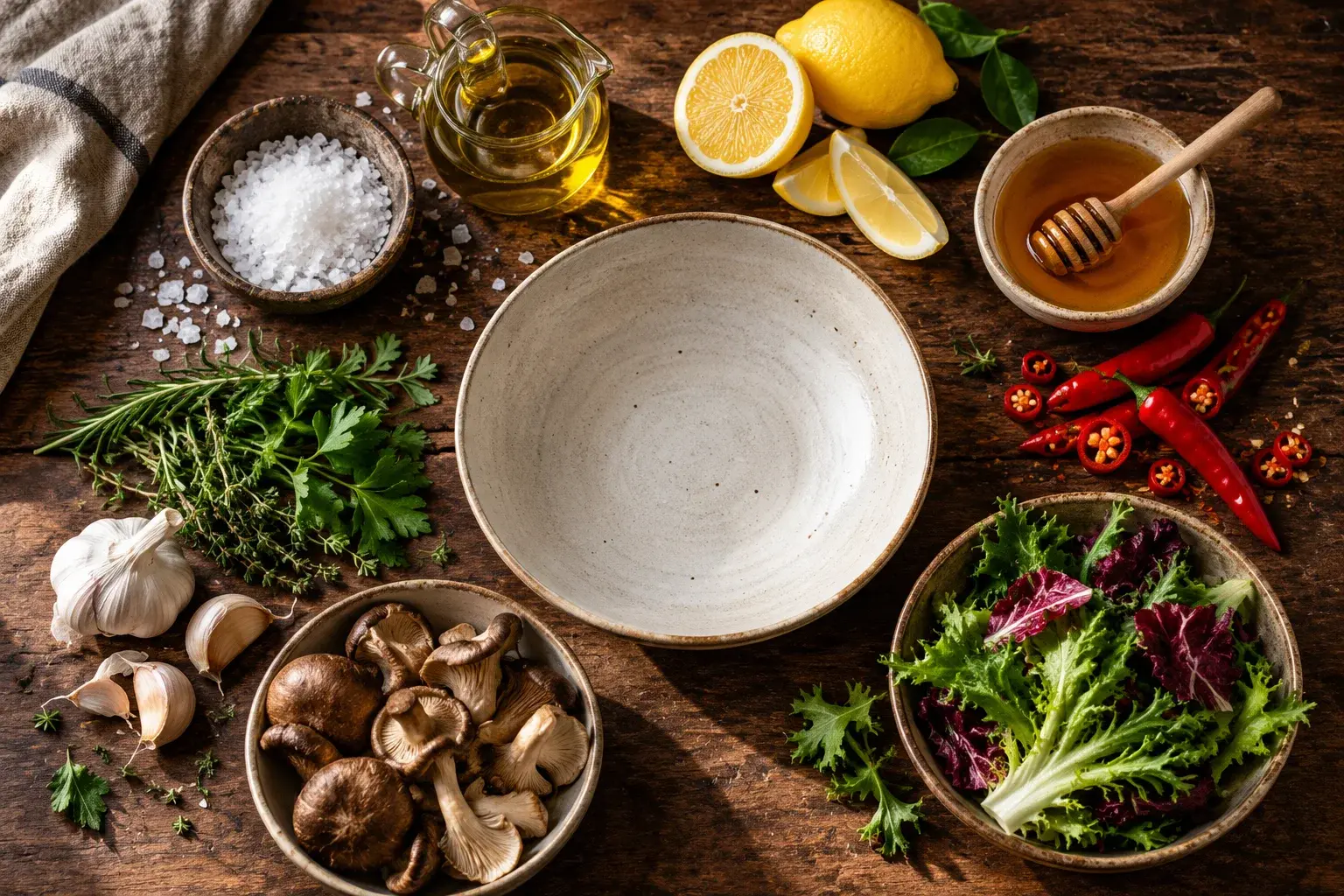
You followed the recipe. You measured everything. And it came out… fine. Edible. But not the thing you get at the restaurant — the version that makes you go quiet for a second. It’s “missing something,” and you can’t name what.
Here’s the good news: that feeling almost always has one of a small number of causes, and once you can name them, you can fix them. Professional kitchens don’t have a secret ingredient. They have a habit — they taste constantly and adjust along a handful of dimensions until the dish snaps into focus. Those dimensions are what we call the flavor axes.
The eight flavor axes
Every savory bite you take is some combination of these. Learn to taste for them individually and you stop cooking by luck.
- 🧂 Salt — the seasoning that makes everything taste more like itself. Not “salty,” just seasoned. This is the single biggest lever in cooking.
- 🧈 Fat — richness, body, and the thing that carries aroma across your palate and softens sharp edges. Butter, oil, cheese, cream, egg yolk.
- 🍋 Acid — brightness and tang. The squeeze of lemon or splash of vinegar that cuts through richness and wakes a dish up.
- 🍯 Sweetness — rounds off harsh edges and balances heat and acid. Not just sugar: onions, carrots, tomatoes, and a good sear all bring it.
- 🌶️ Heat — chili and pungent burn. Exciting, but it needs something to land on.
- ☕ Bitterness — the grown-up edge from dark greens, coffee, cocoa, char, and citrus pith. A little adds sophistication; too much reads as a mistake.
- 🍄 Umami — deep, savory, meaty “moreishness.” The reason parmesan, soy sauce, mushrooms, and tomato paste make food taste finished.
- 🌿 Aromatics — garlic, onion, ginger, herbs, and spices. The complexity and fragrance that make a dish smell like somewhere.
Why “balance” is the whole game
Think of the last genuinely great thing you ate. A good Pad Thai is sweet, sour, salty, and savory all at once, with heat and peanuts for richness — every axis pulling its weight. A plate of pasta aglio e olio is almost the opposite: fat (olive oil), salt, aromatics (garlic), a whisper of heat, and little else — and it’s perfect because it commits.
Balance isn’t sameness. It’s the absence of an accidental hole and the absence of one flavor bullying the rest. A dish is out of balance when:
- An axis is missing. The classic: a rich, brothy, well-seasoned stew that still tastes heavy — because there’s no acid to lift it.
- An axis runs away. A curry so hot you can’t taste anything else, because there’s no fat or sweetness to spread and temper the chili.
Naming which of those is happening is 90% of fixing it.
The two fixes that rescue most dishes
If you take one thing from this article, take this: salt and acid.
Under-salting is the number-one reason home food tastes muted. Salt doesn’t just make things salty — at the right level it amplifies every other flavor and suppresses bitterness. Season in layers as you cook, then taste and adjust at the very end. If a dish tastes boring, try a pinch of salt before you conclude the recipe was wrong.
A lack of acid is the number-two reason. Rich and savory without brightness tastes flat and one-note. A squeeze of fresh lemon, a splash of vinegar off the heat, or a dollop of yogurt at the end will make a surprising range of “something’s off” dishes suddenly taste alive. Restaurants finish plates with acid constantly — it’s why the same braise tastes better there than in your pot.
How to diagnose a dish in 20 seconds
Taste a spoonful and ask, in this order:
- Is it seasoned? If it tastes flat or dull, add salt first. Re-taste.
- Is it bright or heavy? If it sits heavy, it needs acid. Add a little, re-taste.
- Does it have depth? If it’s thin or hollow, it needs umami — a spoonful of tomato paste, miso, soy, a parmesan rind, or stock instead of water.
- Is anything too loud? Too spicy → add fat or a touch of sweet. Too sweet → add salt and acid. Too bitter → add fat or a pinch of sugar.
- Does it smell like something? If not, it needs an aromatic base — sautéed onion and garlic, or a handful of fresh herbs at the end.
This is exactly the logic our free tool runs for you.
Let the tool do the diagnosis
Reading your own cooking is a skill that takes years to build by feel. You can shortcut it: paste your recipe’s ingredients into the free Flavor Balancer and it maps the whole thing across all eight axes, tells you what it’ll taste like, and ranks exactly what to add to fix it — biggest lever first. It’s the fastest way to see the framework in this article applied to your own food.
Where to go next
Once the eight axes click, the rest of cooking gets easier because you know what you’re reaching for. Two axes are worth studying on their own because they do so much heavy lifting:
- The role of acid in cooking — why brightness is the most underused tool in home kitchens.
- Umami explained — how to build deep, savory, restaurant-style depth into anything.
And when a specific dish is falling flat, how to fix a dish that tastes “missing something” is a step-by-step rescue guide.
Then put it into practice on a recipe below — cook it, taste it along the way, and adjust. That last part is the whole secret.