Here’s something that happens in restaurants that almost never happens at home: you eat something simple — a bowl of ramen, a plate of pasta with parmesan, a piece of soy-glazed fish — and it’s so deeply satisfying that you eat the whole thing and then wish for more even though you’re full. It doesn’t taste complicated. It just tastes complete, in a way that makes you lean forward.
That quality has a name: umami. And understanding it will change how you cook more than almost anything else, because it’s the axis that separates food that tastes seasoned from food that tastes deep.
What Umami Actually Is
Umami was identified and named in 1908 by Japanese chemist Kikunae Ikeda, who isolated the compound responsible for the distinctive savory flavor of kombu seaweed. That compound was glutamate — specifically, free glutamic acid, an amino acid that appears in foods whenever proteins are broken down through aging, fermentation, drying, slow cooking, or heat.
When glutamate binds to your tongue’s umami receptors (yes, they exist and we’ve known their location for a while now), it creates a sensation that’s distinct from the other four tastes: savory, mouth-filling, and long-lasting. It also does something the other tastes don’t do as clearly — it signals “this has protein, and the protein is complete.” Evolutionarily, that’s a signal worth paying attention to.
The practical upshot: food without umami tastes thin and one-dimensional. Food with it tastes substantive, even when it’s not particularly rich or heavy.
The Best Umami Sources (and How to Think About Them)
Two chemical compounds carry the umami signal: glutamates (from plant and fungal sources, and some animal ones) and nucleotides — specifically inosinate and guanylate (from meat, seafood, and dried mushrooms). More on why that distinction matters in a moment.
Animal-based sources
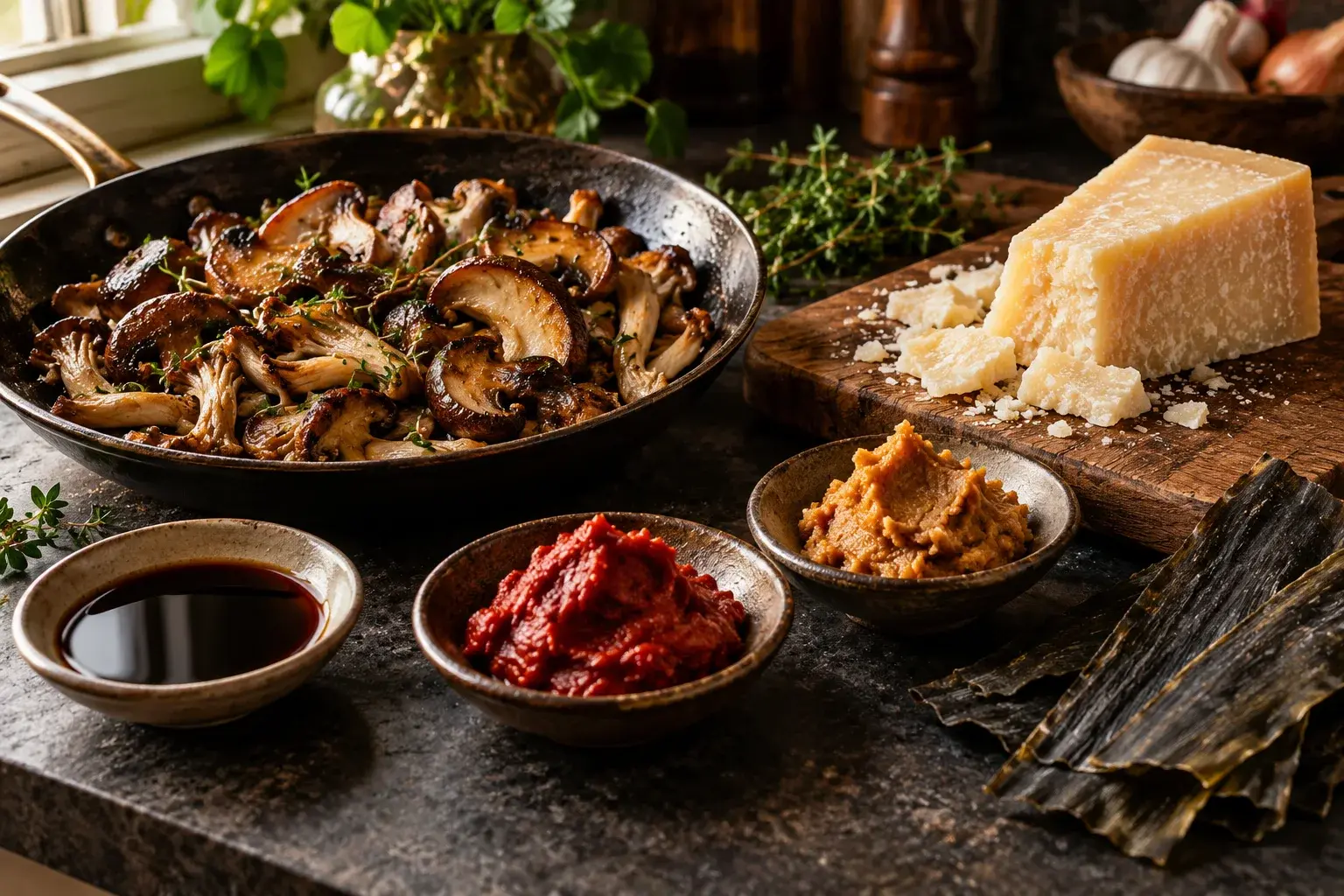
Aged and hard cheeses — parmesan, pecorino, aged cheddar, gruyère — are glutamate-dense because the long aging process breaks down proteins. A tablespoon of grated parmesan stirred into a pasta sauce does more for depth than a tablespoon of almost anything else. A parmesan rind simmered in a pot of soup for 20 minutes is one of the best free moves in cooking.
Cured and fermented meats — prosciutto, pancetta, bacon, salami, anchovies — bring both glutamates and inosinate, plus fat, salt, and often smoke. This is why a small amount of anchovy or pancetta can transform a vegetable dish without making it taste of either one.
Fish sauce is one of the most concentrated umami sources available. Made from fermented fish, it’s extraordinary in savory dishes — not just Thai or Vietnamese cooking, but also pasta sauces, braises, soups, and even burgers. The key is amount: 1–2 teaspoons disappears into a dish and leaves only depth. More than that and you start tasting fish.
Good stock — made from roasted bones, simmered for hours — carries both gelatin (which gives body) and glutamates from the meat and marrow. This is a large part of why a restaurant braise and a home braise from the same recipe don’t taste the same; one starts with real stock, the other often starts with water or store-bought stock that’s barely seasoned.
Plant-based and fermented sources
Tomato paste and sun-dried tomatoes are astonishingly high in glutamates — comparable to parmesan by weight. Cooking a tablespoon of tomato paste in oil for 1–2 minutes until it darkens (called pincering the paste) makes it even more potent by caramelizing some sugars and concentrating the flavor. A spoonful in a braise, a soup, or a pasta sauce is free depth.
Dried mushrooms — especially porcini and shiitake — are dense with both glutamate and guanylate. Their soaking liquid is deeply savory and should almost always be used in the dish rather than discarded. Fresh mushrooms are good; dried mushrooms are more intense per gram.
Miso is fermented soybean paste and one of the most versatile umami tools available. White (shiro) miso is mild and slightly sweet; red (aka) miso is more intense and salty. A teaspoon dissolved in warm liquid and stirred into a soup or sauce at the end of cooking adds complexity you can’t identify but definitely notice. Don’t boil it — the heat kills the probiotic cultures and dulls the flavor.
Soy sauce is liquid umami. Naturally brewed soy sauce (look for “brewed” or “fermented” on the label, not “hydrolyzed”) is rich in glutamates from the fermentation process. Use it to add depth to braises, pan sauces, marinades, and salad dressings — even when the dish isn’t “Asian.” A teaspoon in a beef stew won’t make it taste like soy sauce; it’ll make it taste more like itself.
Nutritional yeast is a deactivated yeast with a nutty, cheesy, savory flavor and significant glutamate content. It’s the easiest umami boost for vegetarian and vegan cooking — a tablespoon stirred into soup, sprinkled on pasta, or blended into a sauce.
MSG deserves more kitchen real estate than most home cooks give it. It’s simply isolated monosodium glutamate — the same compound that makes all the above ingredients taste the way they do, purified and crystallized. A small pinch (about ⅛ to ¼ teaspoon) per serving adds significant umami with no other flavor attached. It’s how certain Chinese restaurant dishes, Japanese instant noodles, and American snack foods achieve that particular addictive depth.
Umami Synergy: The Multiplication Effect
The most important practical insight about umami is that different sources don’t just add together — they multiply.
When you combine a glutamate-rich ingredient with one that’s high in inosinate or guanylate, the savory sensation is dramatically more intense than you’d expect from either alone. This is called umami synergy (technically the Yamagishi-Kuninaka effect), and it’s the reason:
- Japanese dashi — made from kombu (glutamate) and dried bonito (inosinate) — tastes shockingly savory from two ingredients
- Mushrooms and parmesan together taste more powerful than mushrooms alone
- A beef broth enriched with a parmesan rind or miso tastes richer than the stock on its own
- Soy sauce and fish sauce used together amplify each other
In practice: combine a plant-based umami source with an animal-based one. The easiest version: add a tablespoon of tomato paste and a teaspoon of fish sauce to a braise. Neither will dominate. Together, the depth will be immediately noticeable.
How to Layer Umami From the Start
The most effective approach isn’t to fix umami at the end — it’s to build it in from the beginning.
A simple framework:
- Aromatic base with umami-forward fat: start by cooking diced onion and garlic in a mixture of olive oil and a little butter or a strip of pancetta
- Brown your protein fully: the Maillard reaction creates inosinate compounds on the surface of seared meat — this is why you should never crowd a pan when searing
- Deglaze and add an umami liquid: wine, stock, or a tablespoon of soy sauce plus stock
- Add a concentrated paste: tomato paste for savory dishes, miso for lighter ones
- Finish with a high-glutamate accent: parmesan grated in, a few drops of fish sauce, or a spoonful of miso dissolved in broth
For the complete eight-axis picture, see the flavor axes explained. If you want to check whether your specific recipe is hitting the umami mark, paste it into the free Flavor Balancer — it shows your glutamate-rich sources, scores the umami axis, and suggests which additions would have the most impact.
The goal is for your food to taste finished without the diner being able to name exactly why. That invisible quality — the thing that makes you want more even when you’re satisfied — is umami doing its job.