Balthazar's Coq au Vin
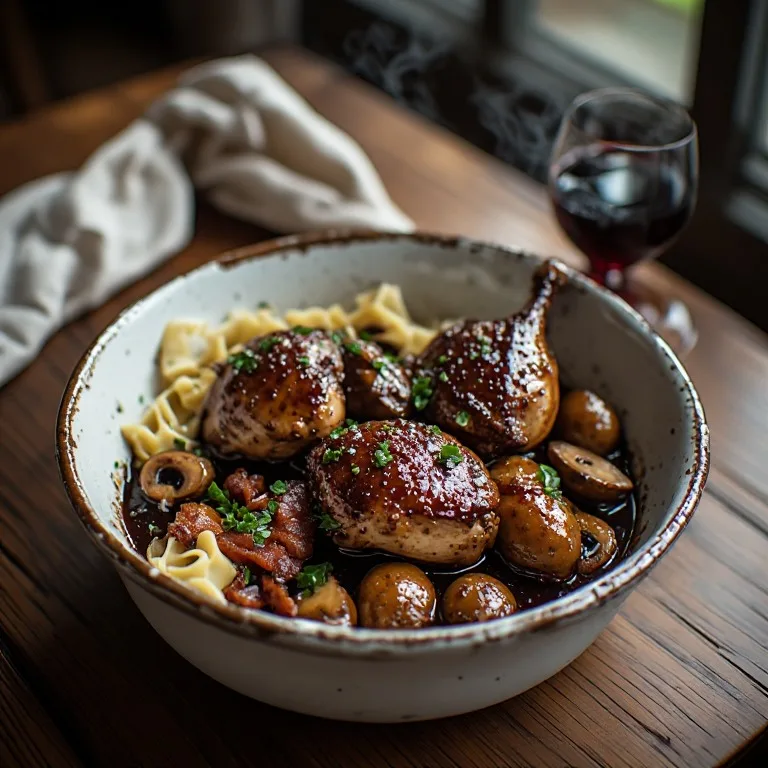
Quick answer: Season a cut-up whole chicken. In a large Dutch oven, render 8 oz smoked bacon lardons until crisp; remove. Brown 1 lb mushrooms in the fat; remove. Sear chicken in batches until deeply golden; remove. Sauté 1 diced onion, 2 carrots, 2 celery stalks, and 1 halved garlic head until soft. Add 1 tbsp tomato paste and 2 tbsp flour. Pour in a full bottle (750ml) red Burgundy — reduce by half (20–25 min). Add 1½ cups beef stock and a bouquet garni; return chicken; braise covered on low for 1 hour. Remove chicken; strain braising liquid; reduce by half again until nearly midnight-black (20–25 min more — do not skip this). Sauté 1 cup pearl onions in butter. Return chicken, bacon, mushrooms, and onions to the sauce; simmer 15 min; finish with a pat of cold butter and chopped parsley. Serve over egg noodles.
Shop the tools
Gear matched to this recipe. These are Amazon affiliate links — we may earn a small commission if you buy, at no extra cost to you.
 Illustrative imageLodge 10.25" Cast Iron SkilletThe restaurant-grade sear most copycats depend onCheck price on Amazon →
 Illustrative imageInstant-Read Digital ThermometerNail fry-oil and doneness temps every timeCheck price on Amazon →
 Illustrative imageNordic Ware Half Sheet PanCommercial-quality aluminum, bakes dead evenCheck price on Amazon →
As an Amazon Associate, Copycat Spices earns from qualifying purchases. Product images are generic illustrations, not the exact item listed.
Balthazar's Coq au Vin
Balthazar's famous coq au vin: a whole bottle of Burgundy braised with smoked bacon, pearl onions, and mushrooms until the sauce turns midnight-black. One of the most requested dishes at Keith McNally's iconic SoHo brasserie since 1997 — and the most dramatic Halloween dinner party main course you can serve. About $9 per serving at home vs. ~$42 at the restaurant.
Medium
Prep: 30 min
Cook: 1 hr 45 min
Total: 2h 15m6 servings
~$4.50/serving
At home~$4.50/serving
vs
Restaurant~$20.25/serving
You save ~78%
The Story Behind the Recipe
Balthazar opened at 80 Spring Street in SoHo in 1997 and immediately became the defining restaurant of downtown New York City — Keith McNally's recreation of a grand Parisian brasserie complete with zinc bar, leather banquettes, and floor-to-ceiling mirrors that made the always-packed dining room feel both intimate and theatrical. It launched the careers of multiple James Beard Award–winning chefs and cemented McNally as the most influential restaurateur of his generation. Coq au vin has been one of its most requested dishes from the start, appearing regularly as the Sunday plat du jour: a whole wine-braised chicken with smoked bacon lardons, button mushrooms, and pearl onions in a sauce that reduces to the color of a Halloween night sky. Dinner entrées at Balthazar run $38–$63 in 2026; the coq au vin lands around $42 per person. Made at home for a Halloween dinner party of six, the cost is roughly $9 per serving plus one bottle of Burgundy you open while you cook.
The dish looks impossibly complex but it is a one-pot braise in three stages, and every stage can be done the day before. The step that separates a forgettable coq au vin from the version you remember — the one at Balthazar — is the double reduction. First the wine reduces alone before the chicken enters the pot, concentrating the tannins and fruit into something dark and serious. Then, after braising, you strain out the spent vegetables and reduce the liquid again until it coats a spoon. That second reduction is what turns a thin braising broth into the midnight-black sauce that clings to the chicken. On a Halloween night, the presentation is pure drama: jet-dark sauce, glistening chicken, pearl onions and mushrooms, the smell of wine and thyme filling the house while guests are still arriving.
Nutrition Facts
Per serving (6 servings)Calories505
Total Fat27g
Total Carbs16g
Dietary Fiber3g
Sugars5g
Protein42g
Sodium690mg
* Estimated values based on standard recipe preparation. Actual values may vary.
Ingredients
- For the garnish
Instructions
Pro tip: This recipe tastes even better the next day. The flavors need time to meld together in the fridge.
Storage: Keeps in an airtight container in the fridge for up to 2 weeks. Freezer-friendly for up to 3 months.
Free PDF — instant download. We'll also send new seasonal copycat recipes now and then; unsubscribe anytime. Or just download it →
🎉 Your Halloween Cookbook is ready!
It's free — but if it's worth something to you, you can pay what you want. It keeps the recipes coming.
$
✓ Downloading your free Halloween Cookbook — check your downloads folder. Happy cooking!
Make It Healthier
Love Balthazar's Coq au Vin but want a lighter version? Try these simple swaps:
- ✓Remove the skin from the chicken thighs before braising — it sheds about 80 calories and 9g of fat per serving with almost no impact on flavor, since the dark wine sauce carries all the richness.
- ✓Use half smoked turkey sausage (cut into rounds) in place of half the bacon — same smoky depth, about 40 fewer calories per serving, and the sausage holds its shape beautifully through the long braise.
- ✓Spend $15 on the wine rather than $40 — the Burgundy reduces heavily twice, so varietal nuance disappears; what matters is light-bodied and acidic, not expensive. Pour the saved money into better chicken.
- ✓Serve over celery root purée or cauliflower mash instead of egg noodles — cuts about 120 calories per serving, adds fiber, and keeps the bistro elegance with an autumnal twist.
Frequently Asked Questions
What wine should I use for coq au vin?
Use any light-bodied red wine you would actually drink — Pinot Noir from Burgundy (the traditional choice), a Côtes du Rhône, a Beaujolais Villages, or a lighter California Pinot Noir. The wine reduces heavily twice, so its varietal character largely disappears; what matters is acidity and moderate tannin to cut through the fat of the chicken and bacon. Avoid jammy, heavily-oaked reds like Cabernet Sauvignon or Zinfandel — they read too sweet after reduction and push the sauce toward a stewed, cloying direction. A $15–$18 bottle works as well as a $40 bottle for this braise; save the good bottle to drink alongside. The one wine to genuinely avoid is anything labeled 'cooking wine' — it contains added sodium and inferior grape product.
Can I make Balthazar's coq au vin ahead for a Halloween dinner party?
Yes, and it is one of the best make-ahead dinner party dishes that exists. Coq au vin genuinely improves after a night in the refrigerator — the chicken reabsorbs the sauce, the flavors deepen and round out, and the fat congeals on the surface so you can lift it off cleanly with a spoon before reheating. Make the full recipe through the second sauce reduction, refrigerate overnight, then gently reheat and add the garnish an hour before guests arrive. The dish holds at a bare simmer for up to 30 minutes with no quality loss — which is exactly what you want when you are also answering the door in a Halloween costume.
What is the 'double reduction' and why does it matter?
Most coq au vin recipes reduce the wine once — either before braising or after. Balthazar's version does both, and the difference in the finished sauce is dramatic. The first reduction (wine alone, before the chicken enters) concentrates the wine's flavor and burns off the raw alcohol, turning it from sharp and tannic into something dark and serious. The second reduction (after braising, after the spent vegetables are strained out) concentrates the collagen from the chicken, the smokiness from the bacon, and the fully reduced wine into a sauce that is viscous, nearly black, and clings to the back of a spoon. Without the second reduction, you have a braising broth — good but thin. With it, you have the sauce. The second reduction takes 20–25 minutes and is the most commonly skipped step in home versions. It is also the most important one.
Can I use only chicken thighs instead of a whole cut-up chicken?
Yes, and for a dinner party it is often the more practical choice. Bone-in, skin-on chicken thighs (3–3½ lbs) work perfectly — they have the same collagen and fat as leg-and-thigh pieces, they braise beautifully for the full hour without drying out, and they are easier to serve evenly than a mix of breast and dark meat. Chicken breasts alone are not ideal: they are lean enough that 60 minutes of braising will make them dry and stringy. If you want to use a mix, add the breast pieces in the last 30 minutes of braising rather than from the start.
How do I know when the sauce is reduced enough?
Two tests: the spoon test and the color test. For the spoon test, dip a clean spoon and run your finger across the back — the line should hold cleanly without the sauce running back together. For the color test, the sauce should be nearly midnight-black — a deep, opaque burgundy so dark it reads black in the pot. Fresh wine is a translucent purple-red; a correctly reduced sauce is dramatically darker and has a slight glossy sheen from dissolved gelatin. If the sauce still looks wine-red or thin, keep reducing. Most home cooks underreduce by 5–10 minutes. It is difficult to over-reduce, but if it becomes truly syrupy (pulls like honey), add a splash of beef stock to loosen slightly before adding the chicken back.
What should I serve alongside coq au vin for a Halloween dinner?
Buttered egg noodles are the Balthazar-style pairing — they soak up the dark sauce and are easy to serve buffet-style for a Halloween party. Crusty baguette slices work beautifully for smaller, more intimate dinners. For something more autumnal, creamy mashed potatoes or celery root purée are excellent and look dramatic on a Halloween table — the white mash against the midnight-black sauce is a visual that almost looks intentional. For a full Halloween menu, open with Halloween deviled egg eyeballs or graveyard taco dip, serve the coq au vin as the centerpiece, and finish with Halloween graveyard brownies. The coq au vin itself is also its own visual centerpiece: bring the Dutch oven to the table with the lid on, lift it tableside, and let the wine-and-thyme steam roll out.
Love this recipe? Share it!
Made it? Buy us a coffee
Every recipe here is free, with no paywalls. If this one was a hit at your table, a small tip keeps new copycats coming.
$
💛 Support checkout is coming soon — the cookbook stays free either way.
Balthazar is a trademark of its owner, used here only to describe the dish this recipe recreates. This is an independent copycat written in our own words — Copycat Spices is not affiliated with, endorsed by or sponsored by Balthazar.



Ratings & Reviews
Rate this recipe
Click a star to rate