



Pin It

Balthazar Steak Frites (The Famous SoHo Brasserie, Made at Home)

Balthazar Steak Frites (The Famous SoHo Brasserie, Made at Home)
Jump to Recipe
Prep 20 min (plus overnight soak) Cook 40 min Serves 2
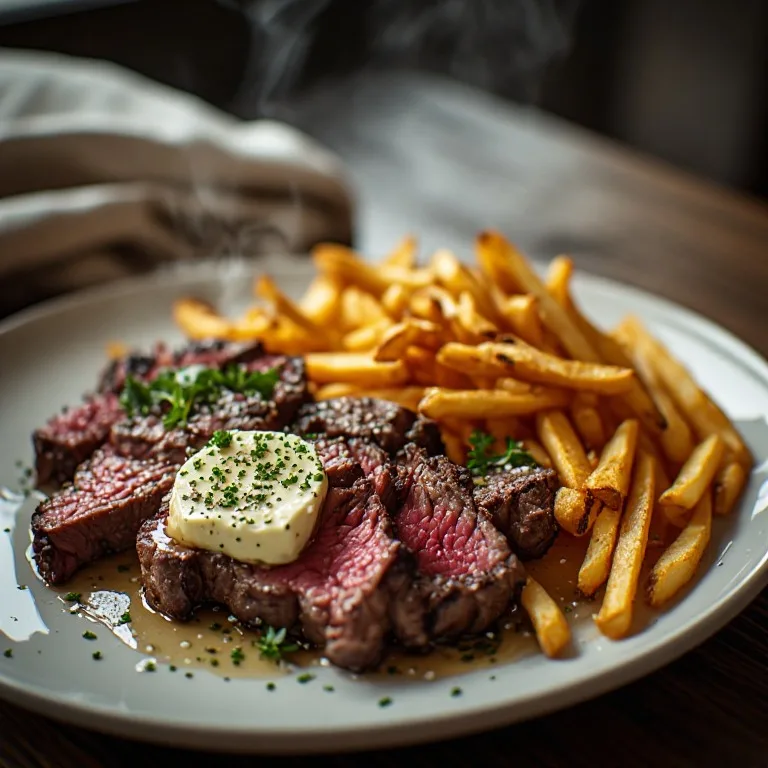
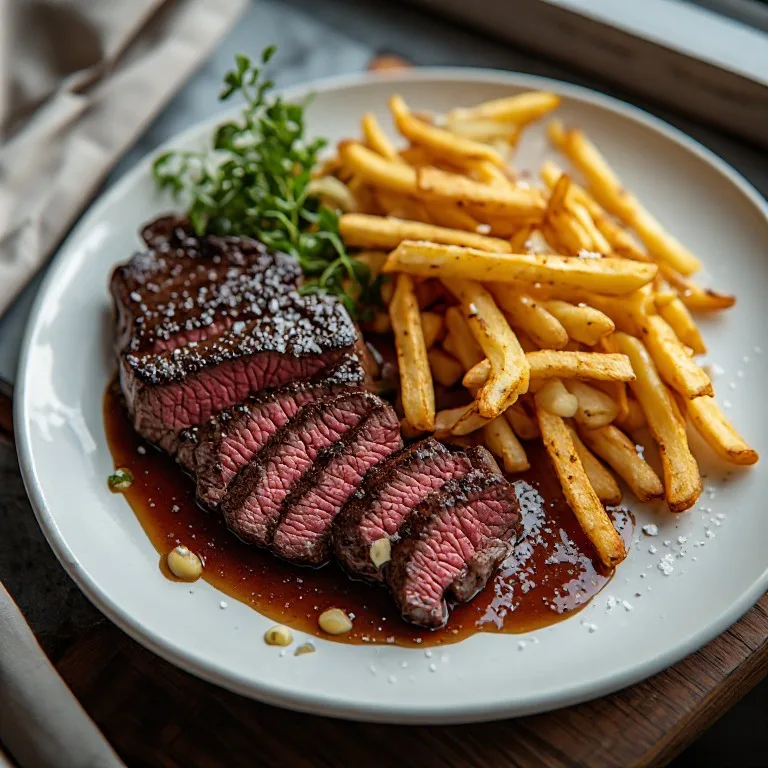
Quick answer: Peel and cut 2 large russet potatoes into 1/4-inch sticks. Submerge in cold water and refrigerate overnight (minimum 4 hours) — this removes surface starch. Drain and pat completely dry with paper towels. Pour peanut oil (or vegetable oil) into a large heavy pot to a depth of 3 inches and heat to 300°F. Fry the potatoes in batches for 5 to 6 minutes per batch until cooked through and pale gold but not crispy. Drain on a wire rack and let cool 10 minutes. (You can hold them at this stage for up to 2 hours.) Season a 12-ounce hanger steak generously on both sides with kosher salt and black pepper. Heat a cast-iron skillet over high heat until smoking. Add 1 tablespoon of neutral oil and sear the steak 3 minutes per side for medium-rare (internal temperature 130°F). Transfer to a cutting board and rest 5 to 7 minutes — do not skip this. While the steak rests, pour off most of the fat from the skillet, leaving a film. Add 1 finely minced shallot and cook 30 seconds over medium heat. Add 1/4 cup dry red wine and let it reduce by half, scraping up the fond. Add 1/4 cup beef stock, reduce by half again. Remove from heat, swirl in 1 tablespoon cold unsalted butter until glossy, and season with salt and a small pinch of fresh thyme leaves. Raise the oil to 375°F. Fry the blanched potatoes in batches for 2 to 3 minutes per batch until deep golden and crackling-crispy. Drain briefly on the rack, salt immediately, and serve. Slice the steak against the grain into 1/2-inch pieces, fan on the plate, pour the pan sauce over, and pile the frites alongside. Balthazar charges $38 for one plate. This recipe makes two for roughly $15 total.

Balthazar Steak Frites (The Famous SoHo Brasserie, Made at Home)

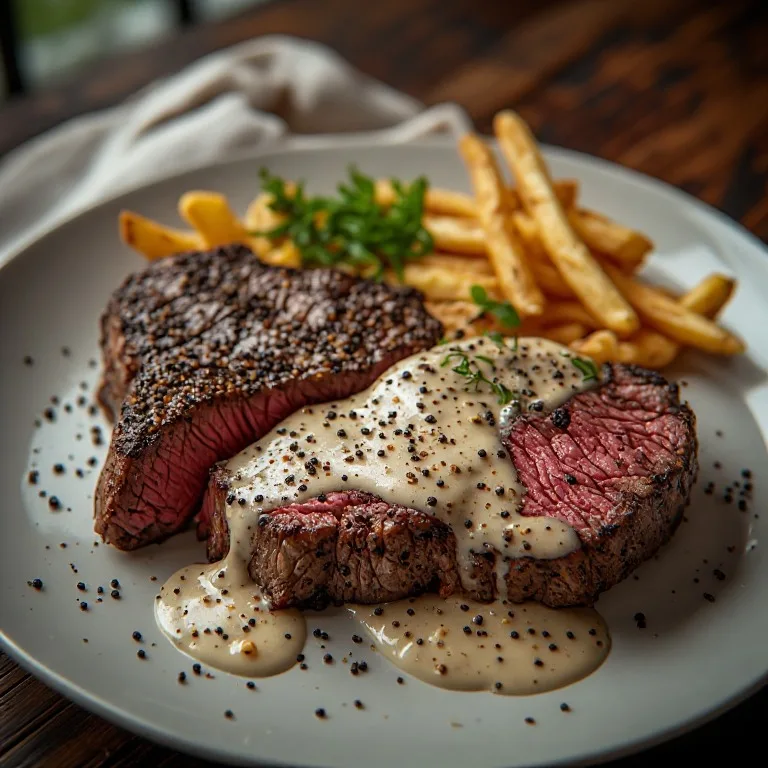
The famous Balthazar steak frites, made at home: a seared hanger steak with a shallot-red wine pan sauce and double-fried Belgian-style frites soaked overnight for maximum crispness. The SoHo brasserie charges $38. This costs under $16.

Medium Prep: 20 min (plus overnight soak) Cook: 40 min Total: 1h 0m2 servings ~$4.50/serving
Prep20 min (plus overnight soak)
Cook40 min
Total1h 0m
Servings
2
At home~$4.50/serving
vs
Restaurant~$20.25/serving
You save ~78%

The Story Behind the Recipe

Balthazar opened in 1997 on Spring Street in SoHo, Keith McNally's recreation of a grand Parisian brasserie in a former textile warehouse. The tin ceilings, mosaic tile floors, mirrored walls, and zinc bar were shipped over from France; the menu followed the brasserie canon — moules, soupe à l'oignon, croque monsieur, and steak frites. Within months it was one of the most crowded restaurants in New York, full of fashion editors, art world regulars, and tourists who had read the reviews. It never really let up. The steak frites costs around $38 now; on a Saturday night you will wait.

The dish itself is simpler than the reservation suggests. A hanger steak — called onglet in French, prized by Parisian butchers for its deep mineral flavor — seared hard in a cast-iron pan, rested, and finished with a fast shallot-red wine pan sauce. The frites are double-fried in peanut oil: a low-temperature first fry to cook them through, a high-temperature second fry to shatter the surface into a crunch that holds for ten minutes on the plate. The overnight cold-water soak before the first fry pulls the surface starch out of the potato, which is the difference between limp fries and the brasserie kind.

Nutrition Facts

Per serving (2 servings)
Calories960
Total Fat58g
Total Carbs54g
Dietary Fiber4g
Sugars2g
Protein48g
Sodium680mg

* Estimated values based on standard recipe preparation. Actual values may vary.

Ingredients

  • Frites
  • Hanger steak
  • Pan sauce

Instructions

💡
Pro tip: This recipe tastes even better the next day. The flavors need time to meld together in the fridge.
❄️
Storage: Keeps in an airtight container in the fridge for up to 2 weeks. Freezer-friendly for up to 3 months.
🎃 Free Halloween cookbook — download now The Copycat Halloween Cookbook A ready-made, photo-illustrated PDF of our best halloween copycat recipes — free to download, no building required. Pay what you want to support if you love it.

Free PDF — instant download. We'll also send new seasonal copycat recipes now and then; unsubscribe anytime. Or just download it →

Copycat Balthazar Steak Frites (The Famous SoHo Brasserie, Made at Home)

Prep time: 20 min (plus overnight potato soak) Cook time: 40 min Servings: 2

Balthazar opened in 1997 on Spring Street in SoHo, Keith McNally’s meticulous recreation of a grand Parisian brasserie. The tin ceilings, zinc bar, and mosaic floor came from France; the menu followed the brasserie canon — moules, soupe à l’oignon, croque monsieur. Steak frites was on the menu from day one, and it has never left.

The restaurant charges $38 for a plate. On a Saturday night, you will wait for it.

The dish itself is not complicated. What it requires is a specific sequence — an overnight soak, a two-temperature fry, a fast pan sauce built from the fond left in the skillet — and a cut of meat the brasserie tradition was built around.

The Cut: Hanger Steak, Not Strip

French brasseries built steak frites around onglet — hanger steak — not ribeye or strip. The hanger is a single muscle near the diaphragm that does almost no work and develops a deep, mineral, almost iron-y flavor you cannot find in the more expensive cuts. Parisian butchers kept it for themselves for years. The flavor is the point.

Hanger steak is also less expensive than a strip or ribeye: typically $9 to $14 per pound at a butcher versus $20 to $35 for a comparable strip. What you give up: you must cook it to medium-rare maximum, and you must slice it correctly. Past 140°F internal, hanger steak turns tough. Sliced with the grain instead of against it, it becomes stringy. Both of those are technique problems, not ingredient problems.

If you cannot find hanger steak, skirt steak is the closest substitute — similar deep flavor, comparable thinness, same requirement to cook medium-rare and slice against the grain.

The Frites: Why the Overnight Soak Matters

The double-fry method is well known. The overnight soak is less discussed and equally important.

Raw cut potatoes have surface starch — a coating on the exterior of each stick that, during frying, absorbs oil and produces a soft, greasy exterior. Remove that starch and the exterior crisps dry instead of absorbing fat.

Cold water pulls the starch out. After 8 hours submerged, the water in the bowl turns milky white — that is the extracted starch. The potatoes that come out of a long soak dry completely differently than potatoes that did not soak; the surface is drier, and the resulting fry achieves a snap that holds for ten minutes on the plate rather than collapsing immediately.

The two-stage frying finishes the job:

  • 300°F first fry (5 to 6 minutes): Cooks the potato through from raw, low enough that the exterior does not brown before the center is done. The result is a limp, pale fry — cooked but not crispy.
  • Cool and rest: The cooked fries release interior moisture from the surface as they cool. This is when the exterior dries out further.
  • 375°F second fry (2 to 3 minutes): The hot oil hits a relatively dry surface and crisps it immediately. The interior is already cooked; it just needs the exterior sealed.

The result is the brasserie fry: crackling outside, creamy inside, no grease.

The Pan Sauce: Four Minutes, Real Flavor

After the steak comes out of the cast-iron, the pan is coated in fond — the caramelized bits of protein and rendered fat from the sear. The pan sauce builds on that.

A finely minced shallot goes in first, softening in the residual heat for 30 seconds. Red wine deglazes the pan, picking up the fond and reducing by half. Beef stock goes in and reduces again. Cold butter mounts the sauce at the end, giving it body and gloss. The whole process takes 4 minutes and produces a sauce with depth because the fond is doing most of the work.

This is not a sauce you make separately and pour over the plate. It is made in the same pan that cooked the steak, which is why it tastes like a restaurant sauce rather than a packet of demi-glace.

Cost Comparison: Balthazar vs. Homemade
BalthazarHomemade (2 servings)
Per plate~$38—
Full order (2 plates)~$76~$14–16
Per serving~$38~$7–8

Hanger steak runs about $7 to $9 for a 12 oz piece. Two russets cost under $2. A bottle of decent red wine used in the sauce costs whatever you pay; a $12 Côtes du Rhône makes 6 to 8 batches.

Tips & Variations
  • Cut frites thick, not thin. The 1/4-inch square stick is the brasserie standard — it produces a fry with enough interior mass to stay creamy while the exterior crisps. Shoestring fries look impressive but cool too fast; steak frite-width strikes the balance.
  • Salt the fries the moment they come out of the oil. Frites salted 30 seconds after coming out of the fryer will have salt sliding off the dry surface; frites salted while the surface oil is still wet will have salt that adheres and seasons every bite. This single step is what makes restaurant frites taste seasoned and home frites taste bland even when you add the same amount of salt.
  • Rest the steak at room temperature before searing. A cold hanger steak from the refrigerator will sear unevenly — the exterior overcooks before the center reaches temperature. 30 minutes at room temperature is enough to take the refrigerator chill off. At high heat, the difference in sear time between a 40°F steak and a 65°F steak is about 90 seconds per side.
  • Add a compound butter for the classic version. If you prefer the compound butter route over the pan sauce: mix 2 tablespoons softened unsalted butter with 1 tablespoon finely chopped flat-leaf parsley, 1 teaspoon each minced shallot and lemon juice, and a pinch of flaky salt. Roll into a log in plastic wrap, refrigerate, and place a disc on the hot steak as it rests.
  • Dijon mustard alongside. Brasseries almost always put a small ramekin of Dijon mustard on the table with steak frites — the combination of well-made mustard with the beef and the frites is specific and worth doing.
Storage & Reheating

Frites are a one-serving food — they do not store well. If you have leftover blanched (first-fried but not second-fried) potatoes, they can be held in the refrigerator for up to 12 hours and given the second fry later. Second-fried frites left more than 10 minutes go limp and do not recover.

Cooked steak stores well. Wrap tightly and refrigerate for up to 3 days. Reheat in a warm (250°F) oven for 10 to 12 minutes rather than microwaving — it reheats more evenly. The pan sauce keeps for up to 2 days refrigerated; reheat gently in a small saucepan with a splash of water.

More Balthazar Classics, Made at Home
🥗

Make It Healthier

Love Balthazar Steak Frites (The Famous SoHo Brasserie, Made at Home) but want a lighter version? Try these simple swaps:

  • ✓Oven-bake the frites instead of deep-frying: toss the soaked and dried potato sticks with 2 tablespoons of olive oil and a pinch of salt, spread in a single layer on a wire rack set over a sheet pan, and bake at 425°F for 30 to 35 minutes, flipping once halfway. They will not achieve the same crunch but will be genuinely good and cut the fat per serving roughly in half.
  • ✓Use a 9 oz hanger steak portion instead of 12 oz — the protein drop is minor (42g vs 48g) but calories fall to roughly 820 per serving with the full frites portion.
  • ✓Skip the pan sauce butter mount and finish with a squeeze of lemon juice and fresh herbs instead — saves about 100 calories per serving and is lighter in a way that works well in warmer weather.
  • ✓Serve with a simple green salad instead of a full frites portion — just as a brasserie might offer the option. Dressed with a shallot vinaigrette, it completes the meal at around 600 calories.

Frequently Asked Questions

Why hanger steak instead of a strip or ribeye for steak frites?

Hanger steak — onglet in French — is the traditional brasserie cut for steak frites, and the reason is almost purely flavor. Hanger steak has a stronger, more mineral, more beefy flavor per ounce than a strip or ribeye. It comes from a muscle near the diaphragm that does almost no work and has no fat marbling; what it has is dark, deeply flavored meat from the higher myoglobin content of a working-area muscle near the organs. French butchers historically kept this cut for themselves — it was not commonly sold retail in France. For steak frites, the deep flavor of the hanger holds up against the richness of the pan sauce and the salt of the frites in a way that a milder, more expensive cut does not. Hanger steak also costs significantly less than a strip or ribeye — at a butcher counter, it typically runs $9 to $14 per pound versus $20 to $35 for a good strip. The tradeoffs: it must be cooked to medium-rare maximum (beyond that it turns tough and chewy), it must be sliced against the grain (the fibers run in an unusual direction and can be stringy if cut incorrectly), and it is sometimes difficult to find at standard grocery stores. Ask your butcher — it is almost always available if you ask. Skirt steak is the closest substitute and will give a similar beefy flavor with a slightly chewier texture.

Why soak the potatoes overnight, and can I skip it?

The overnight cold-water soak removes the surface starch from cut potatoes. Starch on the outside of a fry absorbs oil during frying and produces a greasy, limp exterior; when the starch is gone, the outer layer crisps up dry and hard instead. The difference is visible: fries from unsoaked potatoes turn golden but are soft within minutes of coming out of the oil; fries from well-soaked potatoes develop a crunch that lasts long enough to eat the whole plate. You can shorten the soak to 2 to 3 hours if you change the water once or twice — each water change removes more starch. Four hours is the practical minimum. The overnight soak is a French brasserie standard not because of extra work but because it reliably fits the mise en place: cut the potatoes the night before, refrigerate in water, and the first fry can happen 20 minutes after you start dinner. If you genuinely cannot soak, rinse the cut potatoes under cold water for 5 minutes, pat completely dry, and proceed — the fries will be acceptable but will not achieve brasserie crispness.

What is the difference between the two frying stages?

The double-fry method solves a fundamental physics problem: you cannot cook a potato all the way through AND achieve a crackling crust at the same temperature. At 300°F (the first fry), the oil is hot enough to cook the potato from raw through to fully cooked without burning the exterior — the moisture in the potato keeps the surface from crisping. After the first fry, the potato is cooked through but limp. After the potatoes cool (even 10 minutes at room temperature), the moisture in the exterior layers migrates outward and begins to evaporate. When you drop the par-cooked fries into 375°F oil for the second fry, the hot oil hits that relatively dry surface and crisps it immediately. The interior is already cooked, so it just needs 2 to 3 minutes of high-heat surface work. The result: a fry that is completely cooked through, dry and creamy in the center, and shatteringly crispy outside. This is the standard French brasserie technique and the reason restaurant frites taste different from anything you can produce in a sheet pan.

Can I use a different oil than peanut oil?

Yes. Peanut oil is traditional for French and Belgian frites because it has a high smoke point (450°F), a neutral flavor, and stays clean through extended frying — it does not pick up off-flavors the way some vegetable oils do after the second or third batch. If you cannot use peanut oil (allergy), refined avocado oil or refined sunflower oil are the best alternatives — both have smoke points above 400°F. Standard vegetable oil or canola oil work reasonably well for home use; they have lower smoke points (around 400°F) and will smoke more aggressively at 375°F but are entirely functional. Avoid extra-virgin olive oil (smoke point around 375°F — right at your frying temperature), coconut oil (flavor is noticeable), or butter (smoke point far too low and will burn immediately). The oil does not need to be discarded after one use — strain it through a fine mesh strainer after it cools, store in a sealed container, and it will last for 3 to 4 more fry sessions before flavor starts to degrade.

How do I slice hanger steak against the grain correctly?

Hanger steak has an unusual anatomy: it is actually two muscles separated by a central tendon, and the muscle fibers run in two different directions on opposite sides of that tendon. Most butchers remove the central tendon and sell you a single muscle piece — if that is what you have, the grain (the direction of the muscle fibers) runs visibly down the length of the steak. To slice against the grain: look at the cooked steak from the top and identify which direction the fibers run — they will look like faint parallel lines in the meat. Turn your knife 90 degrees perpendicular to those lines and slice at that angle. Cut 1/2-inch thick slices at a slight diagonal. This shortens the muscle fibers in each slice, which is what makes the meat tender rather than stringy. If you slice with the grain (parallel to the fibers), even a perfectly cooked hanger steak will be unpleasantly chewy. Take 15 seconds to look at the meat before you cut — this one step is what separates restaurant-quality plating from tough, stringy slices.

What sauce does Balthazar actually serve with their steak frites?

Balthazar's steak frites is served with a classic brasserie preparation — a pan sauce built from the fond left in the skillet after searing. The specific sauce varies: traditionally brasseries offer a simple red wine reduction with shallots, sometimes with a swirl of butter (sauce bordelaise-adjacent without the long braise), or a maître d'hôtel compound butter (softened butter with parsley, lemon, and shallot). The recipe here uses a fast shallot-red wine pan sauce — red wine deglazes the pan, picks up the caramelized beef fond, and reduces with stock before being mounted with butter. It takes 4 minutes and produces a sauce with real depth because the fond is doing most of the work. If you prefer compound butter, mix 2 tablespoons softened unsalted butter with 1 tablespoon finely chopped flat-leaf parsley, 1 teaspoon minced shallot, 1 teaspoon lemon juice, and a pinch of sea salt. Form into a log, refrigerate until firm, and slice a disc onto the hot steak just before serving. Both are authentic to the brasserie tradition.

What is Balthazar and why is it so hard to get a reservation?

Balthazar is a French brasserie at 80 Spring Street in SoHo, New York, opened in 1997 by restaurateur Keith McNally. McNally designed it as a faithful recreation of a grand Parisian brasserie — the tin ceilings, zinc bar, mosaic tile floor, and mirrored walls were imported from France; the kitchen was staffed with French chefs and the menu stayed true to brasserie tradition. It became an immediate New York institution, favored by the downtown fashion and art world, and has maintained that status for nearly three decades. Reservations have been difficult since the first year. The dining room seats about 180 guests, but the restaurant is a perennial destination for out-of-town visitors and has a permanent local following that books weeks ahead. The bar seating is walk-in, which is the most reliable way to eat there without planning far in advance. Brunch on Saturday or Sunday is the hardest reservation in the house.

Love this recipe? Share it!

Free PDF: our 12 most-wanted copycat recipes — instant download.

Made it? Buy us a coffee

Every recipe here is free, with no paywalls. If this one was a hit at your table, a small tip keeps new copycats coming.

$

Balthazar is a trademark of its owner, used here only to describe the dish this recipe recreates. This is an independent copycat written in our own words — Copycat Spices is not affiliated with, endorsed by or sponsored by Balthazar.

Ratings & Reviews

—
No ratings yet

Rate this recipe

Click a star to rate

Leave a Review

0/500

CS

Copycat Spices Editorial

Researched + fact-checked. Every recipe on Copycat Spices is built from published sources — official ingredient lists, brand-published recipes, interviews and food-science references — and fact-checked before it goes live, then written as clear, step-by-step instructions for home cooks of all skill levels.

Learn more about our mission →