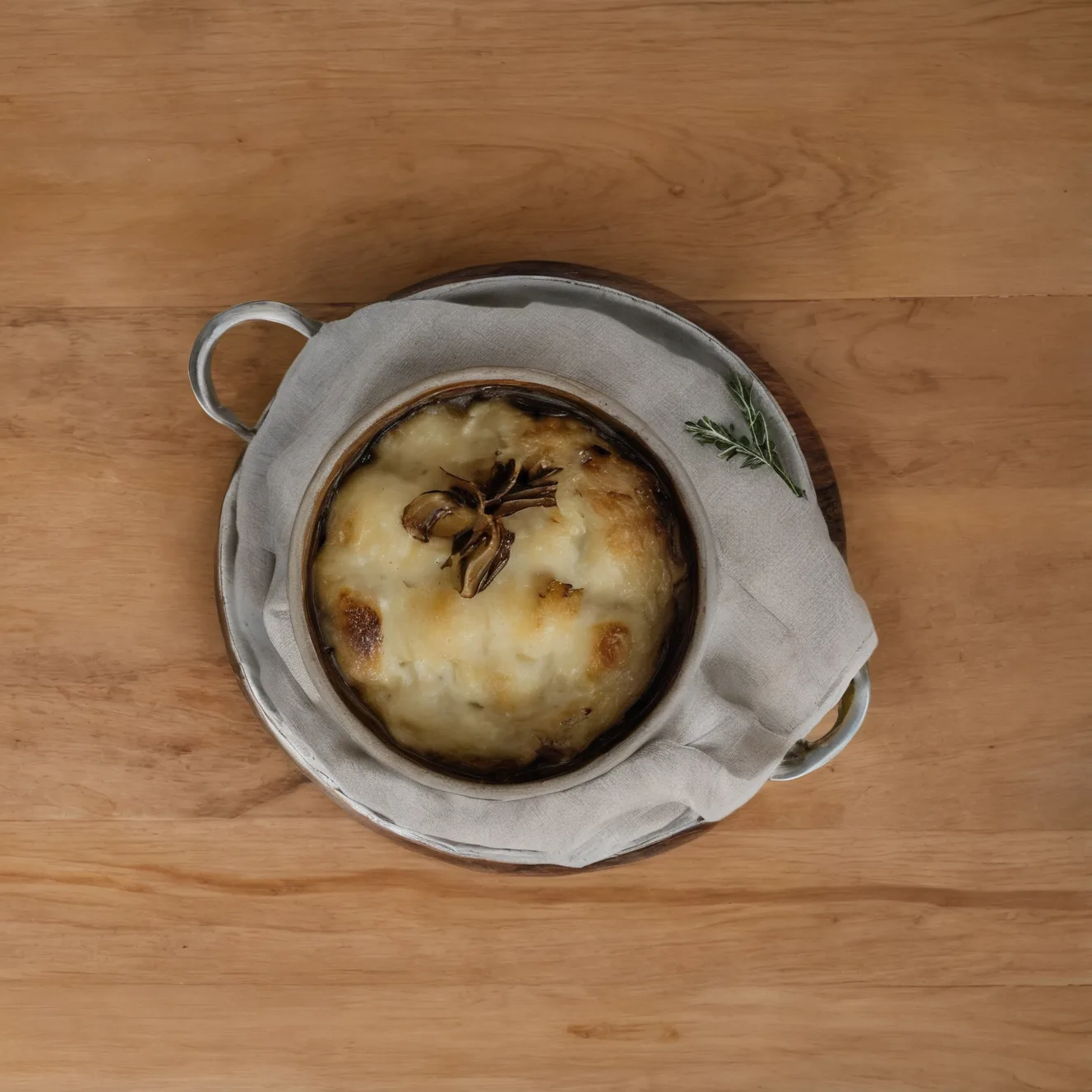



Copycat Balthazar French Onion Soup (The Famous NYC Brasserie Version, Made at Home)
Prep time: 15 min Cook time: 1 hr 30 min Servings: 4
Keith McNally opened Balthazar at 80 Spring Street in SoHo in April 1997. McNally — British-born, raised in Southampton, England — had spent his career working in restaurants and studying what made a room alive, and the New York Times would eventually call him “the restaurateur who invented Downtown.” Balthazar was designed to look like a classic Paris brasserie that had been in continuous operation since the late 19th century: zinc bar, worn tile floors, red banquettes, aged mirrors. It had been open one week before every table was perpetually booked.
The Onion Soup Gratinée has been on the menu since opening day. At Balthazar, it runs around $21. The home version costs roughly $4 to $5 per bowl.
Why Chicken Stock?
This is the most counterintuitive element for anyone who has made traditional French onion soup. The classical recipe — soupe à l’oignon as codified by Escoffier and still served in most French bistros — uses beef stock. The beef’s depth backs the caramelized onions the way a bass line backs a melody: present, important, structural.
Balthazar uses chicken stock, and the result is a cleaner, more elegant soup. The caramelized onions are the star, not a background element in a beef-forward braise. The Gruyère’s nuttiness reads without competition. The port’s fruity finish has room to register. The soup is not lighter in a thin or watery sense — the long caramelization and 45-minute simmer produce real body and sweetness — but it is lighter in the sense of focus. Every element is distinct.
This is an interpretive choice, not a simplification. If you substitute beef stock because you prefer the traditional approach, you will get a very good soup. It will taste like a classic French onion soup rather than Balthazar’s version. Both are correct. They are different dishes.
The Onion Caramelization: What’s Actually Happening
The first 30 minutes of cooking onions, nothing seems to be happening — they collapse, release their water, and sit in a pale steaming mass. This stage requires patience because the water has to evaporate before any browning can begin. Rushing with high heat evaporates the water faster but also scorches the sugars before the Maillard reaction can proceed properly — you get bitter, dark-edged onions rather than sweet, uniformly caramelized ones. Medium heat and time are the correct tools.
After about 15 minutes, the water has mostly evaporated and the onions begin to shrink and color. This is where the real caramelization happens: the natural sugars in the onions (primarily fructose, glucose, and sucrose) begin to break down at around 320°F into hundreds of new compounds, producing the characteristic brown color and sweet-savory flavor. This process is distinct from the Maillard reaction (which requires protein) — straight sugar caramelization produces the concentrated sweetness that makes French onion soup taste the way it does.
By 30 minutes at medium heat, the onions should be a rich amber-gold throughout, deeply reduced in volume (from about 3 pounds raw to perhaps 1.5 cups cooked), and smell intensely of concentrated onion sweetness. If they still look pale gold at 30 minutes, they are not done — cook another 5 to 10 minutes. The additional 10-minute cook with butter and garlic deepens the color to mahogany and adds a savory garlic layer. This is Balthazar’s approach: two-stage caramelization.
The Gruyère Broil
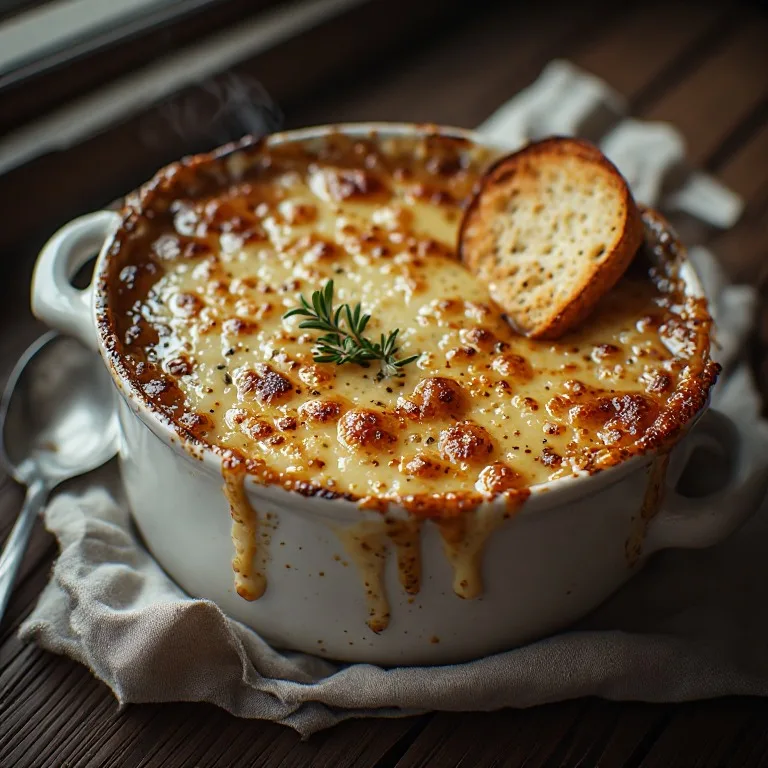
French onion soup is finished under a broiler, not in the oven, because the goal is to char the cheese surface while the soup beneath stays hot. The broiler provides intense top-down heat that bubbles, browns, and blisters the Gruyère into the crust the dish requires.
Two critical steps make the difference between a great gratinée and a mediocre one:
Toast the bread first. Raw or lightly toasted bread placed on hot soup immediately begins absorbing liquid. By the time the Gruyère is melted, the bread has turned to mush. Toast the country-bread slice in a 400°F oven for 5 to 7 minutes until the surface is completely dry — this creates a moisture barrier that holds the bread’s structure long enough for the cheese to set. A well-toasted crouton also has structural integrity to support the mounded cheese without collapsing into the bowl.
Grate Gruyère from a block. Pre-shredded Gruyère contains anti-caking agents (potato starch or cellulose) that coat each strand and prevent the smooth, even melting the dish requires. Block Gruyère grated fresh melts into a cohesive sheet that can bubble and char properly. The flavor difference is also noticeable — pre-shredded Gruyère tastes less nutty and more processed.
More French Onion Flavor
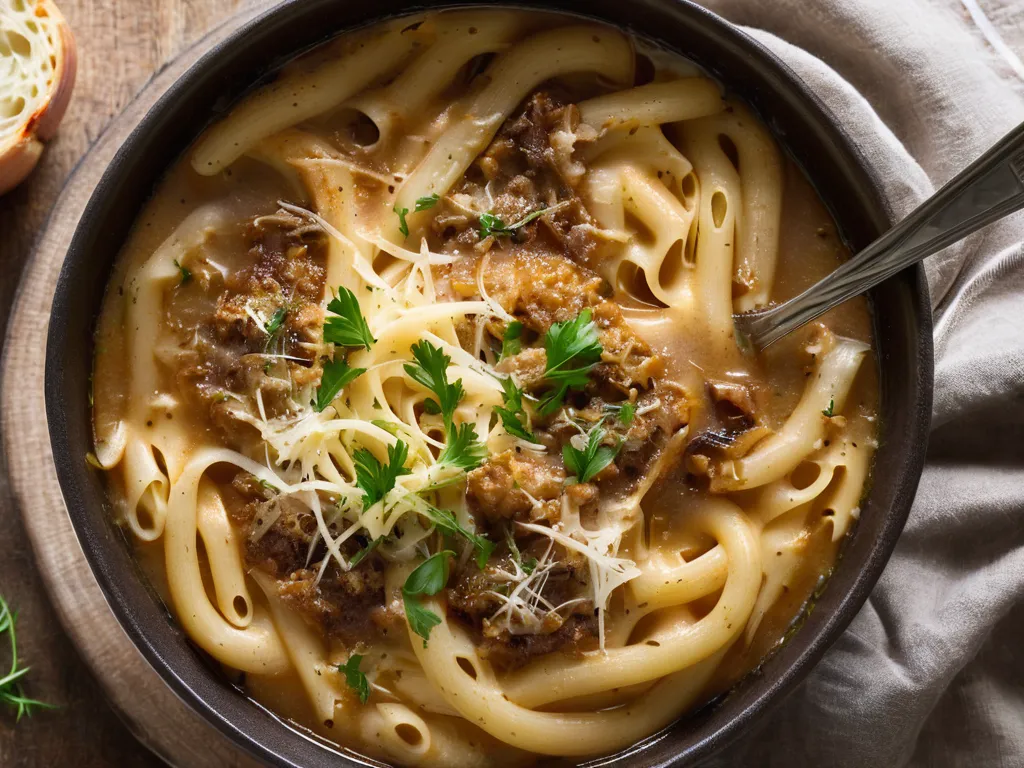
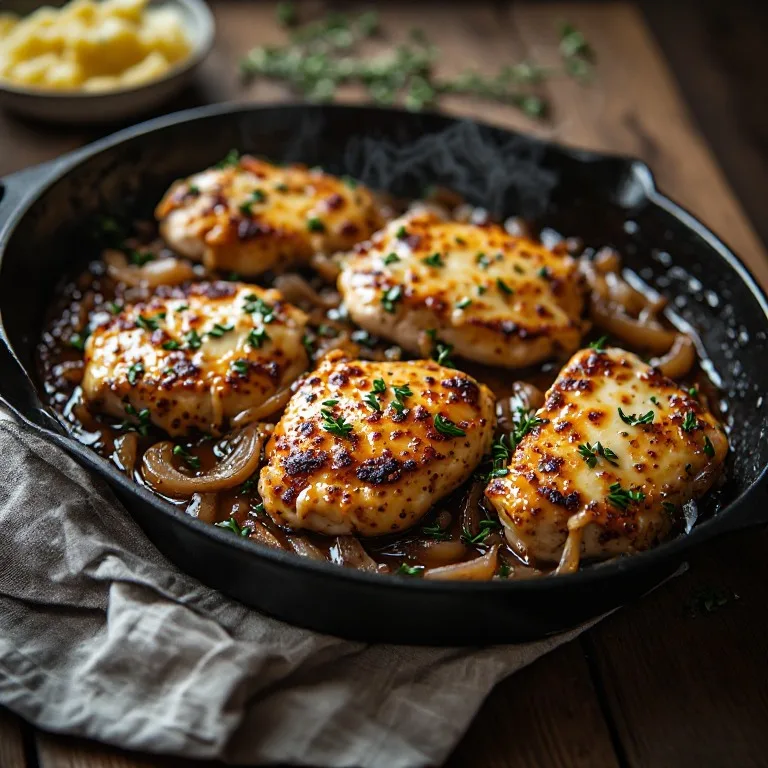
If you want a quick weeknight French onion fix, the Panera Bistro French Onion Soup copycat is a faster route — beef broth base, thin crouton, accessible any day of the week. For the viral TikTok spin that uses all the same caramelized onion flavor in a pasta dish instead, the French onion soup pasta is excellent. The viral French onion chicken version (chicken thighs braised in the same onion-wine-stock base, no bread or cheese) is one of the most-made recipes on the site.
For more famous NYC restaurant at home, the Carbone spicy rigatoni and Rao’s lemon chicken use a similar mindset: take something iconic, identify the two or three things that make it distinctive, and build those into a home recipe rather than a generic approximation.