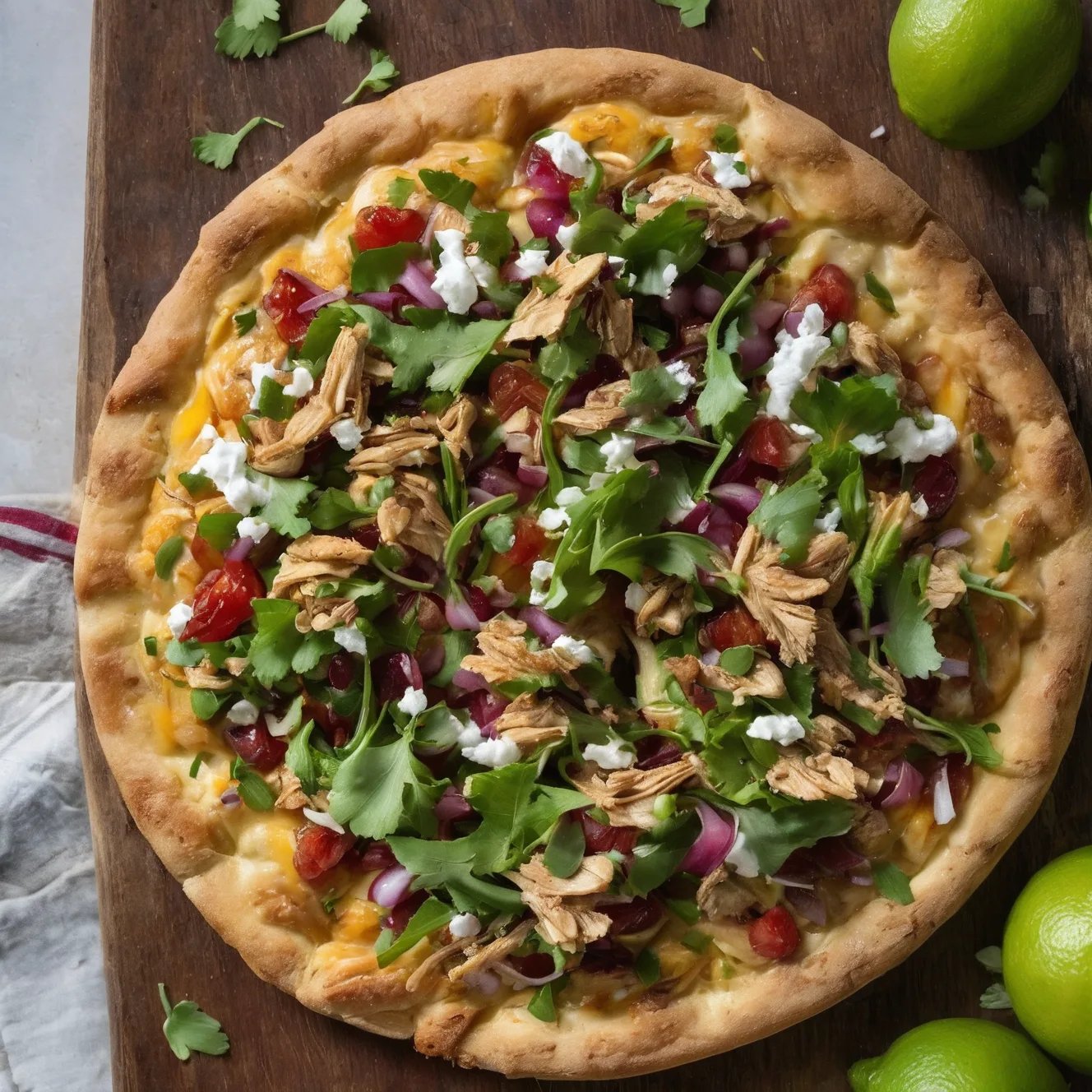
Copycat California Pizza Kitchen Santa Fe Chicken Pizza
Prep time: 25 min Cook time: 14 min Servings: 4–6
California Pizza Kitchen’s Santa Fe Chicken Pizza is unlike any other pizza on their menu, and unlike almost any pizza in casual dining. The reason is structural: there is nothing on the dough when it goes into the oven. No sauce base. No herbs. Just cheese, chicken, and thinly sliced red onion.
Everything that makes this pizza taste like itself — the roasted tomato salsa, the sour cream, the smashed avocado, the fresh cilantro — goes on cold after the pizza comes out.
This is also why almost every copycat version of this pizza gets it wrong. Home cooks see “salsa pizza” and assume there is salsa baked into the base. There is not. They see avocado and either bake it (brown, bitter, wrong) or make guacamole and spread it on (too smooth, too seasoned, dominates everything else). The actual assembly is much simpler and produces a more interesting result: a hot, crispy Monterey Jack and lime chicken pizza topped with cool, tangy, creamy southwestern flavors all at once.
CPK introduced the Santa Fe Chicken Pizza in 1987, two years after the restaurant opened in Beverly Hills. It has spent much of the last 20 years off the menu, returning periodically when enough guests ask for it back — which they consistently do.
TL;DR for the experienced cook
Roast tomatoes, jalapeño, and onion under a broiler. Blend roughly. Drain through a strainer. Cook lime-cumin-cilantro marinated chicken. Build the pizza: dough, Monterey Jack, chicken, red onion — nothing else. Bake at 500°F for 12 to 14 minutes. Out of the oven: sour cream, then drained salsa, then smashed avocado, then cilantro. Serve immediately.
The most important fact about this pizza: it has no sauce base
The BBQ Chicken Pizza has BBQ sauce spread on the dough. The Thai Chicken Pizza has peanut sauce on the dough. The Jamaican Jerk Chicken Pizza has jerk sauce on the dough.
The Santa Fe Chicken Pizza has nothing on the dough except cheese, chicken, and onion.
This is not an oversight — it is the architecture of the dish. CPK’s official description names “roasted tomato salsa” as a component, but the salsa is cold, applied after baking, and goes on top of the hot pizza rather than under it. The entire southwestern flavor profile is in the cold-finish layer.
The result is a pizza that eats in two distinct layers: the hot, caramelized bottom — crispy crust, melted Monterey Jack, lime-char on the chicken, sweet concentrated onion — and the cool, acidic, creamy top — roasted salsa with its smoky depth, sour cream with its tang, and avocado with its richness. Neither layer would work on its own. Together they are the reason this pizza has been requested back every time CPK has polled its customers.
The roasted tomato salsa: why “roasted” is not optional
CPK describes their salsa as “homemade roasted tomato salsa.” Both words matter.
Homemade means not from a jar. Jarred salsa is raw and bright; it lacks the concentrated, slightly smoky depth that fire-roasted tomatoes produce. On a pizza, brightness is fine, but without the roasted richness the salsa tastes thin and out of place against the hot cheese.
Roasted means you put tomatoes, jalapeño, onion, and garlic under a high broiler until they char. The skins blacken, the sugars concentrate, and everything develops a smoky, caramelized quality that makes it taste like it belongs on a pizza rather than like something you poured from a jar. The charred skins blend into the salsa and add color and flavor — do not discard them.
The equally important step happens after blending: drain the salsa through a fine-mesh strainer. Even fire-roasted tomatoes carry significant water. Unbounded water on a hot pizza bottom turns the crust soggy within minutes and makes the cold-finish layer slide. Let the salsa drain for five minutes before using; press it gently to release liquid. The result should be thick enough to spoon and hold its position on the pizza surface.
The chicken marinade: lime as the through-line
The chicken breast marinates in lime juice, cumin, cilantro, oregano, and garlic powder. This is not a bold, spicy marinade — there is no chile heat in the chicken itself. The flavor profile is warm, citrus-forward, and southwestern.
Lime juice is the most important ingredient in the marinade, and the reason is continuity. The same citrus note that you taste in the marinated chicken appears again in the roasted tomato salsa (which gets a lime finish), in the avocado (which wants lime), and in the cilantro (lime and cilantro are inseparable flavor partners). The lime threads through every layer of the pizza and ties the cold-finish toppings back to the hot base.
Cumin provides the warm, slightly earthy undertone that makes a Mexican-American flavor profile immediately recognizable. Without it, the pizza tastes like lime chicken on pizza; with it, it tastes like a southwestern dish.
Marinate for at least 15 minutes, up to 30. The chicken is cooked in a hot pan until it gets golden char on the outside — the lime sugars caramelize against the pan, adding another layer of flavor. Cook through to 165°F and set aside.
The cheese: Monterey Jack only
CPK’s official description names Monterey Jack and no other cheese. This distinguishes the Santa Fe pizza from every other CPK chicken pizza: the BBQ Chicken uses mozzarella and smoked gouda, the Thai Chicken uses mozzarella only, the Jamaican Jerk uses mozzarella and smoked gouda.
Monterey Jack is a mild, creamy cheese from California with a neutral flavor and a very clean melt. It does not compete with lime, avocado, or roasted salsa the way a strongly flavored cheese would. Think of it as a foundational layer — it holds everything together and adds fat and richness without announcing itself. The cold toppings are the stars; the cheese is what makes the hot layer worth eating while those toppings arrive.
Shred it from a block. Pre-shredded Monterey Jack is coated in anti-caking starch that prevents it from melting evenly — you get gummy patches rather than a uniform, creamy layer.
Applying the cold-finish layer: sequence matters
The order in which you add the cold toppings matters because each one serves a different function:
Sour cream first. It is the most temperature-sensitive component and should hit the hot cheese while the pizza is still at maximum heat. The warmth spreads it slightly and helps it adhere. Apply it in small dollops and spread lightly — you want coverage, not a thick layer.
Roasted tomato salsa second. It goes over the sour cream, which keeps the tomato liquid from soaking directly into the crust. Spoon it evenly rather than pouring it — control where it lands.
Smashed avocado third. Halve and pit the avocado at the last moment — cut it while the pizza is resting from the oven, not before. Smash it roughly with a fork inside the skin, then scoop it out in chunks. Do not make it smooth and do not season it separately — the lime from the salsa and the salt in the cheese provide the seasoning. Keeping it chunky gives each slice a different avocado-to-everything-else ratio, which makes eating it more interesting.
Cilantro last. Scatter it over everything. Like all herb finishes on CPK pizzas, the cilantro’s job is to provide a bright, aromatic counterpoint to the rich cheese and creamy toppings.
Once assembled, serve immediately. This pizza does not hold. The moisture from the cold toppings begins to soften the crust within about five minutes, and the avocado will start to oxidize. Slice it while the cold toppings are still cool and distinct.
What to expect vs. the restaurant
The Santa Fe Chicken Pizza has spent more time off the CPK menu than on it. It debuted in 1987 and was removed for nearly two decades before returning in November 2021. CPK consistently reports that it is one of the top two most-requested fan favorites when guests are polled — the other being the Jamaican Jerk Chicken Pizza, which returned at the same time.
Check cpk.com/menu before visiting specifically for this pizza. When it is available, it typically runs in CPK’s specialty pizza price range ($19–23 depending on market). The restaurant serves it on their signature hand-tossed dough.
No official per-slice nutrition data is publicly available for this pizza in current nutrition databases — it spent too long off the menu to accumulate tracked data. CPK specialty pizzas with similar protein and cheese loads typically run 200–260 calories per slice; the avocado and sour cream cold toppings will push this toward the higher end of that range.
Variations
-
Heat level. The jalapeño seeds control heat in the roasted salsa — leave them in for noticeable warmth, remove them for a gentler version. For more heat, add a second jalapeño or swap one jalapeño for a serrano. The chicken marinade itself is not spicy; all the heat is in the salsa.
-
Chipotle salsa variation. Replace one of the jalapeños with one chipotle in adobo, added to the blender after roasting. The chipotle adds smoke and a different kind of heat that works extremely well with the Monterey Jack and lime chicken. This is not the CPK version, but it is arguably better.
-
Black beans. A small amount of warm seasoned black beans, scattered over the pizza just before adding the cold toppings, add protein and a southwestern texture contrast. They should be lightly seasoned with cumin and salt, not from the can straight.
-
Corn. Fire-roasted corn kernels — either roasted on a hot grill pan or from a charred-corn bag — scattered over the salsa layer add sweetness and texture. This is a common addition in southwestern pizza interpretations.
-
Cauliflower crust. CPK offers a cauliflower crust option. It handles this pizza particularly well because the cold-finish toppings are applied after baking and do not depend on crust strength to support a heavy sauce layer. Reduce the bake time by 2 to 3 minutes and watch the crust edge.