

Copycat Dishoom Bacon Naan Roll
Prep time: 15 min (plus 2 hrs naan resting) Cook time: 30 min jam + 5 min per naan Servings: 4
The Bacon Naan Roll is the reason people queue outside Dishoom before the restaurant opens. At Covent Garden on a weekend morning, the wait outside starts before 8am. At King’s Cross and Shoreditch, the same. The dish is served at breakfast and brunch only, and most Dishoom locations do not take reservations for those services — the queue is the only way in.
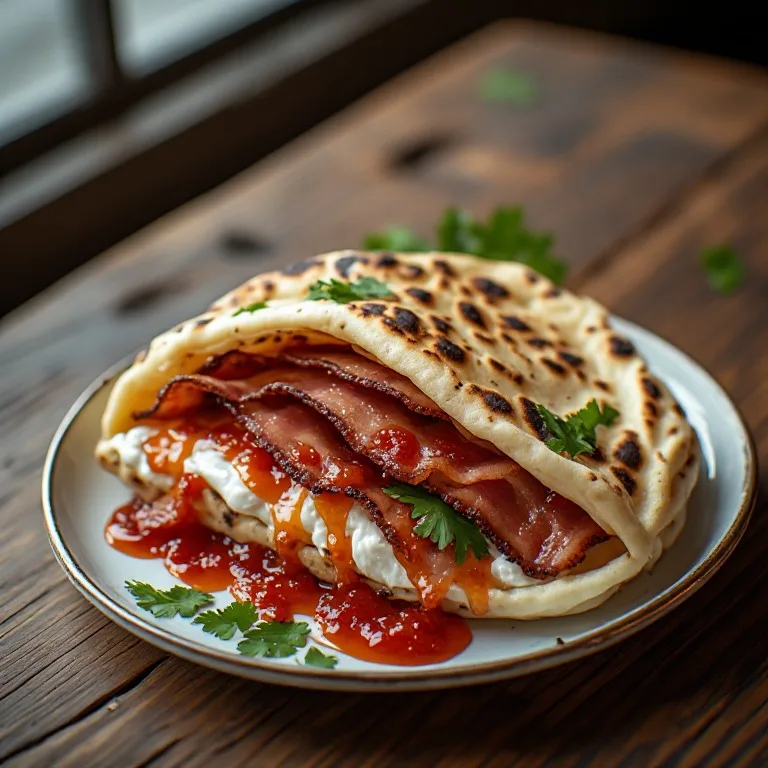
The idea is strange until you eat it: smoked English streaky bacon, Philadelphia cream cheese, a tangy tomato-chilli jam, and a scatter of fresh coriander, all folded into a warm naan that has been cooked directly on a cast-iron pan until it puffs and chars at the edges. Dishoom released their official recipe during the first UK COVID lockdown in April 2020, and it spread everywhere.
At the restaurant, the roll costs about £10. The home version, if you make the naan from scratch, costs roughly £2.50/$3.
The Naan: Why Two Hours of Rest
The dough recipe is Dishoom’s official formula, scaled from ten naans to four. It contains flour, baking powder, sugar, milk, water, egg, and a small amount of oil — no yeast. The softness comes entirely from gluten relaxation during the two-hour rest. Skip the rest and you will roll out a rubbery dough that springs back, cooks thick, and chews like rubber. After two hours, the gluten strands relax fully and the dough becomes supple enough to roll thin, which is the whole point.
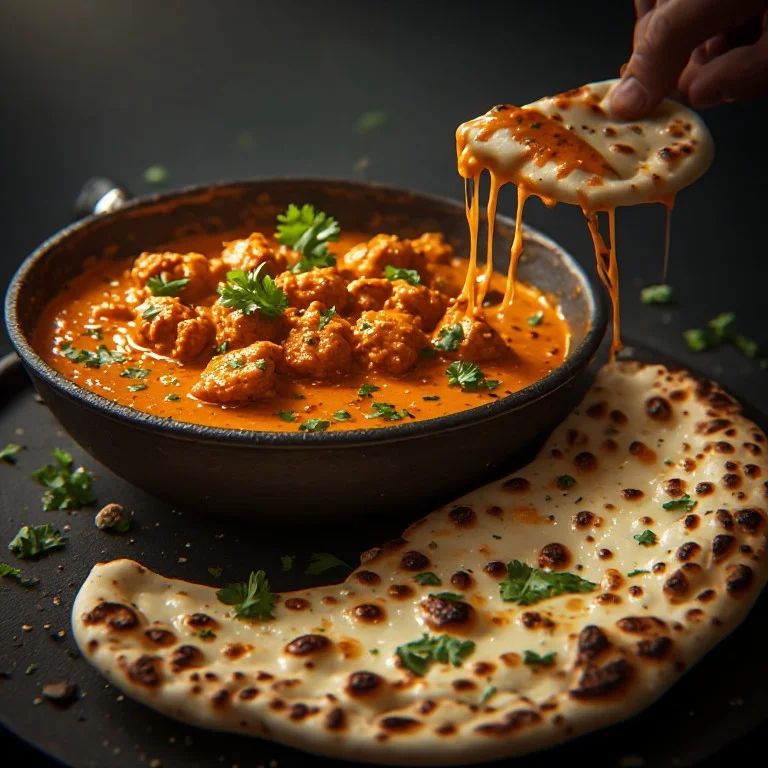
The cooking method is a dry cast-iron skillet on very high heat. No oil. The naan goes in, puffs dramatically in places, and blisters from direct contact with the cast iron. This is the closest home equivalent to a tandoor. The puffed blisters and char spots are not cosmetic — they are the texture the filling needs.
Shortcut option: A store-bought naan warmed directly over a gas flame or under a hot grill until it puffs and chars is a perfectly valid option. It will not have the same softness as a freshly made naan, but it takes 2 minutes instead of 2 hours. Stonefire Originals or any fresh bakery naan works best. Avoid thick, bready supermarket naans.
The Tomato-Chilli Jam
This is not a purchased sweet chilli sauce, which would taste wrong here. The Dishoom version uses rice vinegar as the acidifier (not malt vinegar, not white wine vinegar), which produces a clean, sweet-tart balance without any harsh edge. Fresh ginger and garlic go in minced fine. One green chilli provides gentle heat — this is not a fiery condiment. The sugar is generous: 95g per 250g of tomato. Jam sets when the temperature reaches the right sugar concentration, not just when it looks thick on the stove.
The full restaurant batch makes 800g from two tins of tomatoes. The scaled-down recipe below makes about 250g — enough for 8 to 10 rolls. The jam keeps refrigerated in a sealed jar for three to four weeks, which means one batch set you up for the rest of the month.
It also works on cheese sandwiches, burgers, and with a cheese board. Make a full batch.
Assembly: Everything Must Be Warm
The cream cheese goes on a warm naan. Cold cream cheese on a warm naan creates the right temperature contrast — the warmth of the naan softens the cream cheese slightly so it spreads into the surface. Room temperature cream cheese (not cold from the fridge, not melted) is the right state for spreading.
The bacon goes on crispy. Properly crispy streaky bacon — rendered, with some snap — is different from flaccid bacon in this context. The crispy bacon provides texture against the soft naan and wet jam; without it, the roll is one-dimensional. Three rashers is the restaurant standard. Do not undercook the bacon.
The coriander goes on fresh, and a lot of it — Dishoom is not shy with the herb. Fresh coriander provides a cooling, herbal brightness against the salt and heat.
The jam goes on last, over everything, at a generous spoon. Then fold and eat immediately. The naan softens once it is filled.
Dishoom and the Irani Café Tradition
Dishoom was founded in 2010 by Shamil and Kavi Thakrar. The concept was specific: not an Indian restaurant in the conventional sense, but a recreation of the Irani cafés of Bombay — the all-day establishments run by the city’s Zoroastrian community through the twentieth century. These cafés — Café Military, Café Mondegar, Yazdani Bakery, Café Universal — were democratic rooms that served tea, eggs, and plain food to everyone, all day, without pretension or ceremony. By the time Dishoom opened, most of the original cafés in Bombay were gone or on their way out.
The Bacon Naan Roll is part of that tradition of honest, all-hours breakfast food. It is not a contemporary fusion invention — the Irani cafés of Bombay served eggs and bread and chai as their core morning offering. Dishoom’s version uses English smoked bacon because it is a London restaurant. The naan, the jam, and the coriander are the Indian half of the dish. The bacon and cream cheese are the English half. The collision is the point.
Dishoom now has 11 UK locations: multiple in London (Covent Garden, King’s Cross, Shoreditch, Carnaby, Knightsbridge, Canary Wharf, Battersea), plus Edinburgh, Manchester, Birmingham, and Leeds. A first US location is planned for 11 East 26th Street in Manhattan’s NoMad neighborhood, with an opening projected for 2027.
Cost Comparison
| Dishoom (London) | Homemade | |
|---|---|---|
| Bacon Naan Roll | ~£10 each | ~£2.50 / $3 each |
| Tomato-Chilli Jam | Included | ~£0.50 for a full jar |
| Queue time | 15-60 min (no reservations for breakfast) | Not applicable |
The cookbook — Dishoom: From Bombay with Love by Shamil Thakrar, Kavi Thakrar, and Naved Nasir (Bloomsbury, 2019) — contains the full official recipes for the naan, the jam, and the full breakfast spread. It is accurate. This recipe follows the official ingredient list, scaled for four servings.