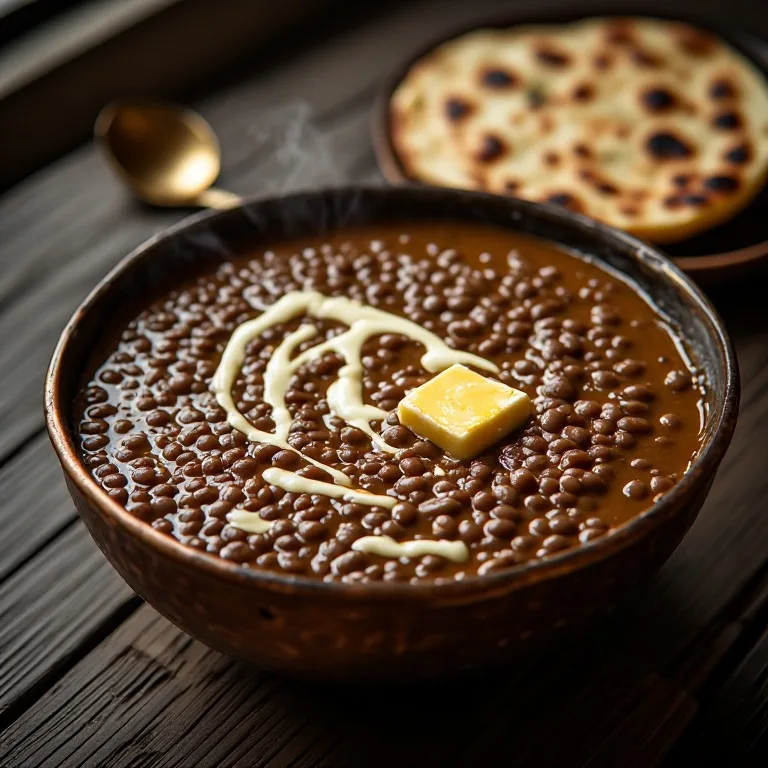



Copycat Dishoom House Black Dal (The Overnight One, Made at Home)
Prep time: 15 min (plus 8–12 hrs soaking) Cook time: 6 hrs Servings: 4
Dishoom opened in Covent Garden in 2010 — not as an Indian restaurant in the conventional sense, but as a recreation of the Irani cafés of Bombay. Those cafés were run by the city’s Zoroastrian community through the twentieth century, all-day places with bentwood chairs and marble tables that served tea, eggs, and simple food to everyone who walked in. By the time Dishoom opened, most of the original Irani cafés were gone. Founders Shamil and Kavi Thakrar built something in London that evoked what those cafés had been: a democratic, all-hours room in a city that needed one.
The House Black Dal is their most-ordered dish. Dishoom cooks it for 24 hours. The recipe is from their cookbook — Dishoom: From Bombay with Love (Bloomsbury, 2019) — and was released publicly in The Guardian during the first UK lockdown in April 2020. The ingredient list is surprisingly short: whole black urad dal, garlic, ginger, tomato purée, Kashmiri chili powder, garam masala, butter, cream. No onion. No whole spices. No tempering.
The home version requires 5 to 6 hours of actual cooking (after an overnight soak and a one-hour initial boil). Most of that time is unsupervised. The dish costs roughly $3 per serving.
What This Is — and What Dal Makhani Usually Is
Dal makhani is a Punjabi dish credited to the kitchen of Moti Mahal in Delhi, sometime around 1947. The traditional version uses whole black urad dal plus kidney beans, starts with a butter-and-cumin tempering, builds an onion-tomato-ginger-garlic base, and finishes with cream. It is the black dal most Indian restaurants in the UK and US serve.
Dishoom’s version is stripped back. No kidney beans. No onion. No tempering. The published recipe contains exactly nine ingredients. This is not an oversight or a shortcut — it is a specific culinary choice in line with the Irani café tradition the restaurant models itself on. Irani café food was simple, honest, not elaborately constructed. The dal reflects that.
The result tastes fundamentally different from a restaurant dal makhani — more concentrated, more purely lentil-forward, slightly deeper and earthier. The long cooking amplifies what the urad dal itself contributes rather than surrounding it with a complex base.
Why Time Is the Whole Technique
Unlike most recipes where technique and ingredients are the primary levers, this recipe is almost entirely controlled by time. The ingredients list is nine items. The technique is boil-then-simmer. What changes the outcome is how long it simmers.
Urad dal, when held at a low simmer for hours, does something no other lentil does quite the same way: the cell walls of the whole lentils gradually break down, releasing starch into the liquid in the pot. That starch — not butter, not cream, not a thickener — is what creates the velvety, thick consistency of the finished dish. In the first two hours of simmering, the lentils are still largely intact. By four hours, the texture has shifted meaningfully. By six hours, the dal has the silky, almost molten quality of the restaurant version.
The 24-hour restaurant cook operates at even lower heat, over an even longer period. You can approximate this at home in two ways:
Overnight in a low oven. After the initial boil and rough-mash, transfer to an oven-safe Dutch oven, add all the flavor ingredients, cover tightly, and cook at 300°F (150°C) overnight. The low, even oven heat extracts a different depth than the stovetop. This is the closest home approximation of the restaurant method.
Two-day stovetop. Cook for 4 to 5 hours on day one, refrigerate overnight (the flavor integrates significantly during rest), and heat for 30 to 60 minutes before serving. The overnight rest adds genuine depth that even hours of simmering don’t fully replicate.
Either approach produces a very good result. The 5-to-6-hour stovetop version in the recipe below is the straightforward approach that most people will use, and it is excellent.
The Kashmiri Chili: Not Optional
Kashmiri chili powder (Kashmiri mirch) is a mild, fruity red chili grown in Kashmir, ground into a powder. It has two properties that make it irreplaceable in this recipe: a very low heat level (much milder than cayenne or regular red chili flakes) and an intensely vibrant ruby-red color that no other common spice replicates.
The deep reddish-black of Dishoom’s dal comes from the Kashmiri chili reacting with the concentrating tomato purée over hours of heat. Substituting cayenne produces heat but not color. Paprika produces approximate color without the specific fruity warmth. If you cannot find Kashmiri chili powder, use 2 parts sweet Hungarian paprika to 1 part cayenne in the same total quantity — you will approximate the heat level and get partial color, but the dal will be noticeably different.
Kashmiri chili powder is stocked at every Indian grocery store under labels like “Kashmiri mirch,” “Kashmiri chilli powder,” or “Deggi mirch.” It is also widely available online. It lasts 12 months in a sealed jar and is useful in any butter chicken, saag, or tikka recipe. Buy a bag rather than a small packet.
The Tomato Purée: Concentrated, Not Passata
The recipe calls for concentrated tomato purée — the double-concentrate kind sold in tubes (like tomato paste, but double-concentrate). This is not the same as passata (sieved tomatoes, sold in cartons and jars), which is much looser and watery, and not the same as crushed or diced canned tomatoes.
The concentrated purée reduces quickly during the long simmer and contributes a deep, slightly caramelized tomato sweetness. Passata would make the dal watery and require much longer reduction. If you can only find regular (single-concentrate) tomato paste in a can, use 4 to 5 tablespoons instead of 4, and the result will be similar.
The Butter: Don’t Halve It
Ninety grams — about 6 tablespoons or ¾ of a standard stick — is a notable quantity of butter to finish a lentil dish. The recipe is explicit about this, and it is what makes the finish of the dal recognizable.
Butter added at the end of a slow-cooked lentil dish behaves differently from butter added early. The starchy lentil base emulsifies the fat as you stir, producing a glossy, uniformly creamy texture rather than a visible layer of fat. This is the same mechanism that makes a properly finished French sauce glossy rather than greasy. If you rush the butter addition, or add it to a too-thin or too-hot dal, the emulsion breaks and you get grease on the surface. Add the butter in pieces over low heat, stirring continuously, when the dal has reached the right thick consistency.
You can reduce the butter to 4 tablespoons without ruining the dish — it will still be very good. The texture will be slightly less glossy and the richness slightly lower. Do not go below 4 tablespoons if authenticity matters to you; below that threshold you are making a different dish.
The Dishoom Restaurant
Dishoom now has 11 locations in the UK: multiple in London (Covent Garden, King’s Cross, Shoreditch, Carnaby, Knightsbridge, Canary Wharf, Battersea), plus Edinburgh, Manchester, Birmingham, and Leeds. A first US location is planned for NoMad, Manhattan — 11 East 26th Street, near Madison Square Park — with an opening projected for 2027.
The restaurant was inspired by the Irani cafés of Bombay, founded by Zoroastrian families who fled Persia in the early 20th century. Café Military, Café Mondegar, Yazdani Bakery — these places defined a particular kind of Bombay hospitality: open to everyone, serving tea and food all day, without pretense. Most of the original Irani cafés in Bombay are gone. Dishoom keeps the spirit of what they were.
The cookbook — Dishoom: From Bombay with Love by Shamil Thakrar, Kavi Thakrar, and Naved Nasir — is an accurate guide to their recipes. The black dal recipe published here follows the cookbook’s ingredient list and method exactly, adapted for home measurements.
Cost Comparison: Dishoom vs. Home
| Dishoom London | Homemade (4 servings) | |
|---|---|---|
| House Black Dal | ~£7 per bowl (side) | ~$12 total |
| Per serving | ~£7 (within a typical £35–45 per person meal) | ~$3 |
| Wait | Often 30–90 min queues (no reservations) | Not applicable |
The dal is a side portion at Dishoom, around £7 — you rarely order it alone, and most tables run £35–45 per person once naan, mains, and chai are added. The restaurant does not take reservations for most seatings, and the queue outside most London locations at peak times runs 30 to 90 minutes. The food is worth it. The home version, at roughly $3 per serving and enough for four, is a different kind of worth it.
The Most Important Technique Points
Soak the dal. Do not skip this step. An unsoaked whole urad dal will take significantly longer to cook and will not break down as smoothly during the simmer.
Boil hard for a full hour. Urad dal contains lectins — proteins that slow cookers and gentle simmers do not neutralize. The full hour at a rolling boil is not about texture; it is about safety. (This is also why you cannot cook urad dal start-to-finish in a slow cooker without the initial stovetop boil.)
Mash a third of the lentils. This is the technique that creates body. If you skip this step and rely entirely on the butter and cream for thickness, the dal will be loose and greasy rather than thick and silky.
Low heat, long time. The single most common mistake with this recipe is cooking on too-high heat. High heat concentrates the liquid too fast before the lentil starches have had time to release. Use the lowest setting your stove has, and add small amounts of liquid (cooking water or fresh water) to prevent sticking rather than raising the heat.
Stir every 20 to 30 minutes. The bottom of the pot will catch and scorch if left alone at low heat. A scorched bottom of the pot introduces bitterness that permeates the dal. Heavy-bottomed pots help; regular stirring is mandatory.